
BuddhistCatholicContemplativeEvangelicalGeneral ChristianHinduJewishLatter-day SaintMuslimNew VisionsProgressive Christian
Beliefs
- Buddhist
- Catholic
- Contemplative
- Evangelical
- General Christian
- Hindu
- Jewish
- Latter-day Saint
- More Voices
- Muslim
- New Visions
- Pagan
- Progressive Christian
Topics
- Religion News
- Food and Religion
- Sports and Religion
- Religious Art
- Religious Music and Entertainment
- Religious Events
- History and Religion
- Style and Religion
- Politics and Religion
- Women in Religion
- Recreation Outdoors and Religion
- Business Finance and Religion
- Careers Workplace and Religion
- Education and Religion
- Family Parenting and Religion
- Health Fitness and Religion
- Home and Religion
- Relationships and Religion
- Technology and Religion
- Travel and Religion
Columnists
- Buddhist Columnists
- Business Finance and Religion Columnists
- Careers Workplace and Religion Columnists
- Catholic Columnists
- Contemplative Columnists
- Education and Religion Columnists
- Evangelists Columnists
- Family Parenting and Religion Columnists
- General Christian Columnists
- Health Fitness and Religion Columnists
- Hindu Columnists
- History and Religion Columnists
- Home and Religion Columnists
- Jewish Columnists
- More Voices Columnists
- Latter Day Columnists
- Muslim Columnists
- New Visions Columnists
- Nonreligious Columnists
- Pagan Columnists
- Politics and Religion Columnists
- Progressive Columnists
- Recreation Outdoors and Religion Columnists
- Relationships and Religion Columnists
- Religion News Columnists
- Religious Art Columnists
- Religious Events Columnists
- Religious Music and Entertainment Columnists
- Sports and Religion Columnists
- Style and Religion Columnists
- Technology and Religion Columnists
- Travel and Religion Columnists
- Women in Religion Columnists
Resource Library
- 2026 Calendar
- Library of World Religions
- The 100 Most Holy Places on Earth
- Patheos Answers
- Podcasts
- Videos
- Faith Leaders Database
- Anglican Episcopalian
- Bahai
- Baptist
- Buddhism
- Christianity
- Confucianism
- Eastern Orthodoxy
- Hinduism
- Holiness and Pentecostal
- ISKCON
- Islam
- Judaism
- Lutheran
- Methodist
- The Church of Jesus Christ of Latter-day Saints
- New Age
- Paganism
- Presbytarian and Reformed
- Protestantism
- Religion Behind the Scenes
- Roman Catholic
- Scientology
- Shia Islam
- Sikhism
- Sufism
- Sunni Islam
- Taoism
- Zen
- See all religions
Research Tools
 Ad-Free & Subscriber Log-In Subscription Support
Ad-Free & Subscriber Log-In Subscription Support
Follow Patheos 

- Trending:
- Forgiveness
- |
- Marriage
- |
- Consciousness
- |
- Death Penalty
- |
- Election
- |
- Halloween

- Home
- Evangelical
- Many gods, One God: Zeus Found (Heraclitus)
Many gods, One God: Zeus Found (Heraclitus)
Last updated on: May 23, 2019 at 12:42 am by John Mark N. Reynolds
Many gods, One God: Zeus Found (Heraclitus) 2019-05-23T00:42:14-04:00 John Mark N. Reynolds
Patheos Explore the world's faith through different perspectives on religion and spirituality! Patheos has the views of the prevalent religions and spiritualities of the world.
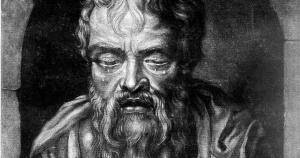
Heraclitus: loved the Divine Logos
The soil under my feet was yellow dirt with small rocks and the sky above me was blue, a simmering sun. The olive trees gave shade so I could look down toward the sea standing on the edge of a ruined Mycenaean palace. Just that moment, in the home of Agamemnon, shepherd of the people herded to Troy, I knew why men loved Zeus.
He fit the scene: beautiful, fierce, civilization and ruin with the hope that something glorious and good might be buried under the dirt: ancient beauty, goodness, and truth.
Stuff, the dirt, the rocks, the sky, the sun mattered to me. The sun burned my skin, the rocks were hard on my feet, and the soil stuck to every part of me. Still there was depth, more to the experience: the sun was hot, but brilliantly beautiful.
The great god, the stories said, ruled all other gods, Demi-gods, and men and this god Zeus was a savior from the horrors of chaos. Zeus brought balance between heaven and earth and kept the worst monsters at bay: Zeus was called all good and he would purify those who sought him. The thunderbolt was his weapon and nothing could long stand against his will. Yet Zeus was not all powerful, the fates would someday bring his rule to an end. In other stories, Zeus was terrible in his power: taking what he wanted. He was awful and the awe inspired while his lusts created fear.
Whatever men encountered that they called Zeus, the stories grew. Under all the tales was something different than the details: Zeus was fearful, out of control with his own desires, but he also was the friend of strangers. If you were cruel to an alien guest, then Zeus would bring justice to you! He was universal, worshipped by all the Greeks. There were, according to the first philosophers, seemingly two beings: one good, the other not so good.
There can be many gods, numberless powers, but only one omnipotent God: logically only one being can be all powerful! Zeus was a name given to the god on Olympus who took what he wished, got duped by Hera his long suffering wife, and toyed with men as entertainment to hold off the boredom of deathlessness. Zeus also was the protector of marriage, friendship, and the god who could bring a good wind when a sailor needed one. The duality is in Homer where Zeus is manipulated by a lesser goddess (Thetis!), but who is also described as having a will nobody can defy.
Heraclitus of Ephesus broke down the duality to the truth beneath.
Heraclitus was the greatest Ephesian until the Mother of God came to the city with Saint John. This early philosopher heard the stories of Zeus. He was seeking a divine Logos, a Word, Order, Logic, a Divine Fire that could provide order and pattern to the changing world. Heraclitus could not worship the Zeus of lustful desires, the immoral tyrant who got away with murder, but he could love the God who was all-wise.
This “all-powerful one” was Zeus and not Zeus: like the savior, unlike the bully-god.
Heraclitus put it this way:
228 One thing, the only truly wise, does not and does consent to be called by the name of Zeus.*
The myths about Zeus that Heraclitus had inherited, like all enduring human things, were a blend of insight, nonsense, and the diabolical. Men had experienced something and named it Zeus when they felt or saw a being with kingly power. Soon an earthly and a heavenly Zeus were conflated and confusion resulted.
One Zeus was unfit for a free man’s service, the other a proper object of a free person’s worship.
That day in the rubble of Agamemnon’s city I felt the tug of both images of Zeus: the god and the good God. The sun was near the top of the sky, the dirt was stirred by a hot, dry wind, things were changing. The city, however, was made of the stones that had been there thousands of years, the sun rising and setting: wind, dirt, rocks, olive trees. These changed, perhaps, but too slowly for me to see. Underneath were the ideas of light, spirit, matter, life. These did not change.
The one thing, the only truly wise, under all, the God whose Mind contains the first principles of the world does and does not consent to be called by the name of Zeus; the old city was waiting for a better name. And of course later nearby, I would pray in a church, ancient by American standards, young to Mycenaean time. I worshiped God with a proper name: seen in the person of Jesus Christ: the Logos of God.
——————————————-
*The Pre-Socratic Philosophers, editors Kirk, Raven, and Schofield, 2013, page
Previous Post

May 20, 2019
The Enduring Truths Of Fairy Tales
Next Post

May 22, 2019 God Gives a Sign (Heraclitus)
Browse Our Archives
Select a Category Apologetics Art Culture Education On Books On Education Philosophy Politics Pop Culture Spiritual Reflections Uncategorized
Select a Month October 2026 September 2026 August 2026 July 2026 July 2025 June 2025 September 2024 July 2024 June 2024 December 2023 June 2023 September 2022 May 2022 April 2022 March 2022 February 2022 July 2021 June 2021 May 2021 April 2021 March 2021 February 2021 January 2021 December 2020 November 2020 October 2020 September 2020 August 2020 July 2020 June 2020 May 2020 April 2020 March 2020 February 2020 January 2020 December 2019 November 2019 October 2019 September 2019 August 2019 July 2019 June 2019 May 2019 April 2019 March 2019 February 2019 January 2019 December 2018 November 2018 October 2018 September 2018 August 2018 July 2018 June 2018 May 2018 April 2018 March 2018 February 2018 January 2018 December 2017 November 2017 October 2017 September 2017 August 2017 July 2017 June 2017 May 2017 April 2017 March 2017 February 2017 January 2017 December 2016 November 2016 October 2016 September 2016 August 2016 July 2016 June 2016 May 2016 April 2016 March 2016 February 2016 January 2016 December 2015 November 2015 October 2015 September 2015 August 2015 July 2015 June 2015 May 2015 April 2015 March 2015 February 2015 January 2015 November 2014 October 2014 September 2014 August 2014 July 2014 June 2014 May 2014 April 2014 March 2014 February 2014 January 2014 December 2013 November 2013 October 2013 September 2013 August 2013 July 2013 June 2013 May 2013 April 2013 March 2013 February 2013 January 2013 December 2012 November 2012 October 2012 September 2012 August 2012 July 2012 June 2012 May 2012
Follow Us!
TAKE THE
Religious Wisdom Quiz
Why was it scandalous for the woman to anoint Jesus' feet with tears?
Select your answer to see how you score.
She was a child She was foreign She was wealthy She was a known sinner
Books by This Author John Mark Reynolds
Related posts from Eidos

Classical Education Must Teach Us to Make the...

Classical Education and the Art of Dying Well

Golden, Golden, Golden: My Mother's Last Lesson

TRENDING AT PATHEOS Evangelical

The REST of Your Life: A Creative Wrestles...
This week I had a conversation with a good friend from church....

How the author of the world's best hymn...
I've been working with John Newton for a while now. This makes...

Long before this Lectio Divina, Psalm 130 - the song - started...

What About the Trees? Another Living Parable
After I finished writing the last article about falling leaves as a...

Why Classical Education Is a Conversation, Not a...
Come and Read: Joy in Classical Education When I was a little...

Cornell University has received a great deal of negative publicity and intense...
view all Evangelical blogs
Ad-Free & Subscriber Log-In Subscription Support
- About Us
- 2026 Calendar
- Videos
- Podcasts
- Library of World Religions
- Faith In Media Tracker
- Advertise With Us
- Write for Us
- Privacy Policy
- Terms of Service
- Do Not Sell My Data
- Contact Us
- Radiant Digital
- Manage Newsletter Subscriptions
- Unsubscribe From Notifications
- Sitemap
Copyright 2008-2026, Patheos. All rights reserved.
Subscription Support Ad-Free & Subscriber Log-In
Follow Patheos