
BuddhistCatholicContemplativeEvangelicalGeneral ChristianHinduJewishLatter-day SaintMuslimNew VisionsProgressive Christian
Beliefs
- Buddhist
- Catholic
- Contemplative
- Evangelical
- General Christian
- Hindu
- Jewish
- Latter-day Saint
- More Voices
- Muslim
- New Visions
- Pagan
- Progressive Christian
Topics
- Religion News
- Food and Religion
- Sports and Religion
- Religious Art
- Religious Music and Entertainment
- Religious Events
- History and Religion
- Style and Religion
- Politics and Religion
- Women in Religion
- Recreation Outdoors and Religion
- Business Finance and Religion
- Careers Workplace and Religion
- Education and Religion
- Family Parenting and Religion
- Health Fitness and Religion
- Home and Religion
- Relationships and Religion
- Technology and Religion
- Travel and Religion
Columnists
- Buddhist Columnists
- Business Finance and Religion Columnists
- Careers Workplace and Religion Columnists
- Catholic Columnists
- Contemplative Columnists
- Education and Religion Columnists
- Evangelists Columnists
- Family Parenting and Religion Columnists
- General Christian Columnists
- Health Fitness and Religion Columnists
- Hindu Columnists
- History and Religion Columnists
- Home and Religion Columnists
- Jewish Columnists
- More Voices Columnists
- Latter Day Columnists
- Muslim Columnists
- New Visions Columnists
- Nonreligious Columnists
- Pagan Columnists
- Politics and Religion Columnists
- Progressive Columnists
- Recreation Outdoors and Religion Columnists
- Relationships and Religion Columnists
- Religion News Columnists
- Religious Art Columnists
- Religious Events Columnists
- Religious Music and Entertainment Columnists
- Sports and Religion Columnists
- Style and Religion Columnists
- Technology and Religion Columnists
- Travel and Religion Columnists
- Women in Religion Columnists
Resource Library
- 2026 Calendar
- Library of World Religions
- The 100 Most Holy Places on Earth
- Patheos Answers
- Podcasts
- Videos
- Faith Leaders Database
- Anglican Episcopalian
- Bahai
- Baptist
- Buddhism
- Christianity
- Confucianism
- Eastern Orthodoxy
- Hinduism
- Holiness and Pentecostal
- ISKCON
- Islam
- Judaism
- Lutheran
- Methodist
- The Church of Jesus Christ of Latter-day Saints
- New Age
- Paganism
- Presbytarian and Reformed
- Protestantism
- Religion Behind the Scenes
- Roman Catholic
- Scientology
- Shia Islam
- Sikhism
- Sufism
- Sunni Islam
- Taoism
- Zen
- See all religions
Research Tools
 Ad-Free & Subscriber Log-In Subscription Support
Ad-Free & Subscriber Log-In Subscription Support
Follow Patheos 

- Trending:
- Forgiveness
- |
- Marriage
- |
- Consciousness
- |
- Death Penalty
- |
- Election
- |
- Halloween

- Home
- Evangelical
- Ancient Witches III (Guest Voice James Harrington)
Ancient Witches III (Guest Voice James Harrington)
Last updated on: May 26, 2019 at 5:04 am by John Mark N. Reynolds
Ancient Witches III (Guest Voice James Harrington) 2019-05-25T00:09:59-04:00 John Mark N. Reynolds
Patheos Explore the world's faith through different perspectives on religion and spirituality! Patheos has the views of the prevalent religions and spiritualities of the world.
I asked for new voices and got some outstanding writers! Today we hear from the erudite James R. Harrington.
 James R. Harrington earned his M.A. in Ancient History at California State University Fulleron and is a member of the Torrey Honors Institute. James has been a classical educator in a variety of settings over the past thirteen years. He lives in Houston with his wife, Sharon, and their daughter.
Harrington began with a series on shields in classical literature and now moves to witches as a theme.
On shields, Mr. Harrington responded to thoughts on his first post. Harrington wrote about the shield of Herakles, He continued to the shield of Aeneas and followed up on that post. We turned to a shield in Ovid. He concluded with Quintus and a follow up.
Now he turns to witches with a second post and now a third:
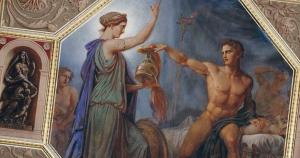
After considering users of potent herbs, or pharmaka, in previous posts, we turn to a womanwhose uses of such drugs are undoubtedly baleful: the bewitching Circe. Indeed, Circe may be the first figure in our study that fits the image of a fairytale witch.* She is a “she,” brews baleful potions that transform men into beasts, and knows the right rituals to commune with the dead.Homer’s world, however, is not a fairytale, and this image of a witch comes with a twist.
The hero Odysseus describes his confrontation with the magic-working goddess Circe in Books 10-12 of Homer’s Odyssey. The hero relates how his men fell into her malefic trap:
Within the forest glades they found the house of Circe … round about it were mountain wolves and lions, whom Circe herself had bewitched; for she gave them evil drugs … within they heard Circe singing with sweet voice, as she went to and fro before a great imperishable web … She brought them in … and made for them a potion … but in the food she mixed evil drugs … Now when she had given them the potion … she immediately struck them with her wand … and they had the heads, and voice, and bristles, and shape of swine …**
Here, we seem to have a wicked witch right out of the pages of the Brothers Grimm. Circe lives in a forest, weaving her webs, and lures lost men with her luscious voice into tasting her potionsbefore transforming them into beasts. She even has a magic wand, an important prop in ritual magic past and present.*** Later in the story, however, we come to the act that most directly violates the injunction against witches in Exodus 22:18 and the example of the Witch of Endor. Circe explains to Odysseus how he may gain knowledge from calling up the dead, using a bloody trench in place of a poisoned cup and his sword in place of a wand:
[In Hades], hero … dig a pit of a cubit’s length …sacrifice a ram and a black ewe … Then many ghosts of men that are dead will come forth … You, yourself, drawing your sharp sword from beside your thigh, must sit there, and not allow the strengthless heads of the dead to draw near to the blood till you have inquired of Teiresias.°
Circe appears a perfect specimen of a “Witch,” that powerful combination of forbidden necromancy and European folklore that haunted the minds of Renaissance Europeans and Puritan jurors.
First–time readers of the Odyssey may be surprised, then, when Circe turns into one of the “good guys.”°° The point of Circe’s necromancy is to help Odysseus find his way home—and it works. Unlike the monotheistic universe imagined by the citizens of Salem in 1692, Homer envisions a chaos of powers that hold their rights by might, none being particularly “good” or “evil.” If Circe, as a goddess, toys with mortals, she is no different from Zeus and the Olympian gods with their Trojan War chess game. To overcome Circe’s pharmaka, Odysseus does not need to call on the One True God with prayer and scripture, but simply to find a bigger bully.
In a perfect deus ex machina, one shows up in the person of the divine, male, wand-wielding, drug-using, and dead-escorting Hermes.°°° Hermes works a little magic of his own with the moly plant. Its white flower counters Circe’s cup, while its black taproot trumps her wand. When Circe’s cup fails, she tries to overpower Odysseus with a little sex-magic, but an oath sworn by the sorceress at sword-point puts Odysseus back on top.§ Defeated, Circe goes on to offer the hero and his friends all the help they need. The lesson is a common one in the Odyssey: the world is not a place of “good” and “evil,” but of powers, perils, and profits that must be navigated, whether by cups and wands or by swords and sacrifices.§§
Our next discussion moves us ever closer to the ideal “Wicked Witch of the West.” We will be focusing on a mere mortal whose magic leads to baleful ends whether she wants them to or not: Medea.
—————————————————
*Shelby Brown, Potions and Poisons: Classical Ancestors of the Wicked Witch. http:blogs.getty.edu/iris/potions-and-poisons-classical-ancestors-of-the-wicked-witch, accessed May 23, 2019. Circe is also invoked to curse perfidious potters for preferring not to pay players in Homeric Epigram XIV.
**Homer, Odyssey, A.T. Murray trans. Cambridge: Harvard University Press, 1998. pp. 373-375. translating for lines X.210-240
***Brown. See also Grevel Lindop, Charles Williams: The Third Inkling. Oxford: Oxford University Press, 2015. pp. 332-337.
°Homer, 395-397. translating for lines X.516-537
°°Suzanne Saïd, Homer and the Odyssey. New York: Oxford University Press, 2011. pp. 172-173.
°°°For Hermes as psychopompos, or “escorter of the dead,” see the opening of Odyssey book 24.
§Homer, 379-383. translating for lines X.374-347
§§Saïd, 344-346, 377-378.
Previous Post

May 25, 2019
Fight for the Law as for the Wall (Heraclitus)
Next Post

May 27, 2019 The Daughters of Union Veterans- An Increased Devotion
Browse Our Archives
Select a Category Apologetics Art Culture Education On Books On Education Philosophy Politics Pop Culture Spiritual Reflections Uncategorized
Select a Month October 2026 September 2026 August 2026 July 2026 July 2025 June 2025 September 2024 July 2024 June 2024 December 2023 June 2023 September 2022 May 2022 April 2022 March 2022 February 2022 July 2021 June 2021 May 2021 April 2021 March 2021 February 2021 January 2021 December 2020 November 2020 October 2020 September 2020 August 2020 July 2020 June 2020 May 2020 April 2020 March 2020 February 2020 January 2020 December 2019 November 2019 October 2019 September 2019 August 2019 July 2019 June 2019 May 2019 April 2019 March 2019 February 2019 January 2019 December 2018 November 2018 October 2018 September 2018 August 2018 July 2018 June 2018 May 2018 April 2018 March 2018 February 2018 January 2018 December 2017 November 2017 October 2017 September 2017 August 2017 July 2017 June 2017 May 2017 April 2017 March 2017 February 2017 January 2017 December 2016 November 2016 October 2016 September 2016 August 2016 July 2016 June 2016 May 2016 April 2016 March 2016 February 2016 January 2016 December 2015 November 2015 October 2015 September 2015 August 2015 July 2015 June 2015 May 2015 April 2015 March 2015 February 2015 January 2015 November 2014 October 2014 September 2014 August 2014 July 2014 June 2014 May 2014 April 2014 March 2014 February 2014 January 2014 December 2013 November 2013 October 2013 September 2013 August 2013 July 2013 June 2013 May 2013 April 2013 March 2013 February 2013 January 2013 December 2012 November 2012 October 2012 September 2012 August 2012 July 2012 June 2012 May 2012
Follow Us!
TAKE THE
Religious Wisdom Quiz
Who prophesied the fall of Babylon?
Select your answer to see how you score.
Ezekiel Isaiah Jeremiah Daniel
Books by This Author John Mark Reynolds
Related posts from Eidos

Why Classical Education Is a Conversation, Not a...

Classical Education Must Teach Us to Make the...

Rooted: Why Classical Education Needs Community

Classical Education: Discussion for Everyone
TRENDING AT PATHEOS Evangelical

The REST of Your Life: A Creative Wrestles...
This week I had a conversation with a good friend from church....

How the author of the world's best hymn...
I've been working with John Newton for a while now. This makes...

Long before this Lectio Divina, Psalm 130 - the song - started...

What About the Trees? Another Living Parable
After I finished writing the last article about falling leaves as a...

Why Classical Education Is a Conversation, Not a...
Come and Read: Joy in Classical Education When I was a little...

Cornell University has received a great deal of negative publicity and intense...
view all Evangelical blogs
Ad-Free & Subscriber Log-In Subscription Support
- About Us
- 2026 Calendar
- Videos
- Podcasts
- Library of World Religions
- Faith In Media Tracker
- Advertise With Us
- Write for Us
- Privacy Policy
- Terms of Service
- Do Not Sell My Data
- Contact Us
- Radiant Digital
- Manage Newsletter Subscriptions
- Unsubscribe From Notifications
- Sitemap
Copyright 2008-2026, Patheos. All rights reserved.
Subscription Support Ad-Free & Subscriber Log-In
Follow Patheos