
BuddhistCatholicContemplativeEvangelicalGeneral ChristianHinduJewishLatter-day SaintMuslimNew VisionsProgressive Christian
Beliefs
- Buddhist
- Catholic
- Contemplative
- Evangelical
- General Christian
- Hindu
- Jewish
- Latter-day Saint
- More Voices
- Muslim
- New Visions
- Pagan
- Progressive Christian
Topics
- Religion News
- Food and Religion
- Sports and Religion
- Religious Art
- Religious Music and Entertainment
- Religious Events
- History and Religion
- Style and Religion
- Politics and Religion
- Women in Religion
- Recreation Outdoors and Religion
- Business Finance and Religion
- Careers Workplace and Religion
- Education and Religion
- Family Parenting and Religion
- Health Fitness and Religion
- Home and Religion
- Relationships and Religion
- Technology and Religion
- Travel and Religion
Columnists
- Buddhist Columnists
- Business Finance and Religion Columnists
- Careers Workplace and Religion Columnists
- Catholic Columnists
- Contemplative Columnists
- Education and Religion Columnists
- Evangelists Columnists
- Family Parenting and Religion Columnists
- General Christian Columnists
- Health Fitness and Religion Columnists
- Hindu Columnists
- History and Religion Columnists
- Home and Religion Columnists
- Jewish Columnists
- More Voices Columnists
- Latter Day Columnists
- Muslim Columnists
- New Visions Columnists
- Nonreligious Columnists
- Pagan Columnists
- Politics and Religion Columnists
- Progressive Columnists
- Recreation Outdoors and Religion Columnists
- Relationships and Religion Columnists
- Religion News Columnists
- Religious Art Columnists
- Religious Events Columnists
- Religious Music and Entertainment Columnists
- Sports and Religion Columnists
- Style and Religion Columnists
- Technology and Religion Columnists
- Travel and Religion Columnists
- Women in Religion Columnists
Resource Library
- 2026 Calendar
- Library of World Religions
- The 100 Most Holy Places on Earth
- Patheos Answers
- Podcasts
- Videos
- Faith Leaders Database
- Anglican Episcopalian
- Bahai
- Baptist
- Buddhism
- Christianity
- Confucianism
- Eastern Orthodoxy
- Hinduism
- Holiness and Pentecostal
- ISKCON
- Islam
- Judaism
- Lutheran
- Methodist
- The Church of Jesus Christ of Latter-day Saints
- New Age
- Paganism
- Presbytarian and Reformed
- Protestantism
- Religion Behind the Scenes
- Roman Catholic
- Scientology
- Shia Islam
- Sikhism
- Sufism
- Sunni Islam
- Taoism
- Zen
- See all religions
Research Tools
 Ad-Free & Subscriber Log-In Subscription Support
Ad-Free & Subscriber Log-In Subscription Support
Follow Patheos 

- Trending:
- Forgiveness
- |
- Marriage
- |
- Consciousness
- |
- Death Penalty
- |
- Election
- |
- Halloween

- Home
- Evangelical
- Shield of Aeneas II (Guest Voice James Harrington)
Shield of Aeneas II (Guest Voice James Harrington)
Last updated on: April 18, 2019 at 10:55 pm by John Mark N. Reynolds
Shield of Aeneas II (Guest Voice James Harrington) 2019-04-18T22:55:05-04:00 John Mark N. Reynolds
Patheos Explore the world's faith through different perspectives on religion and spirituality! Patheos has the views of the prevalent religions and spiritualities of the world.
I asked for new voices and got some outstanding writers! Today we hear from the erudite James R. Harrington.
 James R. Harrington earned his M.A. in Ancient History at California State University Fulleron and is a member of the Torrey Honors Institute. James has been a classical educator in a variety of settings over the past thirteen years. He lives in Houston with his wife, Sharon, and their daughter.
Mr. Harrington responded to thoughts on his first post.
Harrington wrote about the shield of Herakles,
He continued to the shield of Aeneas and now is following up on that first post:
In the previous post on the Shield of Aeneas, we saw how Virgil moves from the generic scenes of Achilles’ and Herakles’ shields to specific moments in the Roman past in order to express his hope that Caesar Augustus will lead the world into an era of universal peace. Today’s post focuses on the circumstances surrounding the gift of Aeneas’ shield and what they reveal about Virgil’s attitude toward his Greek sources.
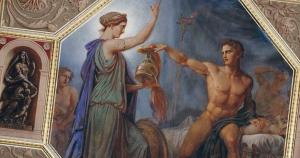
At first glance, the Aeneid appears strongly anti-Greek. The defeated Trojans, not the Greeks, are the heroes of the epic. Odysseus in particular comes off as a weasel, and we are told that Aeneas’ opponent, Turnus, is a new Achilles. Given how closely the structure of the Aeneid follows that of the Odyssey and then the Iliad, it can give the impression that Virgil is trying to undo Homer by some process of literary alchemy. We should take careful note, then, that at the moment when Aeneas receives his shield and prepares to bear Rome’s future on his shoulders, he is forging an alliance with a band of Greeks (Aeneid Book VIII). These Greeks, like the Trojans, are exiles who have found a new home in Italy. Their captain is named Evander, which roughly corresponds to the Greek for “good man.” His son, who will go with Aeneas to seal the alliance, is named Pallas after Pallas Athena, the goddess of Wisdom and patroness of Achilles, Odysseus, and Herakles. Thus, Evander, Pallas, and their men represent all that Virgil sees as good and wise in Ancient Greece. Like Herakles the culture-bringer in pseudo-Hesiod’s Shield of Herakles, Aeneas finds them in the process of bringing pure worship and festivities to a sacred grove. In fact, the god Evander’s people worship is none other than Herakles the culture-bringer! For Virgil, there are Greeks and then there are Greeks.
This is important to Virgil’s project as depicted on Aeneas’ Shield. Herakles was, according to myth, the son of god. Unlike Achilles, who learns that all men, even sons of gods, must die, Herakles is allowed to work his way back to Olympus, after an excruciating death, to join the gods as an Olympian. It is this notion—that a man who suffers nobly for his people can become a god—that Virgil attributes to his “good Greeks,” Evander and Pallas. The possibility that noble suffering could have a cosmic outcome is important to Virgil. His hero, Aeneas, is both a son of the goddess Venus, and a forefather of Julius Caesar, adoptive father of Virgil’s patron, Caesar Augustus. Julius Caesar was declared divine by the Senate shortly after his death, and the title his heir Octavian received as “Augustus” accorded him semi-divine status in his lifetime and godhood after his death. As we saw in the previous post, Virgil hopes that Augustus is a man god-like enough to change the course of human history and bring an end to the reign of Strife. Does Virgil believe it is possible? Perhaps not, but the circumstances surrounding Aeneas’ reception of his heroic shield suggest that Virgil finds hope in the story of the Greek god-man, Herakles.
Previous Post

April 12, 2019
RMS Titanic: Fate, Wrong Turns, and not Being Ismay
Next Post

April 14, 2019 The Story Will Save Us (Ten Truths from RMS Titanic)
Browse Our Archives
Select a Category Apologetics Art Culture Education On Books On Education Philosophy Politics Pop Culture Spiritual Reflections Uncategorized
Select a Month October 2026 September 2026 August 2026 July 2026 July 2025 June 2025 September 2024 July 2024 June 2024 December 2023 June 2023 September 2022 May 2022 April 2022 March 2022 February 2022 July 2021 June 2021 May 2021 April 2021 March 2021 February 2021 January 2021 December 2020 November 2020 October 2020 September 2020 August 2020 July 2020 June 2020 May 2020 April 2020 March 2020 February 2020 January 2020 December 2019 November 2019 October 2019 September 2019 August 2019 July 2019 June 2019 May 2019 April 2019 March 2019 February 2019 January 2019 December 2018 November 2018 October 2018 September 2018 August 2018 July 2018 June 2018 May 2018 April 2018 March 2018 February 2018 January 2018 December 2017 November 2017 October 2017 September 2017 August 2017 July 2017 June 2017 May 2017 April 2017 March 2017 February 2017 January 2017 December 2016 November 2016 October 2016 September 2016 August 2016 July 2016 June 2016 May 2016 April 2016 March 2016 February 2016 January 2016 December 2015 November 2015 October 2015 September 2015 August 2015 July 2015 June 2015 May 2015 April 2015 March 2015 February 2015 January 2015 November 2014 October 2014 September 2014 August 2014 July 2014 June 2014 May 2014 April 2014 March 2014 February 2014 January 2014 December 2013 November 2013 October 2013 September 2013 August 2013 July 2013 June 2013 May 2013 April 2013 March 2013 February 2013 January 2013 December 2012 November 2012 October 2012 September 2012 August 2012 July 2012 June 2012 May 2012
Follow Us!
TAKE THE
Religious Wisdom Quiz
What is the meaning of the word "Golgotha"?
Select your answer to see how you score.
Place of the Skull River of Blood City of Bread Peaceful Garden
Books by This Author John Mark Reynolds
Related posts from Eidos

Classical Education Must Teach Us to Make the...

Classical Education and the Art of Dying Well

Golden, Golden, Golden: My Mother's Last Lesson

TRENDING AT PATHEOS Evangelical

The REST of Your Life: A Creative Wrestles...
This week I had a conversation with a good friend from church....

How the author of the world's best hymn...
I've been working with John Newton for a while now. This makes...

Long before this Lectio Divina, Psalm 130 - the song - started...

What About the Trees? Another Living Parable
After I finished writing the last article about falling leaves as a...

Why Classical Education Is a Conversation, Not a...
Come and Read: Joy in Classical Education When I was a little...

Cornell University has received a great deal of negative publicity and intense...
view all Evangelical blogs
Ad-Free & Subscriber Log-In Subscription Support
- About Us
- 2026 Calendar
- Videos
- Podcasts
- Library of World Religions
- Faith In Media Tracker
- Advertise With Us
- Write for Us
- Privacy Policy
- Terms of Service
- Do Not Sell My Data
- Contact Us
- Radiant Digital
- Manage Newsletter Subscriptions
- Unsubscribe From Notifications
- Sitemap
Copyright 2008-2026, Patheos. All rights reserved.
Subscription Support Ad-Free & Subscriber Log-In
Follow Patheos