
BuddhistCatholicContemplativeEvangelicalGeneral ChristianHinduJewishLatter-day SaintMuslimNew VisionsProgressive Christian
Beliefs
- Buddhist
- Catholic
- Contemplative
- Evangelical
- General Christian
- Hindu
- Jewish
- Latter-day Saint
- More Voices
- Muslim
- New Visions
- Pagan
- Progressive Christian
Topics
- Religion News
- Food and Religion
- Sports and Religion
- Religious Art
- Religious Music and Entertainment
- Religious Events
- History and Religion
- Style and Religion
- Politics and Religion
- Women in Religion
- Recreation Outdoors and Religion
- Business Finance and Religion
- Careers Workplace and Religion
- Education and Religion
- Family Parenting and Religion
- Health Fitness and Religion
- Home and Religion
- Relationships and Religion
- Technology and Religion
- Travel and Religion
Columnists
- Buddhist Columnists
- Business Finance and Religion Columnists
- Careers Workplace and Religion Columnists
- Catholic Columnists
- Contemplative Columnists
- Education and Religion Columnists
- Evangelists Columnists
- Family Parenting and Religion Columnists
- General Christian Columnists
- Health Fitness and Religion Columnists
- Hindu Columnists
- History and Religion Columnists
- Home and Religion Columnists
- Jewish Columnists
- More Voices Columnists
- Latter Day Columnists
- Muslim Columnists
- New Visions Columnists
- Nonreligious Columnists
- Pagan Columnists
- Politics and Religion Columnists
- Progressive Columnists
- Recreation Outdoors and Religion Columnists
- Relationships and Religion Columnists
- Religion News Columnists
- Religious Art Columnists
- Religious Events Columnists
- Religious Music and Entertainment Columnists
- Sports and Religion Columnists
- Style and Religion Columnists
- Technology and Religion Columnists
- Travel and Religion Columnists
- Women in Religion Columnists
Resource Library
- 2026 Calendar
- Library of World Religions
- The 100 Most Holy Places on Earth
- Patheos Answers
- Podcasts
- Videos
- Faith Leaders Database
- Anglican Episcopalian
- Bahai
- Baptist
- Buddhism
- Christianity
- Confucianism
- Eastern Orthodoxy
- Hinduism
- Holiness and Pentecostal
- ISKCON
- Islam
- Judaism
- Lutheran
- Methodist
- The Church of Jesus Christ of Latter-day Saints
- New Age
- Paganism
- Presbytarian and Reformed
- Protestantism
- Religion Behind the Scenes
- Roman Catholic
- Scientology
- Shia Islam
- Sikhism
- Sufism
- Sunni Islam
- Taoism
- Zen
- See all religions
Research Tools
 Ad-Free & Subscriber Log-In Subscription Support
Ad-Free & Subscriber Log-In Subscription Support
Follow Patheos 

- Trending:
- Forgiveness
- |
- Marriage
- |
- Consciousness
- |
- Death Penalty
- |
- Election
- |
- Halloween

- Home
- Evangelical
- Shield of Herakles (Guest Voice James Harrington)
Shield of Herakles (Guest Voice James Harrington)
Last updated on: March 28, 2019 at 7:19 pm by John Mark N. Reynolds
Shield of Herakles (Guest Voice James Harrington) 2019-03-28T19:19:01-04:00 John Mark N. Reynolds
Patheos Explore the world's faith through different perspectives on religion and spirituality! Patheos has the views of the prevalent religions and spiritualities of the world.
I asked for new voices and got some outstanding writers! Today we hear from the erudite James R. Harrington.
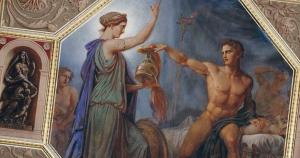 James R. Harrington earned his M.A. in Ancient History at California State University Fulleron and is a member of the Torrey Honors Institute. James has been a classical educator in a variety of settings over the past thirteen years. He lives in Houston with his wife, Sharon, and their daughter.
Mr. Harrington responded to thoughts on his first post.
Now he is turning to a new shield:
Once you learn to pay attention to Achilles’ Shield, you begin to notice the “hero’s shield” trope everywhere in literature. Aeneas carries the future of his people on his shield; Gawain carries his knightly virtues. A hero’s shield, as a literary device, carries significant symbolic meaning. When that hero, like Achilles or Aeneas, speaks for an entire culture, the shield often encapsulates the world-picture his deeds create.
At the beginning of Greek literature stand two great titans: Homer and Hesiod. We have seen in the first post how Homer uses Achilles’ Shield to portray a cosmos in competition. In a fragment attributed to Hesiod called The Shield of Herakles, a similar passage presents one of the culture-hero’s famous exploits: the slaying of Cycnus. This unstoppable war machine has been waylaying pilgrims journeying to Apollo’s sacred grove, and before Herakles can impose civilization on the outlaw, he has to arm himself appropriately. Cycnus is the son of Ares, or unrestrained warfare. To re-impose order on Cycnus, Herakles will need a different kind of force. His patron, Athene, is the goddess of defensive/limited warfare, and he dons armor forged by the god of craftsmen, Hephaistos. As with Achilles’ Shield, the shield Hephaistos gives Herakles is a miniature cosmos bounded by Ocean. In its center, however, are not the orderly stars, but a grim depiction of Fear and Strife. The world of Herakles’ shield is “caught between the Devil and the deep blue sea.” Between these bounds are a series of conflicts that move from the mere savagery of boars fighting lions, through images of the all-victorious gods, to scenes of men: taming the sea with safe harbors, destroying monsters, warring with one another, and finally achieving a civilized state where the violent forces of Fear and Strife are harnessed with the power of Culture to create dances, choirs, races, and a joyous festival.
At first, the images on the two shields seem remarkably alike in imagery and meaning: the cosmos is a place of endless competition between opposite forces. Closer inspection reveals a difference in emphasis. While the Shield of Achilles presents an eternal battle between ordered and unordered strife, Herakles’ Shield shows a definite progression. The scenes begin in Fear, Strife, and animal violence, but a new force appears with the Olympian gods: Culture. In Hesiod’s poems Works and Days and Theogony, Zeus and the Olympian gods impose order on the cosmos after violently overthrowing the Titans. Herakles, as the son of Zeus, repeats this pattern as he slays Cycnus, the son of Ares, and restores Apollo’s grove as a center of Culture where religion and festivities can once again take place. The difference is subtle, but the variation between the two shields reveals a dialogue right at the beginning of Greek Literature. As Hesiod says: “So after all, there was not one kind of Strife alone, but all over the earth there are two. As for the one, a man would praise her when he came to understand her; but the other is blameworthy: and they are wholly different in nature.”*
——————————————-
*Hesiod, Works and Days, lines 11-13 as found in: Hesiod, Hesiod, Homeric Hymns, Epic Cycle, Homerica. Hugh G. Evelyn White trans. Cambridge: Loeb Classical Library, 2002. p 3.
Previous Post

March 27, 2019
Trying to Help: What can philosophy do?
Next Post
March 29, 2019 The Restitution Chorus: Sing It!
Browse Our Archives
Select a Category Apologetics Art Culture Education On Books On Education Philosophy Politics Pop Culture Spiritual Reflections Uncategorized
Select a Month October 2026 September 2026 August 2026 July 2026 July 2025 June 2025 September 2024 July 2024 June 2024 December 2023 June 2023 September 2022 May 2022 April 2022 March 2022 February 2022 July 2021 June 2021 May 2021 April 2021 March 2021 February 2021 January 2021 December 2020 November 2020 October 2020 September 2020 August 2020 July 2020 June 2020 May 2020 April 2020 March 2020 February 2020 January 2020 December 2019 November 2019 October 2019 September 2019 August 2019 July 2019 June 2019 May 2019 April 2019 March 2019 February 2019 January 2019 December 2018 November 2018 October 2018 September 2018 August 2018 July 2018 June 2018 May 2018 April 2018 March 2018 February 2018 January 2018 December 2017 November 2017 October 2017 September 2017 August 2017 July 2017 June 2017 May 2017 April 2017 March 2017 February 2017 January 2017 December 2016 November 2016 October 2016 September 2016 August 2016 July 2016 June 2016 May 2016 April 2016 March 2016 February 2016 January 2016 December 2015 November 2015 October 2015 September 2015 August 2015 July 2015 June 2015 May 2015 April 2015 March 2015 February 2015 January 2015 November 2014 October 2014 September 2014 August 2014 July 2014 June 2014 May 2014 April 2014 March 2014 February 2014 January 2014 December 2013 November 2013 October 2013 September 2013 August 2013 July 2013 June 2013 May 2013 April 2013 March 2013 February 2013 January 2013 December 2012 November 2012 October 2012 September 2012 August 2012 July 2012 June 2012 May 2012
Follow Us!
TAKE THE
Religious Wisdom Quiz
Who built two gold calves, leading Israel into idolatry after the split?
Select your answer to see how you score.
Rehoboam Solomon Jeroboam Josiah
Books by This Author John Mark Reynolds
Related posts from Eidos

Why Classical Education Is a Conversation, Not a...

Does Classical Education Belong Only to the West?

Classical Education Must Teach Us to Make the...

Rooted: Why Classical Education Needs Community
TRENDING AT PATHEOS Evangelical

The REST of Your Life: A Creative Wrestles...
This week I had a conversation with a good friend from church....

How the author of the world's best hymn...
I've been working with John Newton for a while now. This makes...

Long before this Lectio Divina, Psalm 130 - the song - started...

What About the Trees? Another Living Parable
After I finished writing the last article about falling leaves as a...

Why Classical Education Is a Conversation, Not a...
Come and Read: Joy in Classical Education When I was a little...

Cornell University has received a great deal of negative publicity and intense...
view all Evangelical blogs
Ad-Free & Subscriber Log-In Subscription Support
- About Us
- 2026 Calendar
- Videos
- Podcasts
- Library of World Religions
- Faith In Media Tracker
- Advertise With Us
- Write for Us
- Privacy Policy
- Terms of Service
- Do Not Sell My Data
- Contact Us
- Radiant Digital
- Manage Newsletter Subscriptions
- Unsubscribe From Notifications
- Sitemap
Copyright 2008-2026, Patheos. All rights reserved.
Subscription Support Ad-Free & Subscriber Log-In
Follow Patheos