
BuddhistCatholicContemplativeEvangelicalGeneral ChristianHinduJewishLatter-day SaintMuslimNew VisionsProgressive Christian
Beliefs
- Buddhist
- Catholic
- Contemplative
- Evangelical
- General Christian
- Hindu
- Jewish
- Latter-day Saint
- More Voices
- Muslim
- New Visions
- Pagan
- Progressive Christian
Topics
- Religion News
- Food and Religion
- Sports and Religion
- Religious Art
- Religious Music and Entertainment
- Religious Events
- History and Religion
- Style and Religion
- Politics and Religion
- Women in Religion
- Recreation Outdoors and Religion
- Business Finance and Religion
- Careers Workplace and Religion
- Education and Religion
- Family Parenting and Religion
- Health Fitness and Religion
- Home and Religion
- Relationships and Religion
- Technology and Religion
- Travel and Religion
Columnists
- Buddhist Columnists
- Business Finance and Religion Columnists
- Careers Workplace and Religion Columnists
- Catholic Columnists
- Contemplative Columnists
- Education and Religion Columnists
- Evangelists Columnists
- Family Parenting and Religion Columnists
- General Christian Columnists
- Health Fitness and Religion Columnists
- Hindu Columnists
- History and Religion Columnists
- Home and Religion Columnists
- Jewish Columnists
- More Voices Columnists
- Latter Day Columnists
- Muslim Columnists
- New Visions Columnists
- Nonreligious Columnists
- Pagan Columnists
- Politics and Religion Columnists
- Progressive Columnists
- Recreation Outdoors and Religion Columnists
- Relationships and Religion Columnists
- Religion News Columnists
- Religious Art Columnists
- Religious Events Columnists
- Religious Music and Entertainment Columnists
- Sports and Religion Columnists
- Style and Religion Columnists
- Technology and Religion Columnists
- Travel and Religion Columnists
- Women in Religion Columnists
Resource Library
- 2026 Calendar
- Library of World Religions
- The 100 Most Holy Places on Earth
- Patheos Answers
- Podcasts
- Videos
- Faith Leaders Database
- Anglican Episcopalian
- Bahai
- Baptist
- Buddhism
- Christianity
- Confucianism
- Eastern Orthodoxy
- Hinduism
- Holiness and Pentecostal
- ISKCON
- Islam
- Judaism
- Lutheran
- Methodist
- The Church of Jesus Christ of Latter-day Saints
- New Age
- Paganism
- Presbytarian and Reformed
- Protestantism
- Religion Behind the Scenes
- Roman Catholic
- Scientology
- Shia Islam
- Sikhism
- Sufism
- Sunni Islam
- Taoism
- Zen
- See all religions
Research Tools
 Ad-Free & Subscriber Log-In Subscription Support
Ad-Free & Subscriber Log-In Subscription Support
Follow Patheos 

- Trending:
- Forgiveness
- |
- Marriage
- |
- Consciousness
- |
- Death Penalty
- |
- Election
- |
- Halloween

- Home
- Evangelical
- Classical, yes. Trivium, maybe, eventually.
Classical, yes. Trivium, maybe, eventually.
Last updated on: March 19, 2019 at 6:02 am by John Mark N. Reynolds
Classical, yes. Trivium, maybe, eventually. 2019-03-18T21:54:03-04:00 John Mark N. Reynolds
Patheos Explore the world's faith through different perspectives on religion and spirituality! Patheos has the views of the prevalent religions and spiritualities of the world.
Classical.
Christian.
Education.
What is it?
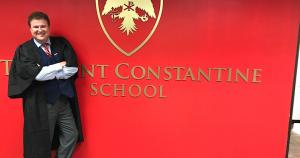
Classical education is not a curriculum you can buy or a fixed pattern of learning for all people at all places at all times. This is especially true if we consider the education offered in the classical period. Ancient Greek culture stretches over hundreds of years and embraces a wide variety of philosophies and forms of education. If we add Roman ideas, then we add centuries more history and even greater diversity.
Global Christians have a Bible rooted in Hebrew and Greek languages: Jerusalem and Athens. Christian education will always include these languages and root cultures, but also must take into account the homeland of the learners and the global church.
We are training in God-given virtue. That is both classical and Christian.
Classical Christian education begins with language, particularly the primary language of the learner.
Classical Christian education is rooted in reading, writing, and communicating. We begin in the vulgar tongue, the one we learned from our mothers and fathers. This is the language of our church liturgy. In the United States the primary (though not the only) language is English. Most curriculum would begin in that tongue, though certainly not in every US community.
Curriculum would begin in mastery of reading, writing, and communicating in English. (God help me!) The root tongues of English (including Latin) are useful in this regard. Other major national languages such as Spanish also will receive great attention. Add to this the languages of the historic church: Latin, Arabic, Russian, Ge’ez, and so many others.
For every student the language of mathematics is also essential.
There is so much to learn!
Classical Christian education is a nursery to cultivate virtue, wonder and joy in learning.
We cannot be sure what any given student must know, but we can be sure that we will all need virtue. (Lord have mercy!). A student that uses anything he learns to ask better and new questions will never tire of learning. Knowledge leads to wonder and wonder to more knowledge, humbly held. This is joy in education.
The dialectic is central to classical Christian education: bewilderment, hypothesis, myth.
Classical education teaches us that a good question is harder to form than the answers it will (inevitably) produce. We want answers, but, as a result, learn first to form good questions.
Christian orthodoxy is truth. We learn that truth by learning the right questions walking with Jesus, reflecting on his Word in relationship with His bride the Church. These truths give us better questions as we know God through the person of Jesus Christ.
Discipleship, lived experience, is central to classical Christian education.
We read books for people. We serve, create, build. Another aspect of Classical, Christian education is the formation of learning communities. These communities must do things and for a Christian these will include acts of charity.
Classical Christian education is tied to a global church.
We learn about home first, our home language, the influences on that language, and the roots of our people. Yet we are not merely citizens of a republic (if American), but primarily subjects of the City of God. We long to study the wisdom and wonders found by our brothers and sisters in every tribe, people, and nation. Just as many of us (given our cultures) begin in Homer and move to the great pagan philosophers, so we can and should find wisdom in every other culture.
We cannot evangelize what we do not understand and love!
What of the trivium or (even) the quadrivium?
One way of dividing up learning for many classical thinkers (perhaps including Plato) and some Medieval people was the trivium (grammar, logic, rhetoric) and the quadrivium (arithematic, geometry, music, and astronomy).
Nobody should base an entire approach to education on an interesting esssay by an excellent mystery writer with (some) scholarly background. Dorothy Sayers’ Lost Tools of Learning is provocative and has inspired many to look into classical, Christian, eduction, but it is no sure guide as to what we should do.
The trivium is an interesting approach to what we should teach and how we should teach it, but is not the only approach. We must supplement ancient wisdom with what science and centuries of further educational experience have taught us about teaching and learning. If many educators today are too hasty to try the new and discard the old, classical Christian educators must avoid being reactionaries who cling to what is merely old even when something works better.
The children in early grades are in the nursery stage of learning and the trivium (even if used woodenly) would not apply to them. In fact, doing so risks draining the joy out of education. In my experience, I can catch a lively learner up, even as late as university, but there is little help for the student reduced to the conformist drill-and-kill drone.
Surely nobody sane would limit a college or university education to the quadrivium! Yes to those disciplines, but yes to so much more discovered over the centuries. The distinction between the two is, after all, artificial. All truth is unified and so the trivium begins with the most simple things (for most students) and ends in the most complex or abstract. Great focus on the distinction is like those schools that get lost deciding just what is religion, what is science, what is history as if making these useful distinctions (for some schools) clear is the goal!
Instead, the focus must always be on aptitudes that will make a person a good and useful neighbor in the city of man and an eternal citizen of the City of God. Both the subjects of learning and the trivium skills (with other important skills) stand in dialog with each other to help us achieve the human aptitudes.
These aptitudes are the great virtues: practical wisdom, moderation, courage, justice and hope, faith, and love. Everything Plato suggested in education was in order to reach classical virtues, just as our salvation by grace and God’s mercy is to create the deeper Christian virtue. A good general education (K-12, college) will make a person fit to work surely, but the fitness is incidental due to a well ordered soul.
The well ordered soul (the virtuous person) will invent, create, and flourish.
Confusing the trivium or quadrivium with classical Christain education is like confusing one way of having a happy marriage with the only way. Instead, any book of marriage advice stands subject to the particular experience of the couple and as a servant to the chief goals of a Christian marriage!
——————————————-
I am writing in response to series of excellent research questions sent to me by a graduate student studying modern classical education.
Previous Post

March 18, 2019
Video Games as Scientism’s Totem (Guest Post by Dr. Eric Holloway)
Next Post

March 20, 2019 Charging for an Artificial Distinction: “Going” to “College”
Browse Our Archives
Select a Category Apologetics Art Culture Education On Books On Education Philosophy Politics Pop Culture Spiritual Reflections Uncategorized
Select a Month October 2026 September 2026 August 2026 July 2026 July 2025 June 2025 September 2024 July 2024 June 2024 December 2023 June 2023 September 2022 May 2022 April 2022 March 2022 February 2022 July 2021 June 2021 May 2021 April 2021 March 2021 February 2021 January 2021 December 2020 November 2020 October 2020 September 2020 August 2020 July 2020 June 2020 May 2020 April 2020 March 2020 February 2020 January 2020 December 2019 November 2019 October 2019 September 2019 August 2019 July 2019 June 2019 May 2019 April 2019 March 2019 February 2019 January 2019 December 2018 November 2018 October 2018 September 2018 August 2018 July 2018 June 2018 May 2018 April 2018 March 2018 February 2018 January 2018 December 2017 November 2017 October 2017 September 2017 August 2017 July 2017 June 2017 May 2017 April 2017 March 2017 February 2017 January 2017 December 2016 November 2016 October 2016 September 2016 August 2016 July 2016 June 2016 May 2016 April 2016 March 2016 February 2016 January 2016 December 2015 November 2015 October 2015 September 2015 August 2015 July 2015 June 2015 May 2015 April 2015 March 2015 February 2015 January 2015 November 2014 October 2014 September 2014 August 2014 July 2014 June 2014 May 2014 April 2014 March 2014 February 2014 January 2014 December 2013 November 2013 October 2013 September 2013 August 2013 July 2013 June 2013 May 2013 April 2013 March 2013 February 2013 January 2013 December 2012 November 2012 October 2012 September 2012 August 2012 July 2012 June 2012 May 2012
Follow Us!
TAKE THE
Religious Wisdom Quiz
What does "Ichabod" mean?
Select your answer to see how you score.
No glory God's gift Blessed son Holy child
Books by This Author John Mark Reynolds
Related posts from Eidos

Why Classical Education Is a Conversation, Not a...

Rooted: Why Classical Education Needs Community

Classical Education: Discussion for Everyone

Speaking Math: the Language of Classical Education
TRENDING AT PATHEOS Evangelical

The REST of Your Life: A Creative Wrestles...
This week I had a conversation with a good friend from church....

How the author of the world's best hymn...
I've been working with John Newton for a while now. This makes...

Long before this Lectio Divina, Psalm 130 - the song - started...

What About the Trees? Another Living Parable
After I finished writing the last article about falling leaves as a...

Why Classical Education Is a Conversation, Not a...
Come and Read: Joy in Classical Education When I was a little...

Cornell University has received a great deal of negative publicity and intense...
view all Evangelical blogs
Ad-Free & Subscriber Log-In Subscription Support
- About Us
- 2026 Calendar
- Videos
- Podcasts
- Library of World Religions
- Faith In Media Tracker
- Advertise With Us
- Write for Us
- Privacy Policy
- Terms of Service
- Do Not Sell My Data
- Contact Us
- Radiant Digital
- Manage Newsletter Subscriptions
- Unsubscribe From Notifications
- Sitemap
Copyright 2008-2026, Patheos. All rights reserved.
Subscription Support Ad-Free & Subscriber Log-In
Follow Patheos