
BuddhistCatholicContemplativeEvangelicalGeneral ChristianHinduJewishLatter-day SaintMuslimNew VisionsProgressive Christian
Beliefs
- Buddhist
- Catholic
- Contemplative
- Evangelical
- General Christian
- Hindu
- Jewish
- Latter-day Saint
- More Voices
- Muslim
- New Visions
- Pagan
- Progressive Christian
Topics
- Religion News
- Food and Religion
- Sports and Religion
- Religious Art
- Religious Music and Entertainment
- Religious Events
- History and Religion
- Style and Religion
- Politics and Religion
- Women in Religion
- Recreation Outdoors and Religion
- Business Finance and Religion
- Careers Workplace and Religion
- Education and Religion
- Family Parenting and Religion
- Health Fitness and Religion
- Home and Religion
- Relationships and Religion
- Technology and Religion
- Travel and Religion
Columnists
- Buddhist Columnists
- Business Finance and Religion Columnists
- Careers Workplace and Religion Columnists
- Catholic Columnists
- Contemplative Columnists
- Education and Religion Columnists
- Evangelists Columnists
- Family Parenting and Religion Columnists
- General Christian Columnists
- Health Fitness and Religion Columnists
- Hindu Columnists
- History and Religion Columnists
- Home and Religion Columnists
- Jewish Columnists
- More Voices Columnists
- Latter Day Columnists
- Muslim Columnists
- New Visions Columnists
- Nonreligious Columnists
- Pagan Columnists
- Politics and Religion Columnists
- Progressive Columnists
- Recreation Outdoors and Religion Columnists
- Relationships and Religion Columnists
- Religion News Columnists
- Religious Art Columnists
- Religious Events Columnists
- Religious Music and Entertainment Columnists
- Sports and Religion Columnists
- Style and Religion Columnists
- Technology and Religion Columnists
- Travel and Religion Columnists
- Women in Religion Columnists
Resource Library
- 2026 Calendar
- Library of World Religions
- The 100 Most Holy Places on Earth
- Patheos Answers
- Podcasts
- Videos
- Faith Leaders Database
- Anglican Episcopalian
- Bahai
- Baptist
- Buddhism
- Christianity
- Confucianism
- Eastern Orthodoxy
- Hinduism
- Holiness and Pentecostal
- ISKCON
- Islam
- Judaism
- Lutheran
- Methodist
- The Church of Jesus Christ of Latter-day Saints
- New Age
- Paganism
- Presbytarian and Reformed
- Protestantism
- Religion Behind the Scenes
- Roman Catholic
- Scientology
- Shia Islam
- Sikhism
- Sufism
- Sunni Islam
- Taoism
- Zen
- See all religions
Research Tools
 Ad-Free & Subscriber Log-In Subscription Support
Ad-Free & Subscriber Log-In Subscription Support
Follow Patheos 

- Trending:
- Forgiveness
- |
- Marriage
- |
- Consciousness
- |
- Death Penalty
- |
- Election
- |
- Halloween

- Home
- Evangelical
- Plain Theology for Plain People: The Way of Salvation (Charles Octavius Boothe 3/9)
Plain Theology for Plain People: The Way of Salvation (Charles Octavius Boothe 3/9)
Last updated on: February 5, 2019 at 8:19 pm by John Mark N. Reynolds
Plain Theology for Plain People: The Way of Salvation (Charles Octavius Boothe 3/9) 2019-02-05T20:19:21-04:00 John Mark N. Reynolds
Patheos Explore the world's faith through different perspectives on religion and spirituality! Patheos has the views of the prevalent religions and spiritualities of the world.
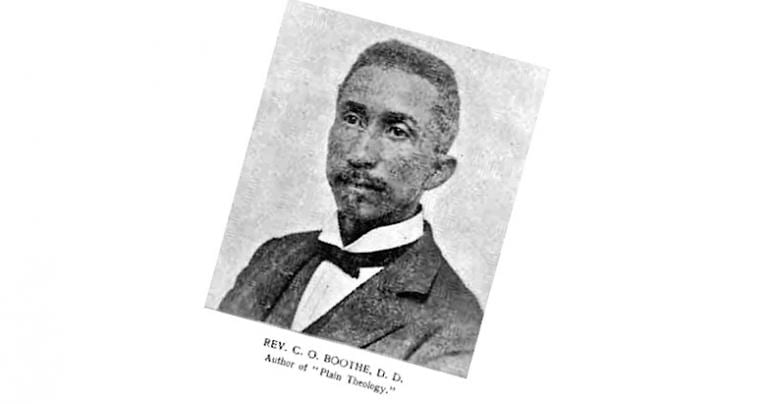 We know too little about the makers of the American mind, particularly in religion. Our roots matter if we are to grow in a healthy manner as a nation. One maker of the modern Evangelical mind was Charles Octavius Boothe, minister, scholar, educator who spoke to the “plain people” in his systemization of Biblical and historical Christianity in Plain Theology for Plain People.
Being reminded of the broad Biblical basis for teachings that all Christians have in common is needful as no Christian can afford to forget the Bible for long, because there the history of God speaking to a people and then to all of us is recorded. There we find the clearest image of Jesus, God in the flesh, who helps us see the glory of God.
When I come to places of differences, I am challenged to understand better what I believe God has said in and through his Church. We must sustain these differences due to our brokenness and while they are not always lessened by clarity, they are at least made plain. When our differences are plain, we can dialog with hope of reconciliation or at the very least without exaggerating the differences we have.
Dr. Boothe explains what we now would call an Evangelical theology to what he calls plain people in plain language. When I read the complexity he still allowed himself, I am reminded that many of the plain people, steeped in King James English through the Bible and eager to learn even if they had no access or opportunity for schooling, would listen to sermons and read books more complex than many produced by Christian publishers today.
Boothe has argued for God in his unique apologetic style: thesis, Scriptural support, common objections, and then a plain response. Boothe never confuses plain or clear with simple minded and any of his readers could have followed the Scriptures he quotes or the names he cites to a deeper understanding of any of his ideas.
Boothe begins with God and God’s great creation: humankind. All of us share a glorious inheritance as part of the human race, yet any man is not what he ought to be. We fall short and only God can save us, because our problem is not merely behavioral, but-personal (ontological). We must be born again, because justice demands that Paradise not be destroyed for the angels, God, and all that is good and beautiful by our brokenness.
Boothe begins with this fall, with Adam and Eve driven from the Garden:
Justice demands that the sinners should be driven from the Garden; but before the Lord God compels them to go, he graciously sets a star of hope in their dark skies.
Boothe does not draw back from the judgment that must come to injustice, but his is a consistent note of hope:
“From the foundation of the world.” The use of this expressive phrase is worthy of special note. Dr. Justin A. Smith, in his “Commentary on Revelation,” [verse] 13: 8, says that this “is the New Testament mode of representing what took place in the remote past, before time, as measured in the periods of this world, had existence.” The phrase would be properly translated in most cases, “from eternity.” It has this meaning undoubtedly in the words of our Lord’s prayer, “Thou lovedst me before the foundation of the world” (John 17: 24).
“The purpose of grace had its origin in the love of God.” Boothe roots salvation not in wrath, though that is a fitting response to injustice, but love:
It was not what has been called “the love of complacency.” It was a love that combined pity for those who were in a very pitiable condition, and a desire to do them good by raising them out of it and establishing them in a better and happier state. It was what is termed “the love of compassion.” It was a truly wonderful love; the more we think of the sinfulness of sin, the more wonderful the love of God will appear to us. We naturally ask, “Why did God so love sinners?” and the only answer that we can give is, “Even so, Father, for so it seemed good in thy sight.” Well may we exclaim with the beloved disciple: “Behold what manner of love the Father hath bestowed upon us, that we should be called the sons of God” (1 John 3: 1).
God has an active love that redeems and restores! God does not fret, God acts. Jesus comes and dies: “to suffer in His human nature as He could not suffer as the Son of God; while his nature as the Son of God gave a value and efficiency to his suffering which it would not and could not have had in a merely human nature.” If some modern Evangelicals are forgetting the importance of the two natures of Christ, Boothe calls us back to this profound and necessary doctrine.
Having rooted the Christian message in the love of God, Boothe does not shrink back from the consequences of refusing to give our consent to God. He reminds his readers:
Those, therefore, that wish to be instrumental in leading sinners to Christ should make special efforts to impress on their minds first the solemn truth, that without the salvation that God has provided they must inevitably perish. The strongly emphatic words of the apostle should be pointed out to them, and they should be earnestly exhorted to meditate earnestly upon them until their sad meaning has been clearly comprehended.
We face doom without the work of Jesus, because of love. We cannot both refuse our consent to the good work of God and receive benefits of a relationship with the Good God. The result is to “perish” and Boothe explains:
This fearful doom is set forth in the one comprehensive word, “perish.” It means, in the case of a sinner, the end of everything that can make existence desirable. It is total and final separation from God, the source and fountain of all true blessedness; the cessation of all those pleasing anticipations that have been wont to throw their brightness on the future toward which men are always advancing; the end of all those hopes that have been to them strength in weakness, help in difficulties, comfort in sorrows, and have made endurable long and weary hours of suffering. It makes the heart sink to think of that perdition which sweeps men away from all that is bright and cheery, and leaves them no prospect to the future but what has been graphically described as the blackness of darkness forever. How infinitely precious the salvation that delivers men from such a dark and terrible doom!
Like the Bible, but unlike some preachers, Boothe neither rejects the possibility of doom nor does he dwell on it. He speaks a plain word: without Jesus we are doomed. He turns quickly to thankfulness for salvation from doom and the benefits of that salvation, if we will receive it.
Boothe is so exalted, rightly, that he does not even comment on one benefit. The great gift of fellowship remains in all caps requiring worship not exposition:
IT BRINGS THE REDEEMED ONE INTO FELLOWSHIP WITH THE FATHER, THE SON, AND THE HOLY SPIRIT; WITH ALL THE HOLY ANGELS, AND THE MULTITUDE OF THE RANSOMED SAINTS THAT SHALL ALL STAND IN SHINING ROBES AROUND THE THRONE OF GOD IN HEAVEN
————————————-
Plain Theology for Plain People: 1, 2, 3,
Previous Post
February 4, 2019
Plain Theology for Plain People: On Man (Charles Octavius Boothe 2/9)

Browse Our Archives
Select a Category Apologetics Art Culture Education On Books On Education Philosophy Politics Pop Culture Spiritual Reflections Uncategorized
Select a Month October 2026 September 2026 August 2026 July 2026 July 2025 June 2025 September 2024 July 2024 June 2024 December 2023 June 2023 September 2022 May 2022 April 2022 March 2022 February 2022 July 2021 June 2021 May 2021 April 2021 March 2021 February 2021 January 2021 December 2020 November 2020 October 2020 September 2020 August 2020 July 2020 June 2020 May 2020 April 2020 March 2020 February 2020 January 2020 December 2019 November 2019 October 2019 September 2019 August 2019 July 2019 June 2019 May 2019 April 2019 March 2019 February 2019 January 2019 December 2018 November 2018 October 2018 September 2018 August 2018 July 2018 June 2018 May 2018 April 2018 March 2018 February 2018 January 2018 December 2017 November 2017 October 2017 September 2017 August 2017 July 2017 June 2017 May 2017 April 2017 March 2017 February 2017 January 2017 December 2016 November 2016 October 2016 September 2016 August 2016 July 2016 June 2016 May 2016 April 2016 March 2016 February 2016 January 2016 December 2015 November 2015 October 2015 September 2015 August 2015 July 2015 June 2015 May 2015 April 2015 March 2015 February 2015 January 2015 November 2014 October 2014 September 2014 August 2014 July 2014 June 2014 May 2014 April 2014 March 2014 February 2014 January 2014 December 2013 November 2013 October 2013 September 2013 August 2013 July 2013 June 2013 May 2013 April 2013 March 2013 February 2013 January 2013 December 2012 November 2012 October 2012 September 2012 August 2012 July 2012 June 2012 May 2012
Follow Us!
TAKE THE
Religious Wisdom Quiz
What is the last book of the Bible?
Select your answer to see how you score.
Exodus Genesis Matthew Revelation
Books by This Author John Mark Reynolds
Related posts from Eidos

Why Classical Education Is a Conversation, Not a...

Does Classical Education Belong Only to the West?

Classical Education Must Teach Us to Make the...

Rooted: Why Classical Education Needs Community
TRENDING AT PATHEOS Evangelical

The REST of Your Life: A Creative Wrestles...
This week I had a conversation with a good friend from church....

How the author of the world's best hymn...
I've been working with John Newton for a while now. This makes...

Long before this Lectio Divina, Psalm 130 - the song - started...

What About the Trees? Another Living Parable
After I finished writing the last article about falling leaves as a...

Why Classical Education Is a Conversation, Not a...
Come and Read: Joy in Classical Education When I was a little...

Cornell University has received a great deal of negative publicity and intense...
view all Evangelical blogs
Ad-Free & Subscriber Log-In Subscription Support
- About Us
- 2026 Calendar
- Videos
- Podcasts
- Library of World Religions
- Faith In Media Tracker
- Advertise With Us
- Write for Us
- Privacy Policy
- Terms of Service
- Do Not Sell My Data
- Contact Us
- Radiant Digital
- Manage Newsletter Subscriptions
- Unsubscribe From Notifications
- Sitemap
Copyright 2008-2026, Patheos. All rights reserved.
Subscription Support Ad-Free & Subscriber Log-In
Follow Patheos