
BuddhistCatholicContemplativeEvangelicalGeneral ChristianHinduJewishLatter-day SaintMuslimNew VisionsProgressive Christian
Beliefs
- Buddhist
- Catholic
- Contemplative
- Evangelical
- General Christian
- Hindu
- Jewish
- Latter-day Saint
- More Voices
- Muslim
- New Visions
- Pagan
- Progressive Christian
Topics
- Religion News
- Food and Religion
- Sports and Religion
- Religious Art
- Religious Music and Entertainment
- Religious Events
- History and Religion
- Style and Religion
- Politics and Religion
- Women in Religion
- Recreation Outdoors and Religion
- Business Finance and Religion
- Careers Workplace and Religion
- Education and Religion
- Family Parenting and Religion
- Health Fitness and Religion
- Home and Religion
- Relationships and Religion
- Technology and Religion
- Travel and Religion
Columnists
- Buddhist Columnists
- Business Finance and Religion Columnists
- Careers Workplace and Religion Columnists
- Catholic Columnists
- Contemplative Columnists
- Education and Religion Columnists
- Evangelists Columnists
- Family Parenting and Religion Columnists
- General Christian Columnists
- Health Fitness and Religion Columnists
- Hindu Columnists
- History and Religion Columnists
- Home and Religion Columnists
- Jewish Columnists
- More Voices Columnists
- Latter Day Columnists
- Muslim Columnists
- New Visions Columnists
- Nonreligious Columnists
- Pagan Columnists
- Politics and Religion Columnists
- Progressive Columnists
- Recreation Outdoors and Religion Columnists
- Relationships and Religion Columnists
- Religion News Columnists
- Religious Art Columnists
- Religious Events Columnists
- Religious Music and Entertainment Columnists
- Sports and Religion Columnists
- Style and Religion Columnists
- Technology and Religion Columnists
- Travel and Religion Columnists
- Women in Religion Columnists
Resource Library
- 2026 Calendar
- Library of World Religions
- The 100 Most Holy Places on Earth
- Patheos Answers
- Podcasts
- Videos
- Faith Leaders Database
- Anglican Episcopalian
- Bahai
- Baptist
- Buddhism
- Christianity
- Confucianism
- Eastern Orthodoxy
- Hinduism
- Holiness and Pentecostal
- ISKCON
- Islam
- Judaism
- Lutheran
- Methodist
- The Church of Jesus Christ of Latter-day Saints
- New Age
- Paganism
- Presbytarian and Reformed
- Protestantism
- Religion Behind the Scenes
- Roman Catholic
- Scientology
- Shia Islam
- Sikhism
- Sufism
- Sunni Islam
- Taoism
- Zen
- See all religions
Research Tools
 Ad-Free & Subscriber Log-In Subscription Support
Ad-Free & Subscriber Log-In Subscription Support
Follow Patheos 

- Trending:
- Forgiveness
- |
- Marriage
- |
- Consciousness
- |
- Death Penalty
- |
- Election
- |
- Halloween

- Home
- Evangelical
- Plain Theology for Plain People- The Bible (Charles Octavius Boothe 7/9)
Plain Theology for Plain People- The Bible (Charles Octavius Boothe 7/9)
Last updated on: February 11, 2019 at 11:37 pm by John Mark N. Reynolds
Plain Theology for Plain People- The Bible (Charles Octavius Boothe 7/9) 2019-02-11T23:37:58-04:00 John Mark N. Reynolds
Patheos Explore the world's faith through different perspectives on religion and spirituality! Patheos has the views of the prevalent religions and spiritualities of the world.
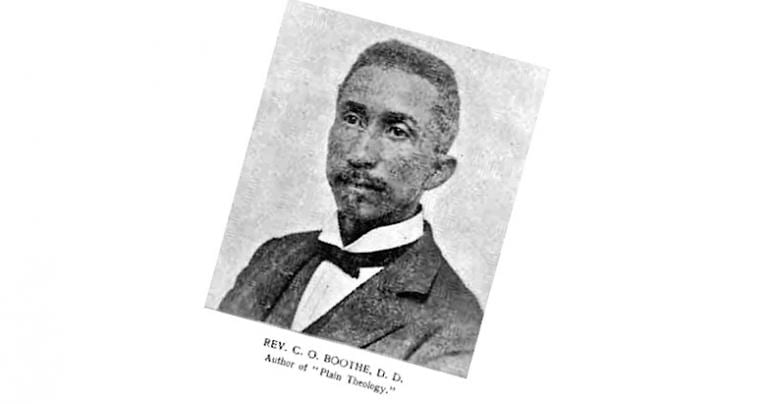 Read The Bible and slavery will die out: it is an abolitionist book. Race based slavery is impossible to a Bible reader without mental disfigurement. You cannot read the entire book and own a man. The slavers knew it and produced a Bible with all those bits removed . . . and there were many of them.
Forget the slavers misuse of Scriptures, instead we can turn to the freedman who knew the Bible was his Bible. Charles Octavius Boothe was born a slave and when free used the Bible and his God-given gifts to bring what he called “uplift” to African-Americans and great gifts to the entire church. His book Plain Theology for Plain People should be read by anyone who wishes to understand the entire story of Evangelical American Christianity. Even if not an Evangelical, all Christians should take the time to follow the ideas of a mind awake and in love with Christ.
For Boothe, the Bible was not instrumental to one good cause, but a ground for knowledge of how to live the good life. He was a man who lived fully in his time, doing good, but not a man of his time, because the Bible lifted him to a higher plane. He entered a great conversation that was, is, and will be as a result of his faithful attempt to understand the text of the books of the Bible.
Reverend Doctor Charles Octavius Boothe was a Bible man. His text is soaked in Scripture, few pages failing to cite long passages to make his argument. He believes he is interpreting what God has revealed in the written Word of God.
Boothe asserts three axioms:
- Humans are moral creatures with a conscience.
- God is Creator, so “his character is the standard of right and wrong.”
- God’s character can only be known by our limited minds if God reveals Himself.
As a result, we would expect God to reveal Himself:
“Maybe,” some one will say, “it is probable that God is hiding his character from his intelligent creatures.” It is out of place for a man who stands in full view of the light of day to say that probably the sun has not risen. But allow the statement that God probably desires to hide his will from man touching man’s moral conduct, and we shall see that we have set him against himself—God against God, the divine government against the divine government. How can he enforce his law against one to whom he has not revealed the law? I speak of intelligent beings.
Here Boothe is talking to Christians in a (mostly) Christian land. He is noting that the idea that the good God would have left us a record to reveal Himself is not surprising. We should anticipate it and when we find it, use this record to go Godward!
Why the Bible? Boothe says “the Bible contains the marks of the Divine mind.” He points to the “simplicity of its records.” The Bible writers speak what they think directly without apology, bluntly what they have seen (“not even removing seeming contradictions”). Boothe points to the fulfillment of prophecy over time. The Bible gets the course of history right over time. We would expect to see Egypt today, but not the Assyrians and so it is.
Dr. Boothe believes most of the Bible points toward Jesus:
Christ appeared in a time that was made ready for him. The dispensation of types and shadows had finished its mission. Its rites and ceremonies were ordained to excite inquiry. They had done this.
Boothe cites Josephus and Tacitus as disinterested witnesses to Jesus Christ and his impact on the world. He points to the nearly unique ability of Christianity to spread to every nation and be understood by them. Christianity could conquer even the Empire of Rome!
Boothe makes a trilemma, but a different one than is often made. He makes a cultural argument for Christianity based on the character of Christians and what Christianity has done:
Before any man can dispute the claims of Christ and Christians, he must prove that the men and women who have given the world its richest blessings are all fools, fanatics, or liars; for the world owes more to Christianity than to all other creeds, and more to Christians than to all other sects among men.
Boothe is in no need of being told Christians have also done bad things. He was capable, as a brilliant man, of looking back over history and seeing what the world would look like without Christ and Christians. He could see what the operation of the Biblical message was over time. He doubles down:
I repeat the statement that every person whose being and character are ennobled by the faith of Jesus Christ is a witness to the authenticity of the New Testament. The doctor can produce no evidences of skill, and leave no praises for his medicines so conclusive, as the health and strength of persons recovered from the power of dangerous diseases. And this wonderful operation of turning sons of sin into sons of righteousness ought to end all controversy as to whether or not Jesus is the Messiah of the Old Testament.
This is a fascinating argument that would have to be unpacked with care. Boothe’s trilemma appears easy to refute, until you consider Boothe and think more deeply!
Boothe notes that God wrote some of the law himself, inspired holy men, and finally came as the Word to inspire the written word. Why? There we learn of God much that would be unknowable without God’s revelation. We find God loves us and is good. We find the “duties and relations of life.”
Boothe was a Bible man and as a result he lived a life of thought, social action, and service to the church. If we are looking for Evangelical heroes or models for own time, perhaps we could begin with any person who is like Charles Octavius Boothe.
—————————————————————-
Plain Theology for Plain People: 1, 2, 3, 4, 5, 6, 7,
Browse Our Archives
Select a Category Apologetics Art Culture Education On Books On Education Philosophy Politics Pop Culture Spiritual Reflections Uncategorized
Select a Month October 2026 September 2026 August 2026 July 2026 July 2025 June 2025 September 2024 July 2024 June 2024 December 2023 June 2023 September 2022 May 2022 April 2022 March 2022 February 2022 July 2021 June 2021 May 2021 April 2021 March 2021 February 2021 January 2021 December 2020 November 2020 October 2020 September 2020 August 2020 July 2020 June 2020 May 2020 April 2020 March 2020 February 2020 January 2020 December 2019 November 2019 October 2019 September 2019 August 2019 July 2019 June 2019 May 2019 April 2019 March 2019 February 2019 January 2019 December 2018 November 2018 October 2018 September 2018 August 2018 July 2018 June 2018 May 2018 April 2018 March 2018 February 2018 January 2018 December 2017 November 2017 October 2017 September 2017 August 2017 July 2017 June 2017 May 2017 April 2017 March 2017 February 2017 January 2017 December 2016 November 2016 October 2016 September 2016 August 2016 July 2016 June 2016 May 2016 April 2016 March 2016 February 2016 January 2016 December 2015 November 2015 October 2015 September 2015 August 2015 July 2015 June 2015 May 2015 April 2015 March 2015 February 2015 January 2015 November 2014 October 2014 September 2014 August 2014 July 2014 June 2014 May 2014 April 2014 March 2014 February 2014 January 2014 December 2013 November 2013 October 2013 September 2013 August 2013 July 2013 June 2013 May 2013 April 2013 March 2013 February 2013 January 2013 December 2012 November 2012 October 2012 September 2012 August 2012 July 2012 June 2012 May 2012
Follow Us!
TAKE THE
Religious Wisdom Quiz
What Christian group is known for singing acapella during worship?
Select your answer to see how you score.
Catholics Churches of Christ Methodists Baptists
Books by This Author John Mark Reynolds
Related posts from Eidos

Classical Education Must Teach Us to Make the...

Classical Education and the Art of Dying Well

Golden, Golden, Golden: My Mother's Last Lesson

TRENDING AT PATHEOS Evangelical

The REST of Your Life: A Creative Wrestles...
This week I had a conversation with a good friend from church....

How the author of the world's best hymn...
I've been working with John Newton for a while now. This makes...

Long before this Lectio Divina, Psalm 130 - the song - started...

What About the Trees? Another Living Parable
After I finished writing the last article about falling leaves as a...

Why Classical Education Is a Conversation, Not a...
Come and Read: Joy in Classical Education When I was a little...

Cornell University has received a great deal of negative publicity and intense...
view all Evangelical blogs
Ad-Free & Subscriber Log-In Subscription Support
- About Us
- 2026 Calendar
- Videos
- Podcasts
- Library of World Religions
- Faith In Media Tracker
- Advertise With Us
- Write for Us
- Privacy Policy
- Terms of Service
- Do Not Sell My Data
- Contact Us
- Radiant Digital
- Manage Newsletter Subscriptions
- Unsubscribe From Notifications
- Sitemap
Copyright 2008-2026, Patheos. All rights reserved.
Subscription Support Ad-Free & Subscriber Log-In
Follow Patheos