
BuddhistCatholicContemplativeEvangelicalGeneral ChristianHinduJewishLatter-day SaintMuslimNew VisionsProgressive Christian
Beliefs
- Buddhist
- Catholic
- Contemplative
- Evangelical
- General Christian
- Hindu
- Jewish
- Latter-day Saint
- More Voices
- Muslim
- New Visions
- Pagan
- Progressive Christian
Topics
- Religion News
- Food and Religion
- Sports and Religion
- Religious Art
- Religious Music and Entertainment
- Religious Events
- History and Religion
- Style and Religion
- Politics and Religion
- Women in Religion
- Recreation Outdoors and Religion
- Business Finance and Religion
- Careers Workplace and Religion
- Education and Religion
- Family Parenting and Religion
- Health Fitness and Religion
- Home and Religion
- Relationships and Religion
- Technology and Religion
- Travel and Religion
Columnists
- Buddhist Columnists
- Business Finance and Religion Columnists
- Careers Workplace and Religion Columnists
- Catholic Columnists
- Contemplative Columnists
- Education and Religion Columnists
- Evangelists Columnists
- Family Parenting and Religion Columnists
- General Christian Columnists
- Health Fitness and Religion Columnists
- Hindu Columnists
- History and Religion Columnists
- Home and Religion Columnists
- Jewish Columnists
- More Voices Columnists
- Latter Day Columnists
- Muslim Columnists
- New Visions Columnists
- Nonreligious Columnists
- Pagan Columnists
- Politics and Religion Columnists
- Progressive Columnists
- Recreation Outdoors and Religion Columnists
- Relationships and Religion Columnists
- Religion News Columnists
- Religious Art Columnists
- Religious Events Columnists
- Religious Music and Entertainment Columnists
- Sports and Religion Columnists
- Style and Religion Columnists
- Technology and Religion Columnists
- Travel and Religion Columnists
- Women in Religion Columnists
Resource Library
- 2026 Calendar
- Library of World Religions
- The 100 Most Holy Places on Earth
- Patheos Answers
- Podcasts
- Videos
- Faith Leaders Database
- Anglican Episcopalian
- Bahai
- Baptist
- Buddhism
- Christianity
- Confucianism
- Eastern Orthodoxy
- Hinduism
- Holiness and Pentecostal
- ISKCON
- Islam
- Judaism
- Lutheran
- Methodist
- The Church of Jesus Christ of Latter-day Saints
- New Age
- Paganism
- Presbytarian and Reformed
- Protestantism
- Religion Behind the Scenes
- Roman Catholic
- Scientology
- Shia Islam
- Sikhism
- Sufism
- Sunni Islam
- Taoism
- Zen
- See all religions
Research Tools
 Ad-Free & Subscriber Log-In Subscription Support
Ad-Free & Subscriber Log-In Subscription Support
Follow Patheos 

- Trending:
- Forgiveness
- |
- Marriage
- |
- Consciousness
- |
- Death Penalty
- |
- Election
- |
- Halloween

- Home
- Evangelical
- Plain Theology for Plain People: On Man (Charles Octavius Boothe 2/9)
Plain Theology for Plain People: On Man (Charles Octavius Boothe 2/9)
Last updated on: February 5, 2019 at 8:04 pm by John Mark N. Reynolds
Plain Theology for Plain People: On Man (Charles Octavius Boothe 2/9) 2019-02-05T20:04:42-04:00 John Mark N. Reynolds
Patheos Explore the world's faith through different perspectives on religion and spirituality! Patheos has the views of the prevalent religions and spiritualities of the world.
 What is a human being?
Our answers will do much to shame society, though our practice will tell us more about what we actually believe. A minority of American Christians persuaded themselves that they could hold to a Christian anthropology and enslave people based on race. In fact, one Baptist, Thomas Dixon, convinced himself that separation of the races and white supremacy were the two most important issues of the era.
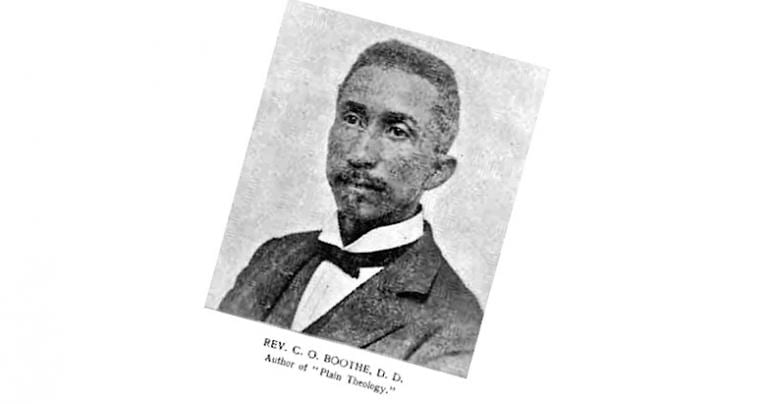
Against this was the majority of global Christianity, but a most powerful exposition of that majority view, the equal humanity of all persons, came from the liberated. Dr C.O. Boothe had been born into a slave system and was part of African-Americans liberating themselves from that system. When he wrote about the doctrine of man, he was writing about ideas that had power to set people free if all those in America who professed to believe them acted according to their beliefs.
He also wanted the plain people (his language) to be introduced to a systematic theology. A person with a Bible has great resources, yet the collection does not present ideas in a systematic manner. There are many genre (poetry, Wisdom literature, ancient forms of history, epistles, apocalypse) and this is a strength. The messages of God to humankind come in stories, proverbs, poems, and letters. The people of God, over time and with great intellectual effort, also found the common themes and great truths of Scripture. What might be unclear in one book (for example, the common humanity of all people) is very plain in another. Boothe gives us an outline with illustrations that help organize the great truths of Christianity that span multiple books.
Left to myself, I can find favorite themes and get stuck on those while ignoring other important ideas. One reason I read other voices or books outside my normal teaching load is that this helps me avoid such narrowing down. A sweeping overview of theology such as this one helps me see the whole picture. Boothe’s insistence on a minimum of theological vocabulary and rejection of any jargon is refreshing.
Boothe is writing at the start of what can properly be called Evangelicalism and since I write (as an Orthodox person) as a guest in the Patheos section of that great tradition, since so many of my students and colleagues are Evangelical, a reminder of the roots and perspectives of the best of the movement is most helpful! As media and news reporters struggle to define “Evangelical” in America, Rev. Dr. Charles Octavius Boothe should be required reading. For Evangelicals, and those of us who are allies, we must assert the fact that people like Boothe were there from the start and must be heard as they were heard by many tens of thousands of Evangelicals in America.
Boothe discusses the race question in this section, by which he means the human race. The brilliance of using the term “race,” the undermining of the Dixon line, in his discussion of being human and the common nature of each individual man is delightful and demolishes racialism without mentioning the cancer. Browne asserts Christian doctrine, ideas that many Protestant seminaries at the time affirmed, about man, yet these very ideas were denied in practice by some of those seminaries.
“There is no respect of persons with God. As many as have sinned without law shall perish without law; and as many as have sinned in the law shall be judged by the law” (Romans 2:11, 12; Ephesians 2:1–3).
This is an exposition of the Christian view of man, fully in the Evangelical mainstream. Dr. Browne sketches out what Christians should know advancing his ministry on his terms. Interestingly, Browne agrees with many Eastern Fathers in seeing man created as an “infant” with the potential for moral greatness. Adam fell not from the dizzying heights of a perfected man, but stumbled from the road that would have brought him there.
God wanted Adam to become a free moral agent:
I know that no sane man will contend that God should not have put man under command. Some one may ask why God left Adam. To this I reply that the only act that has any personal virtue in it is the act that is born of the intelligent, deliberate, obedient choice of the actor; and the act that is performed only because of the presence of another has in it no virtuous character at all.
Men must consent and choose for themselves or they are being deprived of the ability to grow into the fullness of manhood.
Boothe structures the text apologetically. He states a truth, briefly explains, then answers common objections. “Here it may be asked. . . ” followed by “Replying to this, I would say . . .” Boothe demonstrates the doctrine of man with his approach to teaching the doctrine of man. He respects his audience, gives them the truth, and then parries objections looking for mature consent.
When it comes to man, to us, Boothe sees us choosing badly: corporately and individually. We are broken, but Boothe sees hope in Christ.
———————————————————–
Boothe, Charles Octavius. Plain Theology for Plain People (Lexham Classics) . Lexham Press. Kindle Edition.
Browse Our Archives
Select a Category Apologetics Art Culture Education On Books On Education Philosophy Politics Pop Culture Spiritual Reflections Uncategorized
Select a Month October 2026 September 2026 August 2026 July 2026 July 2025 June 2025 September 2024 July 2024 June 2024 December 2023 June 2023 September 2022 May 2022 April 2022 March 2022 February 2022 July 2021 June 2021 May 2021 April 2021 March 2021 February 2021 January 2021 December 2020 November 2020 October 2020 September 2020 August 2020 July 2020 June 2020 May 2020 April 2020 March 2020 February 2020 January 2020 December 2019 November 2019 October 2019 September 2019 August 2019 July 2019 June 2019 May 2019 April 2019 March 2019 February 2019 January 2019 December 2018 November 2018 October 2018 September 2018 August 2018 July 2018 June 2018 May 2018 April 2018 March 2018 February 2018 January 2018 December 2017 November 2017 October 2017 September 2017 August 2017 July 2017 June 2017 May 2017 April 2017 March 2017 February 2017 January 2017 December 2016 November 2016 October 2016 September 2016 August 2016 July 2016 June 2016 May 2016 April 2016 March 2016 February 2016 January 2016 December 2015 November 2015 October 2015 September 2015 August 2015 July 2015 June 2015 May 2015 April 2015 March 2015 February 2015 January 2015 November 2014 October 2014 September 2014 August 2014 July 2014 June 2014 May 2014 April 2014 March 2014 February 2014 January 2014 December 2013 November 2013 October 2013 September 2013 August 2013 July 2013 June 2013 May 2013 April 2013 March 2013 February 2013 January 2013 December 2012 November 2012 October 2012 September 2012 August 2012 July 2012 June 2012 May 2012
Follow Us!
TAKE THE
Religious Wisdom Quiz
What does "Christ" mean in Greek?
Select your answer to see how you score.
Chosen One Lord of Lords Savior Anointed One
Books by This Author John Mark Reynolds
Related posts from Eidos

Why Classical Education Is a Conversation, Not a...

Does Classical Education Belong Only to the West?

Classical Education Must Teach Us to Make the...

Rooted: Why Classical Education Needs Community
TRENDING AT PATHEOS Evangelical

The REST of Your Life: A Creative Wrestles...
This week I had a conversation with a good friend from church....

How the author of the world's best hymn...
I've been working with John Newton for a while now. This makes...

Long before this Lectio Divina, Psalm 130 - the song - started...

What About the Trees? Another Living Parable
After I finished writing the last article about falling leaves as a...

Why Classical Education Is a Conversation, Not a...
Come and Read: Joy in Classical Education When I was a little...

Cornell University has received a great deal of negative publicity and intense...
view all Evangelical blogs
Ad-Free & Subscriber Log-In Subscription Support
- About Us
- 2026 Calendar
- Videos
- Podcasts
- Library of World Religions
- Faith In Media Tracker
- Advertise With Us
- Write for Us
- Privacy Policy
- Terms of Service
- Do Not Sell My Data
- Contact Us
- Radiant Digital
- Manage Newsletter Subscriptions
- Unsubscribe From Notifications
- Sitemap
Copyright 2008-2026, Patheos. All rights reserved.
Subscription Support Ad-Free & Subscriber Log-In
Follow Patheos