
BuddhistCatholicContemplativeEvangelicalGeneral ChristianHinduJewishLatter-day SaintMuslimNew VisionsProgressive Christian
Beliefs
- Buddhist
- Catholic
- Contemplative
- Evangelical
- General Christian
- Hindu
- Jewish
- Latter-day Saint
- More Voices
- Muslim
- New Visions
- Pagan
- Progressive Christian
Topics
- Religion News
- Food and Religion
- Sports and Religion
- Religious Art
- Religious Music and Entertainment
- Religious Events
- History and Religion
- Style and Religion
- Politics and Religion
- Women in Religion
- Recreation Outdoors and Religion
- Business Finance and Religion
- Careers Workplace and Religion
- Education and Religion
- Family Parenting and Religion
- Health Fitness and Religion
- Home and Religion
- Relationships and Religion
- Technology and Religion
- Travel and Religion
Columnists
- Buddhist Columnists
- Business Finance and Religion Columnists
- Careers Workplace and Religion Columnists
- Catholic Columnists
- Contemplative Columnists
- Education and Religion Columnists
- Evangelists Columnists
- Family Parenting and Religion Columnists
- General Christian Columnists
- Health Fitness and Religion Columnists
- Hindu Columnists
- History and Religion Columnists
- Home and Religion Columnists
- Jewish Columnists
- More Voices Columnists
- Latter Day Columnists
- Muslim Columnists
- New Visions Columnists
- Nonreligious Columnists
- Pagan Columnists
- Politics and Religion Columnists
- Progressive Columnists
- Recreation Outdoors and Religion Columnists
- Relationships and Religion Columnists
- Religion News Columnists
- Religious Art Columnists
- Religious Events Columnists
- Religious Music and Entertainment Columnists
- Sports and Religion Columnists
- Style and Religion Columnists
- Technology and Religion Columnists
- Travel and Religion Columnists
- Women in Religion Columnists
Resource Library
- 2026 Calendar
- Library of World Religions
- The 100 Most Holy Places on Earth
- Patheos Answers
- Podcasts
- Videos
- Faith Leaders Database
- Anglican Episcopalian
- Bahai
- Baptist
- Buddhism
- Christianity
- Confucianism
- Eastern Orthodoxy
- Hinduism
- Holiness and Pentecostal
- ISKCON
- Islam
- Judaism
- Lutheran
- Methodist
- The Church of Jesus Christ of Latter-day Saints
- New Age
- Paganism
- Presbytarian and Reformed
- Protestantism
- Religion Behind the Scenes
- Roman Catholic
- Scientology
- Shia Islam
- Sikhism
- Sufism
- Sunni Islam
- Taoism
- Zen
- See all religions
Research Tools
 Ad-Free & Subscriber Log-In Subscription Support
Ad-Free & Subscriber Log-In Subscription Support
Follow Patheos 

- Trending:
- Forgiveness
- |
- Marriage
- |
- Consciousness
- |
- Death Penalty
- |
- Election
- |
- Halloween

- Home
- Evangelical
- Plain Theology for Plain People- How Christians Should Live and Labor (Charles Octavius Boothe 6/9)
Plain Theology for Plain People- How Christians Should Live and Labor (Charles Octavius Boothe 6/9)
Last updated on: February 11, 2019 at 11:36 pm by John Mark N. Reynolds
Plain Theology for Plain People- How Christians Should Live and Labor (Charles Octavius Boothe 6/9) 2019-02-11T23:36:46-04:00 John Mark N. Reynolds
Patheos Explore the world's faith through different perspectives on religion and spirituality! Patheos has the views of the prevalent religions and spiritualities of the world.
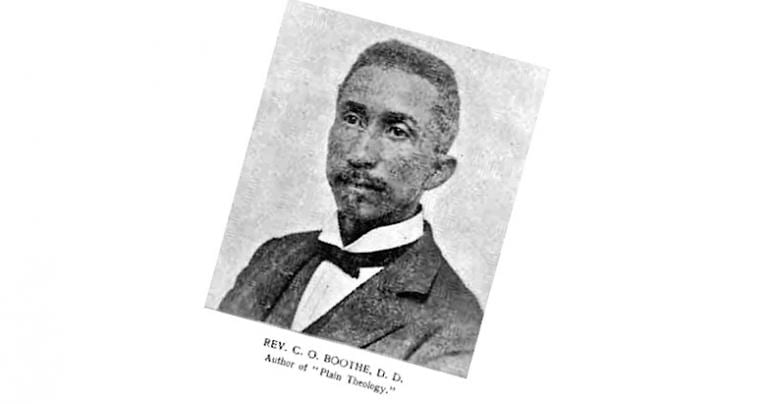 Charles Octavius Boothe lived at a moment in American history where living as a Christian should live meant persecution. If he sought justice and loved mercy, he might be murdered by terrorist organizations. Despite this, Reverend Boothe lived an active Christian life seeking what he called “uplift” for African-Americans coming out of slavery into a world of Jim Crow.
His Plain Theology for Plain People is directed at the hundreds of thousands of African-Americans looking for an education in the Christian faith. As a work of theology, a forerunner to the best of Evangelical thought, it rivals R.A. Torrey for clarity and demonstrates a vital root to the growth of traditional, Bible centered forms of Protestantism as opposed to theological liberalism coming into favor in many seminaries.
Combining concision and passion is hard to do, but Boothe does this while using an apologetic style in most sections that is very appealing. He often will present an idea, objections, and then respond. While his particular expression of Christianity is not one I share, there was much to learn from Boothe both as an American Christian and as a mere Christian!
Boothe turns from God, creation, and redemption:
We now come to ask what his people are to do day by day so long as they live in this world.
The former enslaved man does not hesitate to say:
This means that they do not want to be their own, but really desire to belong now and forever to Christ; that they are glad to take him for their Lord and Master, and are ready to spend and be spent in his service. The faithful servant will, of course, be found asking day by day, “Lord, what wilt thou have me to do?” He should always remember that he will most glorify God by doing promptly, diligently, and faithfully what God wants him to do.
This is powerful and undercuts the notion that slavery could endure in a consistent Christian nation. A Christian is Christ’s and cannot owe the total allegiance of a servant to any other state, person, or ideology. We serve the good, true, beautiful God who can be trusted as He created us and liberates us.
We express this service to Christ alone first in baptism. Boothe makes a strong case of the obedience to Christ by baptism through immersion in water. This is doing “just exactly what he tells us.”
Second, Boothe points the believer to Christian fellowship. It is “both needful and natural for believers to unite themselves in churches. They are of one family, of one mind, of one spirit, of one hope.” We express our unity in one cup, the Lord’s Supper.
The believers act to “edify one another:”
… upon “every one of us”—that is, on all the members of “the body of Christ,” Christ has conferred some gift that is profitable for the building up of the church. This is his “house.”
Boothe repeats several times that everyone, each Christian, has a role and gift in building up God’s house:
Let every one keep fixed in mind the thought, “I am called by the blessed Jesus to help in building up his glorious house,” and seek daily grace and help, so that he may build wisely and rapidly!
This should have undercut Jim Crow and segregation in the lives of any church consistently living out plain theology. Of course, this social justice would have just been an outer sign of inner sanctification, holiness, that Boothe knows is the final aim of a lived faith. While the outside may be clean and the inside rotten, few times is the outside wicked and the inside sanctified. The failure of unity and peace in our gatherings reflects our lack of the Holy Spirit.
Boothe knows that out of this unity we must “seek and save the lost.” We will share what we live and know when we can. The Christian is missional, spreading the good news globally, and supporting this message with his prayers and money, if not his entire life.
All of our witness must spring from “a pure and spotless Christian life.” Who can deny that failure to do as Boothe shows us the Bible teaches continues to mar our testimony? He turns to the Sermon on the Mount first as the source of a holy or pure Christian life. He points to charity, meekness, mercy, purity, peacemaking as the signs of sanctity.
The Christian life is love. We love God and the love of God, if real, makes hatred of our brothers and sisters impossible. Why is the church powerless? We fail to love. Boothe ends with words for his time and for now:
What a power the believers in Christ will be in this world, where such multitudes are hateful and hating one another, when they all come to abound in deep, pure, fervent love to God and to their neighbors! How they will be stimulated to labor and give and pray for the gathering of every creature in the world into the fold of Christ, when they love God the Father, the Son, and the Holy Spirit, “with all their heart, and soul, and might, and mind, and strength,” and really and truly love their neighbor as themselves! An increase of such love will be accompanied by a vast increase of missionary zeal and enterprise; and not long would it be before there will be, “Great voices in heaven, saying, The kingdoms of this world have become the kingdoms of our Lord and of his Christ; and he shall reign for ever and ever” (Revelation 11:15).
——————————————————–
Boothe, Charles Octavius. Plain Theology for Plain People (Lexham Classics) . Lexham Press. Kindle Edition.
Plain Theology for Plain People: 1, 2, 3, 4, 5, 6,
Next Post
February 9, 2019 Plain Theology for Plain People- The Bible (Charles Octavius Boothe 7/9)
Browse Our Archives
Select a Category Apologetics Art Culture Education On Books On Education Philosophy Politics Pop Culture Spiritual Reflections Uncategorized
Select a Month October 2026 September 2026 August 2026 July 2026 July 2025 June 2025 September 2024 July 2024 June 2024 December 2023 June 2023 September 2022 May 2022 April 2022 March 2022 February 2022 July 2021 June 2021 May 2021 April 2021 March 2021 February 2021 January 2021 December 2020 November 2020 October 2020 September 2020 August 2020 July 2020 June 2020 May 2020 April 2020 March 2020 February 2020 January 2020 December 2019 November 2019 October 2019 September 2019 August 2019 July 2019 June 2019 May 2019 April 2019 March 2019 February 2019 January 2019 December 2018 November 2018 October 2018 September 2018 August 2018 July 2018 June 2018 May 2018 April 2018 March 2018 February 2018 January 2018 December 2017 November 2017 October 2017 September 2017 August 2017 July 2017 June 2017 May 2017 April 2017 March 2017 February 2017 January 2017 December 2016 November 2016 October 2016 September 2016 August 2016 July 2016 June 2016 May 2016 April 2016 March 2016 February 2016 January 2016 December 2015 November 2015 October 2015 September 2015 August 2015 July 2015 June 2015 May 2015 April 2015 March 2015 February 2015 January 2015 November 2014 October 2014 September 2014 August 2014 July 2014 June 2014 May 2014 April 2014 March 2014 February 2014 January 2014 December 2013 November 2013 October 2013 September 2013 August 2013 July 2013 June 2013 May 2013 April 2013 March 2013 February 2013 January 2013 December 2012 November 2012 October 2012 September 2012 August 2012 July 2012 June 2012 May 2012
Follow Us!
TAKE THE
Religious Wisdom Quiz
Who was Ruth's first husband?
Select your answer to see how you score.
Elimelech Mahlon Boaz Chilion
Books by This Author John Mark Reynolds
Related posts from Eidos

Classical Education Must Teach Us to Make the...

Classical Education and the Art of Dying Well

Golden, Golden, Golden: My Mother's Last Lesson

TRENDING AT PATHEOS Evangelical

The REST of Your Life: A Creative Wrestles...
This week I had a conversation with a good friend from church....

How the author of the world's best hymn...
I've been working with John Newton for a while now. This makes...

Long before this Lectio Divina, Psalm 130 - the song - started...

What About the Trees? Another Living Parable
After I finished writing the last article about falling leaves as a...

Why Classical Education Is a Conversation, Not a...
Come and Read: Joy in Classical Education When I was a little...

Cornell University has received a great deal of negative publicity and intense...
view all Evangelical blogs
Ad-Free & Subscriber Log-In Subscription Support
- About Us
- 2026 Calendar
- Videos
- Podcasts
- Library of World Religions
- Faith In Media Tracker
- Advertise With Us
- Write for Us
- Privacy Policy
- Terms of Service
- Do Not Sell My Data
- Contact Us
- Radiant Digital
- Manage Newsletter Subscriptions
- Unsubscribe From Notifications
- Sitemap
Copyright 2008-2026, Patheos. All rights reserved.
Subscription Support Ad-Free & Subscriber Log-In
Follow Patheos