
BuddhistCatholicContemplativeEvangelicalGeneral ChristianHinduJewishLatter-day SaintMuslimNew VisionsProgressive Christian
Beliefs
- Buddhist
- Catholic
- Contemplative
- Evangelical
- General Christian
- Hindu
- Jewish
- Latter-day Saint
- More Voices
- Muslim
- New Visions
- Pagan
- Progressive Christian
Topics
- Religion News
- Food and Religion
- Sports and Religion
- Religious Art
- Religious Music and Entertainment
- Religious Events
- History and Religion
- Style and Religion
- Politics and Religion
- Women in Religion
- Recreation Outdoors and Religion
- Business Finance and Religion
- Careers Workplace and Religion
- Education and Religion
- Family Parenting and Religion
- Health Fitness and Religion
- Home and Religion
- Relationships and Religion
- Technology and Religion
- Travel and Religion
Columnists
- Buddhist Columnists
- Business Finance and Religion Columnists
- Careers Workplace and Religion Columnists
- Catholic Columnists
- Contemplative Columnists
- Education and Religion Columnists
- Evangelists Columnists
- Family Parenting and Religion Columnists
- General Christian Columnists
- Health Fitness and Religion Columnists
- Hindu Columnists
- History and Religion Columnists
- Home and Religion Columnists
- Jewish Columnists
- More Voices Columnists
- Latter Day Columnists
- Muslim Columnists
- New Visions Columnists
- Nonreligious Columnists
- Pagan Columnists
- Politics and Religion Columnists
- Progressive Columnists
- Recreation Outdoors and Religion Columnists
- Relationships and Religion Columnists
- Religion News Columnists
- Religious Art Columnists
- Religious Events Columnists
- Religious Music and Entertainment Columnists
- Sports and Religion Columnists
- Style and Religion Columnists
- Technology and Religion Columnists
- Travel and Religion Columnists
- Women in Religion Columnists
Resource Library
- 2026 Calendar
- Library of World Religions
- The 100 Most Holy Places on Earth
- Patheos Answers
- Podcasts
- Videos
- Faith Leaders Database
- Anglican Episcopalian
- Bahai
- Baptist
- Buddhism
- Christianity
- Confucianism
- Eastern Orthodoxy
- Hinduism
- Holiness and Pentecostal
- ISKCON
- Islam
- Judaism
- Lutheran
- Methodist
- The Church of Jesus Christ of Latter-day Saints
- New Age
- Paganism
- Presbytarian and Reformed
- Protestantism
- Religion Behind the Scenes
- Roman Catholic
- Scientology
- Shia Islam
- Sikhism
- Sufism
- Sunni Islam
- Taoism
- Zen
- See all religions
Research Tools
 Ad-Free & Subscriber Log-In Subscription Support
Ad-Free & Subscriber Log-In Subscription Support
Follow Patheos 

- Trending:
- Forgiveness
- |
- Marriage
- |
- Consciousness
- |
- Death Penalty
- |
- Election
- |
- Halloween

- Home
- Evangelical
- Plain Theology for Plain People: Being and Character of God (Charles Octavius Boothe 1/9)
Plain Theology for Plain People: Being and Character of God (Charles Octavius Boothe 1/9)
Last updated on: February 5, 2019 at 7:55 pm by John Mark N. Reynolds
Plain Theology for Plain People: Being and Character of God (Charles Octavius Boothe 1/9) 2019-02-05T19:55:01-04:00 John Mark N. Reynolds
Patheos Explore the world's faith through different perspectives on religion and spirituality! Patheos has the views of the prevalent religions and spiritualities of the world.
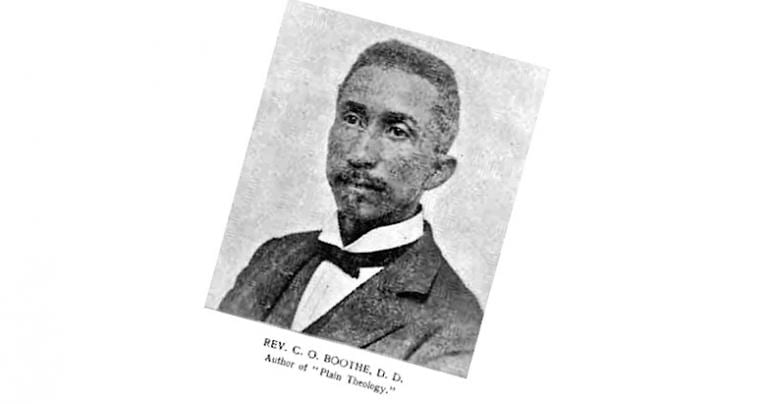 Specialists develop professional language to shorten conversations with each other and to achieve precision in complicated arguments. Gone wrong, however, this can turn into jargon where things that could be said simply and precisely in plain English are made obscure, often so the speaker can bloviate without fear of contradiction.
Sometimes those of us who are lay readers of theology find writers that needlessly complicate (Tillich), leaving us the suspicion there is little sound to the noise ration, but there are also dense writers (Barth) that have so much to say that a technical vocabulary is necessary to keep a long exposition from becoming even longer.
Thank God for thoughtful expositors who lay out the main ideas of Christianity, plain theology, for plain people. God bless them. One of the best is Charles Ocavius Boothe (1845-1924) whose theology is orthodox, but whose perspective was shaped by being enslaved and then liberated. He approaches the being and character of God with a different perspective from a rough contemporary like the Yalie RA Torrey. Evangelicalism was born in the work of Torrey and Boothe. Their commonality is great, but differences are also interesting: orthodoxy in different voices. Here is the voice of Saint Paul in II Corinthians 6: 1-10:
We then, as workers together with him, beseech you also that ye receive not the grace of God in vain. (For he saith, I have heard thee in a time accepted, and in the day of salvation have I succoured thee: behold, now is the accepted time; behold, now is the day of salvation.) Giving no offence in any thing, that the ministry be not blamed: But in all things approving ourselves as the ministers of God, in much patience, in afflictions, in necessities, in distresses, In stripes, in imprisonments, in tumults, in labours, in watchings, in fastings; By pureness, by knowledge, by long suffering, by kindness, by the Holy Ghost, by love unfeigned, By the word of truth, by the power of God, by the armour of righteousness on the right hand and on the left, By honour and dishonour, by evil report and good report: as deceivers, and yet true; As unknown, and yet well known; as dying, and, behold, we live; as chastened, and not killed; As sorrowful, yet alway rejoicing; as poor, yet making many rich; as having nothing, and yet possessing all things.
As a Western person who has joined an Eastern church, hearing how the same doctrine expressed differently is my life: fascinating and illuminating. The truth is easier to see from many perspectives and voices. Writing to sharecroppers or others hungry for the truth but cut off from formal education, Boothe gave himself the task to speak the truth beautifully and faithfully. Just the task shows that the intellectual snobbery that says such doctrines are unnecessary to the “less educated” is a lie. Everyone who loves God wants to know about God, because every person in love wishes to know the Beloved. Nobody wants to love badly through ignorance.
Doctrine is for everyone who loves God known through Jesus. The Bible was a liberation as slavers knew. This is why they created a slave Bible: the whole Word of God was dangerous. Let a bright young man read and he would change the world:
As a teenager, Boothe worked as a clerk at a local law firm. He explored Scripture on a regular basis, because mid-nineteenth-century legal practice was rooted in biblical logic.
Boothe begins with the being and character of God and surpasses Torrey in his clarity. This is a wordsmith, making the rough places plain, not an anti-intellectual:
These remarks are by no means intended as criticisms upon theologians or upon the theological works extant. All the writer means to say is this: There are people who live on a plain so far beneath the mental heights of these works as to be unable to reach up to them and enjoy their spiritual blessings. For these people there come to us calls for the preparation of special works—calls which, in the name of Christ, we must try to answer.
He says:
Before the charge “know thyself,” ought to come the far greater charge, “know thy God.” But, though the study of the being and character of God is a duty which we dare not disregard, still, let us not be unmindful of the fact that we vile, short-sighted worms should approach the solemn task of studying God with feelings of humility and awe. God is found of the lowly, but hides himself from the proud and self-sufficient man. When Daniel fasted and prayed and made confession of sin, the secrets of the Lord were unfolded to his view.
Socrates assumed something he should not have that Christian thinkers like Boothe saw: knowing self, knowing one’s cosmic place, and beginning with First Causes, First Being: God. Boothe moves from Creator to Divine Providence quickly and makes a distinction that would save many budding apologists from mistakes:
The vulgar will call it luck, unbelievers will call it chance, but deep down in each heart there remains the feeling that in verity there are more things in heaven and earth than are dreamed of in common philosophy. . . . For whether we are manly enough to confess it or not, we all, at times, feel with Shakespeare—“There is a divinity that shapes our ends, Rough-hew them how we will.” Let it not be forgotten that I am contending that then.
There is such a thing as a general as well as a special providence; there is the supervision of the works of creation, especially of the intelligent creation.
A people being hindered by a tyrannical majority could appeal to the moral law found in Scripture:
This law demands that men shall worship God and love one another, neither of which principles have origin in the depraved nature of man.
Boothe is Bible centered, as he should be. Whatever our tradition, the Bible is the universal fountain freely available to all. No stream is independent from the Bible and because the text endures, error by way of unwise innovation is made more difficult. All truth is compatible with the Sacred Scriptures or it is not truth. Boothe brings the plain people the plain truth of Scripture.
Even in Trinity, hard to explain in plain language, Boothe finds Bible teaching:
Here I speak with rather more fear than usual, and yet I speak; for the holy book has spoken before me. The doctrine declared here is that God, who is one in substance and one in character, exists in three persons, the Father, the Son, and the Holy Spirit. I would observe that this doctrine is revealed to us in the Sacred Scriptures.
He is careful enough not just to argue his case, but to point out where dissent exists. Perhaps, the use of “we” in Genesis when God creates is a hint of the Trinity, but perhaps not. Boothe gives the truth, plain truth, without covering up all the “maybe” that exists at the margins.
Boothe gives his plain reader an overview of the nature of God that can be filled in for the rest of the life of the reader and student. That’s hard to do and he does it well.
Previous Post

February 2, 2019
The Hindered Hand (Sutton Griggs)
Next Post
February 4, 2019 Plain Theology for Plain People: On Man (Charles Octavius Boothe 2/9)
Browse Our Archives
Select a Category Apologetics Art Culture Education On Books On Education Philosophy Politics Pop Culture Spiritual Reflections Uncategorized
Select a Month October 2026 September 2026 August 2026 July 2026 July 2025 June 2025 September 2024 July 2024 June 2024 December 2023 June 2023 September 2022 May 2022 April 2022 March 2022 February 2022 July 2021 June 2021 May 2021 April 2021 March 2021 February 2021 January 2021 December 2020 November 2020 October 2020 September 2020 August 2020 July 2020 June 2020 May 2020 April 2020 March 2020 February 2020 January 2020 December 2019 November 2019 October 2019 September 2019 August 2019 July 2019 June 2019 May 2019 April 2019 March 2019 February 2019 January 2019 December 2018 November 2018 October 2018 September 2018 August 2018 July 2018 June 2018 May 2018 April 2018 March 2018 February 2018 January 2018 December 2017 November 2017 October 2017 September 2017 August 2017 July 2017 June 2017 May 2017 April 2017 March 2017 February 2017 January 2017 December 2016 November 2016 October 2016 September 2016 August 2016 July 2016 June 2016 May 2016 April 2016 March 2016 February 2016 January 2016 December 2015 November 2015 October 2015 September 2015 August 2015 July 2015 June 2015 May 2015 April 2015 March 2015 February 2015 January 2015 November 2014 October 2014 September 2014 August 2014 July 2014 June 2014 May 2014 April 2014 March 2014 February 2014 January 2014 December 2013 November 2013 October 2013 September 2013 August 2013 July 2013 June 2013 May 2013 April 2013 March 2013 February 2013 January 2013 December 2012 November 2012 October 2012 September 2012 August 2012 July 2012 June 2012 May 2012
Follow Us!
TAKE THE
Religious Wisdom Quiz
What was the name of the sea that Moses parted?
Select your answer to see how you score.
Red Sea Dead Sea Sea of Galilee Jordan River
Books by This Author John Mark Reynolds
Related posts from Eidos

Classical Education Must Teach Us to Make the...

Yet I Love Her: History and the Church


The Iceberg is There: Verbosity Cannot Defeat Reality
TRENDING AT PATHEOS Evangelical

The REST of Your Life: A Creative Wrestles...
This week I had a conversation with a good friend from church....

How the author of the world's best hymn...
I've been working with John Newton for a while now. This makes...

Long before this Lectio Divina, Psalm 130 - the song - started...

What About the Trees? Another Living Parable
After I finished writing the last article about falling leaves as a...

Why Classical Education Is a Conversation, Not a...
Come and Read: Joy in Classical Education When I was a little...

Cornell University has received a great deal of negative publicity and intense...
view all Evangelical blogs
Ad-Free & Subscriber Log-In Subscription Support
- About Us
- 2026 Calendar
- Videos
- Podcasts
- Library of World Religions
- Faith In Media Tracker
- Advertise With Us
- Write for Us
- Privacy Policy
- Terms of Service
- Do Not Sell My Data
- Contact Us
- Radiant Digital
- Manage Newsletter Subscriptions
- Unsubscribe From Notifications
- Sitemap
Copyright 2008-2026, Patheos. All rights reserved.
Subscription Support Ad-Free & Subscriber Log-In
Follow Patheos