
BuddhistCatholicContemplativeEvangelicalGeneral ChristianHinduJewishLatter-day SaintMuslimNew VisionsProgressive Christian
Beliefs
- Buddhist
- Catholic
- Contemplative
- Evangelical
- General Christian
- Hindu
- Jewish
- Latter-day Saint
- More Voices
- Muslim
- New Visions
- Pagan
- Progressive Christian
Topics
- Religion News
- Food and Religion
- Sports and Religion
- Religious Art
- Religious Music and Entertainment
- Religious Events
- History and Religion
- Style and Religion
- Politics and Religion
- Women in Religion
- Recreation Outdoors and Religion
- Business Finance and Religion
- Careers Workplace and Religion
- Education and Religion
- Family Parenting and Religion
- Health Fitness and Religion
- Home and Religion
- Relationships and Religion
- Technology and Religion
- Travel and Religion
Columnists
- Buddhist Columnists
- Business Finance and Religion Columnists
- Careers Workplace and Religion Columnists
- Catholic Columnists
- Contemplative Columnists
- Education and Religion Columnists
- Evangelists Columnists
- Family Parenting and Religion Columnists
- General Christian Columnists
- Health Fitness and Religion Columnists
- Hindu Columnists
- History and Religion Columnists
- Home and Religion Columnists
- Jewish Columnists
- More Voices Columnists
- Latter Day Columnists
- Muslim Columnists
- New Visions Columnists
- Nonreligious Columnists
- Pagan Columnists
- Politics and Religion Columnists
- Progressive Columnists
- Recreation Outdoors and Religion Columnists
- Relationships and Religion Columnists
- Religion News Columnists
- Religious Art Columnists
- Religious Events Columnists
- Religious Music and Entertainment Columnists
- Sports and Religion Columnists
- Style and Religion Columnists
- Technology and Religion Columnists
- Travel and Religion Columnists
- Women in Religion Columnists
Resource Library
- 2026 Calendar
- Library of World Religions
- The 100 Most Holy Places on Earth
- Patheos Answers
- Podcasts
- Videos
- Faith Leaders Database
- Anglican Episcopalian
- Bahai
- Baptist
- Buddhism
- Christianity
- Confucianism
- Eastern Orthodoxy
- Hinduism
- Holiness and Pentecostal
- ISKCON
- Islam
- Judaism
- Lutheran
- Methodist
- The Church of Jesus Christ of Latter-day Saints
- New Age
- Paganism
- Presbytarian and Reformed
- Protestantism
- Religion Behind the Scenes
- Roman Catholic
- Scientology
- Shia Islam
- Sikhism
- Sufism
- Sunni Islam
- Taoism
- Zen
- See all religions
Research Tools
 Ad-Free & Subscriber Log-In Subscription Support
Ad-Free & Subscriber Log-In Subscription Support
Follow Patheos 

- Trending:
- Forgiveness
- |
- Marriage
- |
- Consciousness
- |
- Death Penalty
- |
- Election
- |
- Halloween

- Home
- Evangelical
- Hey! Almost every Bible has important information some of us miss.
Hey! Almost every Bible has important information some of us miss.
Last updated on: January 16, 2019 at 2:22 pm by John Mark N. Reynolds
Hey! Almost every Bible has important information some of us miss. 2019-01-16T14:22:21-04:00 John Mark N. Reynolds
Patheos Explore the world's faith through different perspectives on religion and spirituality! Patheos has the views of the prevalent religions and spiritualities of the world.
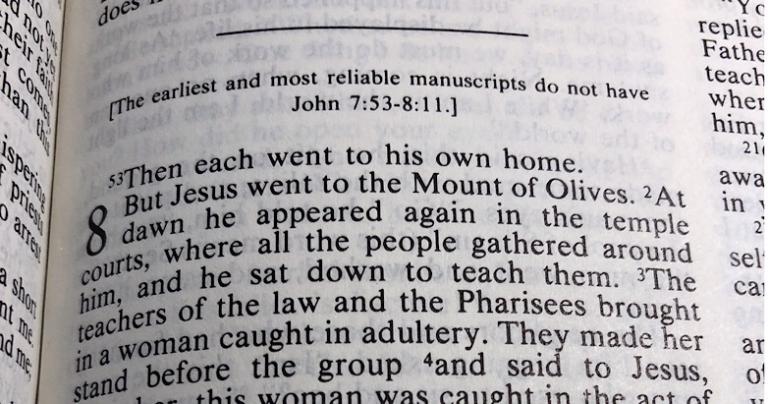
This is a Bible I used as a teenager. Note that textual problems and work are mentioned!
Knowing how to read old books is hard work. Harder still is the work scholars do to make old works in other languages ready for us to read. Scholars translated the books of the Bible for us from such ancient manuscripts and I am in awe at the work they do.
I am happy I get to see some of that work every time I read the English Bible (or even the Greek text).*
A great thing about almost every English Bible is that the translators have shown us some of the science and art of translating an old book.
If you are reading the Gospel of John, for example, almost every Bible on my shelf of translations (all but one pew Bible) will point out that the “woman caught in adultery” story does not appear in the earliest manuscripts of John.
What do you make of that? Talk about it if you care, but notice that nobody is hiding the “problem” from you. Most Bibles will point out alternative readings for passages or tell you where the translators have made a choice that was contentious to the group of translators.
What the Bible is for
This openness is an important strength of the vast majority of Christian groups. No significant group of Christians thinks there is an untainted, perfect copy of any Bible book. Why didn’t God preserve one?
That’s an interesting question, but begin asking with the fact that if you thought there was one perfect Bible copy, your own copy of the Bible was telling you that you had misunderstood the Bible and the function of that text in the Church.
This is not putting down the role of the Bible in Christian life, God forbid! Instead, it is reminding us of what we all know: God so loved the world, God sent His Son. He did not preserve a single original written record of that coming.
This is not news. Those of us who are lay readers of the books of the Bible knew it because we have always been shown it in our Bibles.
The “problem” of John 8
If one looks at the books of the New Testament, even a layperson discovers that we have complete copies as early as the fourth century. Compared to other ancient books such as Plato, my own specialty, that is very close in time to the autograph. We have fragments—though not complete books—of Scripture dating as early as thirty years of the original. We have important Church figures quoting the books of the Bible from very early in Church history.
No reasonable person thinks that we do not have what the original authors wrote. This is not based on religious belief, dogma, but on the same science and scholarship of ancient manuscripts used in every ancient book.
Take a book like the Gospel of John. It is a whole and there is little doubt that whoever wrote it, wrote about sixty years after Jesus died. Why? We have a complete manuscript relatively close in time to the autograph, a fragment of the Gospel (matching the text) from thirty years after the Gospel was written, and many references to and fragments of the text between the time of the earliest fragment and the complete Gospel.
Imagine, however, that a modern Bible contained a bit not found in the ancient copies or not supported by the fragments. We don’t have to imagine this situation, because that is the story of the woman caught in adultery in John 8. Unlike the rest of the text, there is not a good reason to think the story was in the original version of the Gospel. That’s why it is bracketed. Scholars debate the status of the story, but for the layperson, the safe bet is to not base too much on this disputable account by itself.
Notice that the end of the Gospel of Mark is this way as well. Your Bible has always told you so.
Don’t make this mistake
There is one utterly shoddy argument that nobody should make: early fragments that match the text do not confirm the whole, but only themselves! Instead, when you have a whole that reads as a whole and scholars find earlier fragments, and these fragments agree with the passage that exists in the whole, then this is taken to confirm the very high likelihood we have the text as it was written. John 8 and the end of Mark show that this does not always lead to positive results for stories or passages!
When I was working on Plato’s view of the human soul, there were problematic passages in Timaeus that were difficult to square with other things Plato wrote. “What if,” I thought, “they were not in the original?” After all, our manuscript tradition for Timaeus is much weaker than for the Gospels. My advisor rightly stopped that sort of foolish thinking.
The Timaeus is a whole and our manuscript is well attested with numerous citations as early as Plato’s student Aristotle. Just because one particular passage is cited much later in time does not mean I should doubt it was in the original text.
How to know when the text is authentic
Now, if an entire section, like the story of Atlantis, had been missing from all ancient fragments or references, this would begin to be grounds for challenging the section (just like the woman caught in adultery) as in the original—though the book’s smooth transitions would make even that argument difficult to sustain. The fact that a particular line or section in the whole is attested later is interesting to observe and might tell us something about what ancient commentators found interesting, but does nothing to challenge the place of the passage in the book.
Some scholars, due to theories they had about the development of Plato’s ideas, tried to date the text as coming in the middle years of his career instead of being one of his last books. That has mostly failed as the ancient testimony puts it near the end of his life. Notice, however, that overwhelmingly what scholars did not do is to simply dismiss the troubling passages (to their ideas about Plato) as interpolations. There was no good reason to do so.
In the case of the New Testament, a scholar might disagree with Paul in his arguments in Romans, but we know, almost surely, what he wrote. On top of ancient fragments that confirm the text, we have citations in other ancient books that confirm that the text we have is accurate. Go read I Clement where he cites Pauline epistles. Where scholars are not sure, a good English Bible will let you know. This year try delving into the “helps” of your English Bible and learn the nature of the text we have!
—————————————
*Any of the Greek texts (classical, Christian, or later) in my office are based on the hard work of scholars who give me (in Greek) the closest thing they can to the original. It is not translated (good news!), but is not just “what Paul or Plato said.” This is obvious from the textual variants.
Here is a general rule: the more manuscripts (evidence) we have, the more variants there will be. Up to a point, having more notes about alternatives is a sign of strength. Sadly, a book like Timaeus, for example, has a very limited textual tradition and so fewer notes.
Rachel Motte edited this essay and added the sub-headings.
Previous Post

January 14, 2019
You Can Go Home Again
Next Post
January 16, 2019 Ignore Anyone Who Ignores Early Bible Translations
Browse Our Archives
Select a Category Apologetics Art Culture Education On Books On Education Philosophy Politics Pop Culture Spiritual Reflections Uncategorized
Select a Month October 2026 September 2026 August 2026 July 2026 July 2025 June 2025 September 2024 July 2024 June 2024 December 2023 June 2023 September 2022 May 2022 April 2022 March 2022 February 2022 July 2021 June 2021 May 2021 April 2021 March 2021 February 2021 January 2021 December 2020 November 2020 October 2020 September 2020 August 2020 July 2020 June 2020 May 2020 April 2020 March 2020 February 2020 January 2020 December 2019 November 2019 October 2019 September 2019 August 2019 July 2019 June 2019 May 2019 April 2019 March 2019 February 2019 January 2019 December 2018 November 2018 October 2018 September 2018 August 2018 July 2018 June 2018 May 2018 April 2018 March 2018 February 2018 January 2018 December 2017 November 2017 October 2017 September 2017 August 2017 July 2017 June 2017 May 2017 April 2017 March 2017 February 2017 January 2017 December 2016 November 2016 October 2016 September 2016 August 2016 July 2016 June 2016 May 2016 April 2016 March 2016 February 2016 January 2016 December 2015 November 2015 October 2015 September 2015 August 2015 July 2015 June 2015 May 2015 April 2015 March 2015 February 2015 January 2015 November 2014 October 2014 September 2014 August 2014 July 2014 June 2014 May 2014 April 2014 March 2014 February 2014 January 2014 December 2013 November 2013 October 2013 September 2013 August 2013 July 2013 June 2013 May 2013 April 2013 March 2013 February 2013 January 2013 December 2012 November 2012 October 2012 September 2012 August 2012 July 2012 June 2012 May 2012
Follow Us!
TAKE THE
Religious Wisdom Quiz
Who was the scribe and priest that led a second group back to Jerusalem?
Select your answer to see how you score.
Zerubbabel Ezra Mordecai Nehemiah
Books by This Author John Mark Reynolds
Related posts from Eidos

Classical Education Must Teach Us to Make the...

Classical Education and the Art of Dying Well

Golden, Golden, Golden: My Mother's Last Lesson

TRENDING AT PATHEOS Evangelical

The REST of Your Life: A Creative Wrestles...
This week I had a conversation with a good friend from church....

How the author of the world's best hymn...
I've been working with John Newton for a while now. This makes...

Long before this Lectio Divina, Psalm 130 - the song - started...

What About the Trees? Another Living Parable
After I finished writing the last article about falling leaves as a...

Why Classical Education Is a Conversation, Not a...
Come and Read: Joy in Classical Education When I was a little...

Cornell University has received a great deal of negative publicity and intense...
view all Evangelical blogs
Ad-Free & Subscriber Log-In Subscription Support
- About Us
- 2026 Calendar
- Videos
- Podcasts
- Library of World Religions
- Faith In Media Tracker
- Advertise With Us
- Write for Us
- Privacy Policy
- Terms of Service
- Do Not Sell My Data
- Contact Us
- Radiant Digital
- Manage Newsletter Subscriptions
- Unsubscribe From Notifications
- Sitemap
Copyright 2008-2026, Patheos. All rights reserved.
Subscription Support Ad-Free & Subscriber Log-In
Follow Patheos