
BuddhistCatholicContemplativeEvangelicalGeneral ChristianHinduJewishLatter-day SaintMuslimNew VisionsProgressive Christian
Beliefs
- Buddhist
- Catholic
- Contemplative
- Evangelical
- General Christian
- Hindu
- Jewish
- Latter-day Saint
- More Voices
- Muslim
- New Visions
- Pagan
- Progressive Christian
Topics
- Religion News
- Food and Religion
- Sports and Religion
- Religious Art
- Religious Music and Entertainment
- Religious Events
- History and Religion
- Style and Religion
- Politics and Religion
- Women in Religion
- Recreation Outdoors and Religion
- Business Finance and Religion
- Careers Workplace and Religion
- Education and Religion
- Family Parenting and Religion
- Health Fitness and Religion
- Home and Religion
- Relationships and Religion
- Technology and Religion
- Travel and Religion
Columnists
- Buddhist Columnists
- Business Finance and Religion Columnists
- Careers Workplace and Religion Columnists
- Catholic Columnists
- Contemplative Columnists
- Education and Religion Columnists
- Evangelists Columnists
- Family Parenting and Religion Columnists
- General Christian Columnists
- Health Fitness and Religion Columnists
- Hindu Columnists
- History and Religion Columnists
- Home and Religion Columnists
- Jewish Columnists
- More Voices Columnists
- Latter Day Columnists
- Muslim Columnists
- New Visions Columnists
- Nonreligious Columnists
- Pagan Columnists
- Politics and Religion Columnists
- Progressive Columnists
- Recreation Outdoors and Religion Columnists
- Relationships and Religion Columnists
- Religion News Columnists
- Religious Art Columnists
- Religious Events Columnists
- Religious Music and Entertainment Columnists
- Sports and Religion Columnists
- Style and Religion Columnists
- Technology and Religion Columnists
- Travel and Religion Columnists
- Women in Religion Columnists
Resource Library
- 2026 Calendar
- Library of World Religions
- The 100 Most Holy Places on Earth
- Patheos Answers
- Podcasts
- Videos
- Faith Leaders Database
- Anglican Episcopalian
- Bahai
- Baptist
- Buddhism
- Christianity
- Confucianism
- Eastern Orthodoxy
- Hinduism
- Holiness and Pentecostal
- ISKCON
- Islam
- Judaism
- Lutheran
- Methodist
- The Church of Jesus Christ of Latter-day Saints
- New Age
- Paganism
- Presbytarian and Reformed
- Protestantism
- Religion Behind the Scenes
- Roman Catholic
- Scientology
- Shia Islam
- Sikhism
- Sufism
- Sunni Islam
- Taoism
- Zen
- See all religions
Research Tools
 Ad-Free & Subscriber Log-In Subscription Support
Ad-Free & Subscriber Log-In Subscription Support
Follow Patheos 

- Trending:
- Forgiveness
- |
- Marriage
- |
- Consciousness
- |
- Death Penalty
- |
- Election
- |
- Halloween

- Home
- Evangelical
- Don’t you want to be free? Black Thunder and the Question for Our Time (Arna Bontemps)
Don’t you want to be free? Black Thunder and the Question for Our Time (Arna Bontemps)
Last updated on: November 6, 2018 at 7:23 pm by John Mark N. Reynolds
Don’t you want to be free? Black Thunder and the Question for Our Time (Arna Bontemps) 2018-11-06T19:23:29-04:00 John Mark N. Reynolds
Patheos Explore the world's faith through different perspectives on religion and spirituality! Patheos has the views of the prevalent religions and spiritualities of the world.
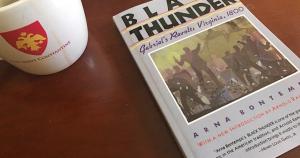 “Don’t you want to be free?”
That’s the question the enslaved people of the United States ask in Black Thunder, a novel that should be read by anyone who cares about the answer to the question.
Arna Bontemps, a product of Christian education and the Harlam Renaissance, was bold enough to write a novel where powerful African-Americans said: “Yes.”
He wrote in 1936 Los Angeles, Watts, when the Civil Rights movement was still thirty years away. Bontemps wanted to be free, even when those who should have proclaimed liberty were too cautious to do more than mutter moderation.
The novel is based on an actual rebellion of enslaved people in Virginia that came tantalizingly close to repeating the amazing liberation of Haiti from slave culture. The battle for freedom failed, the weather, if not the stars in their courses, wiped out any chance for success. A once a century rainstorm saved the slavocrats for a few more decades, a chance to repent before the apocalpyse, or if in the hardness of their hearts, they doubled down on tyranny so the judgment of the good God could be even more fierce.
Bontemps’ created a hero from the history knowing history killed him, false victory of tyrants. The doom was coming as Lincoln expressed:
Fondly do we hope, fervently do we pray, that this mighty scourge of war may speedily pass away. Yet, if God wills that it continue until all the wealth piled by the bondsman’s two hundred and fifty years of unrequited toil shall be sunk, and until every drop of blood drawn with the lash shall be paid by another drawn with the sword, as was said three thousand years ago, so still it must be said “the judgments of the Lord are true and righteous altogether.
Gabriel, the hero of the novel, is fleshed out from the too little that history recalls of this freedom fighter by Arna Bontemps. Most of the characters are complex, though the women are less successful as fully realized humans than the men. This is novel of men created in the image of God refusing to be less than God made them.
An Injured Man, but a Man
The voices of the novel are almost entirely of the African-Americans who wanted to be free to death, some who wanted freedom, but were afraid of the cost. This is just, because the story of slavey is the story of people who were born free, but were put in chains by the sin of American slavery.
The enslaved are not portrayed as perfect, they are men not angels. The slavers are not devils, they also are just bad when they might have been good. The critical fact is the enslaved were men and once the brave people of Haiti gained freedom, the game of race based slavery was over. Napoleon lost to black men before he lost to Wellington.
The enslaved men put fear in the hearts of even a genius like James Madison, governor of Virginia, at the time. How could this be? Madison was, in many ways, a great man, but Gabriel, the slave revolutionary, reduced him.
As a slaver, Madison became less than a man as any man is who would be a tyrant. Plato knew it.
The slavocrats, especially the revolutionaries like Jefferson and Monroe, were utterly inconsistent. They said all men were created equal, but then denied that God had given the right to liberty to millions of men. The inconsistency stank and undercut the glory of the American Revolution as surely as the Terror destroyed the glory of France.
One white man in the novel puts it this way:
”I can well understand how men’s startled consciences make cowards of them. They recognize in the Negro a dangerous man, because they recognize in him an injured one.”
This is true, as far as it goes. What the white men in the novel cannot see is that the injury is not where the power and strength comes. Instead, it is the manly nature of the strong, black man Gabriel and those like him that gives strength.
The white man is guilty, Gabriel is a man. That’s enough.
Anyone Will Want to Be Free
Do you want to be free?
That was the question then to each one of us. Those waiting to be made free will never be free. Those like Frederick Douglass or Arna Botemps cannot be slaves, because they will to be free.
The slavocrats could not enslave Douglass, the Great Depression could not keep Bontemps down. The church let Bontemps down and he left, but the deep truths of the faith never left Bontemps.
He kept proclaiming liberty, not just throughout the land, but in the hardest place of all: in his own soul. Bontemps would not settle for anything less than freedom.
Bontemps was a novelist, poet, children’s author, and scholar. White American Christians gave him education, jobs, but would not give him freedom. When the Depression came, liberals in New York abandoned the Harlem Renaissance. Yet when Bontemps began intellectual exploration, the Christians he knew were not able to allow his soul liberty.
Yet Bontemps did not cease from mental fight. He was free and he lived just long enough to see better days. The job is not done. The question is still asked to all of us: Do you want to be free?
There is another question implicit to those who have power: Do you want us to be free?
There can be no stability, no justice, until all God’s children are free.
God help us all.
Next Post
November 7, 2018 Will Ye No Come Back Again: The Longing for Absent Leaders
Browse Our Archives
Select a Category Apologetics Art Culture Education On Books On Education Philosophy Politics Pop Culture Spiritual Reflections Uncategorized
Select a Month October 2026 September 2026 August 2026 July 2026 July 2025 June 2025 September 2024 July 2024 June 2024 December 2023 June 2023 September 2022 May 2022 April 2022 March 2022 February 2022 July 2021 June 2021 May 2021 April 2021 March 2021 February 2021 January 2021 December 2020 November 2020 October 2020 September 2020 August 2020 July 2020 June 2020 May 2020 April 2020 March 2020 February 2020 January 2020 December 2019 November 2019 October 2019 September 2019 August 2019 July 2019 June 2019 May 2019 April 2019 March 2019 February 2019 January 2019 December 2018 November 2018 October 2018 September 2018 August 2018 July 2018 June 2018 May 2018 April 2018 March 2018 February 2018 January 2018 December 2017 November 2017 October 2017 September 2017 August 2017 July 2017 June 2017 May 2017 April 2017 March 2017 February 2017 January 2017 December 2016 November 2016 October 2016 September 2016 August 2016 July 2016 June 2016 May 2016 April 2016 March 2016 February 2016 January 2016 December 2015 November 2015 October 2015 September 2015 August 2015 July 2015 June 2015 May 2015 April 2015 March 2015 February 2015 January 2015 November 2014 October 2014 September 2014 August 2014 July 2014 June 2014 May 2014 April 2014 March 2014 February 2014 January 2014 December 2013 November 2013 October 2013 September 2013 August 2013 July 2013 June 2013 May 2013 April 2013 March 2013 February 2013 January 2013 December 2012 November 2012 October 2012 September 2012 August 2012 July 2012 June 2012 May 2012
Follow Us!
TAKE THE
Religious Wisdom Quiz
Who said, "Though he slay me, yet will I hope in him"?
Select your answer to see how you score.
David Job Peter Isaiah
Books by This Author John Mark Reynolds
Related posts from Eidos

Classical Education Must Teach Us to Make the...

Yet I Love Her: History and the Church


The Iceberg is There: Verbosity Cannot Defeat Reality
TRENDING AT PATHEOS Evangelical

The REST of Your Life: A Creative Wrestles...
This week I had a conversation with a good friend from church....

How the author of the world's best hymn...
I've been working with John Newton for a while now. This makes...

Long before this Lectio Divina, Psalm 130 - the song - started...

What About the Trees? Another Living Parable
After I finished writing the last article about falling leaves as a...

Why Classical Education Is a Conversation, Not a...
Come and Read: Joy in Classical Education When I was a little...

Cornell University has received a great deal of negative publicity and intense...
view all Evangelical blogs
Ad-Free & Subscriber Log-In Subscription Support
- About Us
- 2026 Calendar
- Videos
- Podcasts
- Library of World Religions
- Faith In Media Tracker
- Advertise With Us
- Write for Us
- Privacy Policy
- Terms of Service
- Do Not Sell My Data
- Contact Us
- Radiant Digital
- Manage Newsletter Subscriptions
- Unsubscribe From Notifications
- Sitemap
Copyright 2008-2026, Patheos. All rights reserved.
Subscription Support Ad-Free & Subscriber Log-In
Follow Patheos