
BuddhistCatholicContemplativeEvangelicalGeneral ChristianHinduJewishLatter-day SaintMuslimNew VisionsProgressive Christian
Beliefs
- Buddhist
- Catholic
- Contemplative
- Evangelical
- General Christian
- Hindu
- Jewish
- Latter-day Saint
- More Voices
- Muslim
- New Visions
- Pagan
- Progressive Christian
Topics
- Religion News
- Food and Religion
- Sports and Religion
- Religious Art
- Religious Music and Entertainment
- Religious Events
- History and Religion
- Style and Religion
- Politics and Religion
- Women in Religion
- Recreation Outdoors and Religion
- Business Finance and Religion
- Careers Workplace and Religion
- Education and Religion
- Family Parenting and Religion
- Health Fitness and Religion
- Home and Religion
- Relationships and Religion
- Technology and Religion
- Travel and Religion
Columnists
- Buddhist Columnists
- Business Finance and Religion Columnists
- Careers Workplace and Religion Columnists
- Catholic Columnists
- Contemplative Columnists
- Education and Religion Columnists
- Evangelists Columnists
- Family Parenting and Religion Columnists
- General Christian Columnists
- Health Fitness and Religion Columnists
- Hindu Columnists
- History and Religion Columnists
- Home and Religion Columnists
- Jewish Columnists
- More Voices Columnists
- Latter Day Columnists
- Muslim Columnists
- New Visions Columnists
- Nonreligious Columnists
- Pagan Columnists
- Politics and Religion Columnists
- Progressive Columnists
- Recreation Outdoors and Religion Columnists
- Relationships and Religion Columnists
- Religion News Columnists
- Religious Art Columnists
- Religious Events Columnists
- Religious Music and Entertainment Columnists
- Sports and Religion Columnists
- Style and Religion Columnists
- Technology and Religion Columnists
- Travel and Religion Columnists
- Women in Religion Columnists
Resource Library
- 2026 Calendar
- Library of World Religions
- The 100 Most Holy Places on Earth
- Patheos Answers
- Podcasts
- Videos
- Faith Leaders Database
- Anglican Episcopalian
- Bahai
- Baptist
- Buddhism
- Christianity
- Confucianism
- Eastern Orthodoxy
- Hinduism
- Holiness and Pentecostal
- ISKCON
- Islam
- Judaism
- Lutheran
- Methodist
- The Church of Jesus Christ of Latter-day Saints
- New Age
- Paganism
- Presbytarian and Reformed
- Protestantism
- Religion Behind the Scenes
- Roman Catholic
- Scientology
- Shia Islam
- Sikhism
- Sufism
- Sunni Islam
- Taoism
- Zen
- See all religions
Research Tools
 Ad-Free & Subscriber Log-In Subscription Support
Ad-Free & Subscriber Log-In Subscription Support
Follow Patheos 

- Trending:
- Forgiveness
- |
- Marriage
- |
- Consciousness
- |
- Death Penalty
- |
- Election
- |
- Halloween

- Home
- Evangelical
- Reality so Grim, Buffering Seems Good (Reading Alan Noble as a Distracted Me 3/8)
Reality so Grim, Buffering Seems Good (Reading Alan Noble as a Distracted Me 3/8)
Last updated on: October 7, 2018 at 6:22 pm by John Mark N. Reynolds
Reality so Grim, Buffering Seems Good (Reading Alan Noble as a Distracted Me 3/8) 2018-10-07T18:22:44-04:00 John Mark N. Reynolds
Patheos Explore the world's faith through different perspectives on religion and spirituality! Patheos has the views of the prevalent religions and spiritualities of the world.
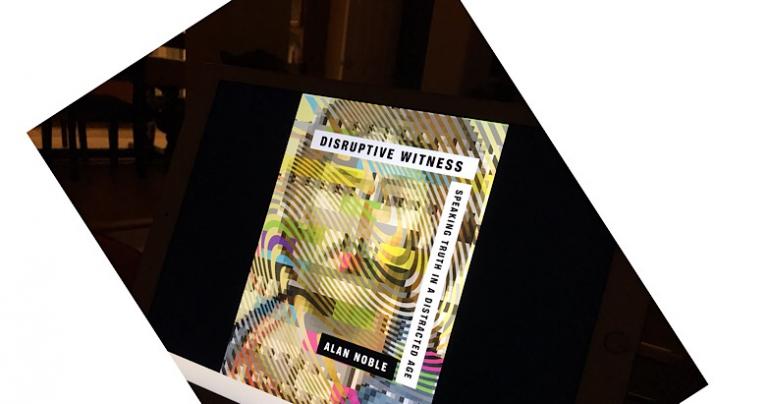 Alan Noble has written a book to give us hope in distracted times. Too much distraction, perhaps, causes us to lose hope, because it presents the worst of us to us. The result is a sense that redemption is not possible, mercy is missing, and grace has been replaced by the mic drop moment.
What is that feeling?
God help me, every day the news seems worse. People are wretched and I lack the faith that I am better. Who that is sane does? We are somehow, someway getting more foolish every day. We must look outside self for hope, but when we we look, we find hucksters selling us stuff. Jesus is Lord, but just now Paradise seems distant. Yet part of my problem, and Professor Alan Jacobs gets this, is that technology, media, and plain old busyiness buffers me from what is.
Imagine that what we should do is know who we are, really are, but we live in a culture designed to distract us, because product must be sold. The person who knows self will not need products to create an image. If I could know myself, then nothing external to me will ever be necessary for my happiness. I will be safe from a changing world, since my interests are what is and what I need, not what some company says I need.
God help us to never exist, distracted by edutainment, as a means to a tyrant’s ends. Instead, we are beautiful souls created in the image of God made to be liberated. We choose, because we are children of God.
Alan Noble tries to help us to live, to speak, in a more secular age. He does not mean we are atheistic:
By secularism I don’t mean “atheism,” although atheism plays a role here. Instead, I’m using the term as defined by the Canadian Catholic philosopher Charles Taylor, who has argued that we live in a “secular age,” which differs from the past not in that most people do not believe in God but that not believing in God is a live option: “The shift to secularity in this sense consists, among other things, of a move from a society where belief in God is unchallenged and indeed, unproblematic, to one in which it is understood to be one option among others, and frequently not the easiest to embrace.” 1 In the secular age, all sorts of beliefs are live options. The one truth we accept about belief in our secular age is that there is an endless number of options, and all of them are contested. In addition, our understanding of these beliefs tends to be more “fragile” than beliefs held in the past. 2 Whereas people traditionally kept the beliefs of their parents and community, today it is normal and even expected for each contemporary individual in the West to choose their own, personal beliefs. And it is common for people to change beliefs multiple times over their lives.
This is worrisome as secularism is merely to have live options and to explore them over the course of life. While this is difficult, this seems good and the very essence of the Faith. One can choose Christianity or choose something other than Christianity: there is a reason Aquinas wrote against the gentiles.
We are tolerant enough, most centuries, to have faced wobbly beliefs before now.
The difference is, as Noble eloquently argues, that just now we are distracted. We have been tempted by (let’s say) spiritualism in the nineteenth century. “Let’s invite the Rev. Vale Owens to our parish to do a seance!” ) Syrian Christians have been tempted by Islam and Catholicism for centuries. We have always had options and the just have lived by faith, not certainty, we kept going forward. Yet now we are not interested in arguments, evidence, or reason, we just choose and too often we are not going anywhere.
Have we shifted the balance too far from doing in both our internal world and the external world to merely be focusing on the internal? Choice is critical, but perhaps that first strip in doing has replaced completing the tasks.
What would this mean?
Our choice is suffient. Our truth is our truth, even if our truth is what reality would call stupid. We are distracted from deep thought . . . And this distraction allows us to treat the culturally shallow hedonism of our time as serious. The man who could not produce and cannot understand the culture he exploits and the rules he demands be modified is unserious, but in a distracted age the serious are losers.
The winners in an age of distraction are less secular than grazers . . .shallow men repeating what they have heard, once, in some seminar, sometimes, back when they were in class in some college. As Noble says:
A lack of reflection makes it easier for us to hold contradictory beliefs, but now we see that our secular age contributes to this condition by leveling beliefs.
Yes.
Professor Noble is correct: we do profess trust in reason, but are too distracted to learn to think logically. We call reason our God, the divine Logos comes, but we are apathetic in worship. Logic is rigorous and we are latitudinarian to the core when it comes to our intellectual habits.
We are secular if secular means isolated from the community of the dilectic, mentally lazy and factually fuzzy. If secular means “makes me feel rainbow goodness” and do not “disturb my preferred narrative” then we are secular, but this is similar to being badly educated. I wonder, Professor Noble, if a buffered self is one kept from the hard rigor of logic or experience.
Just when reality might bite, we binge our way through The Good Place. We see this in the religious as well as the atheist. Noble’s buffering happens to us all. If as Noble claims, the Englightenment and Reformation made us morally responsible to find the truth for ourselves, then everyone must be a philosopher. This is Utopian in the extreme, but we have undercut authority. We know we don’t know and we know we have not invested the time, so:
Being open-minded, refusing to draw conclusions, the idea that diversity of belief is a good unto itself—these are all results of a fundamental shift in our basic beliefs about the world. Thus, we aspire to be noncommittal.
Somebody may be right, but who can know?
Noble points out that this leads to signaling belief being more important than arguing for or practicing our belief:
Our focus shifts away from practicing our beliefs to signaling our beliefs to ourselves and others. In a world where all beliefs are possible, our attention turns to contending about beliefs, and the terms and conditions of those beliefs matter less, except as fodder.
Many of our beliefs are thin, Noble suggests, lightly adopted, fiercely defended, but not considered. We have others that are thick, deeply embedded in our thought and behavior, but the thick and thin are jumbled together.
Perhaps it is too offensive to say, but how is this different from our being merely shallow and badly educated? We adopt (as Noble says) an attitude or position and then defend it knowing we might be wrong, but most interested in seeming an ok person to our circle of friends.
We are so sincere, the Great Pumpkin surely will choose our pumpkin patch. Our views identify “us” not truth. Professor Noble isn’t the simplest solution that we have decided we are all intellectuals, capable of developing a world view, when we are not? We dismiss the “package” of Rome, Constantinople, Geneva, or some other well thought out set of ideas, but then are incapable or unwilling to do the work of developing a set of coherent thick and thin ideas to which we will submit.
Professor Noble rightly lacerates the lazy “world view” thinking in some Christian circles that parodies the opponent and explains too much. Instead, of presenting intellectually rich packages from which to choose, these shallow men make the choice easy by presenting parodies versus the preferred “Christian” option.
Noble says:
James K. A. Smith has demonstrated that traditional worldview studies overemphasize rational, intentional, and cognitive beliefs over the way habits shape our desires.
I would be curious to know where Professor Smith demonstrates any such thing with rigor. Smith says things like this, but a footnote to an argument would be nice here. We certainly should not overemphasize rational, intentional, and cognitive beliefs , but what exactly will that look like?
We are, Noble suggests, living in an immanent framing of reality that makes the transcendent possible, but only as an exception to the very human reality. Here I demure: is this true of most Pentecostal Christians? Is it true of most people? Many students live as if demons and angels are at war in their world. They over divinize what happens to them. In fact, within a few miles of my house here in Houston there are far more churches seeing too many miracles, than there are churches seeing too little of God’s action.
I wonder if Noble is not living in a bubble, academic, a touch-anti-analytic in philosophy, and fairly well off. Yet Noble is on to something and there are millions who live in this world he describes.
Noble brilliantly states the bottom line:
Talking about Christ’s death and resurrection for our sins is categorically different than talking about the importance of conservative politics or the pleasure of some musical album. But if we are born into a culture that sees belief as first a performance of identity and thus something we can easily slip on or off, then it’s only natural that when we share the gospel we will be inclined to treat it as a performance of our identity.
Buy the book.
_______________________
Alan Noble is the “co-founder and editor in chief of Christ and Pop Culture.” If you are not reading Christ and Pop Culture and you are interested in Christ and/or Pop Culture, then bad. Go and subscribe.
I am slow reading his new book. Part 1, Part 2, Part 3,
Previous Post
October 3, 2018
Save Me From Silence (Reading Alan Noble as a Distracted Me 2/8)
Next Post
October 5, 2018 Visions of Truth (Reading Alan Noble as a Distracted Me 4/8)
Browse Our Archives
Select a Category Apologetics Art Culture Education On Books On Education Philosophy Politics Pop Culture Spiritual Reflections Uncategorized
Select a Month October 2026 September 2026 August 2026 July 2026 July 2025 June 2025 September 2024 July 2024 June 2024 December 2023 June 2023 September 2022 May 2022 April 2022 March 2022 February 2022 July 2021 June 2021 May 2021 April 2021 March 2021 February 2021 January 2021 December 2020 November 2020 October 2020 September 2020 August 2020 July 2020 June 2020 May 2020 April 2020 March 2020 February 2020 January 2020 December 2019 November 2019 October 2019 September 2019 August 2019 July 2019 June 2019 May 2019 April 2019 March 2019 February 2019 January 2019 December 2018 November 2018 October 2018 September 2018 August 2018 July 2018 June 2018 May 2018 April 2018 March 2018 February 2018 January 2018 December 2017 November 2017 October 2017 September 2017 August 2017 July 2017 June 2017 May 2017 April 2017 March 2017 February 2017 January 2017 December 2016 November 2016 October 2016 September 2016 August 2016 July 2016 June 2016 May 2016 April 2016 March 2016 February 2016 January 2016 December 2015 November 2015 October 2015 September 2015 August 2015 July 2015 June 2015 May 2015 April 2015 March 2015 February 2015 January 2015 November 2014 October 2014 September 2014 August 2014 July 2014 June 2014 May 2014 April 2014 March 2014 February 2014 January 2014 December 2013 November 2013 October 2013 September 2013 August 2013 July 2013 June 2013 May 2013 April 2013 March 2013 February 2013 January 2013 December 2012 November 2012 October 2012 September 2012 August 2012 July 2012 June 2012 May 2012
Follow Us!
TAKE THE
Religious Wisdom Quiz
What does "Jesus" name mean?
Select your answer to see how you score.
Anointed one God saves Savior Messiah
Books by This Author John Mark Reynolds
Related posts from Eidos

Classical Education Must Teach Us to Make the...

Classical Education and the Art of Dying Well

Golden, Golden, Golden: My Mother's Last Lesson

TRENDING AT PATHEOS Evangelical

The REST of Your Life: A Creative Wrestles...
This week I had a conversation with a good friend from church....

How the author of the world's best hymn...
I've been working with John Newton for a while now. This makes...

Long before this Lectio Divina, Psalm 130 - the song - started...

What About the Trees? Another Living Parable
After I finished writing the last article about falling leaves as a...

Why Classical Education Is a Conversation, Not a...
Come and Read: Joy in Classical Education When I was a little...

Cornell University has received a great deal of negative publicity and intense...
view all Evangelical blogs
Ad-Free & Subscriber Log-In Subscription Support
- About Us
- 2026 Calendar
- Videos
- Podcasts
- Library of World Religions
- Faith In Media Tracker
- Advertise With Us
- Write for Us
- Privacy Policy
- Terms of Service
- Do Not Sell My Data
- Contact Us
- Radiant Digital
- Manage Newsletter Subscriptions
- Unsubscribe From Notifications
- Sitemap
Copyright 2008-2026, Patheos. All rights reserved.
Subscription Support Ad-Free & Subscriber Log-In
Follow Patheos