
BuddhistCatholicContemplativeEvangelicalGeneral ChristianHinduJewishLatter-day SaintMuslimNew VisionsProgressive Christian
Beliefs
- Buddhist
- Catholic
- Contemplative
- Evangelical
- General Christian
- Hindu
- Jewish
- Latter-day Saint
- More Voices
- Muslim
- New Visions
- Pagan
- Progressive Christian
Topics
- Religion News
- Food and Religion
- Sports and Religion
- Religious Art
- Religious Music and Entertainment
- Religious Events
- History and Religion
- Style and Religion
- Politics and Religion
- Women in Religion
- Recreation Outdoors and Religion
- Business Finance and Religion
- Careers Workplace and Religion
- Education and Religion
- Family Parenting and Religion
- Health Fitness and Religion
- Home and Religion
- Relationships and Religion
- Technology and Religion
- Travel and Religion
Columnists
- Buddhist Columnists
- Business Finance and Religion Columnists
- Careers Workplace and Religion Columnists
- Catholic Columnists
- Contemplative Columnists
- Education and Religion Columnists
- Evangelists Columnists
- Family Parenting and Religion Columnists
- General Christian Columnists
- Health Fitness and Religion Columnists
- Hindu Columnists
- History and Religion Columnists
- Home and Religion Columnists
- Jewish Columnists
- More Voices Columnists
- Latter Day Columnists
- Muslim Columnists
- New Visions Columnists
- Nonreligious Columnists
- Pagan Columnists
- Politics and Religion Columnists
- Progressive Columnists
- Recreation Outdoors and Religion Columnists
- Relationships and Religion Columnists
- Religion News Columnists
- Religious Art Columnists
- Religious Events Columnists
- Religious Music and Entertainment Columnists
- Sports and Religion Columnists
- Style and Religion Columnists
- Technology and Religion Columnists
- Travel and Religion Columnists
- Women in Religion Columnists
Resource Library
- 2026 Calendar
- Library of World Religions
- The 100 Most Holy Places on Earth
- Patheos Answers
- Podcasts
- Videos
- Faith Leaders Database
- Anglican Episcopalian
- Bahai
- Baptist
- Buddhism
- Christianity
- Confucianism
- Eastern Orthodoxy
- Hinduism
- Holiness and Pentecostal
- ISKCON
- Islam
- Judaism
- Lutheran
- Methodist
- The Church of Jesus Christ of Latter-day Saints
- New Age
- Paganism
- Presbytarian and Reformed
- Protestantism
- Religion Behind the Scenes
- Roman Catholic
- Scientology
- Shia Islam
- Sikhism
- Sufism
- Sunni Islam
- Taoism
- Zen
- See all religions
Research Tools
 Ad-Free & Subscriber Log-In Subscription Support
Ad-Free & Subscriber Log-In Subscription Support
Follow Patheos 

- Trending:
- Forgiveness
- |
- Marriage
- |
- Consciousness
- |
- Death Penalty
- |
- Election
- |
- Halloween

- Home
- Evangelical
- Disruptive Church (Reading Alan Noble as a Distracted Me 6/8)
Disruptive Church (Reading Alan Noble as a Distracted Me 6/8)
Last updated on: October 9, 2018 at 10:07 pm by John Mark N. Reynolds
Disruptive Church (Reading Alan Noble as a Distracted Me 6/8) 2018-10-09T22:07:49-04:00 John Mark N. Reynolds
Patheos Explore the world's faith through different perspectives on religion and spirituality! Patheos has the views of the prevalent religions and spiritualities of the world.
I go to a Church that tweaks the liturgy every few centuries, whether it needs it or not. We are not old-fashioned, just persistent to the point of puckishness. We have not yet capitulated to the Visigoths, let alone “secular conceptions of faith as a personal lifestyle preference.” We have resisted Lenin and radical forms of Islam all in the last fifty years. One can meet the survivors every Sunday!
We persist and merely persisting seems disruptive to me. Most vitally, the Orthodox do not persist as a strategy, but because we are doing what we do in communion with all the saints.
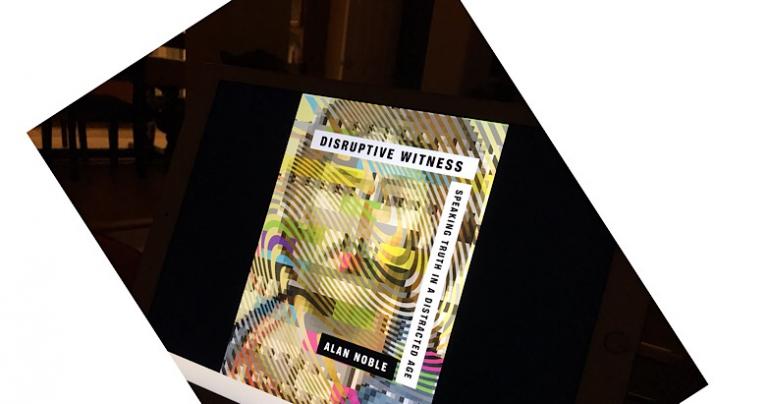
These are thoughts inspired by an excellent book by Professor Alan Noble: Disruptive Witness. I have had concerns, but saying something that challenges much of who we are in North America is difficult. Noble has done this well.
Noble says we are buffered from metaphysical reality by our gadgets and culture. This leads to a default secularism that comes at a price, as reality-denying always does. He says:
The church must embody the faith in such a way as to reveal its exclusivity, solemnity, transcendent power, incarnational theology, and authority.
I think even my Protestant liturgical friends (see those wonderful Lutherans, certain Wesleyans, and the remnant of Anglicans) will agree and hope they get a shout out. This much is sure: if you are at a Church where the liturgy of John Chrysostom is said, then exclusivity, solemnity, transcendence, power, incarnational theology, and authority are not an issue.
Disruptive Liturgy
We Orthodox are exclusive to the point of keeping the Feast for those whom we know are in the Church. We are solemn, leaving jollification for the feasts (Pascha!). The Orthodox in a land like Syria may lack political power, but King Jesus is imaged over our heads. We are urged to be transformed (see: theosis) so as God became man, we can become God. Our authority structures are positively Byzantine.
Let me assume that Professor Noble has no desire to become Orthodox. Perhaps the fact that we persist for centuries in lands where we are declared second-class can serve as a model? The pressures that Noble describes do exist. Our young people face them, too, but at the very least, if one leaves a highly liturgical church one knows what one is losing.
One can change a t-shirt easily, but not forget the sounds of Rachmaninoff’s Vespers. My Anglican friends (or those of us in the Western Rite of Orthodoxy) might reject the God of Evensong, but even Richard Dawkins (I am told) struggles with the loss of beauty.
Leave aside particular theological issues for a moment. Isn’t there some deep liturgy that any big-Evangelical church could adopt? Do we need to reinvent what centuries have made lovely?
Noble takes on contrived awe and this is just so. The power of an unchanging liturgy, which does preclude Bible study, prayer groups, or other forms of outreach, is that we fit to it. The beauty is there, even when (as is often the case) I am ugly. The liturgy does not need me—I need the liturgy.
Disruptive Heritage
Again, even if you forget the Faithful of Orthodoxy, looking only at those Protestant churches, this description seems too much:
As Western culture has shifted its focus inward, toward disengaged reason, Taylor sees a parallel move within Christianity—a move from embodied forms of religious worship to those in which religion is essentially something that only happens in your head. Taylor calls this move “excarnation,” since it devalues and nearly erases the role of our bodies in worship. Consider his description of modern culture, including modern Christianity.
My office is near a basketball arena turned excarnational church, but other options abound. When my son was asked to visit a church different from his own for a college class, he had choices of Protestant liturgy ranging from Anglo-Catholic to vibrant charismatic worship. He ended up in a wonderful Spanish-speaking church that was not big on formal liturgy, but full of Scripture, mystery, and incarnational practices.
The Big Box Church is not the answer, yet congregations more faithful to the deep customs have not always grown. Too often they have been reactionary rather than faithful. A priest who went on to suffer a kind of martyrdom for his witness told me once before he died that the last recourse of the shallow or the heterodox is getting the vestment colors just so.
The liturgy is not a performance, but a participatory act. When the choices were the Evangel with problems or the Old Ways with no life, then many chose the evangelical road. If now the choice is suspect, perhaps the time has come for those people to reclaim the heritage of the hymns, service books, and customs of their mothers and fathers (in a spiritual sense).
Disruptive Testimony
When I was a boy, I heard very old men sing songs during testimony time that arose from the West Virginia hills. These songs were lost when rising wealth tempted the congregation to buy hymnals instead of making music, and fund programs instead of finding God together. They professionalized and much that was precious was lost. Perhaps we could recover what can be found in the moment for musicologists while maintaining the fervor of the faithful—but only in those communities where an authentic liturgical form has been preserved.
You cannot geld the liturgy and then bid it be fruitful.
Noble agrees with James K.A. Smith:
. . . Smith argues that modern Christians have put far too much emphasis on encouraging believers to believe the right things, rather than shaping what we love and therefore desire through liturgies, which Smith defines as “rituals of ultimate concern.”
In decades of Christian college teaching, I have met few students overly catechized on the ideas of the Faith. Maybe Noble and Smith have had generations of students that had strong views on Trinitarian dogmas or substitutionary atonement (as they understood it), but if so, they have had a wholly different experience.
Second, orthodoxy, as lived by the faithful, cannot even grasp a distinction between “right doctrine” and “right worship.” This is not a matter of getting some balance right, but of incarnational truth. When Lutherans, Anglicans, and Orthodox evangelicals say Creeds weekly in a liturgy that is the work of the faithful over centuries, the distinction is meaningless.
Disruptive Decision-Making
It is here I pause and wonder whether Professor Noble, who relies on the work of Professor James K.A. Smith, is not making an error. Too often this section of the book reads as if we must recover or choose from traditions to achieve certain goals. To be picky, for example, contra-Nobel, our culture does not celebrate Advent, ignoring this time of fasting and doctrine to jump straight to Christmas.
We in the West are then gypped out of Twelve Days of Christmas and forced to cram the merrymaking into one day. We do not fast, so we are unready for sustained feasting.
I agree wholly with Noble’s goal but worry about any liturgical innovation that mostly leaves the living in charge of decision making. If we are as in need of medicine as Noble suggests, and certainly I am, then we are the wrong people to prescribe medicine.
This verges on smart-guy consumerism. We must recover a tradition we do not control or join a group that has never lost such organic liturgy or we are merely aesthetically sophisticated consumers. Liturgy is the work of the people—not, I think, the work of academics. This work goes together with catechesis in creeds. (I prefer seven if we must give a number.)
To agree with Noble: let us sing together! That is an embodied act and uncomfortable to a consumer culture that looks for professionals to do the singing. Yet if we simply get to pick the music, then we have not gone far enough. Authentic Christian communities will give some choice, but also prescribe as medicine to our souls certain chants and music.
Singing together songs we have entirely chosen is like knowing that we are poor, blind, and sick and then out of our poverty, blindness, and sickness deciding what will make us rich, help us see, and be well.
Disruptive, but Not Far Enough
Noble gets this just right when he talks about readings from Scripture (please!) and God’s law. If we pick the readings, we will too often let our particular culture drive us:
This is morality within the immanent frame, morality mapped by corporate interests, trending topics, convenience, and expressive individualism.
Thank God there still exist many Lutheran, Wesleyan, and other churches ready to be enlivened and old patterns of worship to which our immediate demands can be submitted!
On this, I can only say “yes, Amen:”
It’s hard to imagine an act more disruptive to secularism than celebrating the Lord’s Supper. Every movement in the liturgy of the Lord’s Supper calls us away from a distracted, flattened, material, individualist, and secular view of the world. The reading from the Gospel grounds the sacrament not in mythology or doctrine but in time and space, and it rips us out of our presentism. We are joined with saints across two thousand years, hearing these same words and partaking in the same sacrament because of one God-man and his words and deeds: “On the night when he was betrayed [the Lord Jesus] took bread, and when he had given thanks, he broke it, and said, ‘This is my body, which is for you. Do this in remembrance of me’”
My complaint with Noble (and mayhaps Smith) is that they are disruptive, but not enough. We are still picking and choosing, the tyranny of the living over the Blessed Dead. Who would not prefer the saints in glory in their wisdom to our own battered souls?
They speak wisdom. Let us attend. (And Professor Noble, I am convicted to once again leave my phone at home.)
Do we live in a world where Thomas Cranmer, liturgist, is the most disruptive Western thinker of all?
Buy the book.
_______________________
Alan Noble is the “co-founder and editor in chief of Christ and Pop Culture.” If you are not reading Christ and Pop Culture and you are interested in Christ and/or Pop Culture, then bad. Go and subscribe.
I am slow-reading his new book. Part 1, Part 2, Part 3, Part 4, Part 5, Part 6.
Rachel Motte edited this essay and added the sub-headings.
Previous Post
October 8, 2018
Disruption of the Mind (Reading Alan Noble as a Distracted Me 5/8)
Next Post
October 10, 2018 Disrupt the Culture! (Reading Alan Noble as a Distracted Me 7/8)
Browse Our Archives
Select a Category Apologetics Art Culture Education On Books On Education Philosophy Politics Pop Culture Spiritual Reflections Uncategorized
Select a Month October 2026 September 2026 August 2026 July 2026 July 2025 June 2025 September 2024 July 2024 June 2024 December 2023 June 2023 September 2022 May 2022 April 2022 March 2022 February 2022 July 2021 June 2021 May 2021 April 2021 March 2021 February 2021 January 2021 December 2020 November 2020 October 2020 September 2020 August 2020 July 2020 June 2020 May 2020 April 2020 March 2020 February 2020 January 2020 December 2019 November 2019 October 2019 September 2019 August 2019 July 2019 June 2019 May 2019 April 2019 March 2019 February 2019 January 2019 December 2018 November 2018 October 2018 September 2018 August 2018 July 2018 June 2018 May 2018 April 2018 March 2018 February 2018 January 2018 December 2017 November 2017 October 2017 September 2017 August 2017 July 2017 June 2017 May 2017 April 2017 March 2017 February 2017 January 2017 December 2016 November 2016 October 2016 September 2016 August 2016 July 2016 June 2016 May 2016 April 2016 March 2016 February 2016 January 2016 December 2015 November 2015 October 2015 September 2015 August 2015 July 2015 June 2015 May 2015 April 2015 March 2015 February 2015 January 2015 November 2014 October 2014 September 2014 August 2014 July 2014 June 2014 May 2014 April 2014 March 2014 February 2014 January 2014 December 2013 November 2013 October 2013 September 2013 August 2013 July 2013 June 2013 May 2013 April 2013 March 2013 February 2013 January 2013 December 2012 November 2012 October 2012 September 2012 August 2012 July 2012 June 2012 May 2012
Follow Us!
TAKE THE
Religious Wisdom Quiz
In Revelation, what is the correct order of the first four seals opened by the Lamb?
Select your answer to see how you score.
White horse, red horse, black horse, pale horse Red horse, white horse, pale horse, black horse White horse, black horse, red horse, pale horse Pale horse, red horse, white horse, black horse
Books by This Author John Mark Reynolds
Related posts from Eidos

Classical Education Must Teach Us to Make the...

Yet I Love Her: History and the Church


The Iceberg is There: Verbosity Cannot Defeat Reality
TRENDING AT PATHEOS Evangelical

The REST of Your Life: A Creative Wrestles...
This week I had a conversation with a good friend from church....

How the author of the world's best hymn...
I've been working with John Newton for a while now. This makes...

Long before this Lectio Divina, Psalm 130 - the song - started...

What About the Trees? Another Living Parable
After I finished writing the last article about falling leaves as a...

Why Classical Education Is a Conversation, Not a...
Come and Read: Joy in Classical Education When I was a little...

Cornell University has received a great deal of negative publicity and intense...
view all Evangelical blogs
Ad-Free & Subscriber Log-In Subscription Support
- About Us
- 2026 Calendar
- Videos
- Podcasts
- Library of World Religions
- Faith In Media Tracker
- Advertise With Us
- Write for Us
- Privacy Policy
- Terms of Service
- Do Not Sell My Data
- Contact Us
- Radiant Digital
- Manage Newsletter Subscriptions
- Unsubscribe From Notifications
- Sitemap
Copyright 2008-2026, Patheos. All rights reserved.
Subscription Support Ad-Free & Subscriber Log-In
Follow Patheos