
BuddhistCatholicContemplativeEvangelicalGeneral ChristianHinduJewishLatter-day SaintMuslimNew VisionsProgressive Christian
Beliefs
- Buddhist
- Catholic
- Contemplative
- Evangelical
- General Christian
- Hindu
- Jewish
- Latter-day Saint
- More Voices
- Muslim
- New Visions
- Pagan
- Progressive Christian
Topics
- Religion News
- Food and Religion
- Sports and Religion
- Religious Art
- Religious Music and Entertainment
- Religious Events
- History and Religion
- Style and Religion
- Politics and Religion
- Women in Religion
- Recreation Outdoors and Religion
- Business Finance and Religion
- Careers Workplace and Religion
- Education and Religion
- Family Parenting and Religion
- Health Fitness and Religion
- Home and Religion
- Relationships and Religion
- Technology and Religion
- Travel and Religion
Columnists
- Buddhist Columnists
- Business Finance and Religion Columnists
- Careers Workplace and Religion Columnists
- Catholic Columnists
- Contemplative Columnists
- Education and Religion Columnists
- Evangelists Columnists
- Family Parenting and Religion Columnists
- General Christian Columnists
- Health Fitness and Religion Columnists
- Hindu Columnists
- History and Religion Columnists
- Home and Religion Columnists
- Jewish Columnists
- More Voices Columnists
- Latter Day Columnists
- Muslim Columnists
- New Visions Columnists
- Nonreligious Columnists
- Pagan Columnists
- Politics and Religion Columnists
- Progressive Columnists
- Recreation Outdoors and Religion Columnists
- Relationships and Religion Columnists
- Religion News Columnists
- Religious Art Columnists
- Religious Events Columnists
- Religious Music and Entertainment Columnists
- Sports and Religion Columnists
- Style and Religion Columnists
- Technology and Religion Columnists
- Travel and Religion Columnists
- Women in Religion Columnists
Resource Library
- 2026 Calendar
- Library of World Religions
- The 100 Most Holy Places on Earth
- Patheos Answers
- Podcasts
- Videos
- Faith Leaders Database
- Anglican Episcopalian
- Bahai
- Baptist
- Buddhism
- Christianity
- Confucianism
- Eastern Orthodoxy
- Hinduism
- Holiness and Pentecostal
- ISKCON
- Islam
- Judaism
- Lutheran
- Methodist
- The Church of Jesus Christ of Latter-day Saints
- New Age
- Paganism
- Presbytarian and Reformed
- Protestantism
- Religion Behind the Scenes
- Roman Catholic
- Scientology
- Shia Islam
- Sikhism
- Sufism
- Sunni Islam
- Taoism
- Zen
- See all religions
Research Tools
 Ad-Free & Subscriber Log-In Subscription Support
Ad-Free & Subscriber Log-In Subscription Support
Follow Patheos 

- Trending:
- Forgiveness
- |
- Marriage
- |
- Consciousness
- |
- Death Penalty
- |
- Election
- |
- Halloween

- Home
- Evangelical
- She Was Equal to the Apostles: Nina, Know Hope
She Was Equal to the Apostles: Nina, Know Hope
Last updated on: September 30, 2018 at 3:15 pm by John Mark N. Reynolds
She Was Equal to the Apostles: Nina, Know Hope 2018-09-30T15:15:09-04:00 John Mark N. Reynolds
Patheos Explore the world's faith through different perspectives on religion and spirituality! Patheos has the views of the prevalent religions and spiritualities of the world.
 Her legacy is a country and her message is the Cross: Blessed Nina (or Nino) came, she taught, she conquered in the sign of the Holy Cross. She was she . . . And she was equal to the Apostles, never reduced to less than she was or made just what they were.
Nina was powerful.
She was also historical and yet historically she was so mighty, so miraculous, that legend creeps around her story. People who met her saw not just history, though she kept making history, but a living window to Heaven. Stories of saints, hagiography, are a sacred history that might be literal (who can know?), but are mystically true. The essential elements of a person are captured in the saint’s story.
There are two happenings: what can be seen and what the meaning is of what can be seen. The hagiography is most concerned with meaning and less concerned with the events. The events were such to motivate or provoke the story of the meaning. They are one, but may not be the same literarily.* The Gospels are not hagiography: read both and see. The Gospels are literal joined to literary. Some hagiography is this way, some cares most for meaning.
Nina existed and lived a life that was powerful and the people she created, Christian Georgia,
At the time of Constantine the Great, Nina was (in all probability) a nun at the edge of the world. If Spain was western Iberia, the edge of civilization, for the Greeks and Romans the nation of Georgia in the Caucus region was the other eastern Iberia. She stood at the edge of the world and taught mercy and brought healing to the nation.
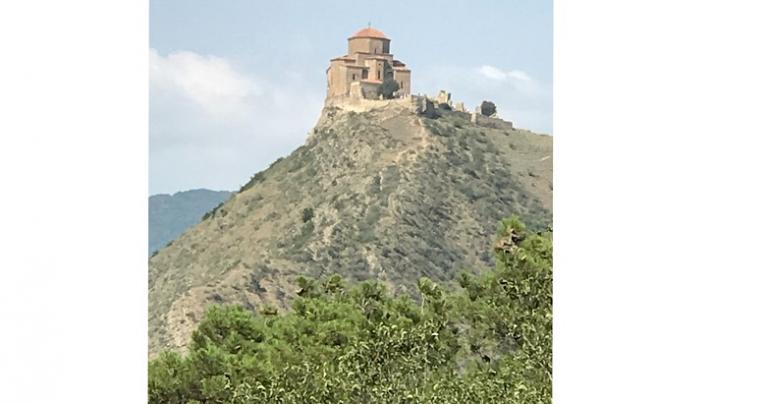 Her message spread and first the Queen Nana and then King Mirian came to Christianity. How? The details of the story are impossible to confirm, but we are told the Queen was ill and Nina prayed and God healed her. The King resisted the good God, his Queen, and Nina. When hunting, he was blinded, surrounded by a great darkness, and cried out to God. His sight was restored and Christian Georgia was born.
Note the details of the tale, even if you are skeptic of hagiography*: Nina and her faith were remembered as bringing healing and enlightenment. Imagine this as the residue of teaching that changed a kingdom. Historical memory fused with imagery and Nina was not recollected with a sword or ugliness. Her cross was made from a grapevine, bound by her hair, a symbol of the ancient association of Georgia with the wine: jolly and sacred.
I visited her church, the site of her great triumph, so perfect even the Bolshevik’s spared it. Atheism was only capable of building ugliness, but atheists are also humans, souls created in the image of God, and they saw the beauty they could not create. I went to pray and venerated this powerful woman: she heard the Word of God and did it.
Her chastity was beautiful, her teaching powerful, her rigor unabated. Nina, saint, used by your Lord Jesus Christ to create the splendid Christian state of Georgia, pray to God for us, equal to the Apostles.
————————————
*We are too skeptical, I think, but regardless, the point is the same: healing and beauty came with Nina.
Previous Post
September 27, 2018
Mom’s Wisdom
Browse Our Archives
Select a Category Apologetics Art Culture Education On Books On Education Philosophy Politics Pop Culture Spiritual Reflections Uncategorized
Select a Month October 2026 September 2026 August 2026 July 2026 July 2025 June 2025 September 2024 July 2024 June 2024 December 2023 June 2023 September 2022 May 2022 April 2022 March 2022 February 2022 July 2021 June 2021 May 2021 April 2021 March 2021 February 2021 January 2021 December 2020 November 2020 October 2020 September 2020 August 2020 July 2020 June 2020 May 2020 April 2020 March 2020 February 2020 January 2020 December 2019 November 2019 October 2019 September 2019 August 2019 July 2019 June 2019 May 2019 April 2019 March 2019 February 2019 January 2019 December 2018 November 2018 October 2018 September 2018 August 2018 July 2018 June 2018 May 2018 April 2018 March 2018 February 2018 January 2018 December 2017 November 2017 October 2017 September 2017 August 2017 July 2017 June 2017 May 2017 April 2017 March 2017 February 2017 January 2017 December 2016 November 2016 October 2016 September 2016 August 2016 July 2016 June 2016 May 2016 April 2016 March 2016 February 2016 January 2016 December 2015 November 2015 October 2015 September 2015 August 2015 July 2015 June 2015 May 2015 April 2015 March 2015 February 2015 January 2015 November 2014 October 2014 September 2014 August 2014 July 2014 June 2014 May 2014 April 2014 March 2014 February 2014 January 2014 December 2013 November 2013 October 2013 September 2013 August 2013 July 2013 June 2013 May 2013 April 2013 March 2013 February 2013 January 2013 December 2012 November 2012 October 2012 September 2012 August 2012 July 2012 June 2012 May 2012
Follow Us!
TAKE THE
Religious Wisdom Quiz
Who was the younger brother of Moses?
Select your answer to see how you score.
Joshua David Solomon Aaron
Books by This Author John Mark Reynolds
Related posts from Eidos

Classical Education Must Teach Us to Make the...

Yet I Love Her: History and the Church


The Iceberg is There: Verbosity Cannot Defeat Reality
TRENDING AT PATHEOS Evangelical

The REST of Your Life: A Creative Wrestles...
This week I had a conversation with a good friend from church....

How the author of the world's best hymn...
I've been working with John Newton for a while now. This makes...

Long before this Lectio Divina, Psalm 130 - the song - started...

What About the Trees? Another Living Parable
After I finished writing the last article about falling leaves as a...

Why Classical Education Is a Conversation, Not a...
Come and Read: Joy in Classical Education When I was a little...

Cornell University has received a great deal of negative publicity and intense...
view all Evangelical blogs
Ad-Free & Subscriber Log-In Subscription Support
- About Us
- 2026 Calendar
- Videos
- Podcasts
- Library of World Religions
- Faith In Media Tracker
- Advertise With Us
- Write for Us
- Privacy Policy
- Terms of Service
- Do Not Sell My Data
- Contact Us
- Radiant Digital
- Manage Newsletter Subscriptions
- Unsubscribe From Notifications
- Sitemap
Copyright 2008-2026, Patheos. All rights reserved.
Subscription Support Ad-Free & Subscriber Log-In
Follow Patheos