
BuddhistCatholicContemplativeEvangelicalGeneral ChristianHinduJewishLatter-day SaintMuslimNew VisionsProgressive Christian
Beliefs
- Buddhist
- Catholic
- Contemplative
- Evangelical
- General Christian
- Hindu
- Jewish
- Latter-day Saint
- More Voices
- Muslim
- New Visions
- Pagan
- Progressive Christian
Topics
- Religion News
- Food and Religion
- Sports and Religion
- Religious Art
- Religious Music and Entertainment
- Religious Events
- History and Religion
- Style and Religion
- Politics and Religion
- Women in Religion
- Recreation Outdoors and Religion
- Business Finance and Religion
- Careers Workplace and Religion
- Education and Religion
- Family Parenting and Religion
- Health Fitness and Religion
- Home and Religion
- Relationships and Religion
- Technology and Religion
- Travel and Religion
Columnists
- Buddhist Columnists
- Business Finance and Religion Columnists
- Careers Workplace and Religion Columnists
- Catholic Columnists
- Contemplative Columnists
- Education and Religion Columnists
- Evangelists Columnists
- Family Parenting and Religion Columnists
- General Christian Columnists
- Health Fitness and Religion Columnists
- Hindu Columnists
- History and Religion Columnists
- Home and Religion Columnists
- Jewish Columnists
- More Voices Columnists
- Latter Day Columnists
- Muslim Columnists
- New Visions Columnists
- Nonreligious Columnists
- Pagan Columnists
- Politics and Religion Columnists
- Progressive Columnists
- Recreation Outdoors and Religion Columnists
- Relationships and Religion Columnists
- Religion News Columnists
- Religious Art Columnists
- Religious Events Columnists
- Religious Music and Entertainment Columnists
- Sports and Religion Columnists
- Style and Religion Columnists
- Technology and Religion Columnists
- Travel and Religion Columnists
- Women in Religion Columnists
Resource Library
- 2026 Calendar
- Library of World Religions
- The 100 Most Holy Places on Earth
- Patheos Answers
- Podcasts
- Videos
- Faith Leaders Database
- Anglican Episcopalian
- Bahai
- Baptist
- Buddhism
- Christianity
- Confucianism
- Eastern Orthodoxy
- Hinduism
- Holiness and Pentecostal
- ISKCON
- Islam
- Judaism
- Lutheran
- Methodist
- The Church of Jesus Christ of Latter-day Saints
- New Age
- Paganism
- Presbytarian and Reformed
- Protestantism
- Religion Behind the Scenes
- Roman Catholic
- Scientology
- Shia Islam
- Sikhism
- Sufism
- Sunni Islam
- Taoism
- Zen
- See all religions
Research Tools
 Ad-Free & Subscriber Log-In Subscription Support
Ad-Free & Subscriber Log-In Subscription Support
Follow Patheos 

- Trending:
- Forgiveness
- |
- Marriage
- |
- Consciousness
- |
- Death Penalty
- |
- Election
- |
- Halloween

- Home
- Evangelical
- Piercing Faith (Interactive Reading of Karen Swallow Prior 6/12)
Piercing Faith (Interactive Reading of Karen Swallow Prior 6/12)
Last updated on: September 11, 2018 at 2:23 pm by John Mark N. Reynolds
Piercing Faith (Interactive Reading of Karen Swallow Prior 6/12) 2018-09-11T14:23:14-04:00 John Mark N. Reynolds
Patheos Explore the world's faith through different perspectives on religion and spirituality! Patheos has the views of the prevalent religions and spiritualities of the world.
Faith is the divine virtue expanding our vision of everything. For those of us who have failed, faith is the substance that disappointed hope finds that helps us live. Faith is rational, passionate, and experiential. Faith moves us to study, love even our enemies, and do works of charity.
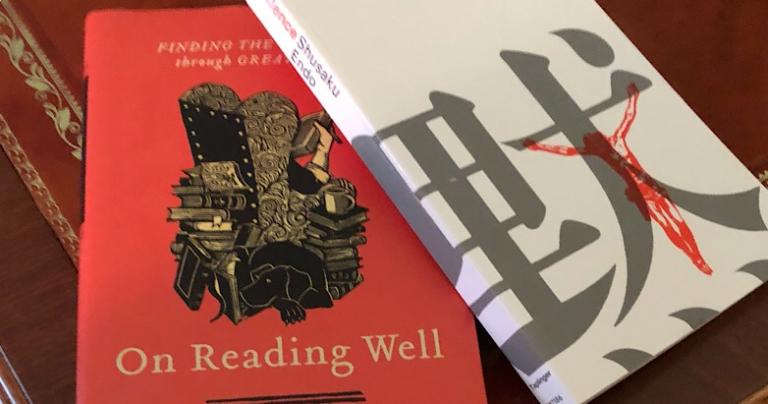
Silence by Shusaku Endo is a piercingly difficult book about faith: difficult to understand, hard on the emotions, and stirring to be a better person. If asked if I agree with Endo’s vision of faith, I would not know what to say. This is not a series of propositions, or an argument, but a picture of reality. Like all pictures of reality, it is limited, perhaps a bit artful, but true. Does a person ask if a picture is true?
Of course it is true, but not the whole truth.
Endo has given us a story of faith: false faith, broken faith, and perhaps faith restored. Karen Swallow Prior (KSP) invites us to consider this account while clearing away some misconceptions.
What is faith?
We can use and know a thing without being able to define it well, but a definition can help us clarify what a thing is not. This has become important regarding faith as weirdlings in both the religious and secular communities have invented definitions of faith that are self-serving.
Of course, anybody can use a term any way they see fit . . . Hurrah for linguistic creativity! We just cannot define a term and then force our definition on everyone else.
What is faith for traditional Christians? Faith is not believing a thing that is impossible that is insanity and if you are in a religious group that says this: leave. If you are skeptic and you think this is what Christian philosophers mean by faith, read some Richard Swinburne.
A problem is that “faith” is used many different ways in English:
We use the word in so many ways. We can have faith in a person or an institution. The law might consider a transaction to be one made “in good faith.” We describe our level of self-confidence as the amount of faith we have in ourselves. But faith as a virtue has a particular meaning, one expressed in the Bible when it explains that faith comes from the grace of God, not from human works (Eph. 2: 8–9). Faith is the “instrument” that brings us to the Christ who saves us.
KSP is defining faith as a divine virtue. Faith is also a cognitive term, an intellectually substantial hope. Sometimes people, including Christian apologists, confuse the two uses and create confusion.
KSP gives us a good breakdown of how faith is often used to avoid any confusion:
Similarly, a colleague who is a New Testament scholar describes faith as having three primary elements: belief (cognitive), trust (relational), and fidelity (obedience). Consider, for example, the faith a child has in a parent: the child may believe that she should trust her parents, and she may obey them, but she may do so without trusting them. On the other hand, a child could believe in and trust her parents—and willfully disobey anyway. Some doubts cannot be expressed apart from faith in God. “Thus, rather than having faith in faith itself, as a point of certainty that relies on our volition only, true faith is a childlike trust in God, who allows his children to question him as they might question their earthly parent, and to do so in the certainty of the relational knowledge and trust of the Father.”
Like any discussion of why we believe what we believe, reason, experience, and personal discipline will never give us certainty through a process.
Doubt (if only in our sanity) is always there, not corrosive skepticism, but humility. We are not God and do not know perfectly.
Plato was helpful to me in understanding the relationship between the “gift of Faith” and cognitive faith. We can reason our way to some truths, like the existence of God or quarks. Doubt will remain, because our arguments are mixed up with personal bias or other limitations we have.
There may come a time, Plato suggests, when after thought and the experience of dialogue in a community that we see. When we see the Good (as he would put it), then all that has come before becomes indubitable to us. This is not accessible to everyone else, they can only see our external experiences and our cognitive work.
That’s good as it (hopefully) shows our sanity!
However, this gift (we cannot make the Good real by words or God reveal Himself to us) is not the product of our work. We can even say “no” to God and so God withdraws Himself from us.
Yet still in this description there is the silence of God that Endo describes with such force. This can be answered intellectually, but if you have not felt this sense of forsakeness, then it cannot be explained or explained away.
Endo does not try and so effectively portrays faith as virtue.
KSP and the Medicine of Silence
Triumph?
Victory happens and triumphant rejoicing is appropriate.
Triumphalism?
That is a heresy and horrible in real life. Ask the suffering Christians of Syria if they can just “name and claim” their way to their best life.
Recall KSP is showing us the virtue of faith, not answers to questions, but living out a wholistic virtue, living in a Divine gift, in a broken world.
Lord Jesus Christ, have mercy on me a sinner.
Silence is not about answering questions. This is not a work of theology, but a story. Asking for theological precision from it, is like a systemic theology showing good character development.
Our questions may not get answers in a novel. KSP puts it succinctly:
Silence asks a question that is difficult for many readers to answer with certainty: Is the faith of its main character, Father Rodrigues, a saving faith that endures to the end?
But the purpose in reading this novel—or any novel—is not to find definitive answers about the characters. It is rather to ask definitive questions about ourselves. To read about an experience of faith as it falters is an opportunity to seek resolution not in the work of fiction but in the work of our own faith.
KSP is not saying reading a book, this great book or any book, can “produce” the virtue of faith. This is like asking an argument to produce a virtue. However, this work may give us a disposition to receive the gift or encourage us to endure as we seek the virtue of faith.
The book is an experience and one that allows us multiple understandings of the ending. The story presents a chance to dialogue or better to experience one icon of faith: Silence. This is not, thank God, the only such picture or image, since this is a very hard one to see.
Yet life is hard. The image as KSP points out has value even beyond the excellence of the story for many of us. First, this is a Japanese and Christian image, a combination more rare than one would wish. Second, the very difficulty of the image is too rare for many of us. We may be a church of martyrs, but prefer hagiography always. Hagiography is a valuable genre, but Silence is a different medicine for the soul. Third, the style is a particular type of twentieth century writing and many souls find this means of story telling effective for them.
On Reading Difficult Books
Too often we read books as a way of finding support for our particular agenda or point of view. When I do this, I am reading badly.
Why?
The author is not me. He or she is (in a great work of literature) more insightful. As a soul created in the image of God, any human can teach me. When I try to make a book say what I would say, then I end up reading my story with a different voice. I turn what should be a learning experience into literary ventriloquism: great authors made to serve my voice.
God forbid.
Instead, KSP points us to a better way: humility before the text or before other people. We can learn from anyone. This is is difficult for the central character of Silence and KSP points to his inner pride. The people in his flock live miserable lives and he has come to help even though he sees them singing to a martyrdom and meeting spiritual challenges he will fail. He reads them and their lives the way to many of us (God have mercy on me!) read great texts: looking for our mission.
The virtue of Faith will not be controlled. It exists with neither modern ambiguity nor fundamentalist certainty. What is it? God knows. We should seek Him and ask.
KJP reminds us that Silence, like the parables of Jesus, are not a series of propositions:
The truth a parable expresses is not found in a straightforward or literal reading. In fact, the Greek original of the word parable means to “throw beside.” A parable is not an allegory (a form to be discussed in chap. 9), because a parable does not have a one-to-one correspondence of symbolic meaning as an allegory does. Whatever spiritual truth is gleaned from a parable, as in Silence or in Jesus’s story of the wheat and the tares, is less absolute. Like a parable, Silence raises questions even as it offers possible answers.
Christian Tragedy
Life, at least viewed in the context of now, is tragic. KSP points that classical tragedy is not the same as Christian tragedy. Classical tragedy includes catharsis: the reader or theater goer knows what to do.
Ancient society had no basis for eternal hope, the afterlife was grim, so things had to be better now. Classical tragedy always runs the risk of being a drug: we are placated because we are not the tragic hero. We suffer for him, but can (mostly) say: “My life is not so bad. Look at Oedipus!”
Christian tragedy could end differently. We do not think things always work out. Partly this is because we think all people’s stories count. The rich, the men who could afford to go to Greek theater, had lives that often worked out. The slave that made such a life possible or the wife back at the farm had far less to gain from a cheap catharsis.
Christianity demands justice for all, but makes the (seemingly) impossible assertion that everyone’s story matters. Every life counts. As a result, a Christian tragedy cannot trade in cheap catharsis. It must work for all, even those who will wake up in a North Korean prison camp.
KSP:
Silence shares more in common with Christian tragedy. In classical tragedy, closure is contained within the text. Christian tragedy, on the other hand, looks outward, upward, and beyond for redemption. Following a dormant period for drama, the Middle Ages saw a rebirth of tragedy. Since then “Christian life and thought have been the matrix out of which tragedy was reborn. It takes account of the Redemption, the absence of which characterized, in part, pagan tragedy. The tragic event in human life is no longer the final word.” Christian tragedy differs from classical tragedy in its emphasis on “the next world’s destiny being determined in the present one,” thus making it “infinitely more intense and serious than any other mode of tragedy.”
KSP concludes:
In Silence, the unique particularities surrounding one man’s faith and the testing of that faith provide a strangeness that allows readers to view through a different lens what the virtue of faith looks like as it is being practiced well (or not).
Buy the book.
————————————-
This will be a twelve part series: Introduction, Prudence, Temperance, Justice, Courage, Faith,
Next Post
September 12, 2018 On the Road with Hope (Interactive Reading of Karen Swallow Prior 7/12)
Browse Our Archives
Select a Category Apologetics Art Culture Education On Books On Education Philosophy Politics Pop Culture Spiritual Reflections Uncategorized
Select a Month October 2026 September 2026 August 2026 July 2026 July 2025 June 2025 September 2024 July 2024 June 2024 December 2023 June 2023 September 2022 May 2022 April 2022 March 2022 February 2022 July 2021 June 2021 May 2021 April 2021 March 2021 February 2021 January 2021 December 2020 November 2020 October 2020 September 2020 August 2020 July 2020 June 2020 May 2020 April 2020 March 2020 February 2020 January 2020 December 2019 November 2019 October 2019 September 2019 August 2019 July 2019 June 2019 May 2019 April 2019 March 2019 February 2019 January 2019 December 2018 November 2018 October 2018 September 2018 August 2018 July 2018 June 2018 May 2018 April 2018 March 2018 February 2018 January 2018 December 2017 November 2017 October 2017 September 2017 August 2017 July 2017 June 2017 May 2017 April 2017 March 2017 February 2017 January 2017 December 2016 November 2016 October 2016 September 2016 August 2016 July 2016 June 2016 May 2016 April 2016 March 2016 February 2016 January 2016 December 2015 November 2015 October 2015 September 2015 August 2015 July 2015 June 2015 May 2015 April 2015 March 2015 February 2015 January 2015 November 2014 October 2014 September 2014 August 2014 July 2014 June 2014 May 2014 April 2014 March 2014 February 2014 January 2014 December 2013 November 2013 October 2013 September 2013 August 2013 July 2013 June 2013 May 2013 April 2013 March 2013 February 2013 January 2013 December 2012 November 2012 October 2012 September 2012 August 2012 July 2012 June 2012 May 2012
Follow Us!
TAKE THE
Religious Wisdom Quiz
What Christian group follows the "Three Self Principle" in church governance?
Select your answer to see how you score.
Seventh-day Adventists Chinese Protestant Churches Quakers Orthodox Christians
Books by This Author John Mark Reynolds
Related posts from Eidos

Classical Education Must Teach Us to Make the...

Classical Education and the Art of Dying Well

Golden, Golden, Golden: My Mother's Last Lesson

TRENDING AT PATHEOS Evangelical

The REST of Your Life: A Creative Wrestles...
This week I had a conversation with a good friend from church....

How the author of the world's best hymn...
I've been working with John Newton for a while now. This makes...

Long before this Lectio Divina, Psalm 130 - the song - started...

What About the Trees? Another Living Parable
After I finished writing the last article about falling leaves as a...

Why Classical Education Is a Conversation, Not a...
Come and Read: Joy in Classical Education When I was a little...

Cornell University has received a great deal of negative publicity and intense...
view all Evangelical blogs
Ad-Free & Subscriber Log-In Subscription Support
- About Us
- 2026 Calendar
- Videos
- Podcasts
- Library of World Religions
- Faith In Media Tracker
- Advertise With Us
- Write for Us
- Privacy Policy
- Terms of Service
- Do Not Sell My Data
- Contact Us
- Radiant Digital
- Manage Newsletter Subscriptions
- Unsubscribe From Notifications
- Sitemap
Copyright 2008-2026, Patheos. All rights reserved.
Subscription Support Ad-Free & Subscriber Log-In
Follow Patheos