
BuddhistCatholicContemplativeEvangelicalGeneral ChristianHinduJewishLatter-day SaintMuslimNew VisionsProgressive Christian
Beliefs
- Buddhist
- Catholic
- Contemplative
- Evangelical
- General Christian
- Hindu
- Jewish
- Latter-day Saint
- More Voices
- Muslim
- New Visions
- Pagan
- Progressive Christian
Topics
- Religion News
- Food and Religion
- Sports and Religion
- Religious Art
- Religious Music and Entertainment
- Religious Events
- History and Religion
- Style and Religion
- Politics and Religion
- Women in Religion
- Recreation Outdoors and Religion
- Business Finance and Religion
- Careers Workplace and Religion
- Education and Religion
- Family Parenting and Religion
- Health Fitness and Religion
- Home and Religion
- Relationships and Religion
- Technology and Religion
- Travel and Religion
Columnists
- Buddhist Columnists
- Business Finance and Religion Columnists
- Careers Workplace and Religion Columnists
- Catholic Columnists
- Contemplative Columnists
- Education and Religion Columnists
- Evangelists Columnists
- Family Parenting and Religion Columnists
- General Christian Columnists
- Health Fitness and Religion Columnists
- Hindu Columnists
- History and Religion Columnists
- Home and Religion Columnists
- Jewish Columnists
- More Voices Columnists
- Latter Day Columnists
- Muslim Columnists
- New Visions Columnists
- Nonreligious Columnists
- Pagan Columnists
- Politics and Religion Columnists
- Progressive Columnists
- Recreation Outdoors and Religion Columnists
- Relationships and Religion Columnists
- Religion News Columnists
- Religious Art Columnists
- Religious Events Columnists
- Religious Music and Entertainment Columnists
- Sports and Religion Columnists
- Style and Religion Columnists
- Technology and Religion Columnists
- Travel and Religion Columnists
- Women in Religion Columnists
Resource Library
- 2026 Calendar
- Library of World Religions
- The 100 Most Holy Places on Earth
- Patheos Answers
- Podcasts
- Videos
- Faith Leaders Database
- Anglican Episcopalian
- Bahai
- Baptist
- Buddhism
- Christianity
- Confucianism
- Eastern Orthodoxy
- Hinduism
- Holiness and Pentecostal
- ISKCON
- Islam
- Judaism
- Lutheran
- Methodist
- The Church of Jesus Christ of Latter-day Saints
- New Age
- Paganism
- Presbytarian and Reformed
- Protestantism
- Religion Behind the Scenes
- Roman Catholic
- Scientology
- Shia Islam
- Sikhism
- Sufism
- Sunni Islam
- Taoism
- Zen
- See all religions
Research Tools
 Ad-Free & Subscriber Log-In Subscription Support
Ad-Free & Subscriber Log-In Subscription Support
Follow Patheos 

- Trending:
- Forgiveness
- |
- Marriage
- |
- Consciousness
- |
- Death Penalty
- |
- Election
- |
- Halloween

- Home
- Evangelical
- Curmudgeon or Critic? (Mild Praise for Heraclitus)
Curmudgeon or Critic? (Mild Praise for Heraclitus)
Last updated on: September 3, 2018 at 9:39 am by John Mark N. Reynolds
Curmudgeon or Critic? (Mild Praise for Heraclitus) 2018-09-03T09:39:51-04:00 John Mark N. Reynolds
Patheos Explore the world's faith through different perspectives on religion and spirituality! Patheos has the views of the prevalent religions and spiritualities of the world.
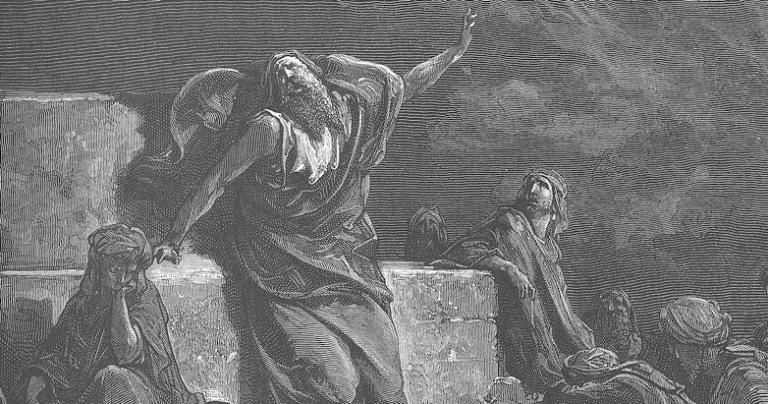 Sometimes the kids do need to get off the grass, but after a certain age you cannot ask them to do so without being “that guy.” Similarly, complaints about bad reasoning are never popular. If not done very gently, a person risks being annoying and making the masses angry. Using the term “masses” about the masses can trigger a bad reaction.
There is a double problem: cranks must be ignored and we are tempted to cry “crank” or “curmudgeon” when we get cranky about the message.
If Jesus is right that we will know people by their fruit, plenty of people seem called to be fruit inspectors who are rotten at the job or perhaps they irritate us so much they cannot do the job. Somebody has the job of giving a jeremiad, but aside from Jeremiah himself, it is hard to know if any particular “truth teller” is merely a jerk or is on to something. Telling us to get off the grass, when we want to walk on the grass, or pointing out our flaws is irritating while simultaneously attracts irritating people to do it who should not.
What if the truth-teller is also curmudgeonly?
One of the first philosophers, Heraclitus of Ephesus, is a cautionary tale for the rest of us. He had a message Ephesus needed to hear, but because he was also a difficult personality, they missed his message. Heraclitus spoke in catchy meme-able phrases (“the way up is the way down”), but he also felt called to inspect the fruit of his fellow Ephesians and his memorable message made men mad. He attacked the degenerate religion of the time:
241 They vainly purify themselves of blood-guilt by defiling themselves with blood, as though one who had stepped into mud were to wash with mud; he would seem to be mad, if any of men noticed him doing this. Further, they pray to these statues, as if one were to carry on a conversation with houses, not recognizing the true nature of gods or demi-gods.
As Saint Paul would discover attacking the religion of the Ephesians is not safe, but Heraclitus was right about Ephesus:
242 The secret rites practised among men are celebrated in an unholy manner.
The Homeric religion never found a good balance between popular religion, the outer sign of truth, and intellectual religion, the reality that the outer sign expressed. Popular religion that begins to focus on externals (such as idol worship in the case of pagans) as if the externals are the “thing” almost always become grafts and messes. The sacrifice was for something, but soon the sacrifice is the end. The stories in Hesiod or Homer had deeper meaning, but it is easy just to repeat the tales as religious entertainment.
Heraclitus was not secularizing, he was restoring the depth to the religion of Homer. Men went to oracles such as the great one at Delphi to find answers, but frequently the questions were merely mundane. The Oracle’s primary message was “know thyself,” a message primarily about seeing the smallness of people and our problems in the light of the great mountains that rise up around the Oracle, the gods, the wine-faced sea in the distance, and the weight of time. Yet too often the Oracle was treated as a “Magic 8 Ball” and what was (possibly) being said was lost. Heraclitus:
244 The lord whose oracle is in Delphi neither speaks out nor conceals, but gives a sign.
The messages from the Oracle were cryptic, perhaps in degenerate days to avoid being wrong and keep the customers coming. At her best, the Oracle was cryptic as a sign: the message of the Divine is always liberating us to begin a journey Godward. The sign points to a continued relationship with the world, people, and Divinity, not telling us what to do.
This is a message that cannot be marketed and so irritates those who would sell the sign! Saint Paul, hundreds of years later, would cut deeper and reveal greater truth, but by this time the images had become mere idols. The great poets Homer and Hesiod had been rendered useless at best and mostly harmful in the hands of the populace by the time of Plato. Four hundred years later at the time of Paul, they were artifacts with no living reality, intellectual chains.
Heraclitus of Ephesus had suggested that there was a reality, a divine Logos, behind Zeus. The great god was not God, but should have pointed to God:
228 One thing, the only truly wise, does not and does consent to be called by the name of Zeus.
This was not identical to the god of Homer, but is the Will hinted at through all his great epics. This Zeus is the master guide:
220 Thunderbolt steers all things.
Philosophical types would ponder Heraclitus’ cryptic messages, though they did not preserve his body of work. Popular religion ignored him or mocked the curmudgeon with the best revenge. They wrote is history after he was dead. Allegedly Heraclitus ended like many philosophers:
Finally he became a misanthrope, withdrew from the world, and lived in the mountains feeding on grasses and plants. However, having fallen in this way into a dropsy he came down to town and asked the doctors in a riddle if they could make a drought out of rainy weather. When they did not understand he buried himself in a cow-stall, expecting that the dropsy would be evaporated off by the heat of the manure; but even so he failed to effect anything, and ended his life at the age of sixty.
He died in his own . . .
Well, you get the idea. He may have been a crank, but he also pointed forward to the creative Word and the need to listen to the Logos:
194 Of the Logos which is as I describe it men always prove to be uncomprehending, both before they have heard it and when once they have heard it. For although all things happen according to this Logos men are like people of no experience, even when they experience such words and deeds as I explain, when I distinguish each thing according to its constitution and declare how it is; but the rest of men fail to notice what they do after they wake up just as they forget what they do when asleep.
Maybe we should wake up and listen to such cranks.
—————————-
Heraclitus quotations are from The Presocratic Philosophers (Kirk, Raven, Schofield) Cambridge University Press.
Previous Post

September 1, 2018
Growing Up: Telemachus Finally Does or Better Late than Never
Next Post

September 3, 2018 Hope is the thing with feathers. . .
Browse Our Archives
Select a Category Apologetics Art Culture Education On Books On Education Philosophy Politics Pop Culture Spiritual Reflections Uncategorized
Select a Month October 2026 September 2026 August 2026 July 2026 July 2025 June 2025 September 2024 July 2024 June 2024 December 2023 June 2023 September 2022 May 2022 April 2022 March 2022 February 2022 July 2021 June 2021 May 2021 April 2021 March 2021 February 2021 January 2021 December 2020 November 2020 October 2020 September 2020 August 2020 July 2020 June 2020 May 2020 April 2020 March 2020 February 2020 January 2020 December 2019 November 2019 October 2019 September 2019 August 2019 July 2019 June 2019 May 2019 April 2019 March 2019 February 2019 January 2019 December 2018 November 2018 October 2018 September 2018 August 2018 July 2018 June 2018 May 2018 April 2018 March 2018 February 2018 January 2018 December 2017 November 2017 October 2017 September 2017 August 2017 July 2017 June 2017 May 2017 April 2017 March 2017 February 2017 January 2017 December 2016 November 2016 October 2016 September 2016 August 2016 July 2016 June 2016 May 2016 April 2016 March 2016 February 2016 January 2016 December 2015 November 2015 October 2015 September 2015 August 2015 July 2015 June 2015 May 2015 April 2015 March 2015 February 2015 January 2015 November 2014 October 2014 September 2014 August 2014 July 2014 June 2014 May 2014 April 2014 March 2014 February 2014 January 2014 December 2013 November 2013 October 2013 September 2013 August 2013 July 2013 June 2013 May 2013 April 2013 March 2013 February 2013 January 2013 December 2012 November 2012 October 2012 September 2012 August 2012 July 2012 June 2012 May 2012
Follow Us!
TAKE THE
Religious Wisdom Quiz
What is the ecumenical council where Roman Catholicism addressed modernization in the 1960s?
Select your answer to see how you score.
Council of Nicaea Ephesus Trent Vatican II
Books by This Author John Mark Reynolds
Related posts from Eidos

Classical Education Must Teach Us to Make the...

Yet I Love Her: History and the Church


The Iceberg is There: Verbosity Cannot Defeat Reality
TRENDING AT PATHEOS Evangelical

The REST of Your Life: A Creative Wrestles...
This week I had a conversation with a good friend from church....

How the author of the world's best hymn...
I've been working with John Newton for a while now. This makes...

Long before this Lectio Divina, Psalm 130 - the song - started...

What About the Trees? Another Living Parable
After I finished writing the last article about falling leaves as a...

Why Classical Education Is a Conversation, Not a...
Come and Read: Joy in Classical Education When I was a little...

Cornell University has received a great deal of negative publicity and intense...
view all Evangelical blogs
Ad-Free & Subscriber Log-In Subscription Support
- About Us
- 2026 Calendar
- Videos
- Podcasts
- Library of World Religions
- Faith In Media Tracker
- Advertise With Us
- Write for Us
- Privacy Policy
- Terms of Service
- Do Not Sell My Data
- Contact Us
- Radiant Digital
- Manage Newsletter Subscriptions
- Unsubscribe From Notifications
- Sitemap
Copyright 2008-2026, Patheos. All rights reserved.
Subscription Support Ad-Free & Subscriber Log-In
Follow Patheos