
BuddhistCatholicContemplativeEvangelicalGeneral ChristianHinduJewishLatter-day SaintMuslimNew VisionsProgressive Christian
Beliefs
- Buddhist
- Catholic
- Contemplative
- Evangelical
- General Christian
- Hindu
- Jewish
- Latter-day Saint
- More Voices
- Muslim
- New Visions
- Pagan
- Progressive Christian
Topics
- Religion News
- Food and Religion
- Sports and Religion
- Religious Art
- Religious Music and Entertainment
- Religious Events
- History and Religion
- Style and Religion
- Politics and Religion
- Women in Religion
- Recreation Outdoors and Religion
- Business Finance and Religion
- Careers Workplace and Religion
- Education and Religion
- Family Parenting and Religion
- Health Fitness and Religion
- Home and Religion
- Relationships and Religion
- Technology and Religion
- Travel and Religion
Columnists
- Buddhist Columnists
- Business Finance and Religion Columnists
- Careers Workplace and Religion Columnists
- Catholic Columnists
- Contemplative Columnists
- Education and Religion Columnists
- Evangelists Columnists
- Family Parenting and Religion Columnists
- General Christian Columnists
- Health Fitness and Religion Columnists
- Hindu Columnists
- History and Religion Columnists
- Home and Religion Columnists
- Jewish Columnists
- More Voices Columnists
- Latter Day Columnists
- Muslim Columnists
- New Visions Columnists
- Nonreligious Columnists
- Pagan Columnists
- Politics and Religion Columnists
- Progressive Columnists
- Recreation Outdoors and Religion Columnists
- Relationships and Religion Columnists
- Religion News Columnists
- Religious Art Columnists
- Religious Events Columnists
- Religious Music and Entertainment Columnists
- Sports and Religion Columnists
- Style and Religion Columnists
- Technology and Religion Columnists
- Travel and Religion Columnists
- Women in Religion Columnists
Resource Library
- 2026 Calendar
- Library of World Religions
- The 100 Most Holy Places on Earth
- Patheos Answers
- Podcasts
- Videos
- Faith Leaders Database
- Anglican Episcopalian
- Bahai
- Baptist
- Buddhism
- Christianity
- Confucianism
- Eastern Orthodoxy
- Hinduism
- Holiness and Pentecostal
- ISKCON
- Islam
- Judaism
- Lutheran
- Methodist
- The Church of Jesus Christ of Latter-day Saints
- New Age
- Paganism
- Presbytarian and Reformed
- Protestantism
- Religion Behind the Scenes
- Roman Catholic
- Scientology
- Shia Islam
- Sikhism
- Sufism
- Sunni Islam
- Taoism
- Zen
- See all religions
Research Tools
 Ad-Free & Subscriber Log-In Subscription Support
Ad-Free & Subscriber Log-In Subscription Support
Follow Patheos 

- Trending:
- Forgiveness
- |
- Marriage
- |
- Consciousness
- |
- Death Penalty
- |
- Election
- |
- Halloween

- Home
- Evangelical
- Doing Well: He Was Never Contented With Too Little (Summer in the Republic 61)
Doing Well: He Was Never Contented With Too Little (Summer in the Republic 61)
Last updated on: August 8, 2018 at 4:16 pm by John Mark N. Reynolds
Doing Well: He Was Never Contented With Too Little (Summer in the Republic 61) 2018-08-08T16:16:03-04:00 John Mark N. Reynolds
Patheos Explore the world's faith through different perspectives on religion and spirituality! Patheos has the views of the prevalent religions and spiritualities of the world.
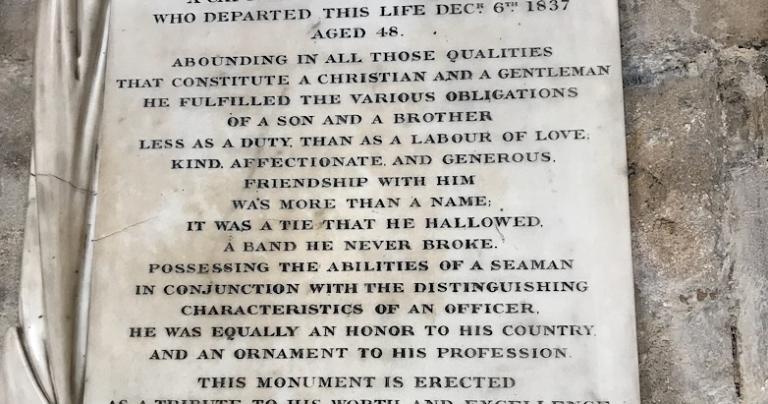 I stood in front of his stone in the English church and read words carved there, as immortal as his crew could make them:
Abounding in all those qualities that constitute a Christian and a gentleman
He fulfilled the various obligations of a son and a brother less as a duty, than as a labor of love
Kind, affectionate, and generous friendship with him was more than a name, it was a tie that he hallowed, a band he never broke.
Possessing the abilities of a seaman in conjunction with the distinguishing characteristics of an officer, he was equally an honor to his country and an ornament to his profession.
This is a man who lived in a community and filled his role. Americans in the last fifty years have so overemphasized marriage and family that we have forgotten friendship and consigned filling one’s role to the memory hole. To be a friend as a labor of love might be recalled, but doing one’s duty lovingly in the place God, nature, and history places us is foreign to us.
Imagine being a man who was not “pals” with his crew, but was their captain. He did his duty and did it honorably. You do not have to imagine it, because here is one and his service, his excellence brought forth honor when he died. This Captain did not settle for victory, though being part of the British navy in this period meant he undoubtedly had his share of victories.
If some fantasty notion of “perfect” can be the enemy of the good, being content with mediocrity, when the good is possible is the foe of philosophy. Nobody can love wisdom who is content to do less that his duty toward wisdom. In Republic (start of Book II), Plato has Socrates about to give up, satisfied with a hollow victor over tyranny. A courageous young man keeps hope alive for something deeper, better, more real:
But on the contrary, the end turned out to be the beginning. With his usual energy, Glaucon objected to “I’hrasymachus’s withdrawal from the contest. He went on to ask: Socrates, do you really want to convince us that justice is preferable to injustice, or will you be content if we only seem to be persuaded?
Socrates admires the courage that Glaucon shows in this passage. He is not the equal of Socrates or Thrasymachus in training or knowledge. He is a student, but one who does his duty with passion. Glaucon is not the equal of Socrates, his friend, or part of his family. Glaucon is the student of Socrates and Plato presents him (often, though not always!) as an ideal student. What does the ideal student do?
Glaucon’s role, at least for this phase of his life, is to learn with energy, sincerity, and courage. A tutor and mentor also learns, but in a way that creates space for the student to drive the conversation forward. The tutor keeps the direction of the conversation pointed (as best he or she can) to the good, truth, beauty. The excellent tutor never loses hope, as Socrates has here, never gives up on learning. Yet in the end, the student drives the discussion. Education needs Glaucon, a student who “fulfilles the various obligations” of his role.
Education cannot be a business, not fundamentally, because it is based on people and the duty of people to seek the good. We have always understood the difference in the military. The Captain did not fight for money or fame. Gold and glory might come, but the Captain was doing his duty. He was no mercenary, but a gentleman. Too much of higher education has become mercenary: the sacred obligation reduced to coin.
Because each student is different, there is no way for a tutor to determine outcomes or be sure just what will be discussed. This is why any religious or secular school that “knows” what the outcome must be is false to education. We are not here to help students answer quiz questions about books or have piles of facts, but to become (God help me!) flourishing human souls.
This is not incompatible with the tutor holding opinions, even holding to an orthodoxy about the truth. We have thought long and hard to see, to develop the best provisional ideas we can. We hold most of them lightly, though a few are, if God wills, the result of an experience of the Divine so deep we cannot doubt it. We have seen the true light and so we know. Yet this is not an experience we can create and so we do not teach it, but from it.
These are truths that I wish I had learned earlier in my life. Lord Jesus Christ, son of God, have mercy on me a sinner. I live them now with my college students, best I can.
Rest in peace Captain Jervoise. We will see you in the morning.
———————————————-
*I begin an informal summer reading of Republic using Scott/Sterling (a new translation for me). Part 1. Part 2. Part 3. Part 4. Part 5. Part 6. Part 7. Part 8. Part 9. Part 10. Part 11. Part 12. Part 13. Part 14. Part 15. Part 16. Part 17. Part 18. Part 19. Part 20. Part 21. Part 22. Part 23. Part 24. Part 25. Part 26. Part 27. Part 28. Part 29. Part 30. Part 31. Part 32. Part 33. Part 34. Part 35. Part 36. Part 37. Part 38. Part 39. Part 40. Part 41. Part 42. Part 43. Part 44. Part 45. Part 45.5. Part 46. Part 47. Part 48. Part 49. Part 50. Part 51. Part 52. Part 52.5. Part 53. Part 54. Part 55. Part 56. Part 57. Part 58. Part 59. Part 60. Part 61.

Browse Our Archives
Select a Category Apologetics Art Culture Education On Books On Education Philosophy Politics Pop Culture Spiritual Reflections Uncategorized
Select a Month October 2026 September 2026 August 2026 July 2026 July 2025 June 2025 September 2024 July 2024 June 2024 December 2023 June 2023 September 2022 May 2022 April 2022 March 2022 February 2022 July 2021 June 2021 May 2021 April 2021 March 2021 February 2021 January 2021 December 2020 November 2020 October 2020 September 2020 August 2020 July 2020 June 2020 May 2020 April 2020 March 2020 February 2020 January 2020 December 2019 November 2019 October 2019 September 2019 August 2019 July 2019 June 2019 May 2019 April 2019 March 2019 February 2019 January 2019 December 2018 November 2018 October 2018 September 2018 August 2018 July 2018 June 2018 May 2018 April 2018 March 2018 February 2018 January 2018 December 2017 November 2017 October 2017 September 2017 August 2017 July 2017 June 2017 May 2017 April 2017 March 2017 February 2017 January 2017 December 2016 November 2016 October 2016 September 2016 August 2016 July 2016 June 2016 May 2016 April 2016 March 2016 February 2016 January 2016 December 2015 November 2015 October 2015 September 2015 August 2015 July 2015 June 2015 May 2015 April 2015 March 2015 February 2015 January 2015 November 2014 October 2014 September 2014 August 2014 July 2014 June 2014 May 2014 April 2014 March 2014 February 2014 January 2014 December 2013 November 2013 October 2013 September 2013 August 2013 July 2013 June 2013 May 2013 April 2013 March 2013 February 2013 January 2013 December 2012 November 2012 October 2012 September 2012 August 2012 July 2012 June 2012 May 2012
Follow Us!
TAKE THE
Religious Wisdom Quiz
What does the word "apostle" mean?
Select your answer to see how you score.
Counselor Leader Teacher One who is sent
Books by This Author John Mark Reynolds
Related posts from Eidos

Why Classical Education Is a Conversation, Not a...

Classical Education Must Teach Us to Make the...

Rooted: Why Classical Education Needs Community

Classical Education: Discussion for Everyone
TRENDING AT PATHEOS Evangelical

The REST of Your Life: A Creative Wrestles...
This week I had a conversation with a good friend from church....

How the author of the world's best hymn...
I've been working with John Newton for a while now. This makes...

Long before this Lectio Divina, Psalm 130 - the song - started...

What About the Trees? Another Living Parable
After I finished writing the last article about falling leaves as a...

Why Classical Education Is a Conversation, Not a...
Come and Read: Joy in Classical Education When I was a little...

Cornell University has received a great deal of negative publicity and intense...
view all Evangelical blogs
Ad-Free & Subscriber Log-In Subscription Support
- About Us
- 2026 Calendar
- Videos
- Podcasts
- Library of World Religions
- Faith In Media Tracker
- Advertise With Us
- Write for Us
- Privacy Policy
- Terms of Service
- Do Not Sell My Data
- Contact Us
- Radiant Digital
- Manage Newsletter Subscriptions
- Unsubscribe From Notifications
- Sitemap
Copyright 2008-2026, Patheos. All rights reserved.
Subscription Support Ad-Free & Subscriber Log-In
Follow Patheos