
BuddhistCatholicContemplativeEvangelicalGeneral ChristianHinduJewishLatter-day SaintMuslimNew VisionsProgressive Christian
Beliefs
- Buddhist
- Catholic
- Contemplative
- Evangelical
- General Christian
- Hindu
- Jewish
- Latter-day Saint
- More Voices
- Muslim
- New Visions
- Pagan
- Progressive Christian
Topics
- Religion News
- Food and Religion
- Sports and Religion
- Religious Art
- Religious Music and Entertainment
- Religious Events
- History and Religion
- Style and Religion
- Politics and Religion
- Women in Religion
- Recreation Outdoors and Religion
- Business Finance and Religion
- Careers Workplace and Religion
- Education and Religion
- Family Parenting and Religion
- Health Fitness and Religion
- Home and Religion
- Relationships and Religion
- Technology and Religion
- Travel and Religion
Columnists
- Buddhist Columnists
- Business Finance and Religion Columnists
- Careers Workplace and Religion Columnists
- Catholic Columnists
- Contemplative Columnists
- Education and Religion Columnists
- Evangelists Columnists
- Family Parenting and Religion Columnists
- General Christian Columnists
- Health Fitness and Religion Columnists
- Hindu Columnists
- History and Religion Columnists
- Home and Religion Columnists
- Jewish Columnists
- More Voices Columnists
- Latter Day Columnists
- Muslim Columnists
- New Visions Columnists
- Nonreligious Columnists
- Pagan Columnists
- Politics and Religion Columnists
- Progressive Columnists
- Recreation Outdoors and Religion Columnists
- Relationships and Religion Columnists
- Religion News Columnists
- Religious Art Columnists
- Religious Events Columnists
- Religious Music and Entertainment Columnists
- Sports and Religion Columnists
- Style and Religion Columnists
- Technology and Religion Columnists
- Travel and Religion Columnists
- Women in Religion Columnists
Resource Library
- 2026 Calendar
- Library of World Religions
- The 100 Most Holy Places on Earth
- Patheos Answers
- Podcasts
- Videos
- Faith Leaders Database
- Anglican Episcopalian
- Bahai
- Baptist
- Buddhism
- Christianity
- Confucianism
- Eastern Orthodoxy
- Hinduism
- Holiness and Pentecostal
- ISKCON
- Islam
- Judaism
- Lutheran
- Methodist
- The Church of Jesus Christ of Latter-day Saints
- New Age
- Paganism
- Presbytarian and Reformed
- Protestantism
- Religion Behind the Scenes
- Roman Catholic
- Scientology
- Shia Islam
- Sikhism
- Sufism
- Sunni Islam
- Taoism
- Zen
- See all religions
Research Tools
 Ad-Free & Subscriber Log-In Subscription Support
Ad-Free & Subscriber Log-In Subscription Support
Follow Patheos 

- Trending:
- Forgiveness
- |
- Marriage
- |
- Consciousness
- |
- Death Penalty
- |
- Election
- |
- Halloween

- Home
- Evangelical
- Doubt, of a sort, is Wonderful, Get Some (Summer in the Republic 56)
Doubt, of a sort, is Wonderful, Get Some (Summer in the Republic 56)
Last updated on: August 4, 2018 at 2:06 am by John Mark N. Reynolds
Doubt, of a sort, is Wonderful, Get Some (Summer in the Republic 56) 2018-08-04T02:06:24-04:00 John Mark N. Reynolds
Patheos Explore the world's faith through different perspectives on religion and spirituality! Patheos has the views of the prevalent religions and spiritualities of the world.
 In some parts of American Christianity there is a weird belief that all forms of doubt are toxic. Thanks to good parents, I missed that error, though I made more than a few of my own!
There are doubtless toxic ideas or practices covered by the very broad term doubt. Anyone who has ever taught Socratically has run into the student who did not read the book, but tries to get through class by doubting any positive thesis advanced by the harder working students. Other people make “not knowing” a virtue as if they would not wish to know for sure, even if they could. We should know all we can and act on our best evidence and reasoning.
“Doubt” can also stand in for rebellion against reason. This is the sneaky sort of pseudo-intellectual who turns away from the evidence and creates spurious doubts to avoid an obvious conclusion. I was once on a jury where the guilt of the client was beyond a reasonable doubt, but one juror pointed out that “space aliens might have created a duplicate” in the seconds the defendant was out of view of the police. The juror wanted the defendant innocent and took any doubt they could manufacture as a reason to vote “not guilty.”
This was unreasonable doubt that threatened to let a bad person go free.
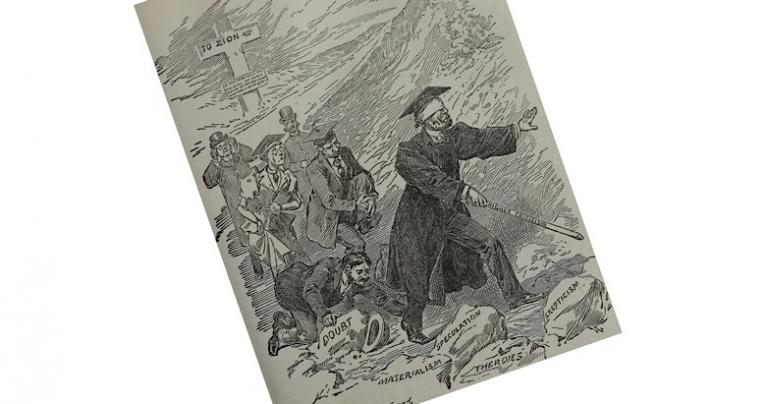
There is an old image of a group of academics wondering away (wandering by wondering!) from the life giving Cross with their eyes covered tripping over doubts. Whatever the artist meant, I am fairly certain that these so-called academics are no more blindfolded than a stage magician, since somehow, improbably, diabolically, they all end up wandering away from the Cross. Atheists in academia like CS Lewis bump into Jesus and His work when they stumble over reasonable doubts regarding their atheism, so we know that “doubt” can take a person in both directions.
Doubt is a form of mental modesty: uncertainty to the extent uncertainty is warranted. Doubt so defined cannot be a vice and is a source of pleasure in life: I am uncertain about my Christmas treat from Hope and that is a good bit of the fun! Doubt is a positive life trait for finite beings and part of truthfulness. It is not just useful in a broken world: Adam had doubts (in one sense), before there was any sin. God brought the animals before Adam and the first human named those animals:
18 Then the Lord God said, ‘It is not good that the man should be alone; I will make him a helper as his partner.’ 19 So out of the ground the Lord God formed every animal of the field and every bird of the air, and brought them to the man to see what he would call them; and whatever the man called each living creature, that was its name. 20 The man gave names to all cattle, and to the birds of the air, and to every animal of the field; but for the man[c] there was not found a helper as his partner.
Adam got to look and wonder when he saw the animals: is this my completion?
“No. I think not.”
Adam remained in his incomplete situation. If this had continued, then it would have been bad, but it did not continue. The gap between finding mere animals, then seeing Eve, when he was feeling alone, and then finding completion is doubt: maybe this, no not this, but this! This wondering is wonderful when our uncertainty (or doubt) finds answers. These answers do not end doubt, they only change the nature of the questions.
We can reach reasonable certainty and this must have been easier in the world before sin. We can call that reasonable certainty knowledge and live by it. In fact, one way of using the term “faith” is a divine revelation to us that is indubitable. We see, so we know. Most humankind gets the fullness of this revelation when glorified after death, but the more God reveals Himself to us the less room we have to wonder if He exists. Our broken and limited capacity means that until we are fully healed this must be so. Even granting us perfect function, there is no reason to think revelation would end wonder (doubt in the sense I mean).
“Look! Bone of my bone!” is not the end of questions, but only the beginning of wonder. Ask any happily married person.
Doubt of this kind is useful in our broken world. When given reasons to doubt, a sensible person must doubt. He has been wrong too many times before now. We can start with a clear divine command: “Love your enemies.” and still make a mess of following that command: ask the Inquisition. When challenged, a good person must hold open the possibility that he or she has misunderstood. Probably is not nothing, but it is not certainty.
Truth does not change based on my uncertainty. Truth is still knowable even if I am, at the moment, uncertain. To pretend to certainty when I do not have it, is not only not a virtue, but a lie. Of course, to cultivate false doubts is also a lie. We must be honest and honesty in most areas will require epistemically modest attitudes.
“Have I mistaken my little idol for the true God?” maybe “yes” or “no,” but it is useful. A critic might reply: “But you confused a sad, but necessary tool for a virtue.”
No.
The same tool that keeps me from sin is part of coming to greater glory. “How is God’s love to be applied today?” I do not know, even if I know (to a reasonable doubt) many things I must not do. The day will be full of surprises. “Perhaps, this!” I pause and think. “Perhaps, not. I doubt it.” God then reveals Himself and love is applied to the changing conditions of life.
Such doubt, questioning what I think or suspect will happen, is wonderful. Isn’t this the very basis of the joys of scientific and other types of intellectual discovery? Humans delight to doubt their earlier ideas and God allows us this pleasure.
At the end of Republic Book I, Socrates has won his argument with an advocate for tyranny. That’s a good thing, but he had his doubts; a better thing. Socrates feared he had won, but by using bad arguments. He has been too hasty to define terms, too quick in his responses to care about clarity and precision. He was right to doubt and that right led to better things.
So may it be said of us all.
———————————————-
*I begin an informal summer reading of Republic using Scott/Sterling (a new translation for me). Part 1. Part 2. Part 3. Part 4. Part 5. Part 6. Part 7. Part 8. Part 9. Part 10. Part 11. Part 12. Part 13. Part 14. Part 15. Part 16. Part 17. Part 18. Part 19. Part 20. Part 21. Part 22. Part 23. Part 24. Part 25. Part 26. Part 27. Part 28. Part 29. Part 30. Part 31. Part 32. Part 33. Part 34. Part 35. Part 36. Part 37. Part 38. Part 39. Part 40. Part 41. Part 42. Part 43. Part 44. Part 45. Part 45.5. Part 46. Part 47. Part 48. Part 49. Part 50. Part 51. Part 52. Part 52.5. Part 53. Part 54. Part 55.
Previous Post

August 2, 2018
Wait! Remember First Questions! (Summer in the Republic 55)

Browse Our Archives
Select a Category Apologetics Art Culture Education On Books On Education Philosophy Politics Pop Culture Spiritual Reflections Uncategorized
Select a Month October 2026 September 2026 August 2026 July 2026 July 2025 June 2025 September 2024 July 2024 June 2024 December 2023 June 2023 September 2022 May 2022 April 2022 March 2022 February 2022 July 2021 June 2021 May 2021 April 2021 March 2021 February 2021 January 2021 December 2020 November 2020 October 2020 September 2020 August 2020 July 2020 June 2020 May 2020 April 2020 March 2020 February 2020 January 2020 December 2019 November 2019 October 2019 September 2019 August 2019 July 2019 June 2019 May 2019 April 2019 March 2019 February 2019 January 2019 December 2018 November 2018 October 2018 September 2018 August 2018 July 2018 June 2018 May 2018 April 2018 March 2018 February 2018 January 2018 December 2017 November 2017 October 2017 September 2017 August 2017 July 2017 June 2017 May 2017 April 2017 March 2017 February 2017 January 2017 December 2016 November 2016 October 2016 September 2016 August 2016 July 2016 June 2016 May 2016 April 2016 March 2016 February 2016 January 2016 December 2015 November 2015 October 2015 September 2015 August 2015 July 2015 June 2015 May 2015 April 2015 March 2015 February 2015 January 2015 November 2014 October 2014 September 2014 August 2014 July 2014 June 2014 May 2014 April 2014 March 2014 February 2014 January 2014 December 2013 November 2013 October 2013 September 2013 August 2013 July 2013 June 2013 May 2013 April 2013 March 2013 February 2013 January 2013 December 2012 November 2012 October 2012 September 2012 August 2012 July 2012 June 2012 May 2012
Follow Us!
TAKE THE
Religious Wisdom Quiz
True or False: David committed adultery with Bathsheba and arranged for her husband Uriah to be killed.
Select your answer to see how you score.
FALSE TRUE
Books by This Author John Mark Reynolds
Related posts from Eidos

Classical Education Must Teach Us to Make the...

Classical Education and the Art of Dying Well

Golden, Golden, Golden: My Mother's Last Lesson

TRENDING AT PATHEOS Evangelical

The REST of Your Life: A Creative Wrestles...
This week I had a conversation with a good friend from church....

How the author of the world's best hymn...
I've been working with John Newton for a while now. This makes...

Long before this Lectio Divina, Psalm 130 - the song - started...

What About the Trees? Another Living Parable
After I finished writing the last article about falling leaves as a...

Why Classical Education Is a Conversation, Not a...
Come and Read: Joy in Classical Education When I was a little...

Cornell University has received a great deal of negative publicity and intense...
view all Evangelical blogs
Ad-Free & Subscriber Log-In Subscription Support
- About Us
- 2026 Calendar
- Videos
- Podcasts
- Library of World Religions
- Faith In Media Tracker
- Advertise With Us
- Write for Us
- Privacy Policy
- Terms of Service
- Do Not Sell My Data
- Contact Us
- Radiant Digital
- Manage Newsletter Subscriptions
- Unsubscribe From Notifications
- Sitemap
Copyright 2008-2026, Patheos. All rights reserved.
Subscription Support Ad-Free & Subscriber Log-In
Follow Patheos