
BuddhistCatholicContemplativeEvangelicalGeneral ChristianHinduJewishLatter-day SaintMuslimNew VisionsProgressive Christian
Beliefs
- Buddhist
- Catholic
- Contemplative
- Evangelical
- General Christian
- Hindu
- Jewish
- Latter-day Saint
- More Voices
- Muslim
- New Visions
- Pagan
- Progressive Christian
Topics
- Religion News
- Food and Religion
- Sports and Religion
- Religious Art
- Religious Music and Entertainment
- Religious Events
- History and Religion
- Style and Religion
- Politics and Religion
- Women in Religion
- Recreation Outdoors and Religion
- Business Finance and Religion
- Careers Workplace and Religion
- Education and Religion
- Family Parenting and Religion
- Health Fitness and Religion
- Home and Religion
- Relationships and Religion
- Technology and Religion
- Travel and Religion
Columnists
- Buddhist Columnists
- Business Finance and Religion Columnists
- Careers Workplace and Religion Columnists
- Catholic Columnists
- Contemplative Columnists
- Education and Religion Columnists
- Evangelists Columnists
- Family Parenting and Religion Columnists
- General Christian Columnists
- Health Fitness and Religion Columnists
- Hindu Columnists
- History and Religion Columnists
- Home and Religion Columnists
- Jewish Columnists
- More Voices Columnists
- Latter Day Columnists
- Muslim Columnists
- New Visions Columnists
- Nonreligious Columnists
- Pagan Columnists
- Politics and Religion Columnists
- Progressive Columnists
- Recreation Outdoors and Religion Columnists
- Relationships and Religion Columnists
- Religion News Columnists
- Religious Art Columnists
- Religious Events Columnists
- Religious Music and Entertainment Columnists
- Sports and Religion Columnists
- Style and Religion Columnists
- Technology and Religion Columnists
- Travel and Religion Columnists
- Women in Religion Columnists
Resource Library
- 2026 Calendar
- Library of World Religions
- The 100 Most Holy Places on Earth
- Patheos Answers
- Podcasts
- Videos
- Faith Leaders Database
- Anglican Episcopalian
- Bahai
- Baptist
- Buddhism
- Christianity
- Confucianism
- Eastern Orthodoxy
- Hinduism
- Holiness and Pentecostal
- ISKCON
- Islam
- Judaism
- Lutheran
- Methodist
- The Church of Jesus Christ of Latter-day Saints
- New Age
- Paganism
- Presbytarian and Reformed
- Protestantism
- Religion Behind the Scenes
- Roman Catholic
- Scientology
- Shia Islam
- Sikhism
- Sufism
- Sunni Islam
- Taoism
- Zen
- See all religions
Research Tools
 Ad-Free & Subscriber Log-In Subscription Support
Ad-Free & Subscriber Log-In Subscription Support
Follow Patheos 

- Trending:
- Forgiveness
- |
- Marriage
- |
- Consciousness
- |
- Death Penalty
- |
- Election
- |
- Halloween

- Home
- Evangelical
- Be stupid like Socrates! (Summer in the Republic 67)
Be stupid like Socrates! (Summer in the Republic 67)
Last updated on: August 14, 2018 at 1:58 pm by John Mark N. Reynolds
Be stupid like Socrates! (Summer in the Republic 67) 2018-08-14T13:58:29-04:00 John Mark N. Reynolds
Patheos Explore the world's faith through different perspectives on religion and spirituality! Patheos has the views of the prevalent religions and spiritualities of the world.
An older man I knew once said to me: “I have not gone to enough school to be that wrong.”
He had a point. Some ideas are so crazy that people need “education” in order to believe them.
Nothing is so good (not even education!) that we cannot mess it up. Teach a man to love his neighbor and he will get confused and start empowering his neighbor in his errors, because he assumes setting boundaries cannot be loving. Learning about charity means running the higher risk that instead of charity we will end up practicing false charity.
Education is most excellent for many reasons, but one great benefit is that some things that seem obviously the case, aren’t. Our uninformed intuitions about the world are interesting and we should reflect on them, but they are often wrong. The table in front of me is solid, as far as my senses, go, but are *really full of empty space.*The man who says: “I don’t know x, but. . . “ is generally about to prove he does not know x by opining badly. Uneducated people often depend on prejudices dressed up as knowledge or hunches hiding out as facts.
Intuition? We mostly get the world right and education can clear up the blind spots: places where the improbable or dubious turns out to be correct. The bent stick we see turns out to be stuck into the fish tank and so only appears to be bent. Education exposes and explains the illusion.
Yet there is a danger: learning common sense is not infallible might be used by tricksters to sell us a load of folly. The insight that different cultures have different ideas about many things can be twisted into a bizarre moral relativism. “Look!” The educated man says. “There exists a tiny culture that assumes throwing battery acid into the ocean for fun is good. The implication is clear. We . . .” At this point the sophist inserts a wild moral belief that the uneducated man has too much common sense to believe. Just as education protects from the limits of common sense, so common sense can protect from intellectual speculation gone feral.
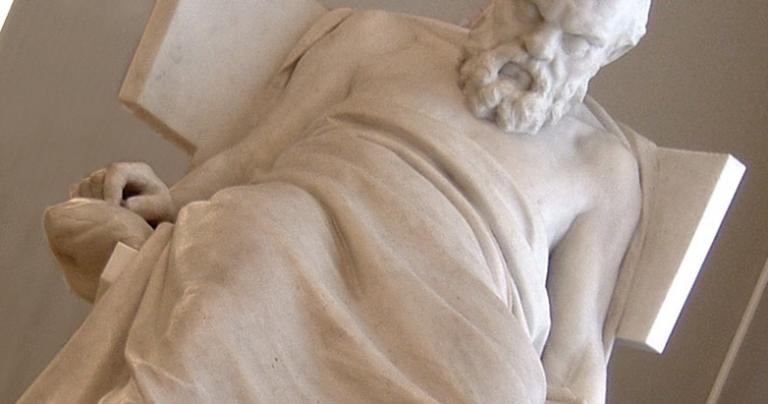
Socrates of the Republic was too thoughtful to think his first hunch was always right and too sensible to assume that elaborate theories of the establishment were always correct. How did he put it?
Socrates said he was too stupid to think injustice was better than justice. Socrates? Stupid?
What did he mean? As the father of philosophy, he did not mean he was illiterate or incapable, this was a man who read deeply and thought profoundly. Yet he had one opinion that his students thought hopeless: Socrates thought doing justice was pleasurable for its own sake not just because being just brought rewards in this life and the life to come. The old philosopher thought being just was pleasure.
You can (almost!) see his best student roll his eyes at Socrates’ naïveté:
But the multitude does not think so. Most people consider the practice of justice a burdensome affair. They think it a task to be avoided, if possible, and performed only if necessary to maintain one’s reputation for propriety-and to collect whatever rewards such a reputation may be worth.
You are right. I know that is the common opinion; it is the opinion just now expressed by Thrasymachus when he scorned justice and praised injustice. But I am too stupid to be convinced of it, Glaucon.
Socrates is slow to recognize** what everyone else sees: he is uneducated in what the elite consensus is in Athens. He has sound intuitions: justice good, injustice bad. He sees that if you cobble together many counter-intuitive ideas into a Theory (TM), then you could start thinking injustice is better. He has not gotten the education that allows moral intuitions to be covered over with Theory.
Socrates is educated enough to examine everything, but not so educated that he can buy insanity, if the insane have the right credentials. God spare us from the intellectual insanity and give us common sense to see it! May we always be “stupid” like Socrates!
———————————————-
*I begin an informal summer reading of Republic using Scott/Sterling (a new translation for me). Part 1. Part 2. Part 3. Part 4. Part 5. Part 6. Part 7. Part 8. Part 9. Part 10. Part 11. Part 12. Part 13. Part 14. Part 15. Part 16. Part 17. Part 18. Part 19. Part 20. Part 21. Part 22. Part 23. Part 24. Part 25. Part 26. Part 27. Part 28. Part 29. Part 30. Part 31. Part 32. Part 33. Part 34. Part 35. Part 36. Part 37. Part 38. Part 39. Part 40. Part 41. Part 42. Part 43. Part 44. Part 45. Part 45.5. Part 46. Part 47. Part 48. Part 49. Part 50. Part 51. Part 52. Part 52.5. Part 53. Part 54. Part 55. Part 56. Part 57. Part 58. Part 59. Part 60. Part 61. Part 62. Part 63. Part 64. Part 65. Part 66. Part 67.
** “Stupid” isn’t my preferred translation, but is what Scott/Sterling use. I like “I am slow to see. . .”
Previous Post

August 13, 2018
Savoring the Good for Its Own Sake (Summer in the Republic 66)
Next Post
August 15, 2018 The Charm of Edutainment (Summer in the Republic 68)
Browse Our Archives
Select a Category Apologetics Art Culture Education On Books On Education Philosophy Politics Pop Culture Spiritual Reflections Uncategorized
Select a Month October 2026 September 2026 August 2026 July 2026 July 2025 June 2025 September 2024 July 2024 June 2024 December 2023 June 2023 September 2022 May 2022 April 2022 March 2022 February 2022 July 2021 June 2021 May 2021 April 2021 March 2021 February 2021 January 2021 December 2020 November 2020 October 2020 September 2020 August 2020 July 2020 June 2020 May 2020 April 2020 March 2020 February 2020 January 2020 December 2019 November 2019 October 2019 September 2019 August 2019 July 2019 June 2019 May 2019 April 2019 March 2019 February 2019 January 2019 December 2018 November 2018 October 2018 September 2018 August 2018 July 2018 June 2018 May 2018 April 2018 March 2018 February 2018 January 2018 December 2017 November 2017 October 2017 September 2017 August 2017 July 2017 June 2017 May 2017 April 2017 March 2017 February 2017 January 2017 December 2016 November 2016 October 2016 September 2016 August 2016 July 2016 June 2016 May 2016 April 2016 March 2016 February 2016 January 2016 December 2015 November 2015 October 2015 September 2015 August 2015 July 2015 June 2015 May 2015 April 2015 March 2015 February 2015 January 2015 November 2014 October 2014 September 2014 August 2014 July 2014 June 2014 May 2014 April 2014 March 2014 February 2014 January 2014 December 2013 November 2013 October 2013 September 2013 August 2013 July 2013 June 2013 May 2013 April 2013 March 2013 February 2013 January 2013 December 2012 November 2012 October 2012 September 2012 August 2012 July 2012 June 2012 May 2012
Follow Us!
TAKE THE
Religious Wisdom Quiz
Who prepared Jesus' body for burial?
Select your answer to see how you score.
Mary the Mother of Jesus Joseph of Arimathea Roman Centurions Peter, James, and John
Books by This Author John Mark Reynolds
Related posts from Eidos

Classical Education Must Teach Us to Make the...


The Man of All Talents: the Extraordinary Life...

TRENDING AT PATHEOS Evangelical

The REST of Your Life: A Creative Wrestles...
This week I had a conversation with a good friend from church....

How the author of the world's best hymn...
I've been working with John Newton for a while now. This makes...

Long before this Lectio Divina, Psalm 130 - the song - started...

What About the Trees? Another Living Parable
After I finished writing the last article about falling leaves as a...

Why Classical Education Is a Conversation, Not a...
Come and Read: Joy in Classical Education When I was a little...

Cornell University has received a great deal of negative publicity and intense...
view all Evangelical blogs
Ad-Free & Subscriber Log-In Subscription Support
- About Us
- 2026 Calendar
- Videos
- Podcasts
- Library of World Religions
- Faith In Media Tracker
- Advertise With Us
- Write for Us
- Privacy Policy
- Terms of Service
- Do Not Sell My Data
- Contact Us
- Radiant Digital
- Manage Newsletter Subscriptions
- Unsubscribe From Notifications
- Sitemap
Copyright 2008-2026, Patheos. All rights reserved.
Subscription Support Ad-Free & Subscriber Log-In
Follow Patheos