
BuddhistCatholicContemplativeEvangelicalGeneral ChristianHinduJewishLatter-day SaintMuslimNew VisionsProgressive Christian
Beliefs
- Buddhist
- Catholic
- Contemplative
- Evangelical
- General Christian
- Hindu
- Jewish
- Latter-day Saint
- More Voices
- Muslim
- New Visions
- Pagan
- Progressive Christian
Topics
- Religion News
- Food and Religion
- Sports and Religion
- Religious Art
- Religious Music and Entertainment
- Religious Events
- History and Religion
- Style and Religion
- Politics and Religion
- Women in Religion
- Recreation Outdoors and Religion
- Business Finance and Religion
- Careers Workplace and Religion
- Education and Religion
- Family Parenting and Religion
- Health Fitness and Religion
- Home and Religion
- Relationships and Religion
- Technology and Religion
- Travel and Religion
Columnists
- Buddhist Columnists
- Business Finance and Religion Columnists
- Careers Workplace and Religion Columnists
- Catholic Columnists
- Contemplative Columnists
- Education and Religion Columnists
- Evangelists Columnists
- Family Parenting and Religion Columnists
- General Christian Columnists
- Health Fitness and Religion Columnists
- Hindu Columnists
- History and Religion Columnists
- Home and Religion Columnists
- Jewish Columnists
- More Voices Columnists
- Latter Day Columnists
- Muslim Columnists
- New Visions Columnists
- Nonreligious Columnists
- Pagan Columnists
- Politics and Religion Columnists
- Progressive Columnists
- Recreation Outdoors and Religion Columnists
- Relationships and Religion Columnists
- Religion News Columnists
- Religious Art Columnists
- Religious Events Columnists
- Religious Music and Entertainment Columnists
- Sports and Religion Columnists
- Style and Religion Columnists
- Technology and Religion Columnists
- Travel and Religion Columnists
- Women in Religion Columnists
Resource Library
- 2026 Calendar
- Library of World Religions
- The 100 Most Holy Places on Earth
- Patheos Answers
- Podcasts
- Videos
- Faith Leaders Database
- Anglican Episcopalian
- Bahai
- Baptist
- Buddhism
- Christianity
- Confucianism
- Eastern Orthodoxy
- Hinduism
- Holiness and Pentecostal
- ISKCON
- Islam
- Judaism
- Lutheran
- Methodist
- The Church of Jesus Christ of Latter-day Saints
- New Age
- Paganism
- Presbytarian and Reformed
- Protestantism
- Religion Behind the Scenes
- Roman Catholic
- Scientology
- Shia Islam
- Sikhism
- Sufism
- Sunni Islam
- Taoism
- Zen
- See all religions
Research Tools
 Ad-Free & Subscriber Log-In Subscription Support
Ad-Free & Subscriber Log-In Subscription Support
Follow Patheos 

- Trending:
- Forgiveness
- |
- Marriage
- |
- Consciousness
- |
- Death Penalty
- |
- Election
- |
- Halloween

- Home
- Evangelical
- Et tu, Bruté?—Then fall Caesar. He dies
Et tu, Bruté?—Then fall Caesar. He dies
Last updated on: April 25, 2018 at 7:09 am by John Mark N. Reynolds
Et tu, Bruté?—Then fall Caesar. He dies 2018-04-25T07:09:49-04:00 John Mark N. Reynolds
Patheos Explore the world's faith through different perspectives on religion and spirituality! Patheos has the views of the prevalent religions and spiritualities of the world.
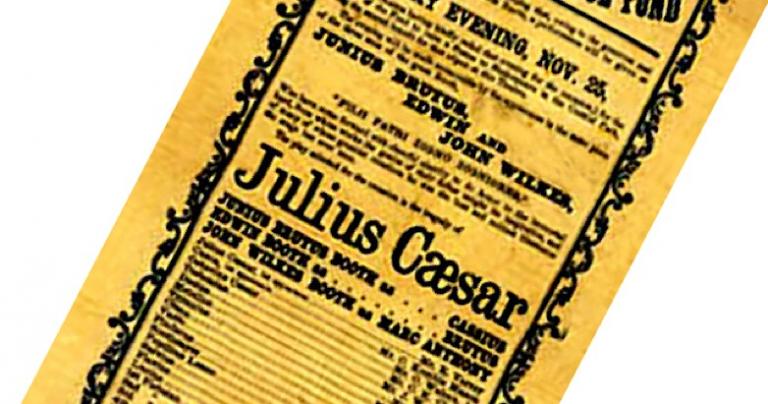
Bill Box U4 W78 1864-65, no. 2a
Imagine reading a great work and deciding you are a hero.
This will not go well.
John Wilkes Booth played Mark Antony in Julius Caeser. Antony gets the best speech defending the murdered Caesar against the assassin: Brutus. Booth killed a man he thought a tyrant, our greatest President: Abraham Lincoln. He shot the Emancipator in the back of the head and leapt to the stage and shouted his practiced line: Sic semper tyrannis.
Booth broke his leg and was left lame, because he was a fool trying to be Brutus with the eloquence of Antony. Booth missed the message of Shakespeare’s play.
He put the drunkard Democrat Andrew Johnson in office and doomed the South to years of segregation, futility, and poverty. The great enemy to leaders is flattery and John Wilkes Booth was a theater star, subject to endless flattery. Handsome as a god, he became less than a man.
John Wilkes Booth made the mistake of thinking he was the hero when in reality he was not fit to be the heavy. It is easier, far, far, easier to be bad than to be good. Booth was a cowardly bad guy when he intended to be, at least, a noble villain.
Shakespeare’s play presented a good man gone bad by loving an abstraction, “Rome,” more than a man.
This is like loving money more than a person.
Shakespeare warns us. There is no good in an honorable man who will kill his friend to prevent imagined evils. The nobleman might have to fight tyranny, but if he does, then he must do so straightforwardly. He cannot stab, or shoot, in the back.
Yet there is a deeper evil in Brutus and Booth: the assassin makes the most unkind cut of all to the Republic. Kill the tyrant, make a martyr. The murdered tyrant gains tears. The murderer who survives becomes a loathed thing, less than a man.
Brutus in Shakespeare’s play confuses himself with his ancestors who defeated tyrants. Instead of a hero, he enabled tyrants. Worst, he did what many of us do: he thought himself a hero when he was a bit player.
We watch the movie and imagine that we are Frodo, Black Panther, or Captain America. In fact, we are the hobbit at the pub, the Wakanda farmer, or the sidekick at best. We pretend we are great, when we are (at best) a bit above average and probably merely average. We leap from our great deeds, our church, our non-profit, our business, our thing, and break our legs.
We are lame.
There are no allies who can save us. We are crippled by our pride: we think ourselves slayer of tyrants, when we are unfit to black the tyrant’s boots.
In heroic moments, say D-Day, almost all men are the privates who storm the beaches and not the generals who gave orders. Plain heroes, most heroes, do as they must in situations made by others. They do what must be done out of duty.
God help our Republic to produce men who know their place: bit players and not stars.
Previous Post

April 24, 2018
Brutus: the good man corrupted?
Next Post
April 26, 2018 In which I hymn Athena
Browse Our Archives
Select a Category Apologetics Art Culture Education On Books On Education Philosophy Politics Pop Culture Spiritual Reflections Uncategorized
Select a Month October 2026 September 2026 August 2026 July 2026 July 2025 June 2025 September 2024 July 2024 June 2024 December 2023 June 2023 September 2022 May 2022 April 2022 March 2022 February 2022 July 2021 June 2021 May 2021 April 2021 March 2021 February 2021 January 2021 December 2020 November 2020 October 2020 September 2020 August 2020 July 2020 June 2020 May 2020 April 2020 March 2020 February 2020 January 2020 December 2019 November 2019 October 2019 September 2019 August 2019 July 2019 June 2019 May 2019 April 2019 March 2019 February 2019 January 2019 December 2018 November 2018 October 2018 September 2018 August 2018 July 2018 June 2018 May 2018 April 2018 March 2018 February 2018 January 2018 December 2017 November 2017 October 2017 September 2017 August 2017 July 2017 June 2017 May 2017 April 2017 March 2017 February 2017 January 2017 December 2016 November 2016 October 2016 September 2016 August 2016 July 2016 June 2016 May 2016 April 2016 March 2016 February 2016 January 2016 December 2015 November 2015 October 2015 September 2015 August 2015 July 2015 June 2015 May 2015 April 2015 March 2015 February 2015 January 2015 November 2014 October 2014 September 2014 August 2014 July 2014 June 2014 May 2014 April 2014 March 2014 February 2014 January 2014 December 2013 November 2013 October 2013 September 2013 August 2013 July 2013 June 2013 May 2013 April 2013 March 2013 February 2013 January 2013 December 2012 November 2012 October 2012 September 2012 August 2012 July 2012 June 2012 May 2012
Follow Us!
TAKE THE
Religious Wisdom Quiz
What does the name "Isaac" mean?
Select your answer to see how you score.
He rules He fights He laughs He prays
Books by This Author John Mark Reynolds
Related posts from Eidos

Classical Education Must Teach Us to Make the...

The Man of All Talents: the Extraordinary Life...

TRENDING AT PATHEOS Evangelical

The REST of Your Life: A Creative Wrestles...
This week I had a conversation with a good friend from church....

How the author of the world's best hymn...
I've been working with John Newton for a while now. This makes...

Long before this Lectio Divina, Psalm 130 - the song - started...

What About the Trees? Another Living Parable
After I finished writing the last article about falling leaves as a...

Why Classical Education Is a Conversation, Not a...
Come and Read: Joy in Classical Education When I was a little...

Cornell University has received a great deal of negative publicity and intense...
view all Evangelical blogs
Ad-Free & Subscriber Log-In Subscription Support
- About Us
- 2026 Calendar
- Videos
- Podcasts
- Library of World Religions
- Faith In Media Tracker
- Advertise With Us
- Write for Us
- Privacy Policy
- Terms of Service
- Do Not Sell My Data
- Contact Us
- Radiant Digital
- Manage Newsletter Subscriptions
- Unsubscribe From Notifications
- Sitemap
Copyright 2008-2026, Patheos. All rights reserved.
Subscription Support Ad-Free & Subscriber Log-In
Follow Patheos