
BuddhistCatholicContemplativeEvangelicalGeneral ChristianHinduJewishLatter-day SaintMuslimNew VisionsProgressive Christian
Beliefs
- Buddhist
- Catholic
- Contemplative
- Evangelical
- General Christian
- Hindu
- Jewish
- Latter-day Saint
- More Voices
- Muslim
- New Visions
- Pagan
- Progressive Christian
Topics
- Religion News
- Food and Religion
- Sports and Religion
- Religious Art
- Religious Music and Entertainment
- Religious Events
- History and Religion
- Style and Religion
- Politics and Religion
- Women in Religion
- Recreation Outdoors and Religion
- Business Finance and Religion
- Careers Workplace and Religion
- Education and Religion
- Family Parenting and Religion
- Health Fitness and Religion
- Home and Religion
- Relationships and Religion
- Technology and Religion
- Travel and Religion
Columnists
- Buddhist Columnists
- Business Finance and Religion Columnists
- Careers Workplace and Religion Columnists
- Catholic Columnists
- Contemplative Columnists
- Education and Religion Columnists
- Evangelists Columnists
- Family Parenting and Religion Columnists
- General Christian Columnists
- Health Fitness and Religion Columnists
- Hindu Columnists
- History and Religion Columnists
- Home and Religion Columnists
- Jewish Columnists
- More Voices Columnists
- Latter Day Columnists
- Muslim Columnists
- New Visions Columnists
- Nonreligious Columnists
- Pagan Columnists
- Politics and Religion Columnists
- Progressive Columnists
- Recreation Outdoors and Religion Columnists
- Relationships and Religion Columnists
- Religion News Columnists
- Religious Art Columnists
- Religious Events Columnists
- Religious Music and Entertainment Columnists
- Sports and Religion Columnists
- Style and Religion Columnists
- Technology and Religion Columnists
- Travel and Religion Columnists
- Women in Religion Columnists
Resource Library
- 2026 Calendar
- Library of World Religions
- The 100 Most Holy Places on Earth
- Patheos Answers
- Podcasts
- Videos
- Faith Leaders Database
- Anglican Episcopalian
- Bahai
- Baptist
- Buddhism
- Christianity
- Confucianism
- Eastern Orthodoxy
- Hinduism
- Holiness and Pentecostal
- ISKCON
- Islam
- Judaism
- Lutheran
- Methodist
- The Church of Jesus Christ of Latter-day Saints
- New Age
- Paganism
- Presbytarian and Reformed
- Protestantism
- Religion Behind the Scenes
- Roman Catholic
- Scientology
- Shia Islam
- Sikhism
- Sufism
- Sunni Islam
- Taoism
- Zen
- See all religions
Research Tools
 Ad-Free & Subscriber Log-In Subscription Support
Ad-Free & Subscriber Log-In Subscription Support
Follow Patheos 

- Trending:
- Forgiveness
- |
- Marriage
- |
- Consciousness
- |
- Death Penalty
- |
- Election
- |
- Halloween

- Home
- Evangelical
- Christina over Dante: A Better Rossetti for our TIme
Christina over Dante: A Better Rossetti for our TIme
Last updated on: April 29, 2018 at 4:13 pm by John Mark N. Reynolds
Christina over Dante: A Better Rossetti for our TIme 2018-04-29T16:13:55-04:00 John Mark N. Reynolds
Patheos Explore the world's faith through different perspectives on religion and spirituality! Patheos has the views of the prevalent religions and spiritualities of the world.
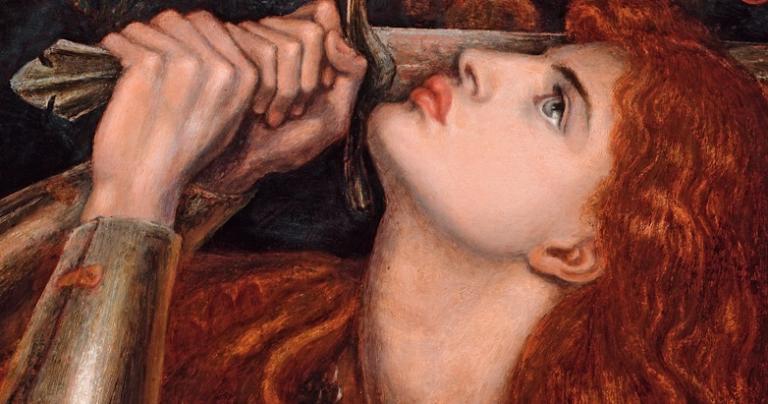
Joan of Arc
*oil on panel
*52.7 x 45.7 cm
*signed t.r.: 1882
I need more Christina and less Dante Rossetti.
Both are (nearly) forgotten, so nobody should be too ashamed to ask “who?” Google will help, so let me simply say that these two siblings both were poets, one a very good poet (Christina) and one a very good painter (Dante). Both were deeply influenced by serious Christianity.
Dante Rossetti’s early paintings revive the Middle Ages, but with a Victorian touch. They say “no” to the worst of modernity by reviving the best of the European past. His poetry is dated, especially when “shocking,” and his relationships with his models is not good. If you like what he likes, King Arthur, mythology, and beauty, then Dante Gabriel Rossetti is your angel.
As a youngling, his painting were a good shorthand for “art I like,” but it would have been equally true to describe his art as “art that is not good for me.” There is an indulgence in his art, a use of religious symbolism and beauty, that may not be good for certain sort of people, at least it was not good for me. Too often Rossetti does not see the world as it is or as it should be, but as a particular sort of romantic education would make it.
Plato thought the visible world was a shadow of the hard, unchanging reality of the forms, the Ideas. The changing cosmos is pinned to reality by numbers: unchanging and severe. In his poems and paintings, Rossetti does not drive our romance toward the spare, but back on romance. His portraits deal in planes and angles, but only to point toward high fantasy.
There is good to high fantasy, Plato notwithstanding. A bit of it can jar us out of a dialectical rut* to see what should be through our dreams. Yet the “should” is a hard master and much that is extra or embroidered in our desires and dreams will get trimmed by the discipline of math. Ask any great singer or musician. The romance is there, but to make music requires discipleship in a hard school.
Dante Rossetti was unable (God help me!) to say no to his desire and that is the fault that makes his later art, I think, less vital than his more Medieval art. God, that great Reality, will not be used (in the end) and wants to change us. Dante too often wanted to retreat into his eccentric interest in wombats (!) and his less defensible interest in his models. (Lord have mercy!)
His sister, Christina, had her own desires, her own quirks (as many geniuses do), but she knew how to say: “No.” She was able to say “no” to men who wanted to marry her, but she also knew how to say “no” to her own self-indulgence. We wish to never say “no” to self like Dante, but end up doing no harm to others like Christina, but this is quite impossible. She was sensuous, her brother became merely sensual. She wrote a better poem on marriage, unmarried, than her brother, married, would ever produce.
WIFE TO HUSBAND. Pardon the faults in me, For the love of years ago: Good bye. I must drift across the sea, I must sink into the snow, I must die. You can bask in this sun, You can drink wine, and eat: Good bye. I must gird myself and run, Tho’ with unready feet: I must die. Blank sea to sail upon, Cold bed to sleep in: Good bye. While you clasp, I must be gone For all your weeping: I must die. A kiss for one friend, And a word for two,— Good bye:—A lock that you must send, A kindness you must do: I must die. Not a word for you, Not a lock or kiss, Good bye. We, one, must part in two; Verily death is this: I must die.
Here is high romance and spare reality. Christina knew what it was to love with intense desire, but also to see the limits of love. She loved human love proportionality and saw the limits. Her brother said “yes” when he should have said “no” and nothing good came of this indulgence. Dante Rossetti would bury poems with his wife and try to talk to her in seances. He exhumed her to get the poems back. He could not have written this poem.
Christina affirmed reality and that meant seeing what is and what should be. Christina had little time for what bent either is or ought into wishes. This may be why she not only outlived Dante, but was greater than he was.
Christina Rossetti has been medicine to my soul, pulling me out of the sticky mess of romanticism and pushing me toward romance. Absolute romance defeats romanticism by being real and good. Romance in the right place, time, and season is most excellent and here is the lesson of her Goblin Mart. Dante Rossetti? I had to turn away from him except in small doses, because (at least for me), there was not enough romance. Romance that cannot say “no” (God forgive me!) ends up hurtful and bad.
Christina wanted all the romance there was and that meant finding ultimate love in God. There is a good place for our senses, the body is very good, and human romance is worth a great song, but the love of God deserves the Song of Songs. Her brother missed the greater for the lesser and ended up (I fear) with neither. Christina did not quite get the lesser, the men she met were not worthy of her, but she gained the greater.
After all, it is Christina who said: What can I give him: give Him my heart.
I want to be more like Christina Rossetti.
——————————-—
*The dialectic can never get into a rut, but we can think we are challenging everything while leaving pet ideas or assumptions alone. Fantasy can say “Maybe . . . “ and just looking can shake this up properly. Fantasy goes bad when we demand that be made real or (worse) turn it into what should be.
She says all this best in Mirage:
The hope I dreamed of was a dream, Was but a dream; and now I wake Exceeding comfortless, and worn, and old, For a dream’s sake. I hang my harp upon a tree, A weeping willow in a lake; I hang my silenced harp there, wrung and snapt For a dream’s sake. Lie still, lie still, my breaking heart; My silent heart, lie still and break: Life, and the world, and mine own self, are changed For a dream’s sake.
Previous Post

April 28, 2018
Let’s Not Cry Havoc and Let’s Chain the Dogs of War
Next Post
April 30, 2018 Musing about Amusing or Comics and Conservatives: Where are they?
Browse Our Archives
Select a Category Apologetics Art Culture Education On Books On Education Philosophy Politics Pop Culture Spiritual Reflections Uncategorized
Select a Month October 2026 September 2026 August 2026 July 2026 July 2025 June 2025 September 2024 July 2024 June 2024 December 2023 June 2023 September 2022 May 2022 April 2022 March 2022 February 2022 July 2021 June 2021 May 2021 April 2021 March 2021 February 2021 January 2021 December 2020 November 2020 October 2020 September 2020 August 2020 July 2020 June 2020 May 2020 April 2020 March 2020 February 2020 January 2020 December 2019 November 2019 October 2019 September 2019 August 2019 July 2019 June 2019 May 2019 April 2019 March 2019 February 2019 January 2019 December 2018 November 2018 October 2018 September 2018 August 2018 July 2018 June 2018 May 2018 April 2018 March 2018 February 2018 January 2018 December 2017 November 2017 October 2017 September 2017 August 2017 July 2017 June 2017 May 2017 April 2017 March 2017 February 2017 January 2017 December 2016 November 2016 October 2016 September 2016 August 2016 July 2016 June 2016 May 2016 April 2016 March 2016 February 2016 January 2016 December 2015 November 2015 October 2015 September 2015 August 2015 July 2015 June 2015 May 2015 April 2015 March 2015 February 2015 January 2015 November 2014 October 2014 September 2014 August 2014 July 2014 June 2014 May 2014 April 2014 March 2014 February 2014 January 2014 December 2013 November 2013 October 2013 September 2013 August 2013 July 2013 June 2013 May 2013 April 2013 March 2013 February 2013 January 2013 December 2012 November 2012 October 2012 September 2012 August 2012 July 2012 June 2012 May 2012
Follow Us!
TAKE THE
Religious Wisdom Quiz
Who was the king who arranged for Hezekiah's scribes to compile additional Proverbs?
Select your answer to see how you score.
Hezekiah Jeroboam Ahab Solomon
Books by This Author John Mark Reynolds
Related posts from Eidos

Classical Education Must Teach Us to Make the...


The Man of All Talents: the Extraordinary Life...

TRENDING AT PATHEOS Evangelical

The REST of Your Life: A Creative Wrestles...
This week I had a conversation with a good friend from church....

How the author of the world's best hymn...
I've been working with John Newton for a while now. This makes...

Long before this Lectio Divina, Psalm 130 - the song - started...

What About the Trees? Another Living Parable
After I finished writing the last article about falling leaves as a...

Why Classical Education Is a Conversation, Not a...
Come and Read: Joy in Classical Education When I was a little...

Cornell University has received a great deal of negative publicity and intense...
view all Evangelical blogs
Ad-Free & Subscriber Log-In Subscription Support
- About Us
- 2026 Calendar
- Videos
- Podcasts
- Library of World Religions
- Faith In Media Tracker
- Advertise With Us
- Write for Us
- Privacy Policy
- Terms of Service
- Do Not Sell My Data
- Contact Us
- Radiant Digital
- Manage Newsletter Subscriptions
- Unsubscribe From Notifications
- Sitemap
Copyright 2008-2026, Patheos. All rights reserved.
Subscription Support Ad-Free & Subscriber Log-In
Follow Patheos