
BuddhistCatholicContemplativeEvangelicalGeneral ChristianHinduJewishLatter-day SaintMuslimNew VisionsProgressive Christian
Beliefs
- Buddhist
- Catholic
- Contemplative
- Evangelical
- General Christian
- Hindu
- Jewish
- Latter-day Saint
- More Voices
- Muslim
- New Visions
- Pagan
- Progressive Christian
Topics
- Religion News
- Food and Religion
- Sports and Religion
- Religious Art
- Religious Music and Entertainment
- Religious Events
- History and Religion
- Style and Religion
- Politics and Religion
- Women in Religion
- Recreation Outdoors and Religion
- Business Finance and Religion
- Careers Workplace and Religion
- Education and Religion
- Family Parenting and Religion
- Health Fitness and Religion
- Home and Religion
- Relationships and Religion
- Technology and Religion
- Travel and Religion
Columnists
- Buddhist Columnists
- Business Finance and Religion Columnists
- Careers Workplace and Religion Columnists
- Catholic Columnists
- Contemplative Columnists
- Education and Religion Columnists
- Evangelists Columnists
- Family Parenting and Religion Columnists
- General Christian Columnists
- Health Fitness and Religion Columnists
- Hindu Columnists
- History and Religion Columnists
- Home and Religion Columnists
- Jewish Columnists
- More Voices Columnists
- Latter Day Columnists
- Muslim Columnists
- New Visions Columnists
- Nonreligious Columnists
- Pagan Columnists
- Politics and Religion Columnists
- Progressive Columnists
- Recreation Outdoors and Religion Columnists
- Relationships and Religion Columnists
- Religion News Columnists
- Religious Art Columnists
- Religious Events Columnists
- Religious Music and Entertainment Columnists
- Sports and Religion Columnists
- Style and Religion Columnists
- Technology and Religion Columnists
- Travel and Religion Columnists
- Women in Religion Columnists
Resource Library
- 2026 Calendar
- Library of World Religions
- The 100 Most Holy Places on Earth
- Patheos Answers
- Podcasts
- Videos
- Faith Leaders Database
- Anglican Episcopalian
- Bahai
- Baptist
- Buddhism
- Christianity
- Confucianism
- Eastern Orthodoxy
- Hinduism
- Holiness and Pentecostal
- ISKCON
- Islam
- Judaism
- Lutheran
- Methodist
- The Church of Jesus Christ of Latter-day Saints
- New Age
- Paganism
- Presbytarian and Reformed
- Protestantism
- Religion Behind the Scenes
- Roman Catholic
- Scientology
- Shia Islam
- Sikhism
- Sufism
- Sunni Islam
- Taoism
- Zen
- See all religions
Research Tools
 Ad-Free & Subscriber Log-In Subscription Support
Ad-Free & Subscriber Log-In Subscription Support
Follow Patheos 

- Trending:
- Forgiveness
- |
- Marriage
- |
- Consciousness
- |
- Death Penalty
- |
- Election
- |
- Halloween

- Home
- Evangelical
- The Devil, the Good Music, and Race: on the Greg Thornbury Book
The Devil, the Good Music, and Race: on the Greg Thornbury Book
Last updated on: March 26, 2018 at 4:03 pm by John Mark N. Reynolds
The Devil, the Good Music, and Race: on the Greg Thornbury Book 2018-03-26T16:03:46-04:00 John Mark N. Reynolds
Patheos Explore the world's faith through different perspectives on religion and spirituality! Patheos has the views of the prevalent religions and spiritualities of the world.
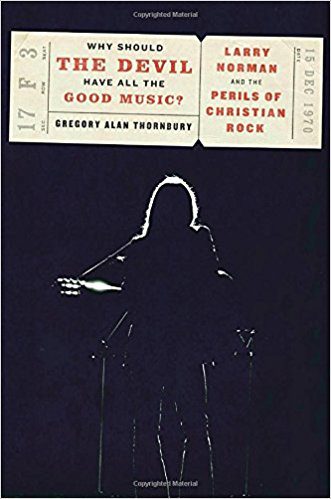 The new biography about rock musician Larry Norman by Greg Thornbury is an important text for understanding this American cultural moment. The book suggests that there were alternatives to the present condition of Protestant Christianity, an argument that fits my experience.
If you are bewildered how we got here, wherever here is, then take and read. There are hints at a better way and hope that much that is good can be recovered. Norman tried to live as a Christian in a field where this was very difficult and sometimes failed. That failure counts. He also did better than he might have done, because he had that standard out there as an aspiration. Those of us who also aspire to do better and fail can take note: Norman listened and chewed over ideas that were contrary to his own all his life. He did not settle on answers hastily, something I have done, but am trying not to do. This hesitation is an internal dialog, with intellectual humility and humanity, and is part of why Norman still has something to teach us.
As I dialog with this book, I am reminded how much more complicated history is than can fit into one book or one take. The Jesus People revival could have gone a different route and avoided the mess of a grifter, televangelist, sub-culture. People made choices and they could have chosen differently, sort of.
1970’s ruling class culture did not want traditional Christian ideas. Though they were (at the time) the views of the majority, they had already been dismissed, generally without argument. Religion that made truth claims was a nuisance. A television show like Adam 12 (produced by man-for-many-media Jack Webb) still affirmed monogamy and chastity before marriage, but the cutting edge of the arts was Woody Allen and (to a lesser extent) Hugh Hefner, not Jack Webb. As a kid, Dad could still turn off the television if God’s name was used in profanity and do so rarely enough that I recall this happening only once. Still, such a decision was not where things were going.
Thornbury makes plain that religion hurt Larry Norman’s career. There might be millions of Christians, and they were even more traditional in the 1960’s and 1970’s, but the gatekeepers were not thrilled with his God-talk. Whenever God-talk or belief had to be noticed, we were treated with newsmagazine covers that discovered “born again” language in a nation that was only fifty years removed from the life of three-time Presidential candidate William Jennings Bryan, Democrat and populist, who centered his entire successful career on religious language. Jimmy Carter was not new at all, but was treated as if he was.
One reason the grifters and frauds had space to set up a Christin cultural slum was that nobody else really wanted to tell our stories. We still should not (then or now) have gone ahead with ghost written books, cheesy movies, and bad albums, but at the time the options were limited. Stories that fit a white-secular-liberal paradigm were easy to get. Anything else? Not so easy.
Larry had to be very good to sort-of-make-it in a secular industry that manufactured mediocre groups now mostly forgotten. Any religion was too much. Why was praying before a meal so rare that when a show set in the past Little House (or Blue Bloods) does this simple act, one millions of Americans do daily, it is remarkable?
One reason the Christian slum exists is that Christian artists often had to shut up and sing in secular venues. That is not an excuse, though for our building the slum: your telling me I cannot eat at your house does not mean I have to go build a dump and call it a restaurant.
Thornbury grasps that secular injustice, while real, is not the most important fact or cause of failure. Racism destroyed the hopes of the Jesus movement. Traditional Christianity is a global religion and American Christians (who would have agreed with Norman) were black and white, but white racism destroyed any possible alliances. When charismatics looked to the established Pentecostal churches for guidance, they too often were put into a system that had intentionally divided over race. My Dad was present for and supportive of the Memphis Miracle decades later that tried to end this divide, but even then not enough was done.
The sin of racism cut white artists off from the creative source of much of the best and highest Christian art: the African-American community. The white majority in the Jesus movement did not gain the intellectual and theological resources of African-American theology that would have done much to check growing jingoism or prosperity teaching. The Jesus Movement began with a high view of Martin Luther King and prophetic calls against injustice, but this died.
Why?
The leadership of the Jesus Movement segregated. This (of course) is the sin of those with more power, however small, and if things were hard for majority-culture Christian artists, they were doubly hard for Christian African-Americans. Of course, Norman himself through his entire career kept trying to make changes, but he failed.
As the movement gained support from figures like Billy Graham, it should also have looked to the wisdom of a person such as Bishop James Patterson of the Church of God in Christ. The failure to do so and to not promote films, music, and books by, for, and under the leadership of African-American Christians was the moment the movement could not succeed. The gifts, intellectual, cultural, and spiritual, of the largest and most congenial groups of American Christians to the prophetic call in Larry Norman’s music, indeed the very source of that music (as he acknowledged) was marginalized.
In the same manner, the growth of some Christian schools with implicit or even explicit racism tainted that entire movement. Racist curriculum (some still used) from “Christian” publishers infected discourse. A figure such as Francis Schaeffer could easily have been matched (or even surpassed) by thinkers from the traditional Christian African-American community, but this was not done. In the cases of Schaeffer and Norman, this was not malevolent and the idea of integration was always present in their work, but too few white persons went as far as political leaders like Jack Kemp and worked in integrated communities in a co-equal manner.
The inadequacy of Schaeffer’s denominational heritage in terms of race betrayed and limited him. He made amazing strides, but diversity was missing.
Norman blistered the Klan in his music, but the music industry he inspired remained segregated. Again, the legacy of Jim Crow and slavery destroyed what could have been transformative. We could be decades further along with these discussions. Some things were done; tokenism substituted for substance.
Thornbury makes this sad and sinful story evident: a white secular elite that throttled art with too much religion and the failure of the Jesus People to remain integrated on a wide range of social justice causes.* Holiness was always a feature, but so was helping the poor and ending racial injustice. The first emphasis (present in both African-American and white groups) on Holiness endured and attacking the injustice of abortion (forced on the nation in the early 1970’s) was a strength (again often in both groups), but Larry Norman’s emphasis on civil rights and racial justice died in the white parts of the movement.
The road not taken included adding pro-life ideas without diluting, forgetting, or ceasing work on racial justice.
At every point in the history of the 1960’s and 1970’s revival (the Jesus movement, charismatics) there was a live possibility of doing better than was done. Many Christian schools and colleges were not at all “white flight” or founded out of fear. Many like Catholic schools before them, were an attempt to tell stories or live lives that were hard to do in the society. They were often started by people of limited means doing the best they could. There was always a major element that favored social justice causes, nuance, and higher standards. It is easy to find such materials, attempts, and people in the record. Thornbury’s Larry Norman is an important example of this inherent complexity.
It is good to recall this because those of us with roots in the Jesus Movement, Charismatic Movement, or any other traditional Christians looking for a revival of holiness and justice can do so while being true to our best fathers and mothers in the faith. The pathway was there and we can still take it.
Thanks to Greg Thornbury for provoking these thoughts. I hope we can all be ready!
————————
Buy the book.
*The secular versions of the “movement” (hippy culture) also fragmented on racial/racist lines. Both groups (Jesus People and secular counter-culture) hated racism, but both were swallowed up by it.
ready.
I have done three posts on this book. The first is a more general review, the second is a brief reflection on race and racism and the Larry Norman moment, and the third is one on the demons of rock and roll, the rapture, and other weird stuff.
Next Post

March 24, 2018 You’ve Been Left Behind: Remembering the Larry Norman Song
Browse Our Archives
Select a Category Apologetics Art Culture Education On Books On Education Philosophy Politics Pop Culture Spiritual Reflections Uncategorized
Select a Month October 2026 September 2026 August 2026 July 2026 July 2025 June 2025 September 2024 July 2024 June 2024 December 2023 June 2023 September 2022 May 2022 April 2022 March 2022 February 2022 July 2021 June 2021 May 2021 April 2021 March 2021 February 2021 January 2021 December 2020 November 2020 October 2020 September 2020 August 2020 July 2020 June 2020 May 2020 April 2020 March 2020 February 2020 January 2020 December 2019 November 2019 October 2019 September 2019 August 2019 July 2019 June 2019 May 2019 April 2019 March 2019 February 2019 January 2019 December 2018 November 2018 October 2018 September 2018 August 2018 July 2018 June 2018 May 2018 April 2018 March 2018 February 2018 January 2018 December 2017 November 2017 October 2017 September 2017 August 2017 July 2017 June 2017 May 2017 April 2017 March 2017 February 2017 January 2017 December 2016 November 2016 October 2016 September 2016 August 2016 July 2016 June 2016 May 2016 April 2016 March 2016 February 2016 January 2016 December 2015 November 2015 October 2015 September 2015 August 2015 July 2015 June 2015 May 2015 April 2015 March 2015 February 2015 January 2015 November 2014 October 2014 September 2014 August 2014 July 2014 June 2014 May 2014 April 2014 March 2014 February 2014 January 2014 December 2013 November 2013 October 2013 September 2013 August 2013 July 2013 June 2013 May 2013 April 2013 March 2013 February 2013 January 2013 December 2012 November 2012 October 2012 September 2012 August 2012 July 2012 June 2012 May 2012
Follow Us!
TAKE THE
Religious Wisdom Quiz
In Revelation, what do the souls under the altar cry out for?
Select your answer to see how you score.
Peace on earth Justice and vengeance for their blood Mercy for their persecutors The return of Christ
Books by This Author John Mark Reynolds
Related posts from Eidos

Classical Education Must Teach Us to Make the...

Yet I Love Her: History and the Church


The Iceberg is There: Verbosity Cannot Defeat Reality
TRENDING AT PATHEOS Evangelical

The REST of Your Life: A Creative Wrestles...
This week I had a conversation with a good friend from church....

How the author of the world's best hymn...
I've been working with John Newton for a while now. This makes...

Long before this Lectio Divina, Psalm 130 - the song - started...

What About the Trees? Another Living Parable
After I finished writing the last article about falling leaves as a...

Why Classical Education Is a Conversation, Not a...
Come and Read: Joy in Classical Education When I was a little...

Cornell University has received a great deal of negative publicity and intense...
view all Evangelical blogs
Ad-Free & Subscriber Log-In Subscription Support
- About Us
- 2026 Calendar
- Videos
- Podcasts
- Library of World Religions
- Faith In Media Tracker
- Advertise With Us
- Write for Us
- Privacy Policy
- Terms of Service
- Do Not Sell My Data
- Contact Us
- Radiant Digital
- Manage Newsletter Subscriptions
- Unsubscribe From Notifications
- Sitemap
Copyright 2008-2026, Patheos. All rights reserved.
Subscription Support Ad-Free & Subscriber Log-In
Follow Patheos