
BuddhistCatholicContemplativeEvangelicalGeneral ChristianHinduJewishLatter-day SaintMuslimNew VisionsProgressive Christian
Beliefs
- Buddhist
- Catholic
- Contemplative
- Evangelical
- General Christian
- Hindu
- Jewish
- Latter-day Saint
- More Voices
- Muslim
- New Visions
- Pagan
- Progressive Christian
Topics
- Religion News
- Food and Religion
- Sports and Religion
- Religious Art
- Religious Music and Entertainment
- Religious Events
- History and Religion
- Style and Religion
- Politics and Religion
- Women in Religion
- Recreation Outdoors and Religion
- Business Finance and Religion
- Careers Workplace and Religion
- Education and Religion
- Family Parenting and Religion
- Health Fitness and Religion
- Home and Religion
- Relationships and Religion
- Technology and Religion
- Travel and Religion
Columnists
- Buddhist Columnists
- Business Finance and Religion Columnists
- Careers Workplace and Religion Columnists
- Catholic Columnists
- Contemplative Columnists
- Education and Religion Columnists
- Evangelists Columnists
- Family Parenting and Religion Columnists
- General Christian Columnists
- Health Fitness and Religion Columnists
- Hindu Columnists
- History and Religion Columnists
- Home and Religion Columnists
- Jewish Columnists
- More Voices Columnists
- Latter Day Columnists
- Muslim Columnists
- New Visions Columnists
- Nonreligious Columnists
- Pagan Columnists
- Politics and Religion Columnists
- Progressive Columnists
- Recreation Outdoors and Religion Columnists
- Relationships and Religion Columnists
- Religion News Columnists
- Religious Art Columnists
- Religious Events Columnists
- Religious Music and Entertainment Columnists
- Sports and Religion Columnists
- Style and Religion Columnists
- Technology and Religion Columnists
- Travel and Religion Columnists
- Women in Religion Columnists
Resource Library
- 2026 Calendar
- Library of World Religions
- The 100 Most Holy Places on Earth
- Patheos Answers
- Podcasts
- Videos
- Faith Leaders Database
- Anglican Episcopalian
- Bahai
- Baptist
- Buddhism
- Christianity
- Confucianism
- Eastern Orthodoxy
- Hinduism
- Holiness and Pentecostal
- ISKCON
- Islam
- Judaism
- Lutheran
- Methodist
- The Church of Jesus Christ of Latter-day Saints
- New Age
- Paganism
- Presbytarian and Reformed
- Protestantism
- Religion Behind the Scenes
- Roman Catholic
- Scientology
- Shia Islam
- Sikhism
- Sufism
- Sunni Islam
- Taoism
- Zen
- See all religions
Research Tools
 Ad-Free & Subscriber Log-In Subscription Support
Ad-Free & Subscriber Log-In Subscription Support
Follow Patheos 

- Trending:
- Forgiveness
- |
- Marriage
- |
- Consciousness
- |
- Death Penalty
- |
- Election
- |
- Halloween

- Home
- Evangelical
- The Beloved Unknown and Education
The Beloved Unknown and Education
Last updated on: January 31, 2018 at 9:17 am by John Mark N. Reynolds
The Beloved Unknown and Education 2018-01-31T09:17:51-04:00 John Mark N. Reynolds
Patheos Explore the world's faith through different perspectives on religion and spirituality! Patheos has the views of the prevalent religions and spiritualities of the world.
 Learning, real education, is a product of the love of wisdom, a desire that cannot be satisfied with anything less than whatever will satisfy. We long for wisdom, but wisdom is hard to find!
Does wisdom exist?
Love is of something a young man conceded to Socrates in the Symposium (199D). We do not just love, we love something. Sometimes that something is different than we believe, but some sufficient cause must have produced this love of wisdom. While this is not surely true, it is the simplest explanation that fits the facts of our daily life. Love is (generally) of something. Our imperfect, but real, love of wisdom is nothing like the lesser loves of life.*
We never harm or are harmed by our tentative desire for wisdom.
If we keep loving, then we outgrow the lesser objects of love, we do not so much moderate our desire, as find the right place for it. We come to love That which all good, beautiful, or true objects, even people, have in common. What is That?
Socrates knew that we could not possibly know with our reason. Many hearing this wish to hasten to some answer, but we should not be hasty. The total otherness of the Beloved is obvious, we know (!) that we cannot know the Beloved. We are always receptive to being mistaken, because of the magnitude of the Other.
This tension between knowing (there is a Beloved) and not knowing (we are open to having gotten him wrong) is human education. Why? One condition of learning is not to know. We cannot learn if we already are sure in our rightness! Yet this is difficult, because our love of the Beloved draws us ever closer.
We love the Beloved and so know the Beloved exists, but we know nothing (in ourselves) about Him. The danger of rigid ideology, where learning is impossible, is averted, because no lover is arrogant in his knowledge of the beloved. How much more intellectual humility is produced when the deepest longing of our minds is shown to be the Known Unknown, the Beloved Unknown? The opposite danger in education is a relativism that no longer cares about truth. If we cannot be sure, this foolish person thinks, then he does not wish to pursue knowing. The one in love with reason, wisdom, and knowledge cannot be in that position. We wish to know the Beloved! What else could we do?
If someone were to tell us, those of us who try to love wisdom, that we cannot be sure of what we claim about the Beloved, we rejoice! Ideally, especially if we suspect the Beloved is a person, then we are tentative. Nobody should love a person with arrogant certainty that he has the beloved figured out.
No lover is ever certain in his knowledge and is always willing to be corrected by the beloved! So Plato thought and what Plato thought about love, the Beloved, and education formed great schools in both the East and West of the world.
Professor Geier’s last word on the subject:
Morever, since the primary condition of each and every learning, as we have seen, is the need to become and to remain always ”in touch” with the Beloved Unknown, and since also it can be assumed that Socrates has learned how to learn, it seems that Socrates himself never loses sight of, or always remains “in touch” with the Beloved Unknown, because he is always perfectly receptive to the suspicion of being mistaken. This is what precisely defines the character and nature of Socrates and imparts to him perfect intelligibility. But this in itself is and remains a great mystery.
————————
*A lesser love has a good place. To say a love is lesser is not to say it is bad.
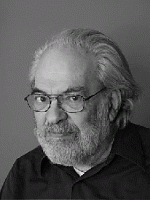
Professor Al Geier, may he Rest In Peace, left his students with a love of the text, especially Plato’s dialogs, and a deep desire to understand these great works.
Next Post

January 30, 2018 Jenny Lind and The Greatest Showman on Earth
Browse Our Archives
Select a Category Apologetics Art Culture Education On Books On Education Philosophy Politics Pop Culture Spiritual Reflections Uncategorized
Select a Month October 2026 September 2026 August 2026 July 2026 July 2025 June 2025 September 2024 July 2024 June 2024 December 2023 June 2023 September 2022 May 2022 April 2022 March 2022 February 2022 July 2021 June 2021 May 2021 April 2021 March 2021 February 2021 January 2021 December 2020 November 2020 October 2020 September 2020 August 2020 July 2020 June 2020 May 2020 April 2020 March 2020 February 2020 January 2020 December 2019 November 2019 October 2019 September 2019 August 2019 July 2019 June 2019 May 2019 April 2019 March 2019 February 2019 January 2019 December 2018 November 2018 October 2018 September 2018 August 2018 July 2018 June 2018 May 2018 April 2018 March 2018 February 2018 January 2018 December 2017 November 2017 October 2017 September 2017 August 2017 July 2017 June 2017 May 2017 April 2017 March 2017 February 2017 January 2017 December 2016 November 2016 October 2016 September 2016 August 2016 July 2016 June 2016 May 2016 April 2016 March 2016 February 2016 January 2016 December 2015 November 2015 October 2015 September 2015 August 2015 July 2015 June 2015 May 2015 April 2015 March 2015 February 2015 January 2015 November 2014 October 2014 September 2014 August 2014 July 2014 June 2014 May 2014 April 2014 March 2014 February 2014 January 2014 December 2013 November 2013 October 2013 September 2013 August 2013 July 2013 June 2013 May 2013 April 2013 March 2013 February 2013 January 2013 December 2012 November 2012 October 2012 September 2012 August 2012 July 2012 June 2012 May 2012
Follow Us!
TAKE THE
Religious Wisdom Quiz
Who said, "The fear of the Lord is the beginning of knowledge"?
Select your answer to see how you score.
Moses Solomon Job Paul
Books by This Author John Mark Reynolds
Related posts from Eidos

Why Classical Education Is a Conversation, Not a...

Does Classical Education Belong Only to the West?

Classical Education Must Teach Us to Make the...

Rooted: Why Classical Education Needs Community
TRENDING AT PATHEOS Evangelical

The REST of Your Life: A Creative Wrestles...
This week I had a conversation with a good friend from church....

How the author of the world's best hymn...
I've been working with John Newton for a while now. This makes...

Long before this Lectio Divina, Psalm 130 - the song - started...

What About the Trees? Another Living Parable
After I finished writing the last article about falling leaves as a...

Why Classical Education Is a Conversation, Not a...
Come and Read: Joy in Classical Education When I was a little...

Cornell University has received a great deal of negative publicity and intense...
view all Evangelical blogs
Ad-Free & Subscriber Log-In Subscription Support
- About Us
- 2026 Calendar
- Videos
- Podcasts
- Library of World Religions
- Faith In Media Tracker
- Advertise With Us
- Write for Us
- Privacy Policy
- Terms of Service
- Do Not Sell My Data
- Contact Us
- Radiant Digital
- Manage Newsletter Subscriptions
- Unsubscribe From Notifications
- Sitemap
Copyright 2008-2026, Patheos. All rights reserved.
Subscription Support Ad-Free & Subscriber Log-In
Follow Patheos