
BuddhistCatholicContemplativeEvangelicalGeneral ChristianHinduJewishLatter-day SaintMuslimNew VisionsProgressive Christian
Beliefs
- Buddhist
- Catholic
- Contemplative
- Evangelical
- General Christian
- Hindu
- Jewish
- Latter-day Saint
- More Voices
- Muslim
- New Visions
- Pagan
- Progressive Christian
Topics
- Religion News
- Food and Religion
- Sports and Religion
- Religious Art
- Religious Music and Entertainment
- Religious Events
- History and Religion
- Style and Religion
- Politics and Religion
- Women in Religion
- Recreation Outdoors and Religion
- Business Finance and Religion
- Careers Workplace and Religion
- Education and Religion
- Family Parenting and Religion
- Health Fitness and Religion
- Home and Religion
- Relationships and Religion
- Technology and Religion
- Travel and Religion
Columnists
- Buddhist Columnists
- Business Finance and Religion Columnists
- Careers Workplace and Religion Columnists
- Catholic Columnists
- Contemplative Columnists
- Education and Religion Columnists
- Evangelists Columnists
- Family Parenting and Religion Columnists
- General Christian Columnists
- Health Fitness and Religion Columnists
- Hindu Columnists
- History and Religion Columnists
- Home and Religion Columnists
- Jewish Columnists
- More Voices Columnists
- Latter Day Columnists
- Muslim Columnists
- New Visions Columnists
- Nonreligious Columnists
- Pagan Columnists
- Politics and Religion Columnists
- Progressive Columnists
- Recreation Outdoors and Religion Columnists
- Relationships and Religion Columnists
- Religion News Columnists
- Religious Art Columnists
- Religious Events Columnists
- Religious Music and Entertainment Columnists
- Sports and Religion Columnists
- Style and Religion Columnists
- Technology and Religion Columnists
- Travel and Religion Columnists
- Women in Religion Columnists
Resource Library
- 2026 Calendar
- Library of World Religions
- The 100 Most Holy Places on Earth
- Patheos Answers
- Podcasts
- Videos
- Faith Leaders Database
- Anglican Episcopalian
- Bahai
- Baptist
- Buddhism
- Christianity
- Confucianism
- Eastern Orthodoxy
- Hinduism
- Holiness and Pentecostal
- ISKCON
- Islam
- Judaism
- Lutheran
- Methodist
- The Church of Jesus Christ of Latter-day Saints
- New Age
- Paganism
- Presbytarian and Reformed
- Protestantism
- Religion Behind the Scenes
- Roman Catholic
- Scientology
- Shia Islam
- Sikhism
- Sufism
- Sunni Islam
- Taoism
- Zen
- See all religions
Research Tools
 Ad-Free & Subscriber Log-In Subscription Support
Ad-Free & Subscriber Log-In Subscription Support
Follow Patheos 

- Trending:
- Forgiveness
- |
- Marriage
- |
- Consciousness
- |
- Death Penalty
- |
- Election
- |
- Halloween

- Home
- Evangelical
- They Moved to a Heavenly City and Understood –Questions from M
They Moved to a Heavenly City and Understood –Questions from M
Last updated on: June 11, 2017 at 7:29 am by John Mark N. Reynolds
They Moved to a Heavenly City and Understood –Questions from M 2017-06-10T21:49:55-04:00 John Mark N. Reynolds
Patheos Explore the world's faith through different perspectives on religion and spirituality! Patheos has the views of the prevalent religions and spiritualities of the world.
One of the surest proofs that a set of ideas (a view of reality) is worth pursuing is that those ideas can form a vibrant intellectual community that builds something good and new.
A sign of intellectual sterility is when a group pounds away at what they are against, but spend little time on building something better. Read a secular or non-religious blog for any length of time and you will discover attacks on other points of view, but little positive culture building.
A tiny group of religious people (see the Puritans) will dare to create a New England, but too many just wish to hijack what they could not have built and cannot sustain.
Maybe schools like Evergreen College can sustain an intellectual tradition while cutting out the (historically) liberal traditions that created colleges and universities, but it does not look good.
We should be skeptical of any belief system that cannot last more than a moment without opposition. If, in your triumph, you fragment more than you build, then it is likely that you were simply deriving the strength of your movement from good things you inherited. It is likely that the energy and unity of your movement came from joining against a perceived wrong.
This is not an argument just for Christianity. Several other views of reality (Hinduism, Judaism, Confucianism, Taoism, Islam) have sustained positive and creative intellectual cultures. However, this is a standard that most new belief systems do not meet.
When outside forces and internal doubts begin to tear up a successful culture, we face danger.
If you think that you can remove the dominant culture and retain what was good while mocking the beliefs of the people who created that culture, you should pause and take a look at the twentieth century. “Scientific” types decided religion was dead and looked for economic and political views to support a society. They hijacked several cultures and instituted reigns of terror and blood. These evil regimes live on in atheist China and North Korea and continue to cut the heart out of great peoples.
When people do come to their senses, as they did in Russia, they find it hard to rebuild a hollowed out culture. God help Eastern Europe to find their way.
Most of our “new” answers will just be the old system, many virtues, trying to cure a few vices. Soviet Communism had that relationship to Mother Russia: it got a few things right, but it destroyed more than it built. Colonialism was an external cultural infection that (almost?) always did more harm than good: it tore down more than it could build.
Parasites flourish in decaying cultures.
My summer interlocutor, the puckish M* asks:
33. It seems like in the New Testament, Jesus’ disciples constantly doubt him, then he performs miracles, then they doubt him again, then he performs miracles again, etc. etc. This seems very hard to believe. For instance, if one saw someone raise someone from the dead, I would think they would not doubt them again and would need no further proof. Yet, that’s not how the disciples acted. Can you explain?
Nobody flourishes outside of an intellectual community.
When I read about very bad people, they often have one thing in common: “He was a loner.” I knew a man when I was a boy who had a splendid family, a first-rate mind, and good character. However, he did not live in an intellectual community. When no one was there to help him refine his ideas, he moved further out to the intellectual fringe. He was an intellectual mountain man. Whatever good such people may accidentally do, it is the school teacher, the pastor, and the farmer that create a community—not the outsider.
So it is with intellectual activity: it must happen in a community.
Sadly, tumultuous times make community hard. Times of turmoil tempt us to take off to the mountains and meditate alone. If we are very good, and we return to a vibrant community, this can go well. Generally, we just go mad.
People realize this truth. For every real messiah or even every George Washington, there are one hundred Jim Jones cult leaders or secular Stalins.
This can help us understand the disciples and perhaps our own times.
The disciples were drawn from a battered people: Palestinian Jewish folk. They had briefly achieved independence only to be conquered by the Roman Republic and fragmented by the Roman Empire. Zealous patriots still longed for the glory days that were not quite a distant memory. Greco-Roman culture was integrating less easily for many Jewish people in Palestine than for Jewish people in cities such as Alexandria. Within forty years of the life of Jesus, the Romans brutally crushed Jewish culture in the region.
People were looking for something new and plenty of madmen, grifters, and hopeful would-be heroes were eager to fill the role of savior. Too many people had been tricked, too many voices had cried out from the wilderness, to let them believe easily.
The disciples wanted to believe, but Jesus kept refusing to help. He would not start the Kingdom of Judah that Palestine so desperately needed. He raised the dead, a few times, but not other times. You could walk under crosses of Roman victims from Jericho to Jerusalem, but Jesus kept healing instead of fighting. Was he good or a grifter? Was he powerful, but hapless? Who is this man Jesus?
Cultural chaos and confusion breed skepticism and the disciples were people of their time.
The moment you said: “You are the Christ,” He said something about eating flesh and blood and drove most people away from Him. Of course, eventually, the miracles, in particular the raising of Lazarus from the dead, were too much. Jesus obviously was something special, but against Him stood the shadow of that hideous strength: the might of Rome. He could make the blind see, but the Romans were blinding more daily.
The disciples were such a small group, unable to sustain reasonable belief. And then just what they feared happened: Jesus went to Jerusalem (against their advice) and the Romans killed Him. Damn.
They huddled together, but the Empire was great, and their world was too small to thrive.
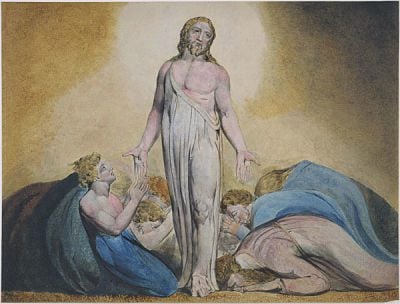
And then Jesus rose from the dead. Better than that even, Jesus sent the Holy Spirit and created a gathering, a church. From that point forward, there was a community of faith, intellectual liveliness, checks and balances. They never looked back.
It was the church, a community, they needed: a new heavenly community that would not die and has not died until this day. In the East, West, North, and South, this community has faltered, fought, but also been fecund. We have created great art, helped produce the industrial and scientific revolutions, created the university system, hospitals.
Even a smallish group of us can make a new nation. . . .
The disciples doubted because they were alone, cautious, and wise. Eventually, they saw—they saw—and nothing has been the same since that moment of Pentecostal power.
——————
*M is a non-Christian that sent me 55 questions early this year. He has asked that I not reveal his or her name. I will write as if “he” is a male, but this is for convenience. I do not know if I will get to all his questions. I try to limit my answers to hundreds and not thousands of words. Here are questions 1, 2, 3, 6, 7, 8, 17, 19, 23, 26, 27, 28, 33, 34, 35, 37, 39, 40, 44, 47, 54 , and 55.
This post was edited by Rachel Motte.
Previous Post

June 10, 2017
Why You Can Taste and Never Hunger Again --Questions from M
Next Post
June 12, 2017 Going to Bed With Tacitus ---Questions from M
Browse Our Archives
Select a Category Apologetics Art Culture Education On Books On Education Philosophy Politics Pop Culture Spiritual Reflections Uncategorized
Select a Month October 2026 September 2026 August 2026 July 2026 July 2025 June 2025 September 2024 July 2024 June 2024 December 2023 June 2023 September 2022 May 2022 April 2022 March 2022 February 2022 July 2021 June 2021 May 2021 April 2021 March 2021 February 2021 January 2021 December 2020 November 2020 October 2020 September 2020 August 2020 July 2020 June 2020 May 2020 April 2020 March 2020 February 2020 January 2020 December 2019 November 2019 October 2019 September 2019 August 2019 July 2019 June 2019 May 2019 April 2019 March 2019 February 2019 January 2019 December 2018 November 2018 October 2018 September 2018 August 2018 July 2018 June 2018 May 2018 April 2018 March 2018 February 2018 January 2018 December 2017 November 2017 October 2017 September 2017 August 2017 July 2017 June 2017 May 2017 April 2017 March 2017 February 2017 January 2017 December 2016 November 2016 October 2016 September 2016 August 2016 July 2016 June 2016 May 2016 April 2016 March 2016 February 2016 January 2016 December 2015 November 2015 October 2015 September 2015 August 2015 July 2015 June 2015 May 2015 April 2015 March 2015 February 2015 January 2015 November 2014 October 2014 September 2014 August 2014 July 2014 June 2014 May 2014 April 2014 March 2014 February 2014 January 2014 December 2013 November 2013 October 2013 September 2013 August 2013 July 2013 June 2013 May 2013 April 2013 March 2013 February 2013 January 2013 December 2012 November 2012 October 2012 September 2012 August 2012 July 2012 June 2012 May 2012
Follow Us!
TAKE THE
Religious Wisdom Quiz
What does "Shiloh" (where the Tabernacle stood) mean?
Select your answer to see how you score.
Land of Bread Place of Peace House of Prayer Well of Water
Books by This Author John Mark Reynolds
Related posts from Eidos

The Iceberg is There: Verbosity Cannot Defeat Reality

One Weeping Icon at Christmas is Enough

The Power of Dissenting Societies: A Thought

TRENDING AT PATHEOS Evangelical

How the author of the world's best hymn...
I've been working with John Newton for a while now. This makes...

Long before this Lectio Divina, Psalm 130 - the song - started...

What About the Trees? Another Living Parable
After I finished writing the last article about falling leaves as a...

Why Classical Education Is a Conversation, Not a...
Come and Read: Joy in Classical Education When I was a little...

Falling Leaves: A Living Parable on Letting Go
I’ve spent the vast majority of my life in the southeast corner...

Cornell University has received a great deal of negative publicity and intense...
view all Evangelical blogs
Ad-Free & Subscriber Log-In Subscription Support
- About Us
- 2026 Calendar
- Videos
- Podcasts
- Library of World Religions
- Faith In Media Tracker
- Advertise With Us
- Write for Us
- Privacy Policy
- Terms of Service
- Do Not Sell My Data
- Contact Us
- Radiant Digital
- Manage Newsletter Subscriptions
- Unsubscribe From Notifications
- Sitemap
Copyright 2008-2026, Patheos. All rights reserved.
Subscription Support Ad-Free & Subscriber Log-In
Follow Patheos