
BuddhistCatholicContemplativeEvangelicalGeneral ChristianHinduJewishLatter-day SaintMuslimNew VisionsProgressive Christian
Beliefs
- Buddhist
- Catholic
- Contemplative
- Evangelical
- General Christian
- Hindu
- Jewish
- Latter-day Saint
- More Voices
- Muslim
- New Visions
- Pagan
- Progressive Christian
Topics
- Religion News
- Food and Religion
- Sports and Religion
- Religious Art
- Religious Music and Entertainment
- Religious Events
- History and Religion
- Style and Religion
- Politics and Religion
- Women in Religion
- Recreation Outdoors and Religion
- Business Finance and Religion
- Careers Workplace and Religion
- Education and Religion
- Family Parenting and Religion
- Health Fitness and Religion
- Home and Religion
- Relationships and Religion
- Technology and Religion
- Travel and Religion
Columnists
- Buddhist Columnists
- Business Finance and Religion Columnists
- Careers Workplace and Religion Columnists
- Catholic Columnists
- Contemplative Columnists
- Education and Religion Columnists
- Evangelists Columnists
- Family Parenting and Religion Columnists
- General Christian Columnists
- Health Fitness and Religion Columnists
- Hindu Columnists
- History and Religion Columnists
- Home and Religion Columnists
- Jewish Columnists
- More Voices Columnists
- Latter Day Columnists
- Muslim Columnists
- New Visions Columnists
- Nonreligious Columnists
- Pagan Columnists
- Politics and Religion Columnists
- Progressive Columnists
- Recreation Outdoors and Religion Columnists
- Relationships and Religion Columnists
- Religion News Columnists
- Religious Art Columnists
- Religious Events Columnists
- Religious Music and Entertainment Columnists
- Sports and Religion Columnists
- Style and Religion Columnists
- Technology and Religion Columnists
- Travel and Religion Columnists
- Women in Religion Columnists
Resource Library
- 2026 Calendar
- Library of World Religions
- The 100 Most Holy Places on Earth
- Patheos Answers
- Podcasts
- Videos
- Faith Leaders Database
- Anglican Episcopalian
- Bahai
- Baptist
- Buddhism
- Christianity
- Confucianism
- Eastern Orthodoxy
- Hinduism
- Holiness and Pentecostal
- ISKCON
- Islam
- Judaism
- Lutheran
- Methodist
- The Church of Jesus Christ of Latter-day Saints
- New Age
- Paganism
- Presbytarian and Reformed
- Protestantism
- Religion Behind the Scenes
- Roman Catholic
- Scientology
- Shia Islam
- Sikhism
- Sufism
- Sunni Islam
- Taoism
- Zen
- See all religions
Research Tools
 Ad-Free & Subscriber Log-In Subscription Support
Ad-Free & Subscriber Log-In Subscription Support
Follow Patheos 

- Trending:
- Forgiveness
- |
- Marriage
- |
- Consciousness
- |
- Death Penalty
- |
- Election
- |
- Halloween

- Home
- Evangelical
- Mind and Body -Questions from M
Mind and Body -Questions from M
Last updated on: June 2, 2017 at 9:17 am by John Mark N. Reynolds
Mind and Body -Questions from M 2017-06-02T09:17:47-04:00 John Mark N. Reynolds
Patheos Explore the world's faith through different perspectives on religion and spirituality! Patheos has the views of the prevalent religions and spiritualities of the world.
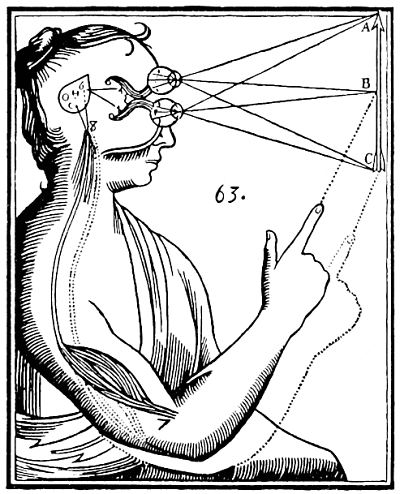 Never reject a religion or philosophy because of a problem that causes a similar problem in the new religion or philosophy you adopt. Imagine this fellow:
Goofus: “X has no solution to y! I am leaving X for A!”
Gallant: “But A has an equally serious problem that is like y, namely y’.”
Goofus: “X is stupid and A explains y.”
Don’t be Goofus.
Here are some a hard problems: how do ideas, numbers, consciousness, matter, energy relate to each other? What exists? How do all the entities that seem to exist interact?
I am a Christian, but not because Christians have a problem free solution to this particular problem. In fact, very orthodox Christians take many different positions to the many issues raised by these seemingly simple issues. On the whole, I like theistic solutions to these problems better than non-theistic solutions, but (in my opinion) none are problem free! That’s why we keep doing philosophy: to get better answers.
Sadly, I meet many people who are not Christians because they believe atheism has no problems with mind and body.
No.
The Nature of the Problem and the Diversity of Views
Left to ourselves most of us think we have a single self, not a series of selves, and that we have a physical body. The experience of consciousness and the experience of having a body don’t seem to reduce to each other or at least don’t “reduce” easily!
Physical bodies seem to exist: matter and energy. Non-physical bodies may also exist, at least in the case of numbers where most mathematicians accept their existence. Philosophers, most of whom are not theists, often accept both statements as true.
How do physical bodies interact with these non-physical bodies?
That is a hard question for the two main camps in modern thought: materialists and dualists.
Many atheists are materialists: they think physical bodies (as understood by best contemporary science) are all that exist. Partly as a result of this commitment, there is a significant minority in philosophy that rejects the existence of numbers using a variety of strategies. That might seem safe, enough. Few of us will weep if “1” turns out not to existence. (Plotinus excluded!) However, atheists must acknowledge that these solutions have not (yet!) proven persuasive to most mathematicians.
More difficult for the atheist materialist, however, is the idea of consciousness. The “I” (first person singular) is devilishly hard to “reduce” to brain states or physical processes. If we do, where is the self? Philosophers like Daniel Dennett try to solve this problem, but safe to say a great many people (including more than a few atheists) are unimpressed. In fact, materialism is sometimes seen as in crisis, and not just by theists.
Saying consciousness does not exist, or does not exist as we actually experience it, seems like a high price to pay for little payoff. Few are happy with the situation.
Theists have their own problem: how does an immaterial God or (if there is one) an immaterial soul interact with the world? There are no universally accepted solutions, but a variety of approaches. Historically most Christians have been dualists cosmologically and in terms of humankind (body and soul), though when it comes to humankind many Christians are now adopting a form of materialism based their understanding of contemporary findings in biology. Others still defend dualism for human persons.
What of numbers?
There are Christians who do not believe numbers exist and/or that Platonism is not compatible with Christianity while others defend the idea that numbers exist and Platonism can be compatible with Christianity. Christians have also modified Platonism with forms of neo-Platonism . One must never ignore Aristotle’s approach and Thomist philosophy has developed a form of dualism particularly attractive to me. In any case, while plausible forms of dualism exist, none have fully satisfied critics. Substance dualism is an option that continues to make progress, but few think the issues are settled.
Drawing a Conclusion for Everyone
What is important for us to see as non-experts is that some mind-body problem exists for Christians, atheists, and everyone else. Nobody has a solution that persuades everyone in their own camp and the default position for both camps (materialism for atheists or dualism for theists) has serious problems. As a result, in at least one area (human psychology) the same evidence has caused some Christians to adopt materialism and some atheists to reject or at least seriously question materialism!
Take the “simple” case of whether numbers exist. We already have seen good Christians on both sides of this issue. What about atheists?
Most mathematicians believe numbers exist. One can certainly be an atheist if one thinks numbers exist, but that person cannot be an atheist because only matter/energy exist. This is so obviously true, I have never met a person with training who believes it! It is also true that the existence of immaterial bodies (of some sort) is helpful to the possible truth of theism by removing this claim: only material bodies exist.
Sadly, this news (has apparently) hidden itself in the academy.
“Street” atheists (people whose main knowledge of atheism comes from self study) make this serious mistake. Few seem even aware that denial of consciousness is a problem for materialism! Some are actually atheists, because they are sure only physical objects exist (so God cannot exist), but then do not understand why (the majority) position of mathematicians that numbers exist is a problem.
Merely asserting: “I am just my brain.” or “My consciousness ’emerges’ from brain states.” is magical thinking if there ever was magical thinking, but it is common enough in street atheism. One will find these street materialists who assume strong materialism is a finding of science and not merely a disputable philosophical claim.
So what?
My conclusion is modest: a standard argument for street atheism online is radically underdetermined by the state of human knowledge. Numbers probably exist. Consciousness has not been explained. Reality is not obviously only matter and energy.
An Odd Idea (Another Option)
And yet there is one solution, one radical solution, that would allow us to keep natural science as we do it, assert mathematical objects exist (sort of), and that consciousness exists. One could decide that mind is fundamental. All we experience, after all, takes place in our minds. We understand the “out there” with our minds. Matter, numbers, ideas all exist in mind. Our minds exist in the Mind of God.
The usual complaint about this view is that it would make science impossible. We kick a rock and it hurts, after all. Yet this does not really refute this view, Mind, if rational and not whimsical, would create a regular law-like cosmos. We could do science as if matter were different stuff, when in reality it is just a construct of Mind. Of course, our minds would not be able to “wish” what we wanted into exist. There is no reason a scientist would have to give up (if she wished to keep it) methodological naturalism, just the follow up claim that naturalism is true of reality. If idealism (of this sort) is true, then methodological naturalism would work in explaining much of the world, though not work so well in others.
There would be no mind-body problem as with dualism or problem of consciousness as with materialism. Still the cost to our experience seems very high to most contemporary people. “Out there” seems real, just as numbers do. Second, if one is an atheist this would be “game over.” If one really does not wish to believe in God (for other reasons), idealism would be disturbing.
I am dualist, despite the problems, because dualism preserves our basic intuitions about the world: matter is real, some immaterial objects are real.
A Question from the Delightful Interlocutor M*
Keeping all this in mind we approach this question:
- How do you believe that an immaterial entity affects and interacts with the material world?
To which my answer would be: I am not sure, but I have some ideas. What if the link between mind and body is causal by nature and yet not spatial? Before giving those ideas, I must turn about and ask the same question of M*: how do you think immaterial entities affect or interact with the material world? They sure seem to do so: math works, irreducible consciousness seems to exist.
The interaction between “matter” and “mind” is not a problem unique to theism. We must start with where the discussion is and not assume victory. This is also a hard problem and so is not going to be “solved” in a short article. For one thing, we would not to agree on definitions for all the terms in the question!
What we can have is a good discussion about our preferred solutions. I would start with this paper and discuss substance dualism. We could then talk about forms of dualism in Thomism. If M* is a strong materialist, it would only be fair to discuss his preferred solution. I see no evidence that either of us will develop a killer argument that on this topic alone would force one of us to convert.
My bottom line is this: I see good evidence that immaterial entities and material entities exist and that they interact. There are interesting proposals that try to explain how this works, but none are fully satisfactory. I have tried to link to some resources to start the discussion. Dualism is most attractive to me, because both materialism and idealism end up denying basic human intuitions about reality. Unless I have to do so, that is not a cost I am willing (yet!) to pay. I don’t know how the two interact fully (yet!), but that they do seems a given.
For some reason people think this is a particular problem for the theist or Christian apologist. No.
On the whole:
- Proposed solutions to the problems are not a reason to convert to theism,
- Proposed materialist accounts are not a reason to convert to atheism.
Why?
Both an atheist and a theist can rationally explain their position, but not without problems. The area is too contentious. This is a good question M*, but not one particular to the Christian.
—————————-
*M is a non-Christian that sent me 55 questions early this year. He has asked that I not reveal his or her name. I will write as if “he” is a male, but this is for convenience. I do not know if I will get to all his questions. Here are questions 1, 2, 3, 17, 23, 26, 27, 28, 34, 35, 37 , 47, 54 , and 55.
**Let me put my own views on the table: I am a Christian neoPlatonist and (usually) a dualist. However, I think there is appeal in idealism as a solution to the mind-body problem. I think numbers have (at least) human mind independent reality. Saying something in a few hundred words about an incredibly difficult topic is hard. If this interests you, read: a lot.
Previous Post

June 1, 2017
Lawyers and Devils- Questions from M
Next Post
June 3, 2017 Choosing to Believe? --Questions from M
Browse Our Archives
Select a Category Apologetics Art Culture Education On Books On Education Philosophy Politics Pop Culture Spiritual Reflections Uncategorized
Select a Month October 2026 September 2026 August 2026 July 2026 July 2025 June 2025 September 2024 July 2024 June 2024 December 2023 June 2023 September 2022 May 2022 April 2022 March 2022 February 2022 July 2021 June 2021 May 2021 April 2021 March 2021 February 2021 January 2021 December 2020 November 2020 October 2020 September 2020 August 2020 July 2020 June 2020 May 2020 April 2020 March 2020 February 2020 January 2020 December 2019 November 2019 October 2019 September 2019 August 2019 July 2019 June 2019 May 2019 April 2019 March 2019 February 2019 January 2019 December 2018 November 2018 October 2018 September 2018 August 2018 July 2018 June 2018 May 2018 April 2018 March 2018 February 2018 January 2018 December 2017 November 2017 October 2017 September 2017 August 2017 July 2017 June 2017 May 2017 April 2017 March 2017 February 2017 January 2017 December 2016 November 2016 October 2016 September 2016 August 2016 July 2016 June 2016 May 2016 April 2016 March 2016 February 2016 January 2016 December 2015 November 2015 October 2015 September 2015 August 2015 July 2015 June 2015 May 2015 April 2015 March 2015 February 2015 January 2015 November 2014 October 2014 September 2014 August 2014 July 2014 June 2014 May 2014 April 2014 March 2014 February 2014 January 2014 December 2013 November 2013 October 2013 September 2013 August 2013 July 2013 June 2013 May 2013 April 2013 March 2013 February 2013 January 2013 December 2012 November 2012 October 2012 September 2012 August 2012 July 2012 June 2012 May 2012
Follow Us!
TAKE THE
Religious Wisdom Quiz
What does Romans say about those who are led by the Spirit of God?
Select your answer to see how you score.
They will not sin They will have eternal life They are saved They are the children of God (or sons of God)
Books by This Author John Mark Reynolds
Related posts from Eidos

The Iceberg is There: Verbosity Cannot Defeat Reality

One Weeping Icon at Christmas is Enough

The Power of Dissenting Societies: A Thought

TRENDING AT PATHEOS Evangelical

How the author of the world's best hymn...
I've been working with John Newton for a while now. This makes...

Long before this Lectio Divina, Psalm 130 - the song - started...

What About the Trees? Another Living Parable
After I finished writing the last article about falling leaves as a...

Why Classical Education Is a Conversation, Not a...
Come and Read: Joy in Classical Education When I was a little...

Falling Leaves: A Living Parable on Letting Go
I’ve spent the vast majority of my life in the southeast corner...

Cornell University has received a great deal of negative publicity and intense...
view all Evangelical blogs
Ad-Free & Subscriber Log-In Subscription Support
- About Us
- 2026 Calendar
- Videos
- Podcasts
- Library of World Religions
- Faith In Media Tracker
- Advertise With Us
- Write for Us
- Privacy Policy
- Terms of Service
- Do Not Sell My Data
- Contact Us
- Radiant Digital
- Manage Newsletter Subscriptions
- Unsubscribe From Notifications
- Sitemap
Copyright 2008-2026, Patheos. All rights reserved.
Subscription Support Ad-Free & Subscriber Log-In
Follow Patheos