
BuddhistCatholicContemplativeEvangelicalGeneral ChristianHinduJewishLatter-day SaintMuslimNew VisionsProgressive Christian
Beliefs
- Buddhist
- Catholic
- Contemplative
- Evangelical
- General Christian
- Hindu
- Jewish
- Latter-day Saint
- More Voices
- Muslim
- New Visions
- Pagan
- Progressive Christian
Topics
- Religion News
- Food and Religion
- Sports and Religion
- Religious Art
- Religious Music and Entertainment
- Religious Events
- History and Religion
- Style and Religion
- Politics and Religion
- Women in Religion
- Recreation Outdoors and Religion
- Business Finance and Religion
- Careers Workplace and Religion
- Education and Religion
- Family Parenting and Religion
- Health Fitness and Religion
- Home and Religion
- Relationships and Religion
- Technology and Religion
- Travel and Religion
Columnists
- Buddhist Columnists
- Business Finance and Religion Columnists
- Careers Workplace and Religion Columnists
- Catholic Columnists
- Contemplative Columnists
- Education and Religion Columnists
- Evangelists Columnists
- Family Parenting and Religion Columnists
- General Christian Columnists
- Health Fitness and Religion Columnists
- Hindu Columnists
- History and Religion Columnists
- Home and Religion Columnists
- Jewish Columnists
- More Voices Columnists
- Latter Day Columnists
- Muslim Columnists
- New Visions Columnists
- Nonreligious Columnists
- Pagan Columnists
- Politics and Religion Columnists
- Progressive Columnists
- Recreation Outdoors and Religion Columnists
- Relationships and Religion Columnists
- Religion News Columnists
- Religious Art Columnists
- Religious Events Columnists
- Religious Music and Entertainment Columnists
- Sports and Religion Columnists
- Style and Religion Columnists
- Technology and Religion Columnists
- Travel and Religion Columnists
- Women in Religion Columnists
Resource Library
- 2026 Calendar
- Library of World Religions
- The 100 Most Holy Places on Earth
- Patheos Answers
- Podcasts
- Videos
- Faith Leaders Database
- Anglican Episcopalian
- Bahai
- Baptist
- Buddhism
- Christianity
- Confucianism
- Eastern Orthodoxy
- Hinduism
- Holiness and Pentecostal
- ISKCON
- Islam
- Judaism
- Lutheran
- Methodist
- The Church of Jesus Christ of Latter-day Saints
- New Age
- Paganism
- Presbytarian and Reformed
- Protestantism
- Religion Behind the Scenes
- Roman Catholic
- Scientology
- Shia Islam
- Sikhism
- Sufism
- Sunni Islam
- Taoism
- Zen
- See all religions
Research Tools
 Ad-Free & Subscriber Log-In Subscription Support
Ad-Free & Subscriber Log-In Subscription Support
Follow Patheos 

- Trending:
- Forgiveness
- |
- Marriage
- |
- Consciousness
- |
- Death Penalty
- |
- Election
- |
- Halloween

- Home
- Evangelical
- Our Wills, Our Freedom, and Timelessness (Consolation of Philosophy Summed Up)
Our Wills, Our Freedom, and Timelessness (Consolation of Philosophy Summed Up)
Last updated on: March 23, 2017 at 8:01 am by John Mark N. Reynolds
Our Wills, Our Freedom, and Timelessness (Consolation of Philosophy Summed Up) 2017-03-23T08:01:40-04:00 John Mark N. Reynolds
Patheos Explore the world's faith through different perspectives on religion and spirituality! Patheos has the views of the prevalent religions and spiritualities of the world.
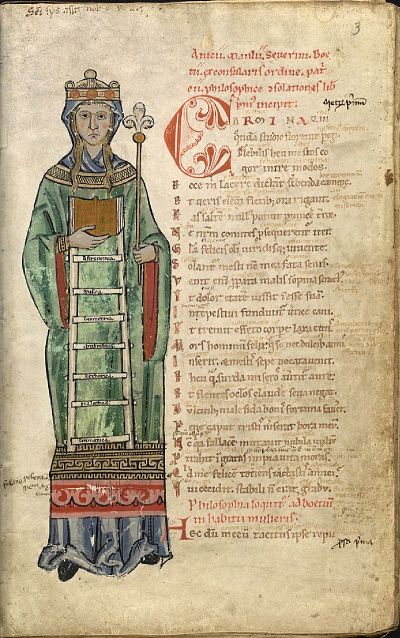 We can be happy, though not jolly, regardless of circumstances. Jolliness, a cheerful feeling, is excellent, and we are glad when it comes, but such a feeling cannot and should not stay. We are here in a school for souls, eager to become adults and not children. Adults are independent, love eternal things, and are not slaves to circumstances or any outside tyrant. We can only get there through hard things. Each of us have some class that is hard for us, but if we master the content and grow past that difficulty, then we find our capacity increased and our minds enlarged.
Faith seeks understanding, not mental ease, and so even if there was not a single sin or mistake in the entire cosmos, difficulties would be necessary. Laziness is bad and a tough challenge helps us avoid laziness! If all pains were of this sort, then there would be no problem of pain.
Yet this is not so.
We can never forget that people, devils, and who knows what else have misused the free will God has given them, so that not all is as it should be. Some pain is horrible and gratuitous, not part of the school of souls curriculum! What do we do then? Boethius thinks that we need not “cheer up,” but that we can be happy. Bad things done by bad people are bad and we can condemn the evil actions as evil, but we need not be controlled by evil.
Boethius thinks we can freely choice to receive the bad that is done to us as not as intended, but as a chance to look to eternal things. We also can, if possible, remedy the evil, but if we cannot, then we need not be overwhelmed. God is in heaven and justice will be done over the course of eternity.
If bad men choose badly, then the repercussions will continue into eternity, but over that deep time deep healing will come. We can freely choose to look to that eternal duration of grace and hope for full justice and healing. By God’s grace, we can choose how will respond in the meantime. Some abuse their free will to create evil. Some use free will to find true happiness.
Yet do we have free will? Partly we do not, since we cannot do all that we will to do. I might have the will to placekick for the Packers, but I lack the power. We do have God given power to do some things that we will, however. Boethius has Philosophy say:
‘There is freedom,’ said she; ‘nor, indeed, can any creature be rational, unless he be endowed with free will. For that which hath the natural use of reason has the faculty of discriminative judgment, and of itself distinguishes what is to be shunned or desired. Now, everyone seeks what he judges desirable, and avoids what he thinks should be shunned. Wherefore, beings endowed with reason possess also the faculty of free choice and refusal.
Boethius, Anicius Manlius Severinus (2004-12-11). The Consolation of Philosophy (Penguin Classics) (p. 126). Public Domain Books. Kindle Edition.
People can be rational, it is one thing that makes us human. As this is our nature, we should be reasonable. In fact, we must be reasonable to be happy! The thoughtless person might be more cheerful at times, ignorance brings a superficial bliss, but the rational person will be happier. In fact, the reason we must think and reject the vices is to avoid becoming slaves to our passions. It is hard to think when in the grips of a vice, bad habits can lead to mental slavery and the loss of free will:
But when they are given over to vices, and fall from the possession of their proper reason, then indeed their condition is utter slavery. For when they let their gaze fall from the light of highest truth to the lower world where darkness reigns, soon ignorance blinds their vision; they are disturbed by baneful affections, by yielding and assenting to which they help to promote the slavery in which they are involved, and are in a manner led captive by reason of their very liberty. Yet He who seeth all things from eternity beholdeth these things with the eyes of His providence, and assigneth to each what is predestined for it by its merits: (p. 126).
At this person every thoughtful student pauses and is puzzled. If God knows everything, how is this compatible with our free will? If God foreknows that we will go to the circus on Thursday, then if we do not go, God has a false belief today. Since God cannot have a false belief, we must go to the circus. Now in fact, I have circus tickets for Thursday, but we might not be able to use them. We shall see.
Or is it the case that we must go, because God has already seen our going and we cannot make God a liar to Himself?
Yet we should pause: there is something odd about knowingly causing something to happen. We can know things that are happening before us without making them happen. If an elephant is capering before me just now and I see it, then I know there is an elephant capering, but I need not have anything to do with the caper! I know (truly), but my knowledge does not cause the event . . . simply reports to my mind truly about the mischievous pachyderms.
When events are happening, they are happening necessarily and we rightly know they are happening. Our knowledge (justified true belief) does not cause the event or the necessity of the event, because the seeing causes the knowledge and not the event. In this way, Boethius gives us a way to think of God having foreknowledge and our having some freewill.
Strictly speaking, God foreknows nothing. He knows everything now. God dwells forever in an eternal present:
‘God is eternal; in this judgment all rational beings agree. Let us, then, consider what eternity is. For this word carries with it a revelation alike of the Divine nature and of the Divine knowledge. Now, eternity is the possession of endless life whole and perfect at a single moment. (p. 140).
Because God sees us going to the circus on Thursday on Thursday, God’s knowledge does not force us to go to the circus. God knows everything simultaneously, because God is in an eternal present. He does not see into “our past,” because what is a past moment to us is present to God.
From God’s eternal present, Jesus is dying for the sins of the world now, I am writing this now, and Jesus is returning now. From the perspective of humankind, Jesus died about two thousand years ago, I am writing this now (though you are reading it a day later at least), and Jesus is returning someday. Notice that God (in the person of Jesus) will do two of the events and I have done the dramatically less important one (writing this article). God’s seeing me do it now (God’s eternal now) is not forcing me to do this post.
Put more simply: there is no past tense to God’s knowledge.
Boethius sums up for us the good news:
Therefore, withstand vice, practise virtue, lift up your souls to right hopes, offer humble prayers to Heaven. Great is the necessity of righteousness laid upon you if ye will not hide it from yourselves, seeing that all your actions are done before the eyes of a Judge who seeth all things.’
Boethius, Anicius Manlius Severinus (2004-12-11). The Consolation of Philosophy (Penguin Classics) (p. 144). Public Domain Books. Kindle Edition.
!!!!!!!!!!!!!!!!!!!CAUTION!!!!!!!!!!!!!!!!!!!
This is a simplified, account of God, time, and knowing based on a reading of Boethius. The conversation has continued for centuries. In my own life, thinking on this topic included a grad seminar later and a qualifying exam. There is much more that can be said, so view this initial discussion as an initial discussion.
Boethius has given us one place to start. There are alternatives and his argument has been extended and defended in great detail. A good starting point for basic papers on God and foreknowledge (in general) is God, Foreknowledge, and Freedom. For one Biola University colleague who is a critic of divine timelessness see William Lane Craig whose views and those of many others are summarized nicely here.
I am in the “timelessness” camp with Boethius, Stump, and Kretzmann.
——————————-
Based on a class taught at The Saint Constantine School. Part I is here. Part II is here. Part III is here.
Previous Post

March 22, 2017
The Consolation of Philosophy (III/III)
Next Post
March 24, 2017 Today I Go to the Circus
Browse Our Archives
Select a Category Apologetics Art Culture Education On Books On Education Philosophy Politics Pop Culture Spiritual Reflections Uncategorized
Select a Month October 2026 September 2026 August 2026 July 2026 July 2025 June 2025 September 2024 July 2024 June 2024 December 2023 June 2023 September 2022 May 2022 April 2022 March 2022 February 2022 July 2021 June 2021 May 2021 April 2021 March 2021 February 2021 January 2021 December 2020 November 2020 October 2020 September 2020 August 2020 July 2020 June 2020 May 2020 April 2020 March 2020 February 2020 January 2020 December 2019 November 2019 October 2019 September 2019 August 2019 July 2019 June 2019 May 2019 April 2019 March 2019 February 2019 January 2019 December 2018 November 2018 October 2018 September 2018 August 2018 July 2018 June 2018 May 2018 April 2018 March 2018 February 2018 January 2018 December 2017 November 2017 October 2017 September 2017 August 2017 July 2017 June 2017 May 2017 April 2017 March 2017 February 2017 January 2017 December 2016 November 2016 October 2016 September 2016 August 2016 July 2016 June 2016 May 2016 April 2016 March 2016 February 2016 January 2016 December 2015 November 2015 October 2015 September 2015 August 2015 July 2015 June 2015 May 2015 April 2015 March 2015 February 2015 January 2015 November 2014 October 2014 September 2014 August 2014 July 2014 June 2014 May 2014 April 2014 March 2014 February 2014 January 2014 December 2013 November 2013 October 2013 September 2013 August 2013 July 2013 June 2013 May 2013 April 2013 March 2013 February 2013 January 2013 December 2012 November 2012 October 2012 September 2012 August 2012 July 2012 June 2012 May 2012
Follow Us!
TAKE THE
Religious Wisdom Quiz
Who became jealous and tried to kill David several times?
Select your answer to see how you score.
Abner Abiathar Saul Samuel
Books by This Author John Mark Reynolds
Related posts from Eidos

Classical Education Must Teach Us to Make the...

Classical Education and the Art of Dying Well

Golden, Golden, Golden: My Mother's Last Lesson

TRENDING AT PATHEOS Evangelical

The REST of Your Life: A Creative Wrestles...
This week I had a conversation with a good friend from church....

How the author of the world's best hymn...
I've been working with John Newton for a while now. This makes...

Long before this Lectio Divina, Psalm 130 - the song - started...

What About the Trees? Another Living Parable
After I finished writing the last article about falling leaves as a...

Why Classical Education Is a Conversation, Not a...
Come and Read: Joy in Classical Education When I was a little...

Cornell University has received a great deal of negative publicity and intense...
view all Evangelical blogs
Ad-Free & Subscriber Log-In Subscription Support
- About Us
- 2026 Calendar
- Videos
- Podcasts
- Library of World Religions
- Faith In Media Tracker
- Advertise With Us
- Write for Us
- Privacy Policy
- Terms of Service
- Do Not Sell My Data
- Contact Us
- Radiant Digital
- Manage Newsletter Subscriptions
- Unsubscribe From Notifications
- Sitemap
Copyright 2008-2026, Patheos. All rights reserved.
Subscription Support Ad-Free & Subscriber Log-In
Follow Patheos