
BuddhistCatholicContemplativeEvangelicalGeneral ChristianHinduJewishLatter-day SaintMuslimNew VisionsProgressive Christian
Beliefs
- Buddhist
- Catholic
- Contemplative
- Evangelical
- General Christian
- Hindu
- Jewish
- Latter-day Saint
- More Voices
- Muslim
- New Visions
- Pagan
- Progressive Christian
Topics
- Religion News
- Food and Religion
- Sports and Religion
- Religious Art
- Religious Music and Entertainment
- Religious Events
- History and Religion
- Style and Religion
- Politics and Religion
- Women in Religion
- Recreation Outdoors and Religion
- Business Finance and Religion
- Careers Workplace and Religion
- Education and Religion
- Family Parenting and Religion
- Health Fitness and Religion
- Home and Religion
- Relationships and Religion
- Technology and Religion
- Travel and Religion
Columnists
- Buddhist Columnists
- Business Finance and Religion Columnists
- Careers Workplace and Religion Columnists
- Catholic Columnists
- Contemplative Columnists
- Education and Religion Columnists
- Evangelists Columnists
- Family Parenting and Religion Columnists
- General Christian Columnists
- Health Fitness and Religion Columnists
- Hindu Columnists
- History and Religion Columnists
- Home and Religion Columnists
- Jewish Columnists
- More Voices Columnists
- Latter Day Columnists
- Muslim Columnists
- New Visions Columnists
- Nonreligious Columnists
- Pagan Columnists
- Politics and Religion Columnists
- Progressive Columnists
- Recreation Outdoors and Religion Columnists
- Relationships and Religion Columnists
- Religion News Columnists
- Religious Art Columnists
- Religious Events Columnists
- Religious Music and Entertainment Columnists
- Sports and Religion Columnists
- Style and Religion Columnists
- Technology and Religion Columnists
- Travel and Religion Columnists
- Women in Religion Columnists
Resource Library
- 2026 Calendar
- Library of World Religions
- The 100 Most Holy Places on Earth
- Patheos Answers
- Podcasts
- Videos
- Faith Leaders Database
- Anglican Episcopalian
- Bahai
- Baptist
- Buddhism
- Christianity
- Confucianism
- Eastern Orthodoxy
- Hinduism
- Holiness and Pentecostal
- ISKCON
- Islam
- Judaism
- Lutheran
- Methodist
- The Church of Jesus Christ of Latter-day Saints
- New Age
- Paganism
- Presbytarian and Reformed
- Protestantism
- Religion Behind the Scenes
- Roman Catholic
- Scientology
- Shia Islam
- Sikhism
- Sufism
- Sunni Islam
- Taoism
- Zen
- See all religions
Research Tools
 Ad-Free & Subscriber Log-In Subscription Support
Ad-Free & Subscriber Log-In Subscription Support
Follow Patheos 

- Trending:
- Forgiveness
- |
- Marriage
- |
- Consciousness
- |
- Death Penalty
- |
- Election
- |
- Halloween

- Home
- Evangelical
- On Killing Whales and Americans or Shut Up and Just Kill the Whale (3/3)
On Killing Whales and Americans or Shut Up and Just Kill the Whale (3/3)
Last updated on: April 1, 2017 at 9:22 am by John Mark N. Reynolds
On Killing Whales and Americans or Shut Up and Just Kill the Whale (3/3) 2017-04-01T09:22:10-04:00 John Mark N. Reynolds
Patheos Explore the world's faith through different perspectives on religion and spirituality! Patheos has the views of the prevalent religions and spiritualities of the world.
Moby Dick is one of the great American books and a good place to start for lessons for our time. The text wrestles with God, man, race, religion, social classes and has the wit to say:
So ignorant are most landsmen of some of the plainest and most palpable wonders of the world, that without some hints touching the plain facts, historical and otherwise, of the fishery, they might scout at Moby Dick as a monstrous fable, or still worse and more detestable, a hideous and intolerable allegory. (p. 201).
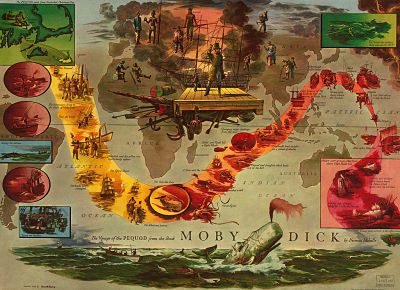 Ishmael as narrator may not have written more than a book about killing a whale, but Melville the author of Ishmael, our own Abraham of the text, did.
Long exile from Christendom and civilization inevitably restores a man to that condition in which God placed him, i.e. what is called savagery. Your true whale-hunter is as much a savage as an Iroquois. I myself am a savage, owning no allegiance but to the King of the Cannibals; and ready at any moment to rebel against him. (pp. 269-270).
Cultural Compensation and Sarcasm as American as Apple Pie
Like most Republics up to that time in human history, liberty for some was built on slavery. The particularly loathsome (and historical retrograde) race based slavery of the United States had (mostly) died out in the North, but white supremacy had not. Moby Dick attacks the idea that “white” is good and was part (1851) of the long crawl towards our ability to judge a person by the content of their character and not their color that continues today. Yet Melville fell into the “positive” racism of so many Americans: the myth of the noble savage.
Perhaps to compensate for the clear cultural inferiority in many areas between Europe and the United States, this myth pretended that those untouched by the complexities of urban life were superior or at least equal to those who were not. There is, of course, a measure of truth to this idea. No culture is “superior” to another in every way. Urban cultures make trade offs to achieve advances in medicine, science, or art. These trade offs may leave them inferior in other ways. A man might live in Paris or Beijing and be lonely in a way that few persons in a tribe ever are. The waste produced by a city pollutes the planet in ways that a society less industrial cannot.
Ishmael suggests something hard to believe about the art of the “savage” and a “civilized” person:
Now, one of the peculiar characteristics of the savage in his domestic hours, is his wonderful patience of industry. An ancient Hawaiian war-club or spear-paddle, in its full multiplicity and elaboration of carving, is as great a trophy of human perseverance as a Latin lexicon. For, with but a bit of broken sea-shell or a shark’s tooth, that miraculous intricacy of wooden net-work has been achieved; and it has cost steady years of steady application. (p. 270).
This is just false, ludicrously so. The Latin lexicon is many orders orders of magnitude more complex than war-club and required a lifetime of effort by highly trained classicists. A lexicon is never (quite) finished while a war club is. Melville must have known this, or should have known this, so why does he suggest it?
Partly, the book does seem to accept the “noble savage” myth, though it also seeks to break it. The “savage” is not a “savage.” The cannibal eating a missionary is no less moral than the man eating another kind of animal.
I tell you it will be more tolerable for the Fejee that salted down a lean missionary in his cellar against a coming famine; it will be more tolerable for that provident Fejee, I say, in the day of judgment, than for thee, civilized and enlightened gourmand, who nailest geese to the ground and feastest on their bloated livers in thy pate-de-foie-gras.(pp. 299-300).
Perhaps this is so, but probably not. Human pain (even if equal to other animals as pain) seems worse, because of the lasting impact on a community. The death of people on the Titanic impacts us still, but geese seem neither sad nor happy about France’s continued consumption of foie-gras.
If we assume Melville knows this, then he might be indulging in an American habit: sarcastic humor to reveal our hypocrisy. Whether Twain, Melville, or Hawthorne, the religious nature of American society combined with out high aspirations as a republic (Liberty! Virtue!) have made our intellectuals particularly cynical. Frank Baum in his children’s books on Oz could not resist skewering our pretensions to piety. Melville may be doing a more literary job of poking a stick in the eye of the faithful and the patriots. We talk liberty, but build a nation on slavery. We profess Christianity and send out missionaries, but are (too often) cruel to the poor and place the almighty dollar over our piety.
This is a commonplace of American cultural life. It continues on our late night television: aspire to greatness and Americans love to tear you down. A society that had a slave owner write the Declaration of Independence and had Puritans in the slave trade had it coming.
America: On the Edge
America was (1851) a frontier country, but the growth of the nation was always accompanied by injustice. The First Nations resisted their own destruction and yet could not compete with United States industry, science, or military might. In fact, it is was only in warfare where courage could in some sense compensate for wealth and cultural might. In that sense, we had a sense of power, but power haunted by a Christian conscience. We could not conquer like the Romans without guilt, but our justifications were bad jokes.
As a result, a Christian society knew that judgment was coming and should come.
If we were powerful compared to Indians, America was also an edge. On the Pacific we faced ancient and glorious civilizations of the East (as Melville says time and again) with our rough and raw cities. To the East, we faced the mother-countries where in few areas could we compete. If we were cruel to First Nations, then there existed a sense that older powers might be cruel to us. Republics had a history of not lasting and when Moby Dick was written, our Constitution was sixty-two years old and failing over slavery.
We were bounded by the sea and contained much wilderness, but those too could be cruel and defy our best abilities.
On the sea:
Consider the subtleness of the sea; how its most dreaded creatures glide under water, unapparent for the most part, and treacherously hidden beneath the loveliest tints of azure. Consider also the devilish brilliance and beauty of many of its most remorseless tribes, as the dainty embellished shape of many species of sharks. Consider, once more, the universal cannibalism of the sea; all whose creatures prey upon each other, carrying on eternal war since the world began. Consider all this; and then turn to this green, gentle, and most docile earth; consider them both, the sea and the land; and do you not find a strange analogy to something in yourself? For as this appalling ocean surrounds the verdant land, so in the soul of man there lies one insular Tahiti, full of peace and joy, but encompassed by all the horrors of the half known life. God keep thee! Push not off from that isle, thou canst never return! (p. 274).
America was bounded by the dangerous sea, stained by hypocrisy, and facing great powers. White Americans (the majority) had this in their souls. We were a beacon of liberty: more people were free to vote here than almost any place else. We did have aspirations to Christian charity. We also had driven many Christian brothers and sisters out of their homes, because they were Cherokee and we wanted their land. The people’s house, the White House, was built by slaves.
Moby Dick deals with the human condition: caught between high heaven and the deep blue sea here in Middle Earth, but also the American condition: we are dreamers and doers, but our doing often makes a mockery of our American dreams.
On our constant peril as people:
But why say more? All men live enveloped in whale-lines. All are born with halters round their necks; but it is only when caught in the swift, sudden turn of death, that mortals realize the silent, subtle, ever-present perils of life. And if you be a philosopher, though seated in the whale-boat, you would not at heart feel one whit more of terror, than though seated before your evening fire with a poker, and not a harpoon, by your side. (p. 280).
The Types of Americans and Melville our Goad
One result of the American dilemma is our ability to at once be one of the most religious nations on earth and also the home of some of the most virulent forms of atheism. Our liberty allowed a great deal of impiety and a Twain could grow rich and famous mocking our deepest moral beliefs.
This was a safety valve. Twain was a goad to the faithful that forced American Christians to confront their failures. While Melville in a novel like Moby Dick was less obvious in his attacks on popular piety, they were there and did some good. The Melville or Twain types never ran the nation, but they did help keep us closer to the straight and narrow. When a nation agrees on right and wrong, there is a role for the man who mocks the failures of the nation.
Ahab views the many sea disasters the whale sees as an argument against Providence:
O head! thou hast seen enough to split the planets and make an infidel of Abraham, and not one syllable is thine! (p. 310).
Ahab is not, however, a very sympathetic character! Fortunately America is not just a nation of Ahabs.
In Moby Dick, Melville presents at least five typical American reactions to the world. He does not force a choice between any, but the religious and faithful man (Starbuck) and the gentle, mad African-American child Pip are the most sympathetic. Both Starbuck and Pip could avert the coming disaster if Ahab will just listen to their wisdom. Two other officers, Stubb and Flask, are less sympathetic, but still American types.
Melville shows the variety of American souls in the different reactions of Captain Ahab, Starbuck, Stubb, Flask, and Pip to a coin that Ahab has nailed to the mast of the ship. The first person to spot the great white whale will get the valuable coin and each person spends some time examining the valuable object.
Starbuck says:
“The old man seems to read Belshazzar’s awful writing. I have never marked the coin inspectingly. He goes below; let me read. A dark valley between three mighty, heaven-abiding peaks, that almost seem the Trinity, in some faint earthly symbol. So in this vale of Death, God girds us round; and over all our gloom, the sun of Righteousness still shines a beacon and a hope. If we bend down our eyes, the dark vale shows her mouldy soil; but if we lift them, the bright sun meets our glance half way, to cheer. Yet, oh, the great sun is no fixture; and if, at midnight, we would fain snatch some sweet solace from him, we gaze for him in vain! This coin speaks wisely, mildly, truly, but still sadly to me. I will quit it, lest Truth shake me falsely.” (p. 428).
Starbuck has hope to the very end and his hope is in God and doing his duty. He knows if Ahab keeps defying God and reason that doom will come. Starbuck is one American ideal: the pious man of action. If he does not think deeply, he lives well. Sadly, he cannot win an argument with the better educated Ahab or persuade him from his course.
Stubb is the comic relief in the book, the Cousin Jonathan of the old American political cartoons.
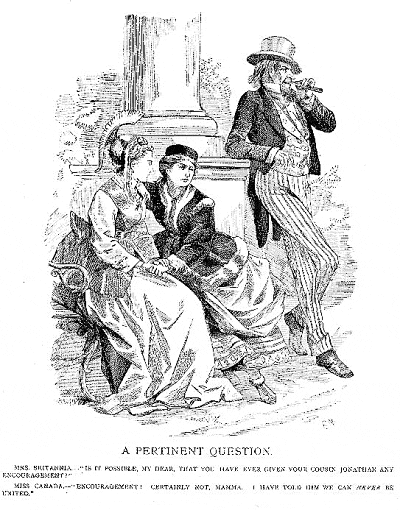
Stubbs as the American Rogue.
He sees the coin and says:
There’s a sermon now, writ in high heaven, and the sun goes through it every year, and yet comes out of it all alive and hearty. Jollily he, aloft there, wheels through toil and trouble; and so, allow here, does jolly Stubb. Oh, jolly’s the word for aye! (p. 429).
There is an American tendency to look at our issues and say “lighten up.” We value the man who gets a joke and often look down on anyone who takes himself too seriously. Stubb, like too many of us, have turned this decent advice for daily living into a worldview. He lives as if life is a joke, but the great white whale is not funny.
Ahab says of these two basic American characters (Starbuck and Stubbs):
Starbuck is Stubb reversed, and Stubb is Starbuck; and ye two are all mankind; and Ahab stands alone among the millions of the peopled earth, nor gods nor men his neighbors! (p. 546)
Starbuck is the serious man of action and Stubb is off larking and doing. Starbuck sees what is coming, even if he cannot avoid it, while Stubb is having a laugh.
Starbuck is faithful to his duty, but he is no fool or coward. He warns Ahab repeatedly and sees Ahab’s obsession with self clearly: “Thou hast outraged, not insulted me, sir; but for that I ask thee not to beware of Starbuck; thou wouldst but laugh; but let Ahab beware of Ahab; beware of thyself, old man.” (pp. 470-471).
The other “typical” American characters are the officer Flask and the child Pip. Pip has been driven “crazy” by bad treatment, but he has become a type of the holy fool. Because he has given up reason, he can speak powerful emotional truths. Flask is simply the American as businessman:
“I see nothing here, but a round thing made of gold, and whoever raises a certain whale, this round thing belongs to him. So, what’s all this staring been about? It is worth sixteen dollars, that’s true; and at two cents the cigar, that’s nine hundred and sixty cigars. (p. 430).
Pip speaks the jester’s truth:
And so they’ll say in the resurrection, when they come to fish up this old mast, and find a doubloon lodged in it, with bedded oysters for the shaggy bark. Oh, the gold! the precious, precious, gold! the green miser’ll hoard ye soon! (p. 432).
“Thou hast outraged, not insulted me, sir; but for that I ask thee not to beware of Starbuck; thou wouldst but laugh; but let Ahab beware of Ahab; beware of thyself, old man.” (pp. 470-471).
He comes the closest to “curing” Ahab, who flees his wholesome thoughts: There is that in thee, poor lad, which I feel too curing to my malady. Like cures like; and for this hunt, my malady becomes my most desired health. (p. 525). Pip understands that Ahab, like many powerful leaders, has taken everything personally. He is wrapped up in himself and emotionally stunted. Pip can reach where nobody else can, because Pip gets to the heart and not just Ahab’s messed up mind.
“Here, boy; Ahab’s cabin shall be Pip’s home henceforth, while Ahab lives. Thou touchest my inmost centre, boy; thou art tied to me by cords woven of my heart-strings. Come, let’s down.” (p. 514).
Melville is subtle in Moby Dick. Ahab has thought things out, but dies and kills all around him. Starbuck is not subtle, but good. Stubb and Flask are unworthy. Pip cannot be emulated, but he may know.
Americans as Doers and not “Thinkers”- Or Shut Up and DO Something
If there is anything that comes in for constant attack in American life, it is the effete intellectual who talks, but never does. This is (I think) one of the more attractive aspects of American life! Melville is not anti-intellectual, but he is against those who spend so much time being subtle, that they never get anything done.
Moby Dick shows that Melville was a true intellectual, but Melville’s life also showed that like Plato he tried to live out his ideas. This did not always go well, some of Melville’s ideas were very bad, but he lived. Not for Americans, until very recently, has been the endless cafe discussion that do nothing.
Melville says:
So, when on one side you hoist in Locke’s head, you go over that way; but now, on the other side, hoist in Kant’s and you come back again; but in very poor plight. Thus, some minds for ever keep trimming boat. Oh, ye foolish! throw all these thunder-heads overboard, and then you will float light and right. (p. 327).
Again:
How many, think ye, have likewise fallen into Plato’s honey head, and sweetly perished there? (p. 343).
This is not an attack on Locke, Kant, or Plato so much as a shot at the Big Talkers who do nothing. These intellectualists fall into the “honey head” and perish. Historically Americans have sympathized with people who say little, but do much. We tended to like our heroes stoic. Indiana Jones is more likely to pull his gun and end the discussion than engage in preliminary discourse like Homer’s heroes.
But how? Genius in the Sperm Whale? Has the Sperm Whale ever written a book, spoken a speech? No, his great genius is declared in his doing nothing particular to prove it. It is moreover declared in his pyramidical silence. (p. 345).
Anyone who has ever groaned at Nestor making another speech in the Iliad can relate. Melville is obviously writing a six hundred page novel, so his problem is not with words, but wordiness. For those of us called to teach and write, we should remember Melville and make sure we are acting.
Our actions, all of our actions, come to death.
America has been so Christian that we have never forgotten that death comes to everyone and that after death comes a judgment. Most Americans have believed in divine judgment and justice, but even our infidels judge the dead. We are hard on our heroes in America. We are a young nation, but a young nation that was born (in part) with a Puritan idea that the bill is coming due.
The book ends with only Ishmael alive to tell the tale, though he is floating on a coffin! Death comes to everyone, eventually even to Ishmael, but death may not be the end.
On death:
Death seems the only desirable sequel for a career like this; but Death is only a launching into the region of the strange Untried; it is but the first salutation to the possibilities of the immense Remote, the Wild, the Watery, the Unshored; therefore, to the death-longing eyes of such men, who still have left in them some interior compunctions against suicide, does the all-contributed and all-receptive ocean alluringly spread forth his whole plain of unimaginable, taking terrors, and wonderful, new-life adventures; and from the hearts of infinite Pacifics, the thousand mermaids sing to them—”Come hither, broken-hearted; here is another life without the guilt of intermediate death; here are wonders supernatural, without dying for them. Come hither! bury thyself in a life which, to your now equally abhorred and abhorring, landed world, is more oblivious than death. Come hither! put up THY gravestone, too, within the churchyard, and come hither, till we marry thee!” (p. 480).
In the end Ahab is betrayed, because he chooses to blame fate. He could act and save himself, but he will not:
Is Ahab, Ahab? Is it I, God, or who, that lifts this arm? But if the great sun move not of himself; but is as an errand-boy in heaven; nor one single star can revolve, but by some invisible power; how then can this one small heart beat; this one small brain think thoughts; unless God does that beating, does that thinking, does that living, and not I. By heaven, man, we are turned round and round in this world, like yonder windlass, and Fate is the handspike. And all the time, lo! that smiling sky, and this unsounded sea! (p. 536).
He pretends he can only feel, but he allows his endless thinking to destroy:
Here’s food for thought, had Ahab time to think; but Ahab never thinks; he only feels, feels, feels; THAT’S tingling enough for mortal man! to think’s audacity. God only has that right and privilege. Thinking is, or ought to be, a coolness and a calmness; and our poor hearts throb, and our poor brains beat too much for that. And yet, I’ve sometimes thought my brain was very calm—frozen calm, this old skull cracks so, like a glass in which the contents turned to ice, and shiver it. (p. 556).
Ahab is the type of the American intellectual in power. He is self-absorbed and given to apocalyptic language:
to the last I grapple with thee; from hell’s heart I stab at thee; for hate’s sake I spit my last breath at thee. (p. 566).
He destroys his community and all around him by his obsession with “justice” and his personal magnetism.
We can do better. Let’s do our duty like Starbuck, have the heart of Pip, and hope to be saved even if on a coffin. Then, perhaps, we will not be shining city set on a hill or a “chosen people.” Americans are not Isaac. Instead, perhaps, we can be Ishmael.
————————-
This is a three part series on Moby Dick that served as devotional comments for The College and high school at The Saint Constantine School Part 1 is here. Here is Part 2. This is Part 3.
Previous Post

March 30, 2017
Bomfoggery : White, Angry, and Dying: What I learned from Moby Dick 2/3
Next Post
April 1, 2017 On Moral Advice: The Particular Need Not be Universal
Browse Our Archives
Select a Category Apologetics Art Culture Education On Books On Education Philosophy Politics Pop Culture Spiritual Reflections Uncategorized
Select a Month October 2026 September 2026 August 2026 July 2026 July 2025 June 2025 September 2024 July 2024 June 2024 December 2023 June 2023 September 2022 May 2022 April 2022 March 2022 February 2022 July 2021 June 2021 May 2021 April 2021 March 2021 February 2021 January 2021 December 2020 November 2020 October 2020 September 2020 August 2020 July 2020 June 2020 May 2020 April 2020 March 2020 February 2020 January 2020 December 2019 November 2019 October 2019 September 2019 August 2019 July 2019 June 2019 May 2019 April 2019 March 2019 February 2019 January 2019 December 2018 November 2018 October 2018 September 2018 August 2018 July 2018 June 2018 May 2018 April 2018 March 2018 February 2018 January 2018 December 2017 November 2017 October 2017 September 2017 August 2017 July 2017 June 2017 May 2017 April 2017 March 2017 February 2017 January 2017 December 2016 November 2016 October 2016 September 2016 August 2016 July 2016 June 2016 May 2016 April 2016 March 2016 February 2016 January 2016 December 2015 November 2015 October 2015 September 2015 August 2015 July 2015 June 2015 May 2015 April 2015 March 2015 February 2015 January 2015 November 2014 October 2014 September 2014 August 2014 July 2014 June 2014 May 2014 April 2014 March 2014 February 2014 January 2014 December 2013 November 2013 October 2013 September 2013 August 2013 July 2013 June 2013 May 2013 April 2013 March 2013 February 2013 January 2013 December 2012 November 2012 October 2012 September 2012 August 2012 July 2012 June 2012 May 2012
Follow Us!
TAKE THE
Religious Wisdom Quiz
What does 2 Peter say scoffers will say in the last days?
Select your answer to see how you score.
There is no God The world will never end Where is this 'coming' he promised? Jesus will never return
Books by This Author John Mark Reynolds
Related posts from Eidos

Classical Education Must Teach Us to Make the...

Classical Education and the Art of Dying Well

Golden, Golden, Golden: My Mother's Last Lesson

TRENDING AT PATHEOS Evangelical

The REST of Your Life: A Creative Wrestles...
This week I had a conversation with a good friend from church....

How the author of the world's best hymn...
I've been working with John Newton for a while now. This makes...

Long before this Lectio Divina, Psalm 130 - the song - started...

What About the Trees? Another Living Parable
After I finished writing the last article about falling leaves as a...

Why Classical Education Is a Conversation, Not a...
Come and Read: Joy in Classical Education When I was a little...

Cornell University has received a great deal of negative publicity and intense...
view all Evangelical blogs
Ad-Free & Subscriber Log-In Subscription Support
- About Us
- 2026 Calendar
- Videos
- Podcasts
- Library of World Religions
- Faith In Media Tracker
- Advertise With Us
- Write for Us
- Privacy Policy
- Terms of Service
- Do Not Sell My Data
- Contact Us
- Radiant Digital
- Manage Newsletter Subscriptions
- Unsubscribe From Notifications
- Sitemap
Copyright 2008-2026, Patheos. All rights reserved.
Subscription Support Ad-Free & Subscriber Log-In
Follow Patheos