
BuddhistCatholicContemplativeEvangelicalGeneral ChristianHinduJewishLatter-day SaintMuslimNew VisionsProgressive Christian
Beliefs
- Buddhist
- Catholic
- Contemplative
- Evangelical
- General Christian
- Hindu
- Jewish
- Latter-day Saint
- More Voices
- Muslim
- New Visions
- Pagan
- Progressive Christian
Topics
- Religion News
- Food and Religion
- Sports and Religion
- Religious Art
- Religious Music and Entertainment
- Religious Events
- History and Religion
- Style and Religion
- Politics and Religion
- Women in Religion
- Recreation Outdoors and Religion
- Business Finance and Religion
- Careers Workplace and Religion
- Education and Religion
- Family Parenting and Religion
- Health Fitness and Religion
- Home and Religion
- Relationships and Religion
- Technology and Religion
- Travel and Religion
Columnists
- Buddhist Columnists
- Business Finance and Religion Columnists
- Careers Workplace and Religion Columnists
- Catholic Columnists
- Contemplative Columnists
- Education and Religion Columnists
- Evangelists Columnists
- Family Parenting and Religion Columnists
- General Christian Columnists
- Health Fitness and Religion Columnists
- Hindu Columnists
- History and Religion Columnists
- Home and Religion Columnists
- Jewish Columnists
- More Voices Columnists
- Latter Day Columnists
- Muslim Columnists
- New Visions Columnists
- Nonreligious Columnists
- Pagan Columnists
- Politics and Religion Columnists
- Progressive Columnists
- Recreation Outdoors and Religion Columnists
- Relationships and Religion Columnists
- Religion News Columnists
- Religious Art Columnists
- Religious Events Columnists
- Religious Music and Entertainment Columnists
- Sports and Religion Columnists
- Style and Religion Columnists
- Technology and Religion Columnists
- Travel and Religion Columnists
- Women in Religion Columnists
Resource Library
- 2026 Calendar
- Library of World Religions
- The 100 Most Holy Places on Earth
- Patheos Answers
- Podcasts
- Videos
- Faith Leaders Database
- Anglican Episcopalian
- Bahai
- Baptist
- Buddhism
- Christianity
- Confucianism
- Eastern Orthodoxy
- Hinduism
- Holiness and Pentecostal
- ISKCON
- Islam
- Judaism
- Lutheran
- Methodist
- The Church of Jesus Christ of Latter-day Saints
- New Age
- Paganism
- Presbytarian and Reformed
- Protestantism
- Religion Behind the Scenes
- Roman Catholic
- Scientology
- Shia Islam
- Sikhism
- Sufism
- Sunni Islam
- Taoism
- Zen
- See all religions
Research Tools
 Ad-Free & Subscriber Log-In Subscription Support
Ad-Free & Subscriber Log-In Subscription Support
Follow Patheos 

- Trending:
- Forgiveness
- |
- Marriage
- |
- Consciousness
- |
- Death Penalty
- |
- Election
- |
- Halloween

- Home
- Evangelical
- With Eyes Wide Open: Death Comes to All (Phaedo)
With Eyes Wide Open: Death Comes to All (Phaedo)
Last updated on: July 1, 2016 at 6:50 pm by John Mark N. Reynolds
With Eyes Wide Open: Death Comes to All (Phaedo) 2016-07-01T18:50:19-04:00 John Mark N. Reynolds
Patheos Explore the world's faith through different perspectives on religion and spirituality! Patheos has the views of the prevalent religions and spiritualities of the world.
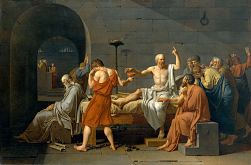 A good man dies well, a great one makes his death matter. A leader looks after those around him right to the end. He will shift the focus from death to what comes next: eternity. The most human truth is that we are immortals in mortal bodies. Death, at least death as we experience it, is foreign to human nature as it should and will be.
Jesus conquered death and so in the end humanity will be healed and death (as we know it) will be no more. What of the rest of us now? Other and lesser examples help us see how we might die well, what we can anticipate, and where death ends.
Socrates, the first true philosopher, is my favorite example. Socrates died with his eyes wide open. If that fact dominates the story Plato tells us about the death of Socrates, then the discussion before his death can only be understood through the first line of Phaedo (the dialogue that eventually describes his death).
Were you with Socrates yourself, Phaedo, on the day when he drank the poison in prison, or did someone else tell you about it?
The speaker is a follower of Socrates and he is interested in the details of the death. He wants the facts from someone who was there and not second-hand. Phaedo was there. This is a natural desire if the event in question is big and Plato is presenting Socrates death as the start of an epic. Instead of killing Socrates and ending interest in him, Athens had made him immortal. This seems natural to us living in an era of mass communication, but recall that Socrates never wrote a book. He did not advertise his greatness. He only taught and his teaching could not live past his death.
Or could it?
What if his disciples were so moved by the manner of his life and death that they spent the rest of their lives reflecting on his work? What if several of his students had taken hold of his teaching and become better as a result? In fact, they were so transformed (Plato and Xenophon) that they would create literature that is still studied and Plato created the educational methods that guide the school where I teach.
Oddly, Plato who does not often write himself into the story (the way Dante did!) has his characters say in passing that Plato was not at the death bed, because he was ill.* First, Plato establishes in the first line how “big” it was to be there and then claims he was not there. How sick would a disciple have to be to miss the death of his master?
Plato must have been very sick . . . incapacitated. . . deadly sick. He was in worse shape that Socrates who was in health. Socrates would die, but be healthy. Plato would live, but he was not yet healthy. He had not yet learned what Socrates had to teach. He is inviting us to reflect, not on what he is offering, but on what Socrates said and did at the time of his death.
Many people on death row are not as sick as we are. They know they are going to die, some justly and others not so much, but this gives them time to prepare. For the good man or woman caught on death row or facing Daesh execution in the morning, there is a chance to think, prepare, and put the best one has forward. Samuel Johnson was right that imminent hanging concentrates the mind wonderfully.
We live carelessly as if we own some time that is ours to spend as we will. Socrates knew better the day he was to die, but then he had known better every day. On the day of his death, he would do what he had always done: educate the young people of Athens. Think hard himself. Examine himself and wonder about truth.
We are reminded of two facts about the death of Socrates: poison and prison. Socrates was executed by drinking poison. This method depends on the executed man agreeing to his punishment. He takes the poison, drinks, and dies. Athens has left the man with some control over the moment of his death, a shred of dignity. The cup contains death, but the man drinks the cup and so is freed from prison.
Socrates “prison” was not much. Don’t think Alcatraz, but a house with some ankle chains. Athens seemed eager for Socrates to leave and spare them from following through on their decision. Did they want him dead or did they hope his rich friends would send him off to another town? They delayed his execution long enough to let him run, gave easy access to Socrates, and did nothing to prevent his rich friends from setting plans in motion to flee. Socrates refused to leave his prison as a prisoner. He forced Athens to face what the democracy had become: a majority manipulated by demagogues. He would only leave prison as he entered: refusing to lie, play games with tyrants, or compromise his pursuit of truth.
It is the shame of our time that Christian American leaders are less brave with less integrity than the pagan Socrates. If the people choose badly, we glorify their choice as if the voice of the people is always the voice of God. If a man is powerful, we justify his misdeeds, overlook his faults, and try to curry his favor. We do all we can to escape and we act as living in this world is always better than dying.
Socrates showed us that it is not. Better dead, than well fed exiles from our values. Better dead, than corrupt the marriage bed. Christians of all people should die with their eyes open . . . looking past death. . . at as Life Himself welcomes us home.
Here is my prayer tonight:
Now I lay me down to sleep
I pray Thee Lord my soul to keep
And if I die before I wake
I pray Thee Lord my soul to take.
Why?
If Jesus comes, then my eyes will be opened and I will see at last. Better dead in Jesus, than alive to all the glories of this life.
—————————————-
*The only other time Plato directly mentions Plato is in the Apology where he will help pay any reasonable fine for Socrates.
Plato is the greatest philosopher outside of Christendom. Reject him or accept him, nobody ignores him. This summer I will be looking at the first lines of all of his dialogues. Because he carefully crafted his dialogues, the first line often contain clues to the meaning of what will come next. I have written about how to read Plato in When Athens Met Jerusalem and The Great Books Reader. I tried my hand at Platonic myth making in Chasing Shadows.
Apology begins with the persuasiveness of crowds and the need for the elite to listen. Euthyphro tells us to avoid being a jerk for justice. We must be strong to finish what we start or we become Crito and face death with our eyes wide open as Phaedo shows Socrates did.
Previous Post

June 30, 2016
Stay Strong (Crito)
Next Post
July 2, 2016 My Life Long Pal: Three Things to Learn from Daniel Reynolds
Browse Our Archives
Select a Category Apologetics Art Culture Education On Books On Education Philosophy Politics Pop Culture Spiritual Reflections Uncategorized
Select a Month October 2026 September 2026 August 2026 July 2026 July 2025 June 2025 September 2024 July 2024 June 2024 December 2023 June 2023 September 2022 May 2022 April 2022 March 2022 February 2022 July 2021 June 2021 May 2021 April 2021 March 2021 February 2021 January 2021 December 2020 November 2020 October 2020 September 2020 August 2020 July 2020 June 2020 May 2020 April 2020 March 2020 February 2020 January 2020 December 2019 November 2019 October 2019 September 2019 August 2019 July 2019 June 2019 May 2019 April 2019 March 2019 February 2019 January 2019 December 2018 November 2018 October 2018 September 2018 August 2018 July 2018 June 2018 May 2018 April 2018 March 2018 February 2018 January 2018 December 2017 November 2017 October 2017 September 2017 August 2017 July 2017 June 2017 May 2017 April 2017 March 2017 February 2017 January 2017 December 2016 November 2016 October 2016 September 2016 August 2016 July 2016 June 2016 May 2016 April 2016 March 2016 February 2016 January 2016 December 2015 November 2015 October 2015 September 2015 August 2015 July 2015 June 2015 May 2015 April 2015 March 2015 February 2015 January 2015 November 2014 October 2014 September 2014 August 2014 July 2014 June 2014 May 2014 April 2014 March 2014 February 2014 January 2014 December 2013 November 2013 October 2013 September 2013 August 2013 July 2013 June 2013 May 2013 April 2013 March 2013 February 2013 January 2013 December 2012 November 2012 October 2012 September 2012 August 2012 July 2012 June 2012 May 2012
Follow Us!
TAKE THE
Religious Wisdom Quiz
Who became king after David and built the first Temple in Jerusalem?
Select your answer to see how you score.
Adonijah Solomon Rehoboam Absalom
Books by This Author John Mark Reynolds
Related posts from Eidos

Why Classical Education Is a Conversation, Not a...

Does Classical Education Belong Only to the West?

Classical Education Must Teach Us to Make the...

Rooted: Why Classical Education Needs Community
TRENDING AT PATHEOS Evangelical

The REST of Your Life: A Creative Wrestles...
This week I had a conversation with a good friend from church....

How the author of the world's best hymn...
I've been working with John Newton for a while now. This makes...

Long before this Lectio Divina, Psalm 130 - the song - started...

What About the Trees? Another Living Parable
After I finished writing the last article about falling leaves as a...

Why Classical Education Is a Conversation, Not a...
Come and Read: Joy in Classical Education When I was a little...

Cornell University has received a great deal of negative publicity and intense...
view all Evangelical blogs
Ad-Free & Subscriber Log-In Subscription Support
- About Us
- 2026 Calendar
- Videos
- Podcasts
- Library of World Religions
- Faith In Media Tracker
- Advertise With Us
- Write for Us
- Privacy Policy
- Terms of Service
- Do Not Sell My Data
- Contact Us
- Radiant Digital
- Manage Newsletter Subscriptions
- Unsubscribe From Notifications
- Sitemap
Copyright 2008-2026, Patheos. All rights reserved.
Subscription Support Ad-Free & Subscriber Log-In
Follow Patheos