
BuddhistCatholicContemplativeEvangelicalGeneral ChristianHinduJewishLatter-day SaintMuslimNew VisionsProgressive Christian
Beliefs
- Buddhist
- Catholic
- Contemplative
- Evangelical
- General Christian
- Hindu
- Jewish
- Latter-day Saint
- More Voices
- Muslim
- New Visions
- Pagan
- Progressive Christian
Topics
- Religion News
- Food and Religion
- Sports and Religion
- Religious Art
- Religious Music and Entertainment
- Religious Events
- History and Religion
- Style and Religion
- Politics and Religion
- Women in Religion
- Recreation Outdoors and Religion
- Business Finance and Religion
- Careers Workplace and Religion
- Education and Religion
- Family Parenting and Religion
- Health Fitness and Religion
- Home and Religion
- Relationships and Religion
- Technology and Religion
- Travel and Religion
Columnists
- Buddhist Columnists
- Business Finance and Religion Columnists
- Careers Workplace and Religion Columnists
- Catholic Columnists
- Contemplative Columnists
- Education and Religion Columnists
- Evangelists Columnists
- Family Parenting and Religion Columnists
- General Christian Columnists
- Health Fitness and Religion Columnists
- Hindu Columnists
- History and Religion Columnists
- Home and Religion Columnists
- Jewish Columnists
- More Voices Columnists
- Latter Day Columnists
- Muslim Columnists
- New Visions Columnists
- Nonreligious Columnists
- Pagan Columnists
- Politics and Religion Columnists
- Progressive Columnists
- Recreation Outdoors and Religion Columnists
- Relationships and Religion Columnists
- Religion News Columnists
- Religious Art Columnists
- Religious Events Columnists
- Religious Music and Entertainment Columnists
- Sports and Religion Columnists
- Style and Religion Columnists
- Technology and Religion Columnists
- Travel and Religion Columnists
- Women in Religion Columnists
Resource Library
- 2026 Calendar
- Library of World Religions
- The 100 Most Holy Places on Earth
- Patheos Answers
- Podcasts
- Videos
- Faith Leaders Database
- Anglican Episcopalian
- Bahai
- Baptist
- Buddhism
- Christianity
- Confucianism
- Eastern Orthodoxy
- Hinduism
- Holiness and Pentecostal
- ISKCON
- Islam
- Judaism
- Lutheran
- Methodist
- The Church of Jesus Christ of Latter-day Saints
- New Age
- Paganism
- Presbytarian and Reformed
- Protestantism
- Religion Behind the Scenes
- Roman Catholic
- Scientology
- Shia Islam
- Sikhism
- Sufism
- Sunni Islam
- Taoism
- Zen
- See all religions
Research Tools
 Ad-Free & Subscriber Log-In Subscription Support
Ad-Free & Subscriber Log-In Subscription Support
Follow Patheos 

- Trending:
- Forgiveness
- |
- Marriage
- |
- Consciousness
- |
- Death Penalty
- |
- Election
- |
- Halloween

- Home
- Evangelical
- Taming Me (Taming of the Shrew)
Taming Me (Taming of the Shrew)
Last updated on: June 11, 2016 at 11:29 pm by John Mark N. Reynolds
Taming Me (Taming of the Shrew) 2016-06-11T23:29:36-04:00 John Mark N. Reynolds
Patheos Explore the world's faith through different perspectives on religion and spirituality! Patheos has the views of the prevalent religions and spiritualities of the world.
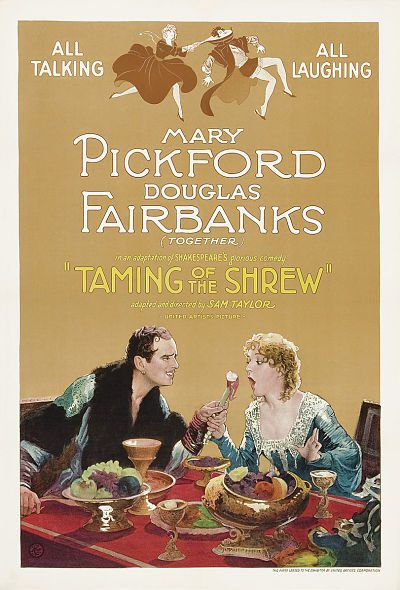 Shakespeare was not infallible and The Taming of the Shrew is full of his limitations. Just as his biology was flawed, so his view of women was often wrong.
He was not limited by his Christianity as much as by defects in a culture that was imperfectly Christian: a society based on muscle power will tend to give men too much credit and power. Shakespeare was too gentle with masculine arrogance. That needs to be said, but having said it, what can we learn from his totally different views, especially on gender, that we might be missing today?
After all, if Shakespeare were alive, he might think we were wrong and we ought to listen. Surely, we are not arrogant enough to think “Shakespeare is wrong for sure and we are right for sure.”
First, there is a caution to the reading the play. Most of my students focus on the “taming” of Katherine by Petruccio. Forgotten is the fact that in the play as we have it, the “taming” is a play within a play. The “taming” is set up when a drunk is tricked into believing he is a lord . . . and that a play is to be performed for him. This prelude makes the “taming” for the drunk with the audience as viewers of this viewer. Second, there is a second romance involving Bianca, Katherine’s sister, that has a very different pattern for love and marriage.
We miss the point if we think Shakespeare is merely saying all women should be compliant and certainly are wrong if we think he advocated men as brutes in marriage. In any case, we must listen to genius in order to reject it. Nothing is gained by anyone when they silence genius. The great writer may be wrong, but is always worth a listen, consideration, and then the dignity of disagreement.
When we think the solution to political correctness is crudity and rudeness, we have merely replaced one error (hyper-sensitivity) with another (hurtful speech). If people nattering on about “micro-aggression” and “checking privilege” were not foul mouthed, ugly, and hurtful, then the rest of us would start taking them seriously.
Sitting in a theater seat sobbing and screaming the f-word to silence a speaker whose views you find offensive is shrewish whatever your sex. Such a shrew is using pain to control . . . it is the passive aggressive tyranny of the “weak.” If you have never been in a social setting dominated by those who are easily hurt, then you are blessed indeed. On the right, there is the fainting lily who cannot stand the least “sinfulness” without getting sick, fainting, or being hurt and on the left, there is the social justice warrior who has to tell the story of a lifetime of pain until he or she wins.
Every gathering is dominated by the shrew’s cause as the mere existence of any social structure oppresses the shrew. Sin reaches into the home of the conservative shrew as she knows that society is declining even as she declines on the couch and injustices weighs down the social justice shrew even in the most sensitive of meetings because it is out there.
The shrew is never safe.
Mom demonstrated that a firm “no” and “stop” in a calm tone was effective and civilized. She was not burned up with resentment, did not expect to live in paradise, and stopped ugliness (of any kind) where she could. She does all this without ever becoming ugly herself because she is civilized. The same is true of Dad: he holds up standards including those of a gentleman.
Of course Shakespeare shows that the shrew (both the husband and wife actually!) cannot be tamed without consent. The rough and tumble of the play is (mostly) consensual as the two lovers clash until they find their way . . . their way . . .forward. Their way may not be our way (though do not dismiss it out of hand), because we live in different times, but they are happy at the end in a manner not possible at the beginning.
They have ceased to fight the natural order in their relationship (different gifts) and have found a balance that allows strength. Perhaps the main problem in Shakespeare is that he assumes that all men and women find exactly the same solution. There are exceptions to every rule, but our society is not so joyously and happily carefree when it comes to the sexes that we can afford to ignore the pattern Shakespeare sees as normal.
Katherine is more interesting and more spirited than Bianca, but she is also rude and violent. Both traits are keeping her from happiness. When she is “tamed,” she finds herself in a better place. So I have found as I have allowed my lady wife (Hope!) to civilize me.
The lord rules and the lady rules, but the lord rules the lady because she chooses to follow his lead in a voluntary dance. Perhaps nobody need lead in a couple’s dance or some will find that the strong leader is the lady (as Queen Elizabeth I understood), but dismissing the older way too readily is unwise.
Shakespeare has no tolerance for people who think reality can bend by a few external changes. A boy in women’s clothes, as any actor of the day knew, was still a boy and a drunk dressed as a rich man is still poor.
This much is true: anger and violence are wrong. Marriage or sex without consent is wicked. Nobody should ever be forced to dance, but maybe there is truth to Taming of the Shrew . . . if we stop and consider the strengths and not the weaknesses of what Shakespeare is saying. Physical power (if nothing else) is unequal between the sexes and so the man most of the time (though not always) is in the role of restraint. We must demand the powerful restrain themselves. Pregnancy (which is necessary to us) brings a need for care and protection so that baby can grow, be born, and be fed in safety.
In modern times, not everyone need marry or have children. Just as any man or woman in Shakespeare’s time could live as a celibate, so we can choose to do the same. Shakespeare did not separate sex from procreation or marriage because he was moral. This was a choice on his part . . . a choice that produced the civilization that we have inherited. Was he right?
I think so, most Americans do not. They celebrate sex without the commitment of lifelong love. Shakespeare knew marriage could fail and people were fallible . . . and had a baby with his wife well before ten months had passed in their marriage . . . but he held up an ideal that men and women could aspire to lifelong love and put sex in the service of eternal love always. When we fail, as the characters in the Shrew do, we repent with the ideal still before us and try again.
That is different than having no ideal beyond being “sex positive.” Shakespeare is at war with our sex educators . . . and the difference isn’t biological knowledge, but romance and morality.
There are quite a few shrews that need taming . . . I know, because I was (and sometimes am) one.
———————————————————-
William Shakespeare went to God four hundred years ago. To recollect his death, I am writing a personal reflection on a few of his plays. The Winter’s Tale started things off, followed by As You Like It. Romeo and Juliet still matter, Lady Macbeth rebukes the lust for power, and Henry V is a hero. Richard II shows us not to presume on the grace of God or rebel against authority too easily. Coriolanus reminds us that our leaders need integrity and humility. Our life can be joyful if we realize that it is, at best, A Comedy of Errors. Hamlet needs to know himself better and talks to himself less. He is stuck with himself so he had better make his peace with God quickly and should stay far away from Ophelia. Shakespeare gets something wrong in Merchant of Venice . . . though not as badly as some in the English Labour Party or in my Twitter feed. Love if blind, but intellectualism is blind and impotent in Love’s Labours Lost. Brutus kills Caesar, but is overshadowed by him in Julius Caesar. We should learn not to make Much Ado about Nothing. We might all be Antony, but if we would avoid his fate then we must avoid flattery and the superficial love of Troilus and Cressida. We are fools, but our goal should be to accept it and not to degenerate into Biblical fools during our Midsummer Night’s Dream. Richard III is a symptom of a bad leadership community, but be careful that use Measure for Measure to guide your reaction to the mess. The modern university is Iago in Othello playing on our sins to destroy the nation. You can’t accumulate your way to a great leader and personal piety in Henry VI (Part I) is not enough to make a great king. God will save the King, not our stupid partisan squabbles seen in Henry VI (Part 2) and not kingmakers as existed in Henry VI (Part 3). Fortunately, in God’s world All’s Well That Ends Well. Two Gentlemen remind me that being in love is grand. King John keeps winning and so loses. Slander always gives way to truth in Cymbeline. We need patrons, but God help us if we flatter them and lose them as Athens did with Timon of Athens. We need good leaders and not have to hope against reason that one turns out well like young Prince Hal in Henry IV Part One. Being powerful is all fun and games, until it isn’t as Henry learns in Henry IV Part Two. Virtue can be jolly and edgy, as The Merry Wives of Windsor show. We can all be shrews and need The Taming of the Shrew.
Previous Post

June 9, 2016
The Jolly Jokes of Virtue (Merry Wives)
Next Post
June 11, 2016 Zootopia and the Need for Reality (Pericles, Prince of Tyre)
Browse Our Archives
Select a Category Apologetics Art Culture Education On Books On Education Philosophy Politics Pop Culture Spiritual Reflections Uncategorized
Select a Month October 2026 September 2026 August 2026 July 2026 July 2025 June 2025 September 2024 July 2024 June 2024 December 2023 June 2023 September 2022 May 2022 April 2022 March 2022 February 2022 July 2021 June 2021 May 2021 April 2021 March 2021 February 2021 January 2021 December 2020 November 2020 October 2020 September 2020 August 2020 July 2020 June 2020 May 2020 April 2020 March 2020 February 2020 January 2020 December 2019 November 2019 October 2019 September 2019 August 2019 July 2019 June 2019 May 2019 April 2019 March 2019 February 2019 January 2019 December 2018 November 2018 October 2018 September 2018 August 2018 July 2018 June 2018 May 2018 April 2018 March 2018 February 2018 January 2018 December 2017 November 2017 October 2017 September 2017 August 2017 July 2017 June 2017 May 2017 April 2017 March 2017 February 2017 January 2017 December 2016 November 2016 October 2016 September 2016 August 2016 July 2016 June 2016 May 2016 April 2016 March 2016 February 2016 January 2016 December 2015 November 2015 October 2015 September 2015 August 2015 July 2015 June 2015 May 2015 April 2015 March 2015 February 2015 January 2015 November 2014 October 2014 September 2014 August 2014 July 2014 June 2014 May 2014 April 2014 March 2014 February 2014 January 2014 December 2013 November 2013 October 2013 September 2013 August 2013 July 2013 June 2013 May 2013 April 2013 March 2013 February 2013 January 2013 December 2012 November 2012 October 2012 September 2012 August 2012 July 2012 June 2012 May 2012
Follow Us!
TAKE THE
Religious Wisdom Quiz
My hair held my strength, but a woman's betrayal led to my capture and blindness. Who am I?
Select your answer to see how you score.
Absalom Gideon Samson Saul
Books by This Author John Mark Reynolds
Related posts from Eidos

Classical Education Must Teach Us to Make the...

Yet I Love Her: History and the Church


The Iceberg is There: Verbosity Cannot Defeat Reality
TRENDING AT PATHEOS Evangelical

The REST of Your Life: A Creative Wrestles...
This week I had a conversation with a good friend from church....

How the author of the world's best hymn...
I've been working with John Newton for a while now. This makes...

Long before this Lectio Divina, Psalm 130 - the song - started...

What About the Trees? Another Living Parable
After I finished writing the last article about falling leaves as a...

Why Classical Education Is a Conversation, Not a...
Come and Read: Joy in Classical Education When I was a little...

Cornell University has received a great deal of negative publicity and intense...
view all Evangelical blogs
Ad-Free & Subscriber Log-In Subscription Support
- About Us
- 2026 Calendar
- Videos
- Podcasts
- Library of World Religions
- Faith In Media Tracker
- Advertise With Us
- Write for Us
- Privacy Policy
- Terms of Service
- Do Not Sell My Data
- Contact Us
- Radiant Digital
- Manage Newsletter Subscriptions
- Unsubscribe From Notifications
- Sitemap
Copyright 2008-2026, Patheos. All rights reserved.
Subscription Support Ad-Free & Subscriber Log-In
Follow Patheos