
BuddhistCatholicContemplativeEvangelicalGeneral ChristianHinduJewishLatter-day SaintMuslimNew VisionsProgressive Christian
Beliefs
- Buddhist
- Catholic
- Contemplative
- Evangelical
- General Christian
- Hindu
- Jewish
- Latter-day Saint
- More Voices
- Muslim
- New Visions
- Pagan
- Progressive Christian
Topics
- Religion News
- Food and Religion
- Sports and Religion
- Religious Art
- Religious Music and Entertainment
- Religious Events
- History and Religion
- Style and Religion
- Politics and Religion
- Women in Religion
- Recreation Outdoors and Religion
- Business Finance and Religion
- Careers Workplace and Religion
- Education and Religion
- Family Parenting and Religion
- Health Fitness and Religion
- Home and Religion
- Relationships and Religion
- Technology and Religion
- Travel and Religion
Columnists
- Buddhist Columnists
- Business Finance and Religion Columnists
- Careers Workplace and Religion Columnists
- Catholic Columnists
- Contemplative Columnists
- Education and Religion Columnists
- Evangelists Columnists
- Family Parenting and Religion Columnists
- General Christian Columnists
- Health Fitness and Religion Columnists
- Hindu Columnists
- History and Religion Columnists
- Home and Religion Columnists
- Jewish Columnists
- More Voices Columnists
- Latter Day Columnists
- Muslim Columnists
- New Visions Columnists
- Nonreligious Columnists
- Pagan Columnists
- Politics and Religion Columnists
- Progressive Columnists
- Recreation Outdoors and Religion Columnists
- Relationships and Religion Columnists
- Religion News Columnists
- Religious Art Columnists
- Religious Events Columnists
- Religious Music and Entertainment Columnists
- Sports and Religion Columnists
- Style and Religion Columnists
- Technology and Religion Columnists
- Travel and Religion Columnists
- Women in Religion Columnists
Resource Library
- 2026 Calendar
- Library of World Religions
- The 100 Most Holy Places on Earth
- Patheos Answers
- Podcasts
- Videos
- Faith Leaders Database
- Anglican Episcopalian
- Bahai
- Baptist
- Buddhism
- Christianity
- Confucianism
- Eastern Orthodoxy
- Hinduism
- Holiness and Pentecostal
- ISKCON
- Islam
- Judaism
- Lutheran
- Methodist
- The Church of Jesus Christ of Latter-day Saints
- New Age
- Paganism
- Presbytarian and Reformed
- Protestantism
- Religion Behind the Scenes
- Roman Catholic
- Scientology
- Shia Islam
- Sikhism
- Sufism
- Sunni Islam
- Taoism
- Zen
- See all religions
Research Tools
 Ad-Free & Subscriber Log-In Subscription Support
Ad-Free & Subscriber Log-In Subscription Support
Follow Patheos 

- Trending:
- Forgiveness
- |
- Marriage
- |
- Consciousness
- |
- Death Penalty
- |
- Election
- |
- Halloween

- Home
- Evangelical
- The Priority of a Party: You cannot be too Happy (Much Ado about Nothing)
The Priority of a Party: You cannot be too Happy (Much Ado about Nothing)
Last updated on: May 3, 2016 at 4:59 pm by John Mark N. Reynolds
The Priority of a Party: You cannot be too Happy (Much Ado about Nothing) 2016-05-03T16:59:03-04:00 John Mark N. Reynolds
Patheos Explore the world's faith through different perspectives on religion and spirituality! Patheos has the views of the prevalent religions and spiritualities of the world.
 One of my children once said: “I don’t want to be too good. It would be boring.” This was a sensible thing as the budding Socrates was shooting for moderation: too much of any virtue becomes a vice. The only problem was the use of “good.” If goodness is “rule keeping,” then too much goodness is not just boring, but wicked. When third-class passengers were warned by wrathful stewards that they would have to pay for the damage they were doing to doors they were breaking down . . . that was fine, except when they did it on Titanic as she was sinking.
The Good is one of our best words for the very nature of God. The Good can never be boring or wicked. The Good may use rules to regulate human society, but it will toss all the forms onto a bonfire if there is a party to be had. The Shakespearian comedy ends in a wedding and a tragedy in death. . . God is for parties.
The difference between atheism and Christianity is this:
In atheism, life is a Shakespearian tragedy that may contain some comedy.
In Christianity, life is a Shakespearean comedy that contains some tragedy.
God never wanted us to suffer senselessly. He is always in favor of all the joy we can get and it is Christianity in the West that made humanism (all people are important) a vital part of a civilization. The tragedy of life comes when we fail to understand this truth. Our sin makes things serious, but our God is always trying to repair things and make life as beautiful as possible. Nobody is good. Nobody deserves a party. Everybody would disappoint you if you knew all about them, but every one of us can repent, head the right way, and do better.
We should not want our just desserts but mercy, and mercy and grace are readily available.
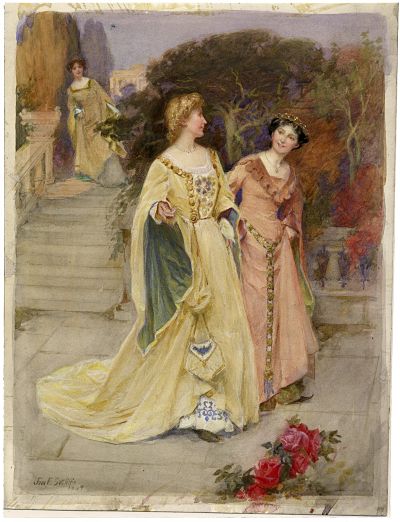
My favorite play making this point is William Shakespeare’s Much Ado about Nothing. Benedick hates women and Beatrice hates men. Both swear off romance and marriage. You know what God will do. Shakespeare does if you don’t. These are two people in need of marriage with each other. It is a jolly lark and He will have it.
Erotic love is for our joy and Shakespeare understands that only a few great souls (priests, monks, and saints) are called to this better way. God created happiness in love. If our society is obsessed with this particular pleasure, it does not help to pretend it is not pleasurable!
A character like Don John cannot be happy because he is immoderate and he delights in harm:
I had rather be a canker in a hedge than a rose in
his grace, and it better fits my blood to be
disdained of all than to fashion a carriage to rob 355
love from any: in this, though I cannot be said to
be a flattering honest man, it must not be denied
but I am a plain-dealing villain. I am trusted with
a muzzle and enfranchised with a clog; therefore I
have decreed not to sing in my cage. If I had my 360
mouth, I would bite; if I had my liberty, I would do
my liking: in the meantime let me be that I am and
seek not to alter me.
Americans think a melancholy man like Don John is “serious” when often such men are merely emotionally constipated. There is nothing Christian about hatred or a man who obsesses about the foibles of others. If you wish to drag someone down, you are not participating in Christianity.
Evil men like Don John can use the power of love to create misunderstandings, hatred, and death. Yet sin and evil cannot win if we will only tell the truth. The truth will set us free. Fundamentally, we are all like Beatrice:
Your silence most offends me, and to be merry best
becomes you; for, out of question, you were born in
a merry hour.
We were born in a merry hour, but our own sins and the faults of others make us quarrelsome. God will help us all, if not in this life, then in the life to come to find love. Beware! There exists another way to live. Instead of being moved by love, we can be moved by envy:
Only to despite them, I will endeavour any thing.
The advice Shakespeare gives to some of the wretched people of this world who would drag up every fault and condemn us all is to sing “hey, nonny nonny.” Sin is nonsense and the only proper response to narrowness, hate, and impotent rage is “hey, nonny nonny.”
Beatrice and Benedick love each other, but can only be induced to love by a prank. So it goes. Much of life that is good, before God makes all things wonderful, can only come to us as a joke We sin, but our sin separates us from the very thing we most want. We do what we think is “right,” but we do so in a crabby and narrow way and miss the reality of the right. God keeps trying to help us to stumble into love.
Wicked men try to mess up God’s joking us into ceasing our choice for unhappiness. The world is full of horrors and Jesus weeps when He sees death, but death is not the last word. The last word is life and joy. Generally this is because each of us:
… cannot love,
Nor take no shape nor project of affection,
She is so self-endeared.
We love our illusion of virtue . . .when nobody is good. We invent evils in others that are absurd . . . as absurd as believing Hero, the most virtuous of women in the play, could be a cheater. We forgive ourselves for much and are harsh, even about things we know in our hearts are lies, about others. The law is a Dogberry . . . stumbling, blind, a bit tipsy toward truth, but reaching it nonetheless. Law is most dangerous when most competent and ideological and best when in the hands of humane and merciful men. Claudio hastily judges Hero and is a wicked fool, but Hero forgives him and Hero repents and so Claudio is redeemed.
What should we do? We need a Friar Francis who understands how men and women are. We must find truth, love purely, have a party reflecting the state of joyous Heaven.
Say: “Hey nonny nonny.”
————————————————–
William Shakespeare went to God four hundred years ago. To recollect his death, I am writing a personal reflection on a few of his plays. The Winter’s Tale started things off, followed by As You Like It. Romeo and Juliet still matter, Lady Macbeth rebukes the lust for power, and Henry V is a hero. Richard II shows us not to presume on the grace of God or rebel against authority too easily. Coriolanus reminds us that our leaders need integrity and humility. Our life can be joyful if we realize that it is, at best, A Comedy of Errors. Hamlet needs to know himself better and talks to himself less. He is stuck with himself so he had better make his peace with God quickly and should stay far away from Ophelia. Shakespeare gets something wrong in Merchant of Venice . . . though not as badly as some in the English Labour Party or in my Twitter feed. Love if blind, but intellectualism is blind and impotent in Love’s Labours Lost. Brutus kills Caesar, but is overshadowed by him in Julius Caesar. We should learn not to make Much Ado about Nothing.
Previous Post

April 30, 2016
The Great Enemy to Leadership: Flattery (Julius Caesar)
Next Post
May 2, 2016 Three Signs that the American Polity is in Trouble
Browse Our Archives
Select a Category Apologetics Art Culture Education On Books On Education Philosophy Politics Pop Culture Spiritual Reflections Uncategorized
Select a Month October 2026 September 2026 August 2026 July 2026 July 2025 June 2025 September 2024 July 2024 June 2024 December 2023 June 2023 September 2022 May 2022 April 2022 March 2022 February 2022 July 2021 June 2021 May 2021 April 2021 March 2021 February 2021 January 2021 December 2020 November 2020 October 2020 September 2020 August 2020 July 2020 June 2020 May 2020 April 2020 March 2020 February 2020 January 2020 December 2019 November 2019 October 2019 September 2019 August 2019 July 2019 June 2019 May 2019 April 2019 March 2019 February 2019 January 2019 December 2018 November 2018 October 2018 September 2018 August 2018 July 2018 June 2018 May 2018 April 2018 March 2018 February 2018 January 2018 December 2017 November 2017 October 2017 September 2017 August 2017 July 2017 June 2017 May 2017 April 2017 March 2017 February 2017 January 2017 December 2016 November 2016 October 2016 September 2016 August 2016 July 2016 June 2016 May 2016 April 2016 March 2016 February 2016 January 2016 December 2015 November 2015 October 2015 September 2015 August 2015 July 2015 June 2015 May 2015 April 2015 March 2015 February 2015 January 2015 November 2014 October 2014 September 2014 August 2014 July 2014 June 2014 May 2014 April 2014 March 2014 February 2014 January 2014 December 2013 November 2013 October 2013 September 2013 August 2013 July 2013 June 2013 May 2013 April 2013 March 2013 February 2013 January 2013 December 2012 November 2012 October 2012 September 2012 August 2012 July 2012 June 2012 May 2012
Follow Us!
TAKE THE
Religious Wisdom Quiz
How many chapters are in Isaiah?
Select your answer to see how you score.
50 72 40 66
Books by This Author John Mark Reynolds
Related posts from Eidos

Classical Education Must Teach Us to Make the...

Yet I Love Her: History and the Church


The Iceberg is There: Verbosity Cannot Defeat Reality
TRENDING AT PATHEOS Evangelical

The REST of Your Life: A Creative Wrestles...
This week I had a conversation with a good friend from church....

How the author of the world's best hymn...
I've been working with John Newton for a while now. This makes...

Long before this Lectio Divina, Psalm 130 - the song - started...

What About the Trees? Another Living Parable
After I finished writing the last article about falling leaves as a...

Why Classical Education Is a Conversation, Not a...
Come and Read: Joy in Classical Education When I was a little...

Cornell University has received a great deal of negative publicity and intense...
view all Evangelical blogs
Ad-Free & Subscriber Log-In Subscription Support
- About Us
- 2026 Calendar
- Videos
- Podcasts
- Library of World Religions
- Faith In Media Tracker
- Advertise With Us
- Write for Us
- Privacy Policy
- Terms of Service
- Do Not Sell My Data
- Contact Us
- Radiant Digital
- Manage Newsletter Subscriptions
- Unsubscribe From Notifications
- Sitemap
Copyright 2008-2026, Patheos. All rights reserved.
Subscription Support Ad-Free & Subscriber Log-In
Follow Patheos