
BuddhistCatholicContemplativeEvangelicalGeneral ChristianHinduJewishLatter-day SaintMuslimNew VisionsProgressive Christian
Beliefs
- Buddhist
- Catholic
- Contemplative
- Evangelical
- General Christian
- Hindu
- Jewish
- Latter-day Saint
- More Voices
- Muslim
- New Visions
- Pagan
- Progressive Christian
Topics
- Religion News
- Food and Religion
- Sports and Religion
- Religious Art
- Religious Music and Entertainment
- Religious Events
- History and Religion
- Style and Religion
- Politics and Religion
- Women in Religion
- Recreation Outdoors and Religion
- Business Finance and Religion
- Careers Workplace and Religion
- Education and Religion
- Family Parenting and Religion
- Health Fitness and Religion
- Home and Religion
- Relationships and Religion
- Technology and Religion
- Travel and Religion
Columnists
- Buddhist Columnists
- Business Finance and Religion Columnists
- Careers Workplace and Religion Columnists
- Catholic Columnists
- Contemplative Columnists
- Education and Religion Columnists
- Evangelists Columnists
- Family Parenting and Religion Columnists
- General Christian Columnists
- Health Fitness and Religion Columnists
- Hindu Columnists
- History and Religion Columnists
- Home and Religion Columnists
- Jewish Columnists
- More Voices Columnists
- Latter Day Columnists
- Muslim Columnists
- New Visions Columnists
- Nonreligious Columnists
- Pagan Columnists
- Politics and Religion Columnists
- Progressive Columnists
- Recreation Outdoors and Religion Columnists
- Relationships and Religion Columnists
- Religion News Columnists
- Religious Art Columnists
- Religious Events Columnists
- Religious Music and Entertainment Columnists
- Sports and Religion Columnists
- Style and Religion Columnists
- Technology and Religion Columnists
- Travel and Religion Columnists
- Women in Religion Columnists
Resource Library
- 2026 Calendar
- Library of World Religions
- The 100 Most Holy Places on Earth
- Patheos Answers
- Podcasts
- Videos
- Faith Leaders Database
- Anglican Episcopalian
- Bahai
- Baptist
- Buddhism
- Christianity
- Confucianism
- Eastern Orthodoxy
- Hinduism
- Holiness and Pentecostal
- ISKCON
- Islam
- Judaism
- Lutheran
- Methodist
- The Church of Jesus Christ of Latter-day Saints
- New Age
- Paganism
- Presbytarian and Reformed
- Protestantism
- Religion Behind the Scenes
- Roman Catholic
- Scientology
- Shia Islam
- Sikhism
- Sufism
- Sunni Islam
- Taoism
- Zen
- See all religions
Research Tools
 Ad-Free & Subscriber Log-In Subscription Support
Ad-Free & Subscriber Log-In Subscription Support
Follow Patheos 

- Trending:
- Forgiveness
- |
- Marriage
- |
- Consciousness
- |
- Death Penalty
- |
- Election
- |
- Halloween

- Home
- Evangelical
- The Great Enemy to Leadership: Flattery (Julius Caesar)
The Great Enemy to Leadership: Flattery (Julius Caesar)
Last updated on: April 30, 2016 at 7:15 pm by John Mark N. Reynolds
The Great Enemy to Leadership: Flattery (Julius Caesar) 2016-04-30T19:15:40-04:00 John Mark N. Reynolds
Patheos Explore the world's faith through different perspectives on religion and spirituality! Patheos has the views of the prevalent religions and spiritualities of the world.
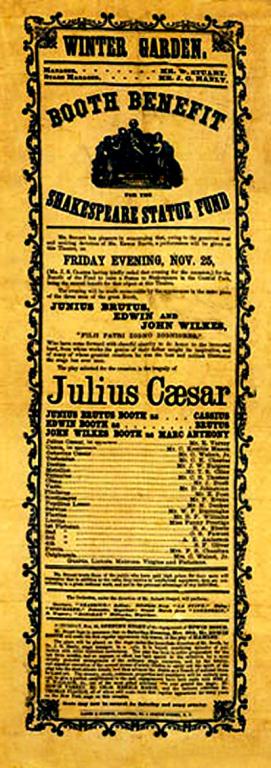
Bill Box U4 W78 1864-65, no. 2a
There are some men so great that even when they are hardly involved in an event, they dominate it. So it is with Shakespeare’s play Julius Caesar. The great man gives his name to the play, but was assassinated early. Death doesn’t keep a Shakespearean character from making an appearance later, but it does limit the number of lines. Brutus, the noble Roman who helps kill his friend in an attempt to save the Republic, is “there” far more than Caesar, but the play is all about Caesar.
Why?
Brutus loves Caesar, recognizes his greatness, yet cannot tolerate his friend’s lust for power.
He listens to lesser men who hope to use his rectitude to screen their jealousy of Caesar. Says Cassius:
Tis just:
And it is very much lamented, Brutus,
That you have no such mirrors as will turn
Your hidden worthiness into your eye,
That you might see your shadow. I have heard,
Where many of the best respect in Rome,
Except immortal Caesar, speaking of Brutus
And groaning underneath this age’s yoke,
Have wish’d that noble Brutus had his eyes.
Brutus is an honorable man, eager to save the Republic from a man who would be king, but he is vain about his honor. As a result, he is easy to flatter into a hopeless project: murder Caesar and save the Republic. Sadly, the Republic can no longer be saved. The decay is too great and the alternative to Caesar is simply a different dictatorship, perhaps an oligarchy under Cassius using Brutus as a genial frontman.
Compounding Brutus’ problems is that Caesar trusts him. He betrays his friend in the name of his cause. Brutus has no real alternative to Caesar but a hopeless civil war, but he deludes himself into believing he can revive the Republic. Brutus makes the same critical error that tempts many of us: we know what is bad, but we do not always know what is good. Brutus comes to believe that his friends and (especially) Brutus are the last true Romans.
He loves Rome, but not as it is. He thinks the Romans to be as they were and will not accept what they are or do the hard work of changing the times. He looks for one grand stroke that will redeem everything and is foolish enough to believe that he can do it. The fault is not in the stars, perhaps, but is also not just in Caesar or in his unwillingness to take Caesar out. The fault may lie in the Romans.
We can oppose evil, but we must also advance an alternative that is better. It is never good to let a bad man rule, but men like Julius Caesar are a mixed bag. A Christian facing Caesar must make a hard call: can the old political ways be saved or is Julius Caesar the best of bad alternatives.
Nobody wants to live at the fall of a regime, but if you do then you must measure what will work. Do not kill Caesar based on flattery and delusions that you can replace him only to plunge the state into two civil wars as his heirs squabble over who will replace him. Brutus is, as Antony points out, “an honorable man,” but he finds himself in the company of less honorable men than Caesar.
He confronts one thus:
Remember March, the ides of March remember:
Did not great Julius bleed for justice’ sake?
What villain touch’d his body, that did stab,
And not for justice? What, shall one of us
That struck the foremost man of all this world
But for supporting robbers, shall we now
Contaminate our fingers with base bribes,
And sell the mighty space of our large honours
For so much trash as may be grasped thus?
I had rather be a dog, and bay the moon,
Than such a Roman.
Brutus has destroyed a flawed man to empower a worse man. Americans must pause at this truth. In this election, like every other, let us be careful not to end the career of a great man simply because we fear him without an alternative.
We never have a chance to vote for a saint, even Abraham Lincoln was flawed and he was our greatest leader. He ignored habeas corpus and stretched presidential powers in other ways to win the War. John Wilkes Booth assassinated Abraham Lincoln under the same delusion shared by Brutus. The tragedy of Booth is that he had performed as Marc Antony, but learned nothing from Shakespeare. He did not recognize that murder of a great man only immortalizes him and does nothing for your cause. Of course, the liberty that Booth was defending, the right of some men to own other men, was far worse than the cause of Brutus.
Brutus and Booth both needed to stop listening to the Devil’s flattery and face reality. You can oppose a great man, and sometimes you should, you can fight a great man, but you must never think death will stop him. Honor and betrayal cannot go together. Never save a ministry, a business, or a nation by stabbing a friend in the back. If we must fight, then as honorable men let us avoid conspiracy with bad men and fight above board and openly.
To kill Caesar in a cabal or smoked filled room . . . to stab him in an act of betrayal is to make a martyr of him. A Julius Caesar cannot be murdered safely. He will come back a legend in the hands of worse men. Flattery, especially about virtues, destroys many a good Christian leader to overreach himself and do harm. Yet this is true: even a mistake or failure done for honor’s sake is better than an action done for graft or envy. In his death Brutus (unlike the more wicked Booth) was recognized as a great and decent Roman. Says Antony who brought him down;
This was the noblest Roman of them all:
All the conspirators save only he
Did that they did in envy of great Caesar;
He only, in a general honest thought
And common good to all, made one of them.
His life was gentle, and the elements
So mix’d in him that Nature might stand up
And say to all the world ‘This was a man!’
Perhaps it is a sign of our decadent age that Brutus, a man ruined by listening to flattery and conspirators, is better than most of us in his approach of politics. He was unwise, but never for evil. May we do so well, but God spare us from flatterers and the errors of Brutus.
————————————————–
William Shakespeare went to God four hundred years ago. To recollect his death, I am writing a personal reflection on a few of his plays. The Winter’s Tale started things off, followed by As You Like It. Romeo and Juliet still matter, Lady Macbeth rebukes the lust for power, and Henry V is a hero. Richard II shows us not to presume on the grace of God or rebel against authority too easily. Coriolanus reminds us that our leaders need integrity and humility. Our life can be joyful if we realize that it is, at best, A Comedy of Errors. Hamlet needs to know himself better and talks to himself less. He is stuck with himself so he had better make his peace with God quickly and should stay far away from Ophelia. Shakespeare gets something wrong in Merchant of Venice . . . though not as badly as some in the English Labour Party or in my Twitter feed. Love if blind, but intellectualism is blind and impotent in Love’s Labours Lost. Brutus kills Caesar, but is overshadowed by him in Julius Caesar.
Next Post

May 1, 2016 The Priority of a Party: You cannot be too Happy (Much Ado about Nothing)
Browse Our Archives
Select a Category Apologetics Art Culture Education On Books On Education Philosophy Politics Pop Culture Spiritual Reflections Uncategorized
Select a Month October 2026 September 2026 August 2026 July 2026 July 2025 June 2025 September 2024 July 2024 June 2024 December 2023 June 2023 September 2022 May 2022 April 2022 March 2022 February 2022 July 2021 June 2021 May 2021 April 2021 March 2021 February 2021 January 2021 December 2020 November 2020 October 2020 September 2020 August 2020 July 2020 June 2020 May 2020 April 2020 March 2020 February 2020 January 2020 December 2019 November 2019 October 2019 September 2019 August 2019 July 2019 June 2019 May 2019 April 2019 March 2019 February 2019 January 2019 December 2018 November 2018 October 2018 September 2018 August 2018 July 2018 June 2018 May 2018 April 2018 March 2018 February 2018 January 2018 December 2017 November 2017 October 2017 September 2017 August 2017 July 2017 June 2017 May 2017 April 2017 March 2017 February 2017 January 2017 December 2016 November 2016 October 2016 September 2016 August 2016 July 2016 June 2016 May 2016 April 2016 March 2016 February 2016 January 2016 December 2015 November 2015 October 2015 September 2015 August 2015 July 2015 June 2015 May 2015 April 2015 March 2015 February 2015 January 2015 November 2014 October 2014 September 2014 August 2014 July 2014 June 2014 May 2014 April 2014 March 2014 February 2014 January 2014 December 2013 November 2013 October 2013 September 2013 August 2013 July 2013 June 2013 May 2013 April 2013 March 2013 February 2013 January 2013 December 2012 November 2012 October 2012 September 2012 August 2012 July 2012 June 2012 May 2012
Follow Us!
TAKE THE
Religious Wisdom Quiz
Who tricked Isaac into giving him the blessing meant for his brother?
Select your answer to see how you score.
Esau Joseph Jacob Laban
Books by This Author John Mark Reynolds
Related posts from Eidos

Classical Education Must Teach Us to Make the...

Yet I Love Her: History and the Church


The Iceberg is There: Verbosity Cannot Defeat Reality
TRENDING AT PATHEOS Evangelical

The REST of Your Life: A Creative Wrestles...
This week I had a conversation with a good friend from church....

How the author of the world's best hymn...
I've been working with John Newton for a while now. This makes...

Long before this Lectio Divina, Psalm 130 - the song - started...

What About the Trees? Another Living Parable
After I finished writing the last article about falling leaves as a...

Why Classical Education Is a Conversation, Not a...
Come and Read: Joy in Classical Education When I was a little...

Cornell University has received a great deal of negative publicity and intense...
view all Evangelical blogs
Ad-Free & Subscriber Log-In Subscription Support
- About Us
- 2026 Calendar
- Videos
- Podcasts
- Library of World Religions
- Faith In Media Tracker
- Advertise With Us
- Write for Us
- Privacy Policy
- Terms of Service
- Do Not Sell My Data
- Contact Us
- Radiant Digital
- Manage Newsletter Subscriptions
- Unsubscribe From Notifications
- Sitemap
Copyright 2008-2026, Patheos. All rights reserved.
Subscription Support Ad-Free & Subscriber Log-In
Follow Patheos