
BuddhistCatholicContemplativeEvangelicalGeneral ChristianHinduJewishLatter-day SaintMuslimNew VisionsProgressive Christian
Beliefs
- Buddhist
- Catholic
- Contemplative
- Evangelical
- General Christian
- Hindu
- Jewish
- Latter-day Saint
- More Voices
- Muslim
- New Visions
- Pagan
- Progressive Christian
Topics
- Religion News
- Food and Religion
- Sports and Religion
- Religious Art
- Religious Music and Entertainment
- Religious Events
- History and Religion
- Style and Religion
- Politics and Religion
- Women in Religion
- Recreation Outdoors and Religion
- Business Finance and Religion
- Careers Workplace and Religion
- Education and Religion
- Family Parenting and Religion
- Health Fitness and Religion
- Home and Religion
- Relationships and Religion
- Technology and Religion
- Travel and Religion
Columnists
- Buddhist Columnists
- Business Finance and Religion Columnists
- Careers Workplace and Religion Columnists
- Catholic Columnists
- Contemplative Columnists
- Education and Religion Columnists
- Evangelists Columnists
- Family Parenting and Religion Columnists
- General Christian Columnists
- Health Fitness and Religion Columnists
- Hindu Columnists
- History and Religion Columnists
- Home and Religion Columnists
- Jewish Columnists
- More Voices Columnists
- Latter Day Columnists
- Muslim Columnists
- New Visions Columnists
- Nonreligious Columnists
- Pagan Columnists
- Politics and Religion Columnists
- Progressive Columnists
- Recreation Outdoors and Religion Columnists
- Relationships and Religion Columnists
- Religion News Columnists
- Religious Art Columnists
- Religious Events Columnists
- Religious Music and Entertainment Columnists
- Sports and Religion Columnists
- Style and Religion Columnists
- Technology and Religion Columnists
- Travel and Religion Columnists
- Women in Religion Columnists
Resource Library
- 2026 Calendar
- Library of World Religions
- The 100 Most Holy Places on Earth
- Patheos Answers
- Podcasts
- Videos
- Faith Leaders Database
- Anglican Episcopalian
- Bahai
- Baptist
- Buddhism
- Christianity
- Confucianism
- Eastern Orthodoxy
- Hinduism
- Holiness and Pentecostal
- ISKCON
- Islam
- Judaism
- Lutheran
- Methodist
- The Church of Jesus Christ of Latter-day Saints
- New Age
- Paganism
- Presbytarian and Reformed
- Protestantism
- Religion Behind the Scenes
- Roman Catholic
- Scientology
- Shia Islam
- Sikhism
- Sufism
- Sunni Islam
- Taoism
- Zen
- See all religions
Research Tools
 Ad-Free & Subscriber Log-In Subscription Support
Ad-Free & Subscriber Log-In Subscription Support
Follow Patheos 

- Trending:
- Forgiveness
- |
- Marriage
- |
- Consciousness
- |
- Death Penalty
- |
- Election
- |
- Halloween

- Home
- Evangelical
- Cleanup the University: Starting with Us
Cleanup the University: Starting with Us
Last updated on: November 13, 2015 at 7:28 pm by John Mark N. Reynolds
Cleanup the University: Starting with Us 2015-11-13T19:28:55-04:00 John Mark N. Reynolds
Patheos Explore the world's faith through different perspectives on religion and spirituality! Patheos has the views of the prevalent religions and spiritualities of the world.
At dear old State U, you might find a Christian engineering professor, carefully quiet, and more than one Christian coach on the playing fields, but you will be hard pressed to find the views of the world’s two billion Christians elsewhere. Much of undergraduate education, at even our best schools, is not worth the money people will borrow, being more about getting the “union card” into the establishment than what a person will actually learn.
I have heard from numerous students that they worked harder in high school to get into the elite school than they had to work in their general education classes, usually the most politicized, to stay there. In fields with “reality constrained” content, such as mathematics and the sciences, Christians can fare well. In such programs the quality of the work in the lab or the classroom will trump any eccentric views the student has at home.
Any number of students have been able to put up with the mild chaff that comes with being a Christian or Republican (or Heaven protect us: both) at school. The best tactic is to do good work, be kind, and learn. You can always store up some amusing anecdotes for later. As Sheldon Vanauken wrote to me in college: “Keep your head down and give them both barrels as you go out the door.”
We should also not stress too much about the trauma of being a minority in school. Safe to say, there were not too many Reagan Republicans at the University of Rochester philosophy department while I was there. Once while sitting with a left-of-center female Christian grad student, a professor came into the grad office and said: “Look! Our token fundamentalists!” Safe to say, he saw little difference in our very different religious outlooks. Yet I can honestly say that I was treated more than fairly in my secular grad school. Those were hard years for me personally and the faculty was very patient with me. My views were treated with more respect than they deserved (at times) and I learned that opposition, rigor, and even hostile examination of my ideas was good for me.
The University of Rochester philosophy department is not responsible for my eccentric philosophical or religious views, but they are greatly responsible for any clarity or breadth of thought I possess. If we do not like “grievance” politics, then we cannot participate in it and when treated fairly, should be quick to praise true liberalism.
Not every school is as fair as Rochester in creating a learning community and being open to dissenting views. My perception from former students is that the situation is growing worse for traditional Christians in schools . . . especially schools on the lower ends of the academic rankings. I know scholars whose careers probably have died over their Christian convictions, though this is nearly impossible to prove. The embrace of administrators of the (disputable) view that gender is merely a social construct distinct from sex with the corresponding codes has made things harder for Christian groups on campus.
As a result, this could be a moment of opportunity for traditional Christian colleges. Sadly, the pressure of accreditation and the socialization of graduate training has left the best Christian colleges relatively weak in terms of Christian commitment. Notre Dame is a very fine school with relatively strong research and a Christian commitment, but the experience of students there and at schools like Notre Dame is very mixed. Some departments are more hostile to traditional Christian ethics at such schools, though one is always more likely to find a Christian mentor.
Schools still connected to the Catholic church or Protestant denominations are often more intent on being “welcoming” and “inclusive” to avoid being thought of as fundamentalist.
What of Evangelical and smaller Catholic colleges and universities? Undergraduate education is often as good or better at some of these schools than at “prestige” schools. They are also slowly taking on more graduate education. Biola University, where I started my teaching career, and Wheaton College, where my wife graduated, are two excellent examples. The King’s College in New York City is engaging with the business and cultural capital of the world. Thomas Aquinas College offers one of the best great books educations available. There is no reason for a Christian parent to send their undergraduate students to State U if the student is in a field that requires graduate school. They can get a first-rate education at a Christian college and then go to graduate school at the “name brand” with little difficulty if they pick the proper Christian college.
Such schools are struggling to find students and all of us who are conservative or traditional Christians have a vested interest in strengthening them. However, there are some good reasons for these schools to struggle. Some are very weak and probably cannot be saved from the higher education bubble. There are schools that are anti-intellectual and essentially unaccredited making it harder for students to attend graduate school. Others have become inbred or have the same administrative bloat as State U.
We should begin by refusing to monetize the ministry of education. We are shaping souls for Paradise, not making money for our own grand visions or academic empires. We must never tolerate the kind of ghostwriting, puffed credentials, or lack of care that impacts too much of the Christian Media Complex.
Here are five things Christian schools should do now, and Christian students and parents should examine schools they plan to attend:
Get regional accreditation.
If you attend a regionally accredited school, then you will have a degree that receives a modicum of respect. A school without regional accreditation may be good, but it may be very narrow. Check the faculty lists. A bad sign is if most faculty at the school went to the same one or two schools.
All our schools should seek regional accreditation while available, but also begin to prepare for the time when secular schools may cast us out by strengthening new accountability groups.
Put student life back in the hands of academics.
Christian colleges should commit to having co-curricular activities, including athletics, as part of the academic program. We need to shrink auxiliary departments and make those departments part of the academic life of the school.
Tip to students: Google the people in the student life area. Find out their views on the social issues of the day. Check out the psychologists and sociologists. Use Facebook and Google. This will tell you the campus climate for conservative Christians very quickly.
Tip to parents: Fear the Christian school that sells to the right and teaches to the left. This happens all the time. The leadership of the school may be traditional, while all the young profs and student life folk mock the benighted administration.
Most activities at your school should come from the professors and the students. Look for schools near urban centers: think jobs, culture, and fun.
Never allow more vice-presidents than there are faculty in any single major.
Administrative bloat is a fatal sign. Christian colleges should commit to spending at least fifty percent of tuition revenue in the academic area. We should commit to fewer than fifteen percent of classes in any area being taught by part-time teachers.
Tip to students: Give no school your money without reading the 990 and comparing administrative pay to faculty pay. Too big a gap and you have trouble. Ask what percent of the money goes directly to academics (usually the Provost or Academic Vice-President). If the number is less than fifty, worry.
Tip to parents: Google through school leadership? How academic is it? Are professors really in charge or are they employees in a monetized venture? If there is no tenure, this can be a very good sign if turnover is low.
Christian schools should commit to having low turnover and learning communities where appropriate participation in decisions and forming of vision are shared from Board to the most junior professor.
On-line programs must have the same quality as on-site.
The day may come when on-line schools are as excellent, but that day is not yet here. Too often on site schools are dragged down by the reputation of on-line programs. Christian schools must commit to the same or similar student/teacher ratios online as on site. We must commit to similar retention numbers. We must not encourage borrowing to attend these programs.
Can you get a good education at an accredited online program? You can, but it requires a particular type of student with strong exterior support.
We must drive the debt out of Christian education.
Christian colleges must innovate to become affordable. Let’s set a goal of charging no more than twelve thousand a year in tuition by 2020 in at least some of our quality programs.
Tip to students and parents: While you wait for debt free education, use this rule of thumb: don’t borrow more money for your whole degree than you would spend on a new car. Don’t buy a new car until your loans are paid off.
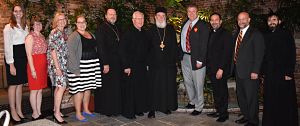
Leaders of The Saint Constantine School, including our beloved Bishop Basil
The rest of my career is dedicated to making these things happen at schools like Houston’s new The Saint Constantine School. The visionary leadership there is committed to excellence, affordability, and an unchanging commitment to the Orthodox Christian faith. We will be welcoming to all people . . . and challenge all our ideas in the classroom. . . but in a classic context. There are other good places out there . . . lights in a dark time. Biola, Wheaton, Kings, Thomas Aquinas, Hellenic College are all exciting places amongst many others. Encourage them and pray for us!
Previous Post

November 12, 2015
A School for Humans, not Snowflakes
Next Post
November 14, 2015 To Our Oldest Ally: God save France!
Browse Our Archives
Select a Category Apologetics Art Culture Education On Books On Education Philosophy Politics Pop Culture Spiritual Reflections Uncategorized
Select a Month October 2026 September 2026 August 2026 July 2026 July 2025 June 2025 September 2024 July 2024 June 2024 December 2023 June 2023 September 2022 May 2022 April 2022 March 2022 February 2022 July 2021 June 2021 May 2021 April 2021 March 2021 February 2021 January 2021 December 2020 November 2020 October 2020 September 2020 August 2020 July 2020 June 2020 May 2020 April 2020 March 2020 February 2020 January 2020 December 2019 November 2019 October 2019 September 2019 August 2019 July 2019 June 2019 May 2019 April 2019 March 2019 February 2019 January 2019 December 2018 November 2018 October 2018 September 2018 August 2018 July 2018 June 2018 May 2018 April 2018 March 2018 February 2018 January 2018 December 2017 November 2017 October 2017 September 2017 August 2017 July 2017 June 2017 May 2017 April 2017 March 2017 February 2017 January 2017 December 2016 November 2016 October 2016 September 2016 August 2016 July 2016 June 2016 May 2016 April 2016 March 2016 February 2016 January 2016 December 2015 November 2015 October 2015 September 2015 August 2015 July 2015 June 2015 May 2015 April 2015 March 2015 February 2015 January 2015 November 2014 October 2014 September 2014 August 2014 July 2014 June 2014 May 2014 April 2014 March 2014 February 2014 January 2014 December 2013 November 2013 October 2013 September 2013 August 2013 July 2013 June 2013 May 2013 April 2013 March 2013 February 2013 January 2013 December 2012 November 2012 October 2012 September 2012 August 2012 July 2012 June 2012 May 2012
Follow Us!
TAKE THE
Religious Wisdom Quiz
Who said, "As for me, I know that my redeemer lives"?
Select your answer to see how you score.
Moses Abraham Job Joseph
Books by This Author John Mark Reynolds
Related posts from Eidos

Why Classical Education Is a Conversation, Not a...

Does Classical Education Belong Only to the West?

Classical Education Must Teach Us to Make the...

Rooted: Why Classical Education Needs Community
TRENDING AT PATHEOS Evangelical

The REST of Your Life: A Creative Wrestles...
This week I had a conversation with a good friend from church....

How the author of the world's best hymn...
I've been working with John Newton for a while now. This makes...

Long before this Lectio Divina, Psalm 130 - the song - started...

What About the Trees? Another Living Parable
After I finished writing the last article about falling leaves as a...

Why Classical Education Is a Conversation, Not a...
Come and Read: Joy in Classical Education When I was a little...

Cornell University has received a great deal of negative publicity and intense...
view all Evangelical blogs
Ad-Free & Subscriber Log-In Subscription Support
- About Us
- 2026 Calendar
- Videos
- Podcasts
- Library of World Religions
- Faith In Media Tracker
- Advertise With Us
- Write for Us
- Privacy Policy
- Terms of Service
- Do Not Sell My Data
- Contact Us
- Radiant Digital
- Manage Newsletter Subscriptions
- Unsubscribe From Notifications
- Sitemap
Copyright 2008-2026, Patheos. All rights reserved.
Subscription Support Ad-Free & Subscriber Log-In
Follow Patheos