
BuddhistCatholicContemplativeEvangelicalGeneral ChristianHinduJewishLatter-day SaintMuslimNew VisionsProgressive Christian
Beliefs
- Buddhist
- Catholic
- Contemplative
- Evangelical
- General Christian
- Hindu
- Jewish
- Latter-day Saint
- More Voices
- Muslim
- New Visions
- Pagan
- Progressive Christian
Topics
- Religion News
- Food and Religion
- Sports and Religion
- Religious Art
- Religious Music and Entertainment
- Religious Events
- History and Religion
- Style and Religion
- Politics and Religion
- Women in Religion
- Recreation Outdoors and Religion
- Business Finance and Religion
- Careers Workplace and Religion
- Education and Religion
- Family Parenting and Religion
- Health Fitness and Religion
- Home and Religion
- Relationships and Religion
- Technology and Religion
- Travel and Religion
Columnists
- Buddhist Columnists
- Business Finance and Religion Columnists
- Careers Workplace and Religion Columnists
- Catholic Columnists
- Contemplative Columnists
- Education and Religion Columnists
- Evangelists Columnists
- Family Parenting and Religion Columnists
- General Christian Columnists
- Health Fitness and Religion Columnists
- Hindu Columnists
- History and Religion Columnists
- Home and Religion Columnists
- Jewish Columnists
- More Voices Columnists
- Latter Day Columnists
- Muslim Columnists
- New Visions Columnists
- Nonreligious Columnists
- Pagan Columnists
- Politics and Religion Columnists
- Progressive Columnists
- Recreation Outdoors and Religion Columnists
- Relationships and Religion Columnists
- Religion News Columnists
- Religious Art Columnists
- Religious Events Columnists
- Religious Music and Entertainment Columnists
- Sports and Religion Columnists
- Style and Religion Columnists
- Technology and Religion Columnists
- Travel and Religion Columnists
- Women in Religion Columnists
Resource Library
- 2026 Calendar
- Library of World Religions
- The 100 Most Holy Places on Earth
- Patheos Answers
- Podcasts
- Videos
- Faith Leaders Database
- Anglican Episcopalian
- Bahai
- Baptist
- Buddhism
- Christianity
- Confucianism
- Eastern Orthodoxy
- Hinduism
- Holiness and Pentecostal
- ISKCON
- Islam
- Judaism
- Lutheran
- Methodist
- The Church of Jesus Christ of Latter-day Saints
- New Age
- Paganism
- Presbytarian and Reformed
- Protestantism
- Religion Behind the Scenes
- Roman Catholic
- Scientology
- Shia Islam
- Sikhism
- Sufism
- Sunni Islam
- Taoism
- Zen
- See all religions
Research Tools
 Ad-Free & Subscriber Log-In Subscription Support
Ad-Free & Subscriber Log-In Subscription Support
Follow Patheos 

- Trending:
- Forgiveness
- |
- Marriage
- |
- Consciousness
- |
- Death Penalty
- |
- Election
- |
- Halloween

- Home
- Evangelical
- What Walt Taught Me: Three Caballeros
What Walt Taught Me: Three Caballeros
Last updated on: August 10, 2015 at 10:36 pm by John Mark N. Reynolds
What Walt Taught Me: Three Caballeros 2015-08-10T22:36:01-04:00 John Mark N. Reynolds
Patheos Explore the world's faith through different perspectives on religion and spirituality! Patheos has the views of the prevalent religions and spiritualities of the world.
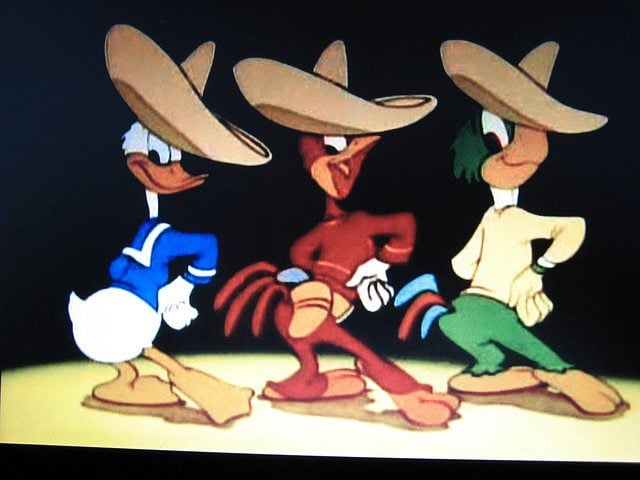 Three Caballeros is an experimental movie, a licit drug trip disguised as an animated movie. Walt did not control his studio in World War II, the government did, but Walt refused to surrender creativity. This is another “package” movie… a series of cartoons thinly linked together as birthday presents to Donald Duck. If you think your great-grandfather lived in creatively sterile times, watch this film and compare the risks Walt took with the Ninties Disney revival.
I love Aladdin, but it is a 1950’s musical disguised as a cartoon. No wonder Disney has taken such movies to Broadway since that is their true birthplace. The effects in the inferior film Three Caballaros could not be done on stage… Walt and his team were stretching the medium, not copying another. There could not have been Cinderella or the second Golden Age under Eisner (so much more careful!) if Walt and his creative team had not been willing to take risks. They kept learning even when learning seemed futile on simple little projects.
What does Walt teach us in this movie?
Walt is unafraid in this film of mixing normal human desires into his movies and allowed his wholesome crew passions. The three caballeros liked . . . girls. At the time, this made puritanical types grouchy and now the new puritans are upset because one of the three smokes a cigar. . . the horrors of the 1940s! Admittedly, the three caballeros are birds and so their dating lives would be odd if we thought about it . . . but they also wear clothes, sing, dance, eat human food, and are interested in human customs. They are people in a different form and nothing like a duck, rooster, or parrot.
Decent people, and Walt at least tried to represent decent people, are unpopular today. Prudes are worried they are having fun that might be bad for their health (physical well being is everything to the new prudes!) while libertines dislike the notion of decency. The three caballeros are having jolly, normal fun. The images of Carnival in Rio reinforce the point: I saw young men in ties! Apparently, it was still possible to party in the 1940s with decency and moderation. I am confident (having talked to my grandparents!) that bad stuff happened on the back streets, but if you wished to be decent this was allowed.
If barbarism is allowed in public, the decent will be driven away altogether. The libertines can always go from the “main party” to the backrooms, but when the backroom becomes the main party, there is no decent fun left at the party. Excess will consume prudence and the cultural hangover will be great. Walt and his three caballeros are having a rollicking time. They are not limited by irrational prejudice or prudery, but they are also bound by certain limits. They will go “thus far” while honoring societies moral code.
But that does not lead to “same old” or conformity: instead it leads to what one person called “an acid trip” set of cartoon effects. I would note that if this is so, if an acid trip does give one these effects, then Disney gave these visions to the rest of us without any of the dangers of drugs. Walt and his merry band were unconstrained by “what had been done before now” in the art form. Moral codes did not really limit them by closing off barbarism, but pushed them forward to experiment with the billions of licit artistic combinations that exist in God’s universe. Some of it was silly, some of it failed, but all of it was jolly.
This jollification was the goal of the cartoon: international relationships could be warm and friendly. The writers of Three Caballeros called it “gay” back then . . . three gay caballeros . . . but that was another and different time. .
Previous Post

August 4, 2015
What Walt Taught Me: Saludos Amigos
Next Post
August 6, 2015 What Walt Taught Me: Make Mine Music
Browse Our Archives
Select a Category Apologetics Art Culture Education On Books On Education Philosophy Politics Pop Culture Spiritual Reflections Uncategorized
Select a Month October 2026 September 2026 August 2026 July 2026 July 2025 June 2025 September 2024 July 2024 June 2024 December 2023 June 2023 September 2022 May 2022 April 2022 March 2022 February 2022 July 2021 June 2021 May 2021 April 2021 March 2021 February 2021 January 2021 December 2020 November 2020 October 2020 September 2020 August 2020 July 2020 June 2020 May 2020 April 2020 March 2020 February 2020 January 2020 December 2019 November 2019 October 2019 September 2019 August 2019 July 2019 June 2019 May 2019 April 2019 March 2019 February 2019 January 2019 December 2018 November 2018 October 2018 September 2018 August 2018 July 2018 June 2018 May 2018 April 2018 March 2018 February 2018 January 2018 December 2017 November 2017 October 2017 September 2017 August 2017 July 2017 June 2017 May 2017 April 2017 March 2017 February 2017 January 2017 December 2016 November 2016 October 2016 September 2016 August 2016 July 2016 June 2016 May 2016 April 2016 March 2016 February 2016 January 2016 December 2015 November 2015 October 2015 September 2015 August 2015 July 2015 June 2015 May 2015 April 2015 March 2015 February 2015 January 2015 November 2014 October 2014 September 2014 August 2014 July 2014 June 2014 May 2014 April 2014 March 2014 February 2014 January 2014 December 2013 November 2013 October 2013 September 2013 August 2013 July 2013 June 2013 May 2013 April 2013 March 2013 February 2013 January 2013 December 2012 November 2012 October 2012 September 2012 August 2012 July 2012 June 2012 May 2012
Follow Us!
TAKE THE
Religious Wisdom Quiz
What New Testament letter addresses a runaway slave returning to his master?
Select your answer to see how you score.
Titus Colossians Philemon 2 John
Books by This Author John Mark Reynolds
Related posts from Eidos

Yet I Love Her: History and the Church


The Iceberg is There: Verbosity Cannot Defeat Reality

TRENDING AT PATHEOS Evangelical

The REST of Your Life: A Creative Wrestles...
This week I had a conversation with a good friend from church....

How the author of the world's best hymn...
I've been working with John Newton for a while now. This makes...

Long before this Lectio Divina, Psalm 130 - the song - started...

What About the Trees? Another Living Parable
After I finished writing the last article about falling leaves as a...

Why Classical Education Is a Conversation, Not a...
Come and Read: Joy in Classical Education When I was a little...

Cornell University has received a great deal of negative publicity and intense...
view all Evangelical blogs
Ad-Free & Subscriber Log-In Subscription Support
- About Us
- 2026 Calendar
- Videos
- Podcasts
- Library of World Religions
- Faith In Media Tracker
- Advertise With Us
- Write for Us
- Privacy Policy
- Terms of Service
- Do Not Sell My Data
- Contact Us
- Radiant Digital
- Manage Newsletter Subscriptions
- Unsubscribe From Notifications
- Sitemap
Copyright 2008-2026, Patheos. All rights reserved.
Subscription Support Ad-Free & Subscriber Log-In
Follow Patheos