
BuddhistCatholicContemplativeEvangelicalGeneral ChristianHinduJewishLatter-day SaintMuslimNew VisionsProgressive Christian
Beliefs
- Buddhist
- Catholic
- Contemplative
- Evangelical
- General Christian
- Hindu
- Jewish
- Latter-day Saint
- More Voices
- Muslim
- New Visions
- Pagan
- Progressive Christian
Topics
- Religion News
- Food and Religion
- Sports and Religion
- Religious Art
- Religious Music and Entertainment
- Religious Events
- History and Religion
- Style and Religion
- Politics and Religion
- Women in Religion
- Recreation Outdoors and Religion
- Business Finance and Religion
- Careers Workplace and Religion
- Education and Religion
- Family Parenting and Religion
- Health Fitness and Religion
- Home and Religion
- Relationships and Religion
- Technology and Religion
- Travel and Religion
Columnists
- Buddhist Columnists
- Business Finance and Religion Columnists
- Careers Workplace and Religion Columnists
- Catholic Columnists
- Contemplative Columnists
- Education and Religion Columnists
- Evangelists Columnists
- Family Parenting and Religion Columnists
- General Christian Columnists
- Health Fitness and Religion Columnists
- Hindu Columnists
- History and Religion Columnists
- Home and Religion Columnists
- Jewish Columnists
- More Voices Columnists
- Latter Day Columnists
- Muslim Columnists
- New Visions Columnists
- Nonreligious Columnists
- Pagan Columnists
- Politics and Religion Columnists
- Progressive Columnists
- Recreation Outdoors and Religion Columnists
- Relationships and Religion Columnists
- Religion News Columnists
- Religious Art Columnists
- Religious Events Columnists
- Religious Music and Entertainment Columnists
- Sports and Religion Columnists
- Style and Religion Columnists
- Technology and Religion Columnists
- Travel and Religion Columnists
- Women in Religion Columnists
Resource Library
- 2026 Calendar
- Library of World Religions
- The 100 Most Holy Places on Earth
- Patheos Answers
- Podcasts
- Videos
- Faith Leaders Database
- Anglican Episcopalian
- Bahai
- Baptist
- Buddhism
- Christianity
- Confucianism
- Eastern Orthodoxy
- Hinduism
- Holiness and Pentecostal
- ISKCON
- Islam
- Judaism
- Lutheran
- Methodist
- The Church of Jesus Christ of Latter-day Saints
- New Age
- Paganism
- Presbytarian and Reformed
- Protestantism
- Religion Behind the Scenes
- Roman Catholic
- Scientology
- Shia Islam
- Sikhism
- Sufism
- Sunni Islam
- Taoism
- Zen
- See all religions
Research Tools
 Ad-Free & Subscriber Log-In Subscription Support
Ad-Free & Subscriber Log-In Subscription Support
Follow Patheos 

- Trending:
- Forgiveness
- |
- Marriage
- |
- Consciousness
- |
- Death Penalty
- |
- Election
- |
- Halloween

- Home
- Evangelical
- What Walt Taught Me: The Sword in the Stone
What Walt Taught Me: The Sword in the Stone
Last updated on: August 17, 2015 at 4:28 pm by John Mark N. Reynolds
What Walt Taught Me: The Sword in the Stone 2015-08-17T16:28:16-04:00 John Mark N. Reynolds
Patheos Explore the world's faith through different perspectives on religion and spirituality! Patheos has the views of the prevalent religions and spiritualities of the world.
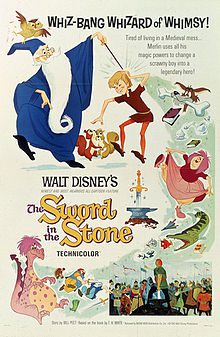 Walt was dying the year I was born, but nobody knew it yet, not even Walt. His genius had turned to Disneyworld and away from animation. Mary Poppins was very profitable, but Sleeping Beauty had failed. To make things worse, the Disney studio challenged the curse of King Arthur: the universal rule that anything based on the Matter of Britain in pop culture will be dreadful, forgettable, crude, or worse. This curse is best described in the wonderful Lyre of Orpheus written by the underrated Robertson Davies.
Sword in the Stone confirms the curse; even Disney could not make a great film about Arthur, just as TH White had failed to write a decent series the more he got involved in the British myth. Thank God that Tolkien refrained from redoing Arthur and gave Britain a new and better mythology in Lord of the Rings.
This is a fine little film, but it is isn’t a great one. Sword in the Stone is the first full scale animated Disney film for which there is no excuse for less than greatness. Yet without Walt’s full attention and his best people, like the Sherman Brothers, the film collapses into Disney habits without the Disney magic. There is nothing wrong with the film, but precious little right with it.
Walt would make a last film in Jungle Book, a much better film, but Sword in the Stone proved that the less Walt Disney there was, and soon there would be none, the more derivative, imitative, and forgettable the films would be. The humor is no longer innocent, but childish (“Marvin” instead of “Merlin” Hardee har-har!), slapstick without the light touch, and the entire film feels slap dash. The animation lacks beauty and the voice acting is inconsistent as Wart is obviously done by two different people.
What did Walt teach me?
Walt should have never have let this film out because Disney meant high quality animation. The War years had been a struggle, but he was still pushing the edge of what he had left. To make money for his dreams, Walt had been willing to make live action films that were marginal, throw away projects that did not harm the “brand.” A film like Sword in the Stone challenges the core brand: it feels like animation made to make money and only to make money.
This was an epic error and Walt Disney made it. He recovered in Jungle Book, shifting the Sherman Brothers to the music. Sword in the Stone was not that bad by “other” studio animation standards of the time, but Walt had set the precedent. His company would take the art they created to advance and put out “crown jewel” made of plastic.
There is a story that Walt hired Dick Van Dyke because the comic bemoaned the move toward “dirty movies” in the press. Walt agreed and Van Dyke ended up in Mary Poppins. By now we know Walt was right: morality was warped (partly) by mass numbers of people consuming films written to appeal to their base instincts instead of their better natures. Walt did not respond by making better films, more innocent and yet adult, but by turning to childhood and easy appeal to “the kids.”
There was a narrow step from this to childish films: the Piglet Movie, a film no adult can enjoy, was the natural outcome. Instead of meaning “fit for everyone,” the hardest thing to write, a “G” movie started meaning dull, doltish, and childish. “Adult” meant merely nasty. Walt proved this need not be true in Mary Poppins, but sadly Poppins was still a children’s book adapted.
Walt was not making family films with Sword in the Stone: he was making an animated film for children that adults struggled to enjoy. This was a horrific precedent: smart meant wicked, innocent mean dull. He had done better, but he lacked the worldview and time to do better. If there is a reason to hate cigarette smoking, his early death when we most needed him to keep growing is a good one . . . and the very year of Sword in the Stone, tobacco would kill CS Lewis just as he was hitting the height of his literary powers (Till We Have Faces). Pixar began to make films and then there were smart family films again from an American animation company. Incredibles is the film Walt should have made, not Sword in the Stone.
There was a good theme to the film: brains over brawn, right making might. This was the theme in the book that must have appealed to Walt at the start and the point is a good one. As a nerdy little boy with little brawn, I needed the encouragement! “Big” does not mean “better” and “strong” can mean a stench and not a good thing. Walt loved Lincoln and the great President was correct when he said that our siding with a righteous cause gives strength. Moral strength and love are greater than brute force.
The film does a good job showing that might can do a great deal of damage when disconnected from right. Arthur (Wart) will attempt, best he can, to join might to right. He will put brawn in the service of noble brains.
Sadly, Walt used his marketing muscle to push this brainless film on us: marketing brawn over brains.
If you think this film is “not so bad” and contains some wonderful moments (Madame Mim!), then you are right. Walt set a higher standard, however, and in this area of full length animated films, he failed his own high standards. By doing so, he doomed animation for decades after his death to further mediocrity and family films to ever declining IQ.
This was failure indeed.
Previous Post

August 16, 2015
What Walt Taught Me: Mary Poppins
Next Post
August 18, 2015 What Walt Taught Me: The Jungle Book
Browse Our Archives
Select a Category Apologetics Art Culture Education On Books On Education Philosophy Politics Pop Culture Spiritual Reflections Uncategorized
Select a Month October 2026 September 2026 August 2026 July 2026 July 2025 June 2025 September 2024 July 2024 June 2024 December 2023 June 2023 September 2022 May 2022 April 2022 March 2022 February 2022 July 2021 June 2021 May 2021 April 2021 March 2021 February 2021 January 2021 December 2020 November 2020 October 2020 September 2020 August 2020 July 2020 June 2020 May 2020 April 2020 March 2020 February 2020 January 2020 December 2019 November 2019 October 2019 September 2019 August 2019 July 2019 June 2019 May 2019 April 2019 March 2019 February 2019 January 2019 December 2018 November 2018 October 2018 September 2018 August 2018 July 2018 June 2018 May 2018 April 2018 March 2018 February 2018 January 2018 December 2017 November 2017 October 2017 September 2017 August 2017 July 2017 June 2017 May 2017 April 2017 March 2017 February 2017 January 2017 December 2016 November 2016 October 2016 September 2016 August 2016 July 2016 June 2016 May 2016 April 2016 March 2016 February 2016 January 2016 December 2015 November 2015 October 2015 September 2015 August 2015 July 2015 June 2015 May 2015 April 2015 March 2015 February 2015 January 2015 November 2014 October 2014 September 2014 August 2014 July 2014 June 2014 May 2014 April 2014 March 2014 February 2014 January 2014 December 2013 November 2013 October 2013 September 2013 August 2013 July 2013 June 2013 May 2013 April 2013 March 2013 February 2013 January 2013 December 2012 November 2012 October 2012 September 2012 August 2012 July 2012 June 2012 May 2012
Follow Us!
TAKE THE
Religious Wisdom Quiz
What does Paul tell Titus that the grace of God teaches us to do?
Select your answer to see how you score.
Say no to ungodliness and live self-controlled, upright and godly lives Obey the authorities Spread the gospel Love one another
Books by This Author John Mark Reynolds
Related posts from Eidos

Yet I Love Her: History and the Church


The Iceberg is There: Verbosity Cannot Defeat Reality

TRENDING AT PATHEOS Evangelical

The REST of Your Life: A Creative Wrestles...
This week I had a conversation with a good friend from church....

How the author of the world's best hymn...
I've been working with John Newton for a while now. This makes...

Long before this Lectio Divina, Psalm 130 - the song - started...

What About the Trees? Another Living Parable
After I finished writing the last article about falling leaves as a...

Why Classical Education Is a Conversation, Not a...
Come and Read: Joy in Classical Education When I was a little...

Cornell University has received a great deal of negative publicity and intense...
view all Evangelical blogs
Ad-Free & Subscriber Log-In Subscription Support
- About Us
- 2026 Calendar
- Videos
- Podcasts
- Library of World Religions
- Faith In Media Tracker
- Advertise With Us
- Write for Us
- Privacy Policy
- Terms of Service
- Do Not Sell My Data
- Contact Us
- Radiant Digital
- Manage Newsletter Subscriptions
- Unsubscribe From Notifications
- Sitemap
Copyright 2008-2026, Patheos. All rights reserved.
Subscription Support Ad-Free & Subscriber Log-In
Follow Patheos