
BuddhistCatholicContemplativeEvangelicalGeneral ChristianHinduJewishLatter-day SaintMuslimNew VisionsProgressive Christian
Beliefs
- Buddhist
- Catholic
- Contemplative
- Evangelical
- General Christian
- Hindu
- Jewish
- Latter-day Saint
- More Voices
- Muslim
- New Visions
- Pagan
- Progressive Christian
Topics
- Religion News
- Food and Religion
- Sports and Religion
- Religious Art
- Religious Music and Entertainment
- Religious Events
- History and Religion
- Style and Religion
- Politics and Religion
- Women in Religion
- Recreation Outdoors and Religion
- Business Finance and Religion
- Careers Workplace and Religion
- Education and Religion
- Family Parenting and Religion
- Health Fitness and Religion
- Home and Religion
- Relationships and Religion
- Technology and Religion
- Travel and Religion
Columnists
- Buddhist Columnists
- Business Finance and Religion Columnists
- Careers Workplace and Religion Columnists
- Catholic Columnists
- Contemplative Columnists
- Education and Religion Columnists
- Evangelists Columnists
- Family Parenting and Religion Columnists
- General Christian Columnists
- Health Fitness and Religion Columnists
- Hindu Columnists
- History and Religion Columnists
- Home and Religion Columnists
- Jewish Columnists
- More Voices Columnists
- Latter Day Columnists
- Muslim Columnists
- New Visions Columnists
- Nonreligious Columnists
- Pagan Columnists
- Politics and Religion Columnists
- Progressive Columnists
- Recreation Outdoors and Religion Columnists
- Relationships and Religion Columnists
- Religion News Columnists
- Religious Art Columnists
- Religious Events Columnists
- Religious Music and Entertainment Columnists
- Sports and Religion Columnists
- Style and Religion Columnists
- Technology and Religion Columnists
- Travel and Religion Columnists
- Women in Religion Columnists
Resource Library
- 2026 Calendar
- Library of World Religions
- The 100 Most Holy Places on Earth
- Patheos Answers
- Podcasts
- Videos
- Faith Leaders Database
- Anglican Episcopalian
- Bahai
- Baptist
- Buddhism
- Christianity
- Confucianism
- Eastern Orthodoxy
- Hinduism
- Holiness and Pentecostal
- ISKCON
- Islam
- Judaism
- Lutheran
- Methodist
- The Church of Jesus Christ of Latter-day Saints
- New Age
- Paganism
- Presbytarian and Reformed
- Protestantism
- Religion Behind the Scenes
- Roman Catholic
- Scientology
- Shia Islam
- Sikhism
- Sufism
- Sunni Islam
- Taoism
- Zen
- See all religions
Research Tools
 Ad-Free & Subscriber Log-In Subscription Support
Ad-Free & Subscriber Log-In Subscription Support
Follow Patheos 

- Trending:
- Forgiveness
- |
- Marriage
- |
- Consciousness
- |
- Death Penalty
- |
- Election
- |
- Halloween
 Egregious Twaddle
- Home
- Catholic
- iDolatry? There’s an App for That!
iDolatry? There’s an App for That!
Last updated on: May 2, 2016 at 11:28 am by Joanne McPortland
iDolatry? There’s an App for That! 2016-05-02T11:28:29-06:00 Joanne McPortland
Patheos Explore the world's faith through different perspectives on religion and spirituality! Patheos has the views of the prevalent religions and spiritualities of the world.
Strange Gods: Unmasking the Idols in Everyday Life
by Elizabeth Scalia
Ave Maria Press, 2013
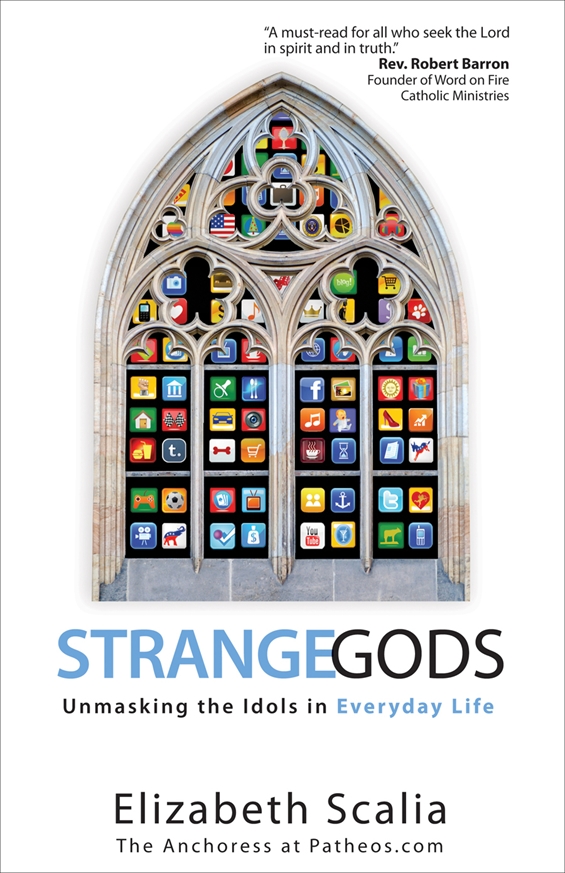 While over for dinner the other night with his parents, my going-on-4-year-old grandson was engaged in his usual sweeping of my apartment for Interesting Stuff. I’m trying to keep the acquisition of things to a rigorous minimum, but Luke can occasionally spot a new refrigerator magnet, a surprise toy, or something chocolate, so this surveillance is part of the arrival ritual.
He paused at the coffee table, riveted by the cover of Elizabeth Scalia’s Strange Gods, with its brilliant design depicting a church window’s stone Gothic tracery, with multiple Internet icons (representing everyday idols) where the stained glass would be. He picked up the book, reverently, and brought it me.
“Nana,” he asked, “is this a whole book of apps?”
When I had finished laughing (and giving thanks for such a great way to kick off this review), I explained. “Not really a book of apps,” I told Luke, “but a book about how we sometimes use things like apps to take time away from being with God and being with each other.” He looked dubious. “Not that the things in these pictures are bad—just that we can do too much of them for our own good.”
“Is Super Smash Bros [that’s how he pronounces it, actually] on here?” he asked, knowing that access to his new favorite video game is sometimes limited for the sake of his sleep cycle and the carpal nerves of his teenage cousins. “Are videos?” (This said by a kid who can already multitask by using a second iPad to look up videos on how to beat the level of Angry Birds Star Wars he’s playing on the first iPad.)
“I don’t think so,” I said. But Luke took it to a higher authority. “Daddy, look!” he said. “There’s a video game controller, and a movie, and videos-on-YouTube! And food, Daddy! We spend a lot of time with food!”
It turned into a pretty good discussion for the couple of minutes before Luke decided that what he really needed to do was CUT THINGS WITH SCISSORS, and WHY DON’T YOU HAVE KID SCISSORS, NANA? and I WILL CUT THINGS WITH NANA-SIZE SCISSORS BECAUSE I NEED TO!
Which is still right on topic, because what my friend and boss and blogmother The Anchoress points out so beautifully and painfully in this new book of hers is that we are all, in some way, in some form, always teetering on the edge of going-on-four, with the world revolving around us, with stuff that we will have or things that we will do because the strange god that is the “I” in idol demands to be served.
As with everything Elizabeth Scalia writes, I learned from and was moved by and want to make everybody sit down and listen while I read them passages from Strange Gods. Elizabeth has a unique voice. She speaks poetry in what my grandmother would call “sensible shoes”: the ineffable deeply rooted in the down-to-earth, a warm hug that isn’t afraid to end with a Leroy Jethro Gibbs slap to the back of the head, an uncompromising commitment to truth-telling. (I think that Elizabeth’s writing must get some of this ora et labora quality of uniting the prayerful with the practical from her spiritual roots as a Benedictine Oblate; it’s black-and-white magic.)
One of the biggest lessons I learned from Strange Gods is just how limited my definition of idolatry was. There’s a bit of a blogalog (OK, a lot of cheering and booing) going on right now around Barbara Nicolosi’s suggestion that a return to the Baltimore Catechism would be just the thing to reverse the effects of what’s usually referred to around here as 30 Years of Miserably Bad Catechesis (otherwise known as My Career), but all I can say is my childhood formation by the B.C. left me woefully unprepared to understand idolatry in terms more sophisticated and relevant than that scene from The Ten Commandments when they’re all dancing around the golden calf. Not me! I ain’t no pagan idol worshiper (pace, Pagans). OK, well, yes, I did get a Golden Calf Award from The Wanderer once (see My Career, above), but honestly, my religious education pretty much summed up idolatry as reading the daily horoscope, lining up to see a fortune-teller at a fair, or (worst of all) Visiting a Protestant Church (pace, Protestants). In other words, steer clear of gypsies, tramps, and thieves and you’re cool. While a memory-jogging search of Google images does remind me that there was a little more to it in the Baltimore Catechism (pace, Buddhists), it’s still not a sin I ever imagined myself committing every damn day.
Elizabeth performs an immense catechetical favor by reminding us—er, me—that we are both the golden calf and the golden calfee. The idolatries she explores in Strange Gods—Ideas, Prosperity, Technology, Coolness, Sex, Plans, and the Super-Gods of ideologies—are much closer to us than, much more likely to receive our sacrifices and our incense, much more in the way of our relationships with one another and with God than any golden calves. They are graven images that distort the image of God in us. They are all, in essence, the worship of self. I-dolatry indeed.
Like the best spiritual writing, Strange Gods is personal testimony before it is preaching. I can’t think of a more apt comparison than Augustine’s Confessions, not only because of the autobiographical details and the quality of the writing, but because both are aimed like salvation-seeking missiles at the same goal: union with God, and asskicking out of the way anything and everything not-God that competes for our worship.
The whole point is this: when we have cleared away the idols we have placed before God—imagine using your arm and just sweeping away all those trophies from the mantle so there is nothing between us and him—we open up a direct line to God who is all in all. He is all love, all mercy, all light, all power, all compassion, all goodness, and all wealth. God is the God of all our longings fulfilled, in whom no voids remain. And that is all God wants and needs from us—our willingness to keep the direct line open so that he may be with us and be all of those things for us, with nothing standing between our love. (p. 61)
If you won’t take my word for the importance of this book in this time, take the pope’s. There’s been a running joke around the Patheos Catholic Channel that Pope Francis has been cribbing from Lizzie’s book. Maybe a divine kwinkydink, but His Holiness has been calling out idolatry in just such “Elizabethan” language since the beginning of his papacy, which coincided with the book’s going to print. On May 13, in his homily at St. Martha House, +Francis had this to say:
And when a little vanity creeps in, when someone believes themselves to be a winner of the Nobel Prize for Holiness, then memory is also good for us. Memory is a great grace, and when a Christian has no memory – this is a hard thing, but it’s true – he is not a Christian, he is an idolater. Because he is before a God that has no road, that does not know how to move forward on the road. Our God is moving forward on the road with us, He is among us, He walks with us. He saves us. He makes history with us. Be mindful of all that, and life becomes more fruitful, with the grace of memory.
And just this morning, Pope Francis concluded his homily this way:
We praise Him [God] by coming out of ourselves . . . freely. This is something new, new in our new spiritual life. Giving praise to God, coming out of ourselves to give praise; spending a little bit of time giving praise. This is what eternity will be: giving praise to God! And that will not be boring: it will be beautiful! This joy makes us free.
. . . which is really just Italian for the penultimate paragraph of Strange Gods:
We also love God only as much as we are willing to ponder his good gifts in our lives (yes, we all have them) and feel gratitude. The gratitude expressed every day foments real joy, and it cannot help but move us to praise him. And before praise of the Lord no idol can stand. (p. 159)
Like Pope Francis, Elizabeth doesn’t stop at pointing out the problem. She gives us good spiritual advice, too. This Anchoress, like Julian of Norwich, brews up simples for purging ourselves of each of the idols we encounter. They’re old remedies for a very old illness: prayer, fasting, humility, generosity, simplicity, sacrifice, humor, wonder. There’s even a handy chart for distinguishing idols from Icons (the channels of grace through which we are drawn to God) on page 162.
Hey, Luke, you were right! In the best of ways, this is a Book of Apps after all!
_____
This is less a review than a deep appreciation and a thank-you note, me grabbing you by the arm and saying “Hey, you need to hear this!” Strange Gods has received lots of insightful reviews and responses at the Patheos Book Club, where a roundtable on the book closes today (yup, I’m late again), and around the blogosphere. Read about it, buy it, learn from it, share it. It’s going to be a classic.
Previous Post

May 13, 2013
"A Palpable Hopefulness": A Book Response and a Wish
Next Post
June 1, 2013 Five for Joy: June Gloom, Love Decoded, and Other Saturday Mysteries
Browse Our Archives
Select a Category Abortion Advent Art Bishops Book Review Catholicism Fortnight 4 Freedom In the News Lent Marriage Mary Mental Health New Evangelization Nuns Pilgrimage 2012 Pop Culture Pope Francis Religious Education Reverts Saints' Lives and Legends Sin Staying Catholic Uncategorized Year of Faith
Select a Month May 2016 May 2015 April 2015 March 2015 December 2014 November 2014 October 2014 September 2014 August 2014 July 2014 June 2014 April 2014 March 2014 February 2014 December 2013 November 2013 October 2013 September 2013 August 2013 July 2013 June 2013 May 2013 April 2013 March 2013 February 2013 January 2013 December 2012 November 2012 October 2012 September 2012 August 2012 July 2012 June 2012 May 2012 April 2012 March 2012 February 2012 January 2012 November 2011 April 2011 March 2011 December 2010
Follow Us!
TAKE THE
Religious Wisdom Quiz
What food did Jesus say He is, symbolically?
Select your answer to see how you score.
Honey from the Rock Salt of the Earth Fruit of the Vine Bread of Life
Related posts from Egregious Twaddle

Depressed and Catholic: Learning It's OK to Live

No Good Guys, No Bad Guys: Fr Greg...

5 Reasons Why Catholics (of All People!) Should...

Dearest Pope Francis . . . Snap Out...
TRENDING AT PATHEOS Catholic

Rejecting Doom: Christian Hope And Human Action
Christianity is a religion of hope. We are to have hope and...

It’s What Comes From Within Which Matters
One of the most difficult things for us to understand is why...

Why I Choose the Eucharist Over the Sermon
Choose the Eucharist, Not the Sermon What are we supposed to get...

5 Design Elements Found in Spiritually Rooted Homes
Putting Spirituality Into Home Decor Our homes are more than our living...

Credo: A Story of God Told with the...
About 10 years ago, I began to imagine a personal "Credo" that...

The Anatomy of Divine Revelation in Catholic Thought
The claim that God has made Himself known to human beings is...
view all Catholic blogs
Ad-Free & Subscriber Log-In Subscription Support
- About Us
- 2026 Calendar
- Videos
- Podcasts
- Library of World Religions
- Faith In Media Tracker
- Advertise With Us
- Write for Us
- Privacy Policy
- Terms of Service
- Do Not Sell My Data
- Contact Us
- Radiant Digital
- Manage Newsletter Subscriptions
- Unsubscribe From Notifications
- Sitemap
Copyright 2008-2026, Patheos. All rights reserved.
Subscription Support Ad-Free & Subscriber Log-In
Follow Patheos