
BuddhistCatholicContemplativeEvangelicalGeneral ChristianHinduJewishLatter-day SaintMuslimNew VisionsProgressive Christian
Beliefs
- Buddhist
- Catholic
- Contemplative
- Evangelical
- General Christian
- Hindu
- Jewish
- Latter-day Saint
- More Voices
- Muslim
- New Visions
- Pagan
- Progressive Christian
Topics
- Religion News
- Food and Religion
- Sports and Religion
- Religious Art
- Religious Music and Entertainment
- Religious Events
- History and Religion
- Style and Religion
- Politics and Religion
- Women in Religion
- Recreation Outdoors and Religion
- Business Finance and Religion
- Careers Workplace and Religion
- Education and Religion
- Family Parenting and Religion
- Health Fitness and Religion
- Home and Religion
- Relationships and Religion
- Technology and Religion
- Travel and Religion
Columnists
- Buddhist Columnists
- Business Finance and Religion Columnists
- Careers Workplace and Religion Columnists
- Catholic Columnists
- Contemplative Columnists
- Education and Religion Columnists
- Evangelists Columnists
- Family Parenting and Religion Columnists
- General Christian Columnists
- Health Fitness and Religion Columnists
- Hindu Columnists
- History and Religion Columnists
- Home and Religion Columnists
- Jewish Columnists
- More Voices Columnists
- Latter Day Columnists
- Muslim Columnists
- New Visions Columnists
- Nonreligious Columnists
- Pagan Columnists
- Politics and Religion Columnists
- Progressive Columnists
- Recreation Outdoors and Religion Columnists
- Relationships and Religion Columnists
- Religion News Columnists
- Religious Art Columnists
- Religious Events Columnists
- Religious Music and Entertainment Columnists
- Sports and Religion Columnists
- Style and Religion Columnists
- Technology and Religion Columnists
- Travel and Religion Columnists
- Women in Religion Columnists
Resource Library
- 2026 Calendar
- Library of World Religions
- The 100 Most Holy Places on Earth
- Patheos Answers
- Podcasts
- Videos
- Faith Leaders Database
- Anglican Episcopalian
- Bahai
- Baptist
- Buddhism
- Christianity
- Confucianism
- Eastern Orthodoxy
- Hinduism
- Holiness and Pentecostal
- ISKCON
- Islam
- Judaism
- Lutheran
- Methodist
- The Church of Jesus Christ of Latter-day Saints
- New Age
- Paganism
- Presbytarian and Reformed
- Protestantism
- Religion Behind the Scenes
- Roman Catholic
- Scientology
- Shia Islam
- Sikhism
- Sufism
- Sunni Islam
- Taoism
- Zen
- See all religions
Research Tools
 Ad-Free & Subscriber Log-In Subscription Support
Ad-Free & Subscriber Log-In Subscription Support
Follow Patheos 

- Trending:
- Forgiveness
- |
- Marriage
- |
- Consciousness
- |
- Death Penalty
- |
- Election
- |
- Halloween
 Egregious Twaddle
- Home
- Catholic
- In the Breaking of the Bread: A Book Review
In the Breaking of the Bread: A Book Review
Last updated on: May 2, 2016 at 11:28 am by Joanne McPortland
In the Breaking of the Bread: A Book Review 2016-05-02T11:28:37-06:00 Joanne McPortland
Patheos Explore the world's faith through different perspectives on religion and spirituality! Patheos has the views of the prevalent religions and spiritualities of the world.
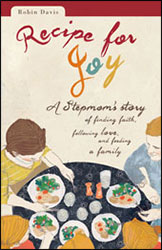 Recipe for Joy: A Stepmom’s Story of Finding Faith, Following Love, and Feeding a Family
by Robin Davis
Loyola Press, 2013
We’re all on a journey of faith, love, and family. It’s a journey with detours and U-turns, scenic roads and midnight breakdowns. But whether in Emmaus or Columbus or wherever (as the airline pilots say) our final destination may be, when we come to ourselves it is always around a table.
I’m weighing in shamefully late, as in the very last hours, with my contribution to the Patheos Book Club roundtable on Robin Davis’s wonderful Recipe for Joy. (My shame is earned and salutary, I hasten to add; see today’s terrific posts from Elizabeth Husted Duffy and Dr Gregory Popcak for why.) But I didn’t want my month-long struggle with blogger’s block to keep you from enjoying Davis’s culinary, spiritual, and marital autobiography—Eat, Pray, Love in real life—and from sharing it with folks who will find something in it to love and learn from. Which is, I think, everybody.
Robin Davis’s U-turn took her from a high-profile job (James Beard Award-winning restaurant critic for the San Francisco Chronicle), a religious profile as a None, and a lifestyle free of the ties of marriage and motherhood to a new life back in the Ohio of her childhood, reception into the Catholic Church, and marriage to a widower with children. Recipe for Joy lays out the unfolding of this transformation in a series of chapters framed to reflect courses on a menu, each with a corresponding recipe.
Davis doesn’t gloss over the bumps in the road—one of which, tellingly, was her own perfectionism and desire to present her blended family to herself and to the world as something as effortlessly gorgeous as a staged dinner-party photo in Bon Appetit.
Somewhere along the way, I decided that if I was going to do this stepmother thing, I was going to do it perfectly. Perfect is a dangerous word. It’s full of expectations, most of which I’ve since come to believe aren’t based in reality. Perfection as I’d perceived it precluded emptying oneself to become obedient to God’s plan. Being perfect takes up an awful lot of space, and so it doesn’t allow for that emptying thing to happen. . . . I allowed myself no leeway, no room for learning, or God forbid, mistakes. (p. 82)
But the joy that Davis brought to the table as an ingredient of her own soul bubbled up even on the worst days, and makes Recipe for Joy an optimistic, inviting read. Stepmoms—in particular the stepmothers of teenagers—have, I would imagine, one of the thorniest gardens to hoe, and will find in Recipe for Joy good company and a strengthening soup. Davis shares some of the fears she felt about “competing” with the memory of Grace, her husband’s first wife and the mother of his children. I suspect the challenges are equally, if not more, daunting when the “real mom” is still in the picture. I know many stepmothers—my own son’s among them—who have met those challenges with surpassing grace and a courage that often goes unrecognized and uncelebrated. If you know stepmoms (or stepdads) who have walked or are walking this road, slip them a copy of Recipe for Joy as a Mother’s Day or Father’s Day gift.
Foodies (and really, who isn’t one?) will love Davis’s rich descriptions of meals both real and metaphorical. The included recipes—born of the need to make high-end food family friendly—sound delicious and look doable. And it was a special kick for me to read about the Ohio that was part of my own opposite U-turning: Dayton, Cincinnati, Columbus, UD (Go, Flyers!), the particular gifts of the vibrant Church that flourishes there.
I also think it’s important to add a Catholic voice (however late) to the roundtable on this very Catholic book. In “My Beef with a Delicious Read,” Schaeffer’s Ghost guest blogger Jennilee Miller expressed disappointment that there seemed to be so little about Jesus in Davis’s account of coming to faith:
I kept thinking of this book as Strawberry Soup. Strawberry Soup is one of my favorite first courses for a summer meal: sweet, cool, smooth, easy to consume and appetizing. But nutritiously satisfying? Maybe not. When we are talking about a journey of faith that brings someone to God, I’m eager to hear about Christ. In “Recipe for Joy,” there’s barely any Jesus. In fact, I think I made it over 100 pages before there was any mention of him. There was a lot about murmurs of faith, God, the Catholic Church and growing prayers. And, don’t get me wrong: it’s tremendously encouraging to read Davis’s testimony of how God drew her to Himself. Through difficult circumstances and changed desires, the Lord made Himself known to Davis and gave her courage and grace to walk in faith.
But, the path the Bible lays out is that Jesus Christ is the means to reconcile man to God.
Of course that is true for Catholics, too. But as Robin Davis’s book so beautifully testifies, Jesus is not separate from his Church and his people. We encounter him, and come to know his Father, in his Church, in the Scriptures, in the Sacraments, in his people. Recipe for Joy has a 3-part subtitle, but in truth the process is not sequential: we find faith, follow love, and feed our families all at once and inseparably. And without meeting Christ and allowing ourselves to be met by him in faith, love, and the community of a family (by which I mean the openness to be vulnerable to others on a daily basis, to serve and nurture them as we find them), it’s all Strawberry Soup. Only with them is it Eucharist, the wedding feast of the Lamb.
We don’t always know it when it’s happening. “And it happened that while they were conversing and debating, Jesus himself drew near and walked with them, but their eyes were prevented from recognizing him” (Luke 24:15-16). The deacon who prepared Robin Davis for her entrance into the Church put it this way when addressing her and the other inquirers:
“There are a lot of reasons you’re all here,” he said. “Maybe a friend convinced you to come. Maybe a spouse. Maybe you’re tired of your kids tripping over you as they leave the pew for communion each week. But there’s another reason you’re here that you may not realize.” He took a moment to meet each of our gazes. “You’re here because Jesus wants you here.” (p. 109)
“And it happened that, while he was with them at table, he took bread, said the blessing, broke it, and gave it to them. With that their eyes were opened and they recognized him” (Luke 24:30-31).
_____
For more on Recipe for Joy: A Stepmom’s Story of Finding Faith, Following Love, and Feeding a Family, visit (quickly!) the Patheos Book Club.
Previous Post

April 8, 2013
Something New, Something Other: An Annunciation Diptych
Next Post

May 9, 2013 Seven Buses: The Love That Builds Bridges
Browse Our Archives
Select a Category Abortion Advent Art Bishops Book Review Catholicism Fortnight 4 Freedom In the News Lent Marriage Mary Mental Health New Evangelization Nuns Pilgrimage 2012 Pop Culture Pope Francis Religious Education Reverts Saints' Lives and Legends Sin Staying Catholic Uncategorized Year of Faith
Select a Month May 2016 May 2015 April 2015 March 2015 December 2014 November 2014 October 2014 September 2014 August 2014 July 2014 June 2014 April 2014 March 2014 February 2014 December 2013 November 2013 October 2013 September 2013 August 2013 July 2013 June 2013 May 2013 April 2013 March 2013 February 2013 January 2013 December 2012 November 2012 October 2012 September 2012 August 2012 July 2012 June 2012 May 2012 April 2012 March 2012 February 2012 January 2012 November 2011 April 2011 March 2011 December 2010
Follow Us!
TAKE THE
Religious Wisdom Quiz
Who was known for interpreting dreams in Babylon?
Select your answer to see how you score.
Moses Daniel David Joseph
Related posts from Egregious Twaddle

Depressed and Catholic: Learning It's OK to Live

5 Reasons Why Catholics (of All People!) Should...

Pope and African Bishops to Cardinal Kasper: "Can...

Thanks, Catholic News Service, But No Thanks
TRENDING AT PATHEOS Catholic

Rejecting Doom: Christian Hope And Human Action
Christianity is a religion of hope. We are to have hope and...

It’s What Comes From Within Which Matters
One of the most difficult things for us to understand is why...

Why I Choose the Eucharist Over the Sermon
Choose the Eucharist, Not the Sermon What are we supposed to get...

5 Design Elements Found in Spiritually Rooted Homes
Putting Spirituality Into Home Decor Our homes are more than our living...

Credo: A Story of God Told with the...
About 10 years ago, I began to imagine a personal "Credo" that...

The Anatomy of Divine Revelation in Catholic Thought
The claim that God has made Himself known to human beings is...
view all Catholic blogs
Ad-Free & Subscriber Log-In Subscription Support
- About Us
- 2026 Calendar
- Videos
- Podcasts
- Library of World Religions
- Faith In Media Tracker
- Advertise With Us
- Write for Us
- Privacy Policy
- Terms of Service
- Do Not Sell My Data
- Contact Us
- Radiant Digital
- Manage Newsletter Subscriptions
- Unsubscribe From Notifications
- Sitemap
Copyright 2008-2026, Patheos. All rights reserved.
Subscription Support Ad-Free & Subscriber Log-In
Follow Patheos