
BuddhistCatholicContemplativeEvangelicalGeneral ChristianHinduJewishLatter-day SaintMuslimNew VisionsProgressive Christian
Beliefs
- Buddhist
- Catholic
- Contemplative
- Evangelical
- General Christian
- Hindu
- Jewish
- Latter-day Saint
- More Voices
- Muslim
- New Visions
- Pagan
- Progressive Christian
Topics
- Religion News
- Food and Religion
- Sports and Religion
- Religious Art
- Religious Music and Entertainment
- Religious Events
- History and Religion
- Style and Religion
- Politics and Religion
- Women in Religion
- Recreation Outdoors and Religion
- Business Finance and Religion
- Careers Workplace and Religion
- Education and Religion
- Family Parenting and Religion
- Health Fitness and Religion
- Home and Religion
- Relationships and Religion
- Technology and Religion
- Travel and Religion
Columnists
- Buddhist Columnists
- Business Finance and Religion Columnists
- Careers Workplace and Religion Columnists
- Catholic Columnists
- Contemplative Columnists
- Education and Religion Columnists
- Evangelists Columnists
- Family Parenting and Religion Columnists
- General Christian Columnists
- Health Fitness and Religion Columnists
- Hindu Columnists
- History and Religion Columnists
- Home and Religion Columnists
- Jewish Columnists
- More Voices Columnists
- Latter Day Columnists
- Muslim Columnists
- New Visions Columnists
- Nonreligious Columnists
- Pagan Columnists
- Politics and Religion Columnists
- Progressive Columnists
- Recreation Outdoors and Religion Columnists
- Relationships and Religion Columnists
- Religion News Columnists
- Religious Art Columnists
- Religious Events Columnists
- Religious Music and Entertainment Columnists
- Sports and Religion Columnists
- Style and Religion Columnists
- Technology and Religion Columnists
- Travel and Religion Columnists
- Women in Religion Columnists
Resource Library
- 2026 Calendar
- Library of World Religions
- The 100 Most Holy Places on Earth
- Patheos Answers
- Podcasts
- Videos
- Faith Leaders Database
- Anglican Episcopalian
- Bahai
- Baptist
- Buddhism
- Christianity
- Confucianism
- Eastern Orthodoxy
- Hinduism
- Holiness and Pentecostal
- ISKCON
- Islam
- Judaism
- Lutheran
- Methodist
- The Church of Jesus Christ of Latter-day Saints
- New Age
- Paganism
- Presbytarian and Reformed
- Protestantism
- Religion Behind the Scenes
- Roman Catholic
- Scientology
- Shia Islam
- Sikhism
- Sufism
- Sunni Islam
- Taoism
- Zen
- See all religions
Research Tools
 Ad-Free & Subscriber Log-In Subscription Support
Ad-Free & Subscriber Log-In Subscription Support
Follow Patheos 

- Trending:
- Forgiveness
- |
- Marriage
- |
- Consciousness
- |
- Death Penalty
- |
- Election
- |
- Halloween
 Egregious Twaddle
- Home
- Catholic
- Spiritual AND Religious—Surprise!: A Book Review
Spiritual AND Religious—Surprise!: A Book Review
Last updated on: May 2, 2016 at 11:30 am by Joanne McPortland
Spiritual AND Religious—Surprise!: A Book Review 2016-05-02T11:30:03-06:00 Joanne McPortland
Patheos Explore the world's faith through different perspectives on religion and spirituality! Patheos has the views of the prevalent religions and spiritualities of the world.
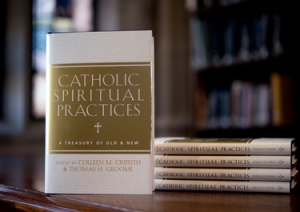
Catholic Spiritual Practices: A Treasury of Old & New
Edited by Colleen M. Griffith & Thomas H. Groome
Paraclete Press, 2012
This time of year, our thoughts often turn to the good things that come in small packages, the gifts that have the power to surprise us, to contain more than they might promise at first glance. Catholic Spiritual Practices, a slim volume published by Paraclete Press for Boston College’s Church in the 21st Century Center, is just such surprise package.
At first glance, the book’s gold and white cover design evokes (quite probably intentionally) the dust jackets of Blessed John Paul II’s writings. Catholics of a traditional bent seeking papal wisdom will, however, get their first surprise on scanning the list of authors whose brief reflections on spiritual practices old and new editors Griffith and Groome have collected. Danger, Will Robinson! With a few exceptions, this could be the speaker’s roster for an LCWR annual meeting, with names like Elizabeth Johnson, CSJ, Sandra Schneiders, IHM, and Joan Chittister, OSB—nuns not only on, but driving, the post-Christian bus—sure to raise red flags for orthodox readers. Editor Tom Groome himself was, in an earlier priestly incarnation, even more responsible for the US Church’s notorious 40 Years of Wandering in the Catechetical Wilderness than I was, and tended to look down his praxis-and-paradigm-shift nose, in the past, at efforts by people like me to include traditional Catholic spiritual practices and devotions in religion programs.
So here’s the second big surprise, not only for trads but for the progressive-if-elderly cohort of the authors, who might have been expecting DIY rituals based on generic Native American creation myths with a side of Wicca. These really are Catholic spiritual practices, presented for the most part quite traditionally and with a deep note of respect that’s been missing since many of the babies of tradition got thrown out with the Vatican II baptismal water. Divided into three sections—Practices of Prayer, Practices of Care, and Practices of Spiritual Growth—Catholic Spiritual Practices contains short essays on everything from the Rosary to Eucharistic Adoration (this essay from Brian Daley, SJ, is an eloquent tribute to the revival of this practice among young Catholics, which so impressed me on my reversion), with stops along the way for the Ignatian Examen, Retreats, Spiritual Direction, Stations of the Cross, Fasting, and Praying with Images, along with many more.
In addition to particular prayers and devotions, Catholic Spiritual Practices does a fine job of addressing the attitudes of Catholic spirituality. The marvelous Wendy M. Wright writes about family life as spirituality, rooted in the Incarnation:
Family life is not only busy but it is an intensely embodied life. Bodies jostling for places at the dinner table, bodies intermingling to create new bodies, which then inhabit one and then are held, carried, nursed, tended, bathed, and fed; bodies kissed for “boo-boos”; bodies patiently accommodated as they age and fail; bodies whose proximity one longs for and whose absence inflicts pain; bodies that keep one awake by crowding into bed on a stormy childhood winter night or keep one awake long past curfew in a sultry adolescent summer; bodies that arrive unannounced for a fortnight’s stay; bodies whose presence is required at holiday functions; bodies lithe and limber; bodies stiff and aching—the sacred realized in intense engagement with other bodies. . . . To put it in the language of Christian theology, the mystery of the incarnation itself—God becoming human—pushes us toward the insight that to encounter the infinite one must go through the finite . . . not by passing or eliminating the finite but going through it, in all its unique, unrepeatable particularity. (pp. 86-87)
I think my sister bloggers Calah Alexander and Elizabeth Duffy, and all who occasionally struggle (as who doesn’t?) with that “intensely embodied life” of families, might find comfort in this reminder that they are practicing spirituality all along.
Ana Maria Pineda, RSM, unpacks the practice of Christian hospitality by describing the Latino custom of Las Posadas, the reenactment of Mary and Joseph’s search for shelter in Bethlehem. “When the ritual takes place in the Mission District of San Francisco,” she writes,
. . . many of the participants—once refugees themselves—remember their own experience as strangers. Through the ritual, the community affirms the goodness of taking people in, and those who once needed posada are reminded to offer it to others. This is a lesson that is needed in other communities as well. The need for shelter, for posada, is a fundamental human need. None of us ever knows for sure when we might be uprooted and cast on the mercy of others. (p. 71)
For me, this year, uprooted through my own fault and cast on the mercy of others, and having by God’s and my family’s grace found posada in the Ciudad de Los Angeles, this essay was particularly moving.
As Kathy Schiffer has noted in her review, Catholic Spiritual Practices truly does offer a little something for everyone. You can dip and sample, but be prepared to look at everything in a new light. If you think Elizabeth Johnson is too radical in her insistence that praying with the saints is intended to move us to “the making of a just society and a compassionate world here and now” (p. 20), remember that Mary’s Magnificat is just as radical in just the same way. If you think Tom Groome betrays his liberal street cred by confessing that he still follows the traditional format for making a thanksgiving after Communion that he learned 60 years ago from his second grade teacher (p. 144), consider that a ritual 6 decades old might have stuck around because it works, because it was literally “learned by heart.”
Catholic Spiritual Practices might make a good stocking stuffer for a new convert or a revert drawn by Catholics Come Home ads (although Leah Libresco and Kathy Schiffer are correct in noting that it’s just a start, and Kathy generously suggests some further resources), but I think it would make an even better gift for those—like me, like the authors—who once loved, then repudiated, these traditional practices and need to know it’s OK to embrace them again. And it would be a superb nudge to those who think it’s possible to be “spiritual, but not religious.” In one of this little book’s biggest surprises, co-editor Colleen Griffith uses her Introduction to slay that myth, once and for all:
A spirituality that is disconnected from religious tradition is bereft of both community and history; it has no recourse to the benefits of a larger body of discourse and practice, and it lacks accountability. Such spirituality quickly becomes privatized and rootless, something directly opposite to the Christian understanding of “life in the Spirit.” (p. 3)
Wham! Bam! Who’da thunk it? When it comes to Catholic spirituality, it seems, Peter Allen was right: Everything old is new again.
_____
Visit the Patheos Book Club to learn more about Catholic Spiritual Practices and its editors, and to join the discussion.
Church in the 21st Century Center
Previous Post

December 3, 2012
10 Things I'll Miss Most About Catholic Ohio
Next Post

December 13, 2012 The Cleaning Crew: 3 Advent Allies for Spiritual Warriors
Browse Our Archives
Select a Category Abortion Advent Art Bishops Book Review Catholicism Fortnight 4 Freedom In the News Lent Marriage Mary Mental Health New Evangelization Nuns Pilgrimage 2012 Pop Culture Pope Francis Religious Education Reverts Saints' Lives and Legends Sin Staying Catholic Uncategorized Year of Faith
Select a Month May 2016 May 2015 April 2015 March 2015 December 2014 November 2014 October 2014 September 2014 August 2014 July 2014 June 2014 April 2014 March 2014 February 2014 December 2013 November 2013 October 2013 September 2013 August 2013 July 2013 June 2013 May 2013 April 2013 March 2013 February 2013 January 2013 December 2012 November 2012 October 2012 September 2012 August 2012 July 2012 June 2012 May 2012 April 2012 March 2012 February 2012 January 2012 November 2011 April 2011 March 2011 December 2010
Follow Us!
TAKE THE
Religious Wisdom Quiz
Who was the wealthy woman who supported Jesus and the apostles?
Select your answer to see how you score.
Lydia Tabitha (Dorcas) Priscilla Phoebe
Related posts from Egregious Twaddle

Depressed and Catholic: Learning It's OK to Live

5 Reasons Why Catholics (of All People!) Should...

Pope and African Bishops to Cardinal Kasper: "Can...

The Magdalene's Cave: Thoughts on Priesthood and Women
TRENDING AT PATHEOS Catholic

Rejecting Doom: Christian Hope And Human Action
Christianity is a religion of hope. We are to have hope and...

It’s What Comes From Within Which Matters
One of the most difficult things for us to understand is why...

Why I Choose the Eucharist Over the Sermon
Choose the Eucharist, Not the Sermon What are we supposed to get...

5 Design Elements Found in Spiritually Rooted Homes
Putting Spirituality Into Home Decor Our homes are more than our living...

Credo: A Story of God Told with the...
About 10 years ago, I began to imagine a personal "Credo" that...

The Anatomy of Divine Revelation in Catholic Thought
The claim that God has made Himself known to human beings is...
view all Catholic blogs
Ad-Free & Subscriber Log-In Subscription Support
- About Us
- 2026 Calendar
- Videos
- Podcasts
- Library of World Religions
- Faith In Media Tracker
- Advertise With Us
- Write for Us
- Privacy Policy
- Terms of Service
- Do Not Sell My Data
- Contact Us
- Radiant Digital
- Manage Newsletter Subscriptions
- Unsubscribe From Notifications
- Sitemap
Copyright 2008-2026, Patheos. All rights reserved.
Subscription Support Ad-Free & Subscriber Log-In
Follow Patheos