
BuddhistCatholicContemplativeEvangelicalGeneral ChristianHinduJewishLatter-day SaintMuslimNew VisionsProgressive Christian
Beliefs
- Buddhist
- Catholic
- Contemplative
- Evangelical
- General Christian
- Hindu
- Jewish
- Latter-day Saint
- More Voices
- Muslim
- New Visions
- Pagan
- Progressive Christian
Topics
- Religion News
- Food and Religion
- Sports and Religion
- Religious Art
- Religious Music and Entertainment
- Religious Events
- History and Religion
- Style and Religion
- Politics and Religion
- Women in Religion
- Recreation Outdoors and Religion
- Business Finance and Religion
- Careers Workplace and Religion
- Education and Religion
- Family Parenting and Religion
- Health Fitness and Religion
- Home and Religion
- Relationships and Religion
- Technology and Religion
- Travel and Religion
Columnists
- Buddhist Columnists
- Business Finance and Religion Columnists
- Careers Workplace and Religion Columnists
- Catholic Columnists
- Contemplative Columnists
- Education and Religion Columnists
- Evangelists Columnists
- Family Parenting and Religion Columnists
- General Christian Columnists
- Health Fitness and Religion Columnists
- Hindu Columnists
- History and Religion Columnists
- Home and Religion Columnists
- Jewish Columnists
- More Voices Columnists
- Latter Day Columnists
- Muslim Columnists
- New Visions Columnists
- Nonreligious Columnists
- Pagan Columnists
- Politics and Religion Columnists
- Progressive Columnists
- Recreation Outdoors and Religion Columnists
- Relationships and Religion Columnists
- Religion News Columnists
- Religious Art Columnists
- Religious Events Columnists
- Religious Music and Entertainment Columnists
- Sports and Religion Columnists
- Style and Religion Columnists
- Technology and Religion Columnists
- Travel and Religion Columnists
- Women in Religion Columnists
Resource Library
- 2026 Calendar
- Library of World Religions
- The 100 Most Holy Places on Earth
- Patheos Answers
- Podcasts
- Videos
- Faith Leaders Database
- Anglican Episcopalian
- Bahai
- Baptist
- Buddhism
- Christianity
- Confucianism
- Eastern Orthodoxy
- Hinduism
- Holiness and Pentecostal
- ISKCON
- Islam
- Judaism
- Lutheran
- Methodist
- The Church of Jesus Christ of Latter-day Saints
- New Age
- Paganism
- Presbytarian and Reformed
- Protestantism
- Religion Behind the Scenes
- Roman Catholic
- Scientology
- Shia Islam
- Sikhism
- Sufism
- Sunni Islam
- Taoism
- Zen
- See all religions
Research Tools
 Ad-Free & Subscriber Log-In Subscription Support
Ad-Free & Subscriber Log-In Subscription Support
Follow Patheos 

- Trending:
- Forgiveness
- |
- Marriage
- |
- Consciousness
- |
- Death Penalty
- |
- Election
- |
- Halloween
 Egregious Twaddle
- Home
- Catholic
- Picturing the Destination: Egregious Twaddle on Pilgrimage
Picturing the Destination: Egregious Twaddle on Pilgrimage
Last updated on: May 2, 2016 at 11:20 am by Joanne McPortland
Picturing the Destination: Egregious Twaddle on Pilgrimage 2016-05-02T11:20:54-06:00 Joanne McPortland
Patheos Explore the world's faith through different perspectives on religion and spirituality! Patheos has the views of the prevalent religions and spiritualities of the world.
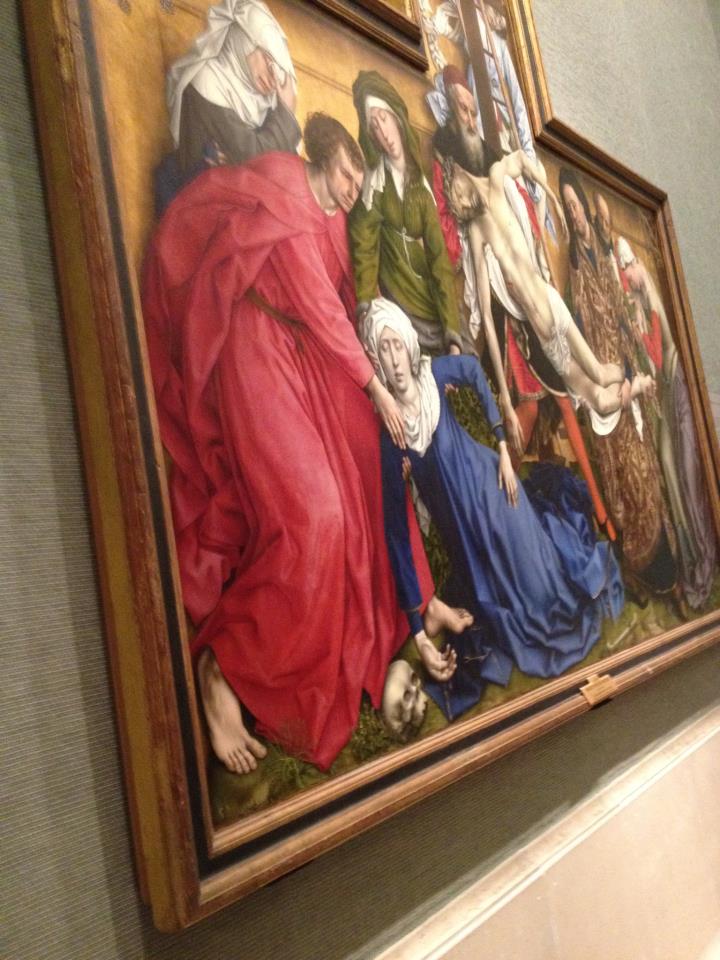
On the walls of a museum, we come face-to-face with two views of life. Both have the power to shake us to our roots. Both look like madness. And both are roadmaps of the human journey. But only one is true, and you can tell it by the tears.
Pilgrimage 2012, Day 6: Madrid
[A note to the patient pilgrims: After wrestling with jetlag and some personal baggage—not the kind subject to customs inspections, but carried with me on the pilgrimage no less, and seriously over the weight limit—I’m back on the virtual road. Thank you for not wandering away when we left you by the highway so long ago!]
Our stay in Madrid was meant to be a bit of a break in the pilgrimage routine, with an emphasis more on exploring the culture of Spain than on visiting shrines to cultivate the culture of our souls. It worked that way for many of us, those who took advantage of the rare free time to shop for souvenirs (and, in one case, to replace the blister-y dress shoes—the sandals forgotten at home—with more comfortable walking shoes of Spanish leather), to stroll in the park of El Retiro or sit on a bench in the sun in the botanical gardens, to seek out a tapas bar or attend a flamenco performance. We did run into interference from the real world: some folks riding a city bus to the Plaza Mayor were turned back because of threatened demonstrations against economic cuts. The demonstrations didn’t amount to much until last week, when we were back home, and the Spanish MSM news ignored them completely. (I know, because I watched the news after catching NCIS in Spanish.)

The reredos of the main altar of the Cathedral of Santa Maria la Real de la Almudena. Mary stands on the crescent moon as a sign of her role in the Reconquest of Spain from the Moors.
We did encounter Mary under another miraculous title, when we celebrated Mass at the cathedral. Only recently completed, the cathedral is named for an image of Mary that, according to legend, dates back to the 8th century or earlier. When the Moors conquered Madrid in the early 700s, an image of Mary then known as Santa Maria Mayor (St Mary Major) was hidden in the city wall. Three hundred years later, when Madrid was returned to Christian rule, the besieging army dreamed that Mary led them into the city. They awoke to find the city wall had crumbled in one place, revealing the image and allowing the armies a way in. After driving the Moors from the city, the bishop set up the image in what had been the central mosque. When the palace of the Spanish kings was built next door, the shrine of the image became the chapel royal. Today, the cathedral stands here, named Santa Maria la Real de la Almudena—St Mary the Royal of the Almudena (from the Arabic for “the citadel,” because she was pulled from the fortified walls). One more story of the interplay of faith and power on the Iberian peninsula, and the role in it the devout have assigned to Mary.
After Mass, we were guided on the cultural portion of our pilgrimage—visits to El Prado, the enormous and dizzyingly rich art museum of the Spanish kings, and to the royal palace. We had precisely an hour in the Prado, which is stuffed with a lifetime’s worth of religious masterpieces alone, not to mention the other works of the world’s greatest painters. I knew that our local guides, given the brevity of our visit, would focus on the pride of Spain, the museum’s vast collections of Velasquez, El Greco, Murillo, and Goya. And I love these. But I also knew that the Prado holds my favorite painting in the world—and it’s not Spanish. The thought of being in the same house as Rogier van der Weyden’s Deposition of Christ altarpiece and not seeing it had me in fits. My friend Michael, however, arranged that the group we were in (one of three into which our large pilgrimage was divided) was led first to the Flemish wing, and straight to the Deposition.
I started crying the minute we entered the room. I’ve written and taught about this marvelous painting for decades, and in its presence all I could do was weep silently and allow it to teach me.

I begged off from the group, and kept Mary’s station at the cross with her for another 30 minutes. Then, walking back to where I was to meet the group, I picked up a map of the museum and learned that the Flemish wing contained at least 5 or 6 other favorites. So I literally ran from room to room, genuflecting in front of a Fra Angelico Annunciation (with the Joyful Mysteries picked out in exquisite miniature beneath, and a woeful Adam and Eve leaving Paradise on the left), the Mantegna Dormition of the Virgin (tinier than I had imagined, but perfect), the chaos of Bosch’s Garden of Earthly Delights and his wonderful table depicting the Seven Deadly Sins that Philip II commissioned for his bedchamber and used as a nightstand or a To-Do list, the wonderful sweeping drama of Correggio’s Noli mi tangere, and an entire roomful of nursing Madonnas, each proffering a chaste and egg-white breast from bodices of intricately-woven Flemish tapestry. And I cried the whole time.
 I found out later that my fellow pilgrims had also, many of them, been stricken to the quick by a painting—Goya’s Saturn Devouring His Children. (Several were so disturbed by the subject matter and the treatment that they insisted it was called Satan Devouring Sinners.) This nightmarish vision, one of the so-called Black Paintings that Goya painted directly on the walls of his house in his last years of madness and despair, may not refer to the classical myth at all, as the paintings were all named by art historians after Goya’s death. But I couldn’t help but think what a terrific diptych of contrast the Prado had provided us with.
Both the Deposition and Saturn present us with the notion of a divine Father sacrificing his child. In the myth of Saturn (also known as Cronus, or Time) the father of the gods is told that he will be supplanted by one of his children. In a jealous rage, he devours each child as it is born; only Jupiter (Zeus) escapes, and does in the end destroy his father and seize power. That is the picture of life the world gives us: that Time devours all things, that true power can only be achieved by killing and supplanting those who hold it. I can feel pity for Goya in his darkness, but the painting—and the worldview it enshrines—engenders only terror and disgust.

Tears in the eyes of Mary of Clopas (van der Weyden, Deposition, detail)
The Deposition shows us another way. This Father has sacrificed his Son not out of selfishness but out of bountiful generosity. For us, for us! Time only appears to devour our lives—the curve of Mary’s swooning body, echoing that of her lifeless Son, the tears on the faces of Mary’s sisters and of the weeping Magdalene, John’s red eyes and the wince of pain on Nicodemus’s brow all testify to the pain that illusion brings, even to those of deepest faith—but we know the story ends with Eternity victorious. And true power lies—like the graceful body of the Crucified One—in the arc of surrender to God’s will. This one is the true picture of our lives. You can tell, because of the tears it depicts and the tears it engenders.
I didn’t visit the royal palace of the kings of Spain. After my hour in the museum, all I could was sit on the darkened bus and pray. My fellow pilgrims were impressed, then overwhelmed, by the luxury—the countless state dining rooms, the velvet bed hangings, the gilded ceilings, the crystal and china and jewels beyond price. It was a good contrast, they said over dinner, to our own lives, and a good reminder of what really counts. Me, I am profoundly grateful in one sense for the wealth of the Spanish crown, which enabled the placement of the Deposition and Saturn Devouring His Children under one roof, for our contemplation.
It just goes to show that even when you’re on a break from pilgrimage, your soul can turn a corner and come upon a shrine you will never forget. Eyes open, pilgrims!
_____
NEXT: Zaragoza, and the Oldest Pilgrim Shrine Outside the Holy Land



Browse Our Archives
Select a Category Abortion Advent Art Bishops Book Review Catholicism Fortnight 4 Freedom In the News Lent Marriage Mary Mental Health New Evangelization Nuns Pilgrimage 2012 Pop Culture Pope Francis Religious Education Reverts Saints' Lives and Legends Sin Staying Catholic Uncategorized Year of Faith
Select a Month May 2016 May 2015 April 2015 March 2015 December 2014 November 2014 October 2014 September 2014 August 2014 July 2014 June 2014 April 2014 March 2014 February 2014 December 2013 November 2013 October 2013 September 2013 August 2013 July 2013 June 2013 May 2013 April 2013 March 2013 February 2013 January 2013 December 2012 November 2012 October 2012 September 2012 August 2012 July 2012 June 2012 May 2012 April 2012 March 2012 February 2012 January 2012 November 2011 April 2011 March 2011 December 2010
Follow Us!
TAKE THE
Religious Wisdom Quiz
I returned the stolen ark with gold tumors and gold rats after plagues struck our cities. Who are we?
Select your answer to see how you score.
The Moabites The Amalekites The Ammonites The Philistines
Related posts from Egregious Twaddle

Finding My Way Back to Fatima, and Down...

O Key of David! Opening Wide to the...

O Root of Jesse! Grant Us Patience, and...

O Wisdom! Pile on the Prudence, Please!
TRENDING AT PATHEOS Catholic

Rejecting Doom: Christian Hope And Human Action
Christianity is a religion of hope. We are to have hope and...

It’s What Comes From Within Which Matters
One of the most difficult things for us to understand is why...

Why I Choose the Eucharist Over the Sermon
Choose the Eucharist, Not the Sermon What are we supposed to get...

5 Design Elements Found in Spiritually Rooted Homes
Putting Spirituality Into Home Decor Our homes are more than our living...

Credo: A Story of God Told with the...
About 10 years ago, I began to imagine a personal "Credo" that...

The Anatomy of Divine Revelation in Catholic Thought
The claim that God has made Himself known to human beings is...
view all Catholic blogs
Ad-Free & Subscriber Log-In Subscription Support
- About Us
- 2026 Calendar
- Videos
- Podcasts
- Library of World Religions
- Faith In Media Tracker
- Advertise With Us
- Write for Us
- Privacy Policy
- Terms of Service
- Do Not Sell My Data
- Contact Us
- Radiant Digital
- Manage Newsletter Subscriptions
- Unsubscribe From Notifications
- Sitemap
Copyright 2008-2026, Patheos. All rights reserved.
Subscription Support Ad-Free & Subscriber Log-In
Follow Patheos