
BuddhistCatholicContemplativeEvangelicalGeneral ChristianHinduJewishLatter-day SaintMuslimNew VisionsProgressive Christian
Beliefs
- Buddhist
- Catholic
- Contemplative
- Evangelical
- General Christian
- Hindu
- Jewish
- Latter-day Saint
- More Voices
- Muslim
- New Visions
- Pagan
- Progressive Christian
Topics
- Religion News
- Food and Religion
- Sports and Religion
- Religious Art
- Religious Music and Entertainment
- Religious Events
- History and Religion
- Style and Religion
- Politics and Religion
- Women in Religion
- Recreation Outdoors and Religion
- Business Finance and Religion
- Careers Workplace and Religion
- Education and Religion
- Family Parenting and Religion
- Health Fitness and Religion
- Home and Religion
- Relationships and Religion
- Technology and Religion
- Travel and Religion
Columnists
- Buddhist Columnists
- Business Finance and Religion Columnists
- Careers Workplace and Religion Columnists
- Catholic Columnists
- Contemplative Columnists
- Education and Religion Columnists
- Evangelists Columnists
- Family Parenting and Religion Columnists
- General Christian Columnists
- Health Fitness and Religion Columnists
- Hindu Columnists
- History and Religion Columnists
- Home and Religion Columnists
- Jewish Columnists
- More Voices Columnists
- Latter Day Columnists
- Muslim Columnists
- New Visions Columnists
- Nonreligious Columnists
- Pagan Columnists
- Politics and Religion Columnists
- Progressive Columnists
- Recreation Outdoors and Religion Columnists
- Relationships and Religion Columnists
- Religion News Columnists
- Religious Art Columnists
- Religious Events Columnists
- Religious Music and Entertainment Columnists
- Sports and Religion Columnists
- Style and Religion Columnists
- Technology and Religion Columnists
- Travel and Religion Columnists
- Women in Religion Columnists
Resource Library
- 2026 Calendar
- Library of World Religions
- The 100 Most Holy Places on Earth
- Patheos Answers
- Podcasts
- Videos
- Faith Leaders Database
- Anglican Episcopalian
- Bahai
- Baptist
- Buddhism
- Christianity
- Confucianism
- Eastern Orthodoxy
- Hinduism
- Holiness and Pentecostal
- ISKCON
- Islam
- Judaism
- Lutheran
- Methodist
- The Church of Jesus Christ of Latter-day Saints
- New Age
- Paganism
- Presbytarian and Reformed
- Protestantism
- Religion Behind the Scenes
- Roman Catholic
- Scientology
- Shia Islam
- Sikhism
- Sufism
- Sunni Islam
- Taoism
- Zen
- See all religions
Research Tools
 Ad-Free & Subscriber Log-In Subscription Support
Ad-Free & Subscriber Log-In Subscription Support
Follow Patheos 

- Trending:
- Forgiveness
- |
- Marriage
- |
- Consciousness
- |
- Death Penalty
- |
- Election
- |
- Halloween
 Egregious Twaddle
- Home
- Catholic
- Climb Ev’ry Mountain: Egregious Twaddle on Pilgrimage
Climb Ev’ry Mountain: Egregious Twaddle on Pilgrimage
Last updated on: May 2, 2016 at 11:02 am by Joanne McPortland
Climb Ev’ry Mountain: Egregious Twaddle on Pilgrimage 2016-05-02T11:02:51-06:00 Joanne McPortland
Patheos Explore the world's faith through different perspectives on religion and spirituality! Patheos has the views of the prevalent religions and spiritualities of the world.

An hour in the Pyrenees, and you suddenly understand the deep ties between geography and belief. And you get a clue about why we’re always fighting over territory. Gerald O’Hara was partly right: “It’s land, Katie Scarlett! . . . Why, land is the only thing in the world worth workin’ for, worth fightin’ for, worth dyin’ for, because it’s the only thing that lasts.” Of course it doesn’t, really. But since Eden was foreclosed on, that’s the story we tell ourselves.
Pilgrimage 2012, Day 8: Zaragoza to Lourdes, through the Pyrenees
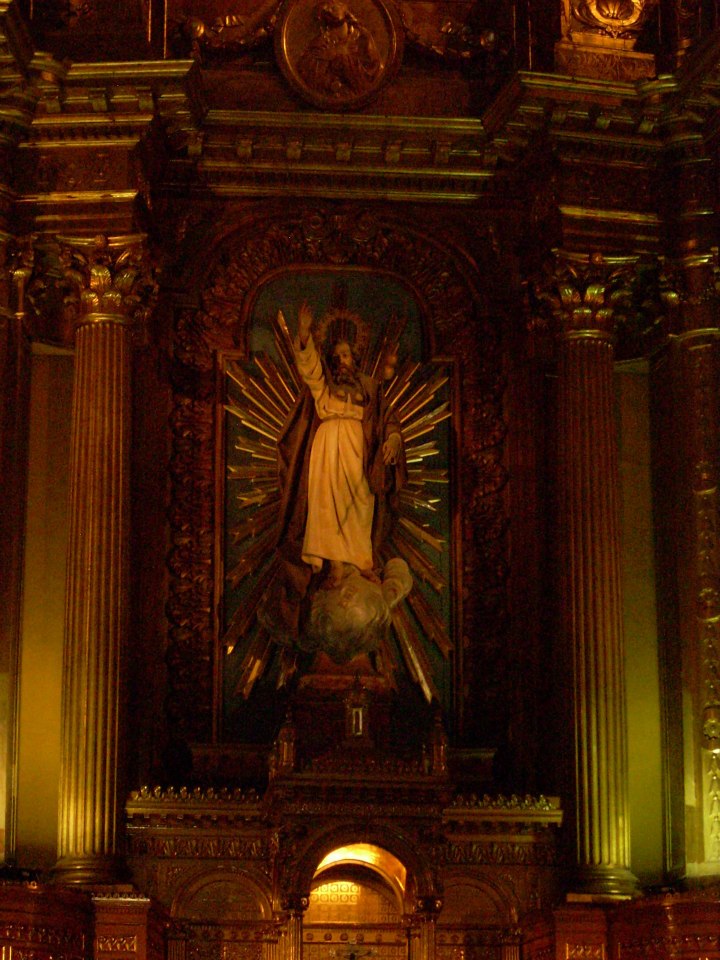 Leaving Zaragoza (the name of the city, by the way, is a corruption of Caesaraugusta, its title as a Roman camp), we pause to celebrate Mass in the parish church of Santiago el Mayor—St James the Greater again. With its coffered ceiling and gilded baroque statuary, this is a far cry from our home parishes, though it seems to be the standard here in Spain. At the back of the church are leaflets promoting the Year of Faith and sign-up sheets for volunteer catechists. Over the altar towers the saint himself.
No one has mentioned during this trip—perhaps out of cultural sensitivity, perhaps assuming we knew—that St James the evangelizer and pilgrim bears another, more bloodthirsty identity in Spain. He is also Santiago Matamoros (St James the Moor-Killer), after the legend that he appeared, mounted on a white horse, at the side of Christian king Ramiro I and helped to beat back the Moorish armies in the Battle of Clavijo in 844. Cervantes has Don Quixote pay homage to the legend, and the battle cry of Spanish armies ever since has been Santiago y cierra Espana (“St James! and strike for Spain”).
Zaragoza, and the Spanish and French Pyrenees beyond, have been contested lands over and over. The Old French epic Chanson de Roland (the Song of Roland) sings of another battle between the Christians and the Moors, on the north side of the Pyrenees at Roncesvalles. There the brave Roland, a knight in Charlemagne’s army, single-handedly fights off a treacherous attack by the Muslim Saracens—the poem calls them, inaccurately, pagans—and dies on a peak, literally blowing his brains out, sounding his elephant tusk horn to warn the Christians. He has just time for a last confession, and so his soul is carried to heaven by angels—while the Saracens are driven back to Zaragoza by Charlemagne and drowned in the Ebro.
But Rollant feels he’s no more time to seek;
Looking to Spain, he lies on a sharp peak,
And with one hand upon his breast he beats:
“Mea Culpa! God, by Thy Virtues clean
Me from my sins, the mortal and the mean,
Which from the hour that I was born have been
Until this day, when life is ended here!”
Holds out his glove towards God, as he speaks
Angels descend from heaven on that scene.
~ La Chanson de Roland, CLXXV
As we drove through these ancient, brooding mountains, their sheer slopes and time-softened peaks crisscrossed with light and cloud shadow, it was easy to see how this landscape could breed legends. It’s as stark and awe-inspiring as Sinai, and the people of the region seem to have inherited the same fierce territorial loyalty and faith-sliding-sometimes-into-madness that haunts the Holy Land. This was Cathar country, too—the home of the medieval Christian heretics known to themselves as Les Bons Hommes (the Good People) and to others, for the gnostic rigor of their fasting and abstinence from the world, the Pure Ones (Cathari, in Greek). The Cathars flourished in province of Toulouse, now in southern France, around the walled town of Albi (thus another name for them, Albigensians). They were people of the Languedoc, the Aquitane, the “people who talk like us,” the ones who said Oc instead of Oui for Yes. Their autonomy, their wealth, the power they accorded women, their refusal to acknowledge the authority of Rome or France, their past connections with the Moors of Al-Andalus and the shady Knights Templar all made the Cathars easy targets for Church-State reprisals. When the efforts of the newly formed Dominican Order and the Inquisition failed to contain the spread of the Good People’s influence, the pope and the king of France declared the only crusade of Christian against Christian.
In 45 years of bloody European-on-European battle—“How can we tell the heretics from the true Christians?” one puzzled soldier asked; “Kill them all, and let God sort them out” was his commander’s reply—the Cathars were eventually eradicated. Their last stand was at a walled fortress high in the French Pyrenees called Montsegur. On the final day of the siege, the grand dame of the remaining heretics, the 70-year-old Lady Esclarmonde du Foix, led 220 inhabitants of the fortress into the fires of martyrdom, singing. (Disclaimer: I do love me some Cathars. Yeah, they were heretics, but they were intense.) Bonus points: France got control of Toulouse, the Church got its churches back .
Today it’s the Basques—or, as they refer to themselves in their unique language, the Euskaldunak, or “people who talk like us”—who fiercely battle for the autonomy of their territories in the Spanish and French Pyrenees. Basque separatist organizations, including the ETA (whose violent protests, bombings, and kidnappings have taken nearly 900 lives over the years and have earned the group the label of terrorists) fight as hard for land as Gerald O’Hara’s Irish descendants have in Belfast and Derry.
All you have to do is look at these peaks (even in the foreshortened and pathetic views I caught out our bus window) and something stirs. You know why one of God’s ancient Hebrew names is El Shaddai (God Almighty, awesome God, but literally “God of the mountains”) and why the psalmist sang:
I love you, LORD, my strength,
LORD my rock, my fortress, my deliverer,
My God, my rock of refuge,
my shield, my saving horn, my stronghold.
~ Psalm 18:2-3
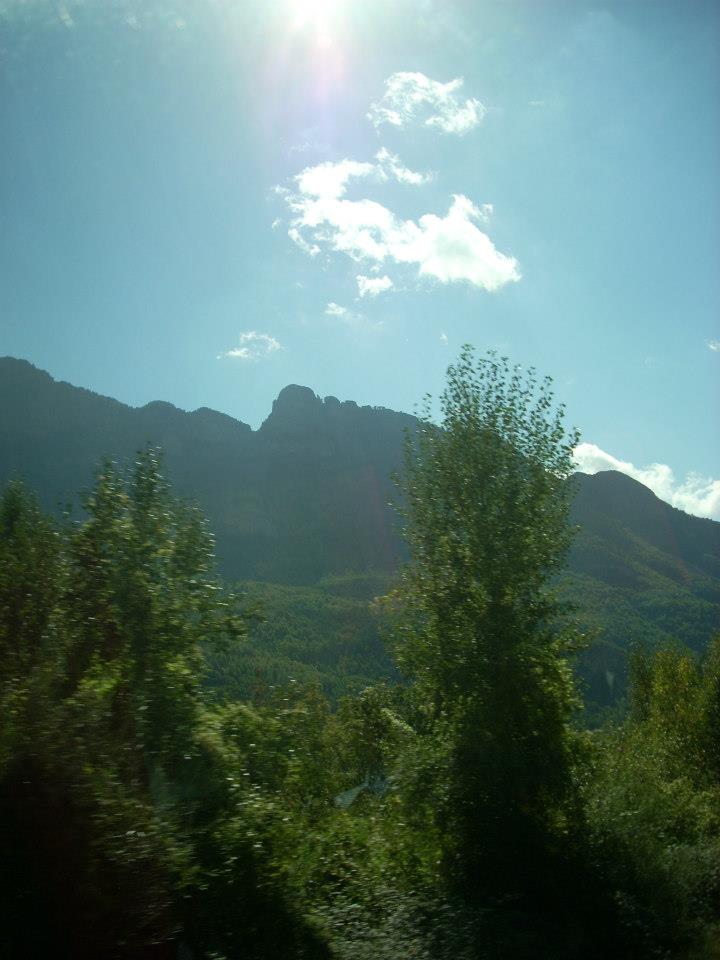 We sang, too, as we took a break atop the pass from Spain into France. Our rest stop (a bar and grill serving hikers in the summer and skiers in the winter) resembled an Alpine chalet, so it was only natural that as we waited for the staff to whip up paella for the masses on short notice, and the Archbishop himself acted as sommelier, the pilgrims chorused “Edelweiss” and “Doe, a Deer”—hits from that musical (known in Spanish, we discovered in Madrid where it is enjoying a stage revival, as Sonrisas y Lagrimas, “Smiles and Tears”) in which the heights truly act as deliverers. We didn’t attempt “Climb Ev’ry Mountain,” but it was background music in all our hearts as we descended a bit to the little village where a shepherdess saw a Lady in a rocky grotto just like the ones we were passing. When that Lady spoke, it’s worth noting, she spoke not French but Occitan, the ancient language of the region—Bernadette’s language. “Soi era immaculado councepciou,” she said. Oc, indeed!
_____
NEXT: Holy Disneyland! It’s Lourdes

Next Post
October 5, 2012 The Village of St Bernadette: Egregious Twaddle on Pilgrimage
Browse Our Archives
Select a Category Abortion Advent Art Bishops Book Review Catholicism Fortnight 4 Freedom In the News Lent Marriage Mary Mental Health New Evangelization Nuns Pilgrimage 2012 Pop Culture Pope Francis Religious Education Reverts Saints' Lives and Legends Sin Staying Catholic Uncategorized Year of Faith
Select a Month May 2016 May 2015 April 2015 March 2015 December 2014 November 2014 October 2014 September 2014 August 2014 July 2014 June 2014 April 2014 March 2014 February 2014 December 2013 November 2013 October 2013 September 2013 August 2013 July 2013 June 2013 May 2013 April 2013 March 2013 February 2013 January 2013 December 2012 November 2012 October 2012 September 2012 August 2012 July 2012 June 2012 May 2012 April 2012 March 2012 February 2012 January 2012 November 2011 April 2011 March 2011 December 2010
Follow Us!
TAKE THE
Religious Wisdom Quiz
How old was Abraham when Sarah died?
Select your answer to see how you score.
127 years 147 years 117 years 137 years
Related posts from Egregious Twaddle

Finding My Way Back to Fatima, and Down...

Depressed and Catholic: Learning It's OK to Live

5 Reasons Why Catholics (of All People!) Should...

Pope and African Bishops to Cardinal Kasper: "Can...
TRENDING AT PATHEOS Catholic

Rejecting Doom: Christian Hope And Human Action
Christianity is a religion of hope. We are to have hope and...

It’s What Comes From Within Which Matters
One of the most difficult things for us to understand is why...

Why I Choose the Eucharist Over the Sermon
Choose the Eucharist, Not the Sermon What are we supposed to get...

5 Design Elements Found in Spiritually Rooted Homes
Putting Spirituality Into Home Decor Our homes are more than our living...

Credo: A Story of God Told with the...
About 10 years ago, I began to imagine a personal "Credo" that...

The Anatomy of Divine Revelation in Catholic Thought
The claim that God has made Himself known to human beings is...
view all Catholic blogs
Ad-Free & Subscriber Log-In Subscription Support
- About Us
- 2026 Calendar
- Videos
- Podcasts
- Library of World Religions
- Faith In Media Tracker
- Advertise With Us
- Write for Us
- Privacy Policy
- Terms of Service
- Do Not Sell My Data
- Contact Us
- Radiant Digital
- Manage Newsletter Subscriptions
- Unsubscribe From Notifications
- Sitemap
Copyright 2008-2026, Patheos. All rights reserved.
Subscription Support Ad-Free & Subscriber Log-In
Follow Patheos