
BuddhistCatholicContemplativeEvangelicalGeneral ChristianHinduJewishLatter-day SaintMuslimNew VisionsProgressive Christian
Beliefs
- Buddhist
- Catholic
- Contemplative
- Evangelical
- General Christian
- Hindu
- Jewish
- Latter-day Saint
- More Voices
- Muslim
- New Visions
- Pagan
- Progressive Christian
Topics
- Religion News
- Food and Religion
- Sports and Religion
- Religious Art
- Religious Music and Entertainment
- Religious Events
- History and Religion
- Style and Religion
- Politics and Religion
- Women in Religion
- Recreation Outdoors and Religion
- Business Finance and Religion
- Careers Workplace and Religion
- Education and Religion
- Family Parenting and Religion
- Health Fitness and Religion
- Home and Religion
- Relationships and Religion
- Technology and Religion
- Travel and Religion
Columnists
- Buddhist Columnists
- Business Finance and Religion Columnists
- Careers Workplace and Religion Columnists
- Catholic Columnists
- Contemplative Columnists
- Education and Religion Columnists
- Evangelists Columnists
- Family Parenting and Religion Columnists
- General Christian Columnists
- Health Fitness and Religion Columnists
- Hindu Columnists
- History and Religion Columnists
- Home and Religion Columnists
- Jewish Columnists
- More Voices Columnists
- Latter Day Columnists
- Muslim Columnists
- New Visions Columnists
- Nonreligious Columnists
- Pagan Columnists
- Politics and Religion Columnists
- Progressive Columnists
- Recreation Outdoors and Religion Columnists
- Relationships and Religion Columnists
- Religion News Columnists
- Religious Art Columnists
- Religious Events Columnists
- Religious Music and Entertainment Columnists
- Sports and Religion Columnists
- Style and Religion Columnists
- Technology and Religion Columnists
- Travel and Religion Columnists
- Women in Religion Columnists
Resource Library
- 2026 Calendar
- Library of World Religions
- The 100 Most Holy Places on Earth
- Patheos Answers
- Podcasts
- Videos
- Faith Leaders Database
- Anglican Episcopalian
- Bahai
- Baptist
- Buddhism
- Christianity
- Confucianism
- Eastern Orthodoxy
- Hinduism
- Holiness and Pentecostal
- ISKCON
- Islam
- Judaism
- Lutheran
- Methodist
- The Church of Jesus Christ of Latter-day Saints
- New Age
- Paganism
- Presbytarian and Reformed
- Protestantism
- Religion Behind the Scenes
- Roman Catholic
- Scientology
- Shia Islam
- Sikhism
- Sufism
- Sunni Islam
- Taoism
- Zen
- See all religions
Research Tools
 Ad-Free & Subscriber Log-In Subscription Support
Ad-Free & Subscriber Log-In Subscription Support
Follow Patheos 

- Trending:
- Forgiveness
- |
- Marriage
- |
- Consciousness
- |
- Death Penalty
- |
- Election
- |
- Halloween
 Egregious Twaddle
- Home
- Catholic
- Bilocation, Chocolate, and the Patron Saint of Pilgrims: Egregious Twaddle on Pilgrimage
Bilocation, Chocolate, and the Patron Saint of Pilgrims: Egregious Twaddle on Pilgrimage
Last updated on: May 2, 2016 at 11:02 am by Joanne McPortland
Bilocation, Chocolate, and the Patron Saint of Pilgrims: Egregious Twaddle on Pilgrimage 2016-05-02T11:02:59-06:00 Joanne McPortland
Patheos Explore the world's faith through different perspectives on religion and spirituality! Patheos has the views of the prevalent religions and spiritualities of the world.

Pilgrim Pop Quiz: What’s the oldest Christian pilgrimage shrine in Europe? Hint: It’s associated with St James (Santiago, as they call him in Spain), but it’s not the one from that movie with Charlie Sheen’s dad. It’s in Zaragoza, where the ancient and the thoroughly post-modern meet for tapas, and neither one blinks.
Pilgrimage 2012, Day 7: Madrid to Zaragoza
When you say Spain, Santiago, and pilgrimage, everybody thinks Compostela, the purported resting place of St James the Greater, who was said to evangelize the Iberian peninsula. That shrine, just inland from Spain’s northwest coast (the forward brim of the matador’s cap, if like me you were taught to envision the map of Spain in that fashion) has been drawing pilgrims for centuries, as they walk the ancient path known as el Camino, the Way. The scallop shells that litter the nearby beaches were the only souvenirs available to medieval pilgrims, who started wearing them in their hats or pinned to their cloaks as badges of authenticity—been there, done that, got the coquilles St Jacques—just as pilgrims to the Holy Land wore palm branches and were known as palmers. Soon the scallop shell became the universal pilgrim symbol, as St James became the universal patron of pilgrims. For that reason, we’ve named the newly formed pilgrimage society of the Archdiocese of Cincinnati The Companions of St James.
But though we watched The Way on our buses crossing the Spanish foothills out of Madrid (the similar landscape out the windows making it seem like we were watching on a very wide screen indeed), Compostela was not on our itinerary. The shrine we visited has a much, much older story, though a far less familiar one to non-Spanish speaking Catholics. We saw it from a distance as we crossed the River Ebro, an ancient route of Roman conquest at the base of the Pyrenees: the Basilica and Shrine of Nuestra Senora del Pilar (Our Lady of the Pillar), its minaret-like towers one more reminder of the dance of the cross and the crescent in this land.
The shrine honors a miraculous encounter between Mary and the Apostle James the Greater, but as our local guide and the city tourist brochure insist on clarifying, this was no penny ante run-of-Bernadette’s-father’s-mill apparition. It was a visitation. According to a legend as old as the Church, James was holed up in Zaragoza about the year 40, despairing of his mission to convert the Romano-Celtic tribes of the region. So Mary, who was still living, visited him to cheer him on. She did this while remaining at home in the Holy Land at the same time. “It was bilocation,” our guide patiently and matter-of-factly explained, like a science museum docent introducing children to e-lec-tri-ci-ty. And like any good friend, Mary didn’t come empty handed. She brought James a small marble pillar (some odd or end Joseph had left around the house?) and told him to build a church around it. He did, and the Spanish-speaking Church built itself around that pillar. If you know a woman named Pilar, from Mexico or the Philippines or Chile or Spain or East Los Angeles, you know how widely that Church returns the favor.
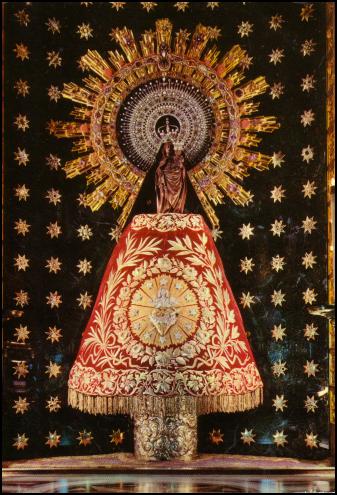
The image of Our Lady of the Pillar dressed in one of her many mantles, this one embroidered with her Immaculate Heart
Pretty soon after Mary’s visit, pilgrims began monolocating to the small shrine where the pillar was ensconced. Later, an image of the Madonna, credited with many miracles, was placed atop the pillar. On all but three days of the month, the image is robed in a triangular mantle—the shrine is in possession of thousands of them, richly embroidered and encrusted with jewels; we got to see Her unmantled, because it was the day each month that celebrates the crowning of the image. Over the centuries, larger and larger churches were built around the pillar, but it has never been moved from the place where Mary set it.
Today, access to the miraculous image and to the pillar is very limited. With a few exceptions, only those of the guild responsible for the shrine may touch the image’s mantle, to change it each day; children about to make their First Communion are allowed to climb a stepladder and touch the hem of Her mantle—as are the members of the Zaragoza soccer team at the start of the season. All other pilgrims—among whom Blessed John Paul II was numbered—must kneel before a small gilded opening at the back of the shrine, where the pillar may be touched or kissed. I placed my wonky knees where so many had been before, in far greater pain of body and soul than mine, and touched my lips to the cool marble. In no other place did I feel so much a part of the long pilgrim parade, the chain of unceasing prayer and praise and petition and thanksgiving stretching back along a camino of 2,000 years.
Many on our pilgrimage consecrated themselves to the Immaculate Heart at Fatima or at Lourdes; I claim the mantle of the Lady of the Pillar. That mantle recalls the earliest known prayer for Mary’s intercession, the 3rd century Coptic Christian hymn known in Latin as Sub tuum praesidium.
Under thy protection we seek refuge, Holy Mother of God;
despise not our petitions in our needs,
but from all dangers deliver us always,
Virgin Glorious and Blessed.
You may recognize it as the root of my mother’s favorite prayer, the Memorare. And praying it, let us hold up for Her protection the Coptic Christians of Egypt, in so much danger today.
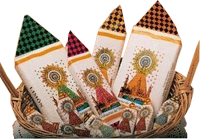 The mantled Virgin atop her pillar is everywhere in Zaragoza, an unmistakable image. The New World sent Zaragoza and the province of Aragon the gift of chocolate, and now Mary’s sweetness multilocates wherever you go—on thick bars of chocolate studded with Spain’s plump marcona almonds, on cakes in tins, on the addictive local confection known as frutas de Aragon, fresh fruits simmered in honey, robed in dark chocolate, and wrapped in rainbow colors.
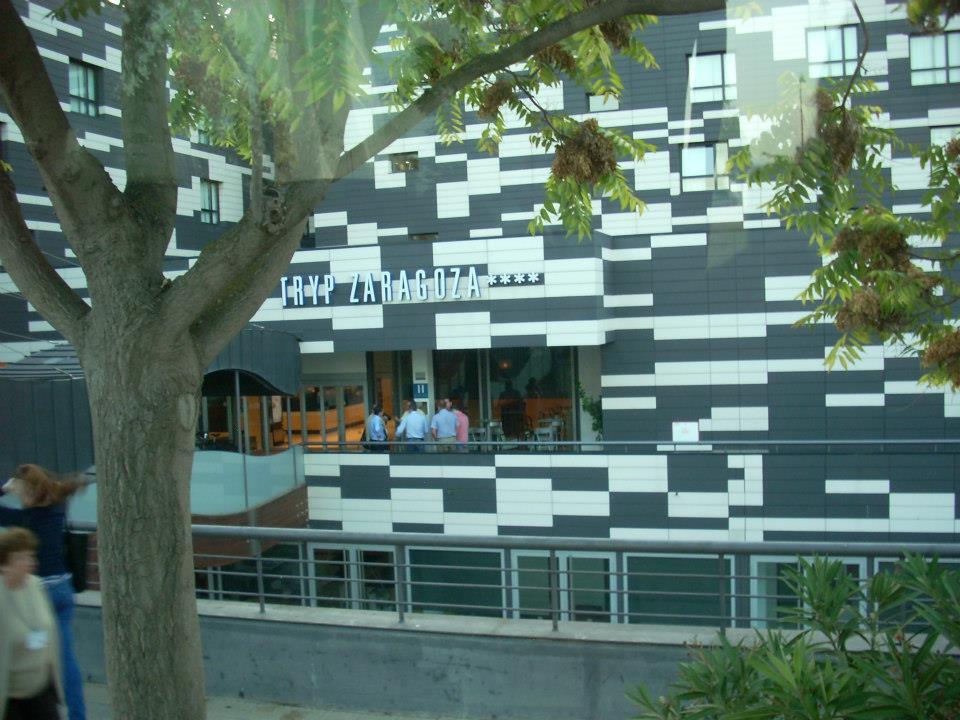 Our hotel in Zaragoza was as post-modern as the pillar is ancient—a zebra-striped wonder with rooms decorated in tomato-red acrylic and sleek teak, with a sophisticated wine-and-tapas bar in the lobby and a sky car line (the nonfunctioning relic of a World Expo) outside the windows. But the contrast wasn’t jarring at all. Perhaps, like the Zaragozans, we had begun to find bilocation—in time, anyway, if not yet in space—as simple as breathing, as sweet as chocolate. Under Mary’s mantle, we slept.
_____
NEXT: We Lift Our Eyes to the Hills: Over the Pyrenees to Lourdes
Previous Post

October 1, 2012
Picturing the Destination: Egregious Twaddle on Pilgrimage
Next Post

October 3, 2012 Climb Ev'ry Mountain: Egregious Twaddle on Pilgrimage
Browse Our Archives
Select a Category Abortion Advent Art Bishops Book Review Catholicism Fortnight 4 Freedom In the News Lent Marriage Mary Mental Health New Evangelization Nuns Pilgrimage 2012 Pop Culture Pope Francis Religious Education Reverts Saints' Lives and Legends Sin Staying Catholic Uncategorized Year of Faith
Select a Month May 2016 May 2015 April 2015 March 2015 December 2014 November 2014 October 2014 September 2014 August 2014 July 2014 June 2014 April 2014 March 2014 February 2014 December 2013 November 2013 October 2013 September 2013 August 2013 July 2013 June 2013 May 2013 April 2013 March 2013 February 2013 January 2013 December 2012 November 2012 October 2012 September 2012 August 2012 July 2012 June 2012 May 2012 April 2012 March 2012 February 2012 January 2012 November 2011 April 2011 March 2011 December 2010
Follow Us!
TAKE THE
Religious Wisdom Quiz
Who was Saul's son?
Select your answer to see how you score.
Absalom Jonathan David Samuel
Related posts from Egregious Twaddle

Finding My Way Back to Fatima, and Down...

Depressed and Catholic: Learning It's OK to Live

5 Reasons Why Catholics (of All People!) Should...

Pope and African Bishops to Cardinal Kasper: "Can...
TRENDING AT PATHEOS Catholic

Rejecting Doom: Christian Hope And Human Action
Christianity is a religion of hope. We are to have hope and...

It’s What Comes From Within Which Matters
One of the most difficult things for us to understand is why...

Why I Choose the Eucharist Over the Sermon
Choose the Eucharist, Not the Sermon What are we supposed to get...

5 Design Elements Found in Spiritually Rooted Homes
Putting Spirituality Into Home Decor Our homes are more than our living...

Credo: A Story of God Told with the...
About 10 years ago, I began to imagine a personal "Credo" that...

The Anatomy of Divine Revelation in Catholic Thought
The claim that God has made Himself known to human beings is...
view all Catholic blogs
Ad-Free & Subscriber Log-In Subscription Support
- About Us
- 2026 Calendar
- Videos
- Podcasts
- Library of World Religions
- Faith In Media Tracker
- Advertise With Us
- Write for Us
- Privacy Policy
- Terms of Service
- Do Not Sell My Data
- Contact Us
- Radiant Digital
- Manage Newsletter Subscriptions
- Unsubscribe From Notifications
- Sitemap
Copyright 2008-2026, Patheos. All rights reserved.
Subscription Support Ad-Free & Subscriber Log-In
Follow Patheos