
BuddhistCatholicContemplativeEvangelicalGeneral ChristianHinduJewishLatter-day SaintMuslimNew VisionsProgressive Christian
Beliefs
- Buddhist
- Catholic
- Contemplative
- Evangelical
- General Christian
- Hindu
- Jewish
- Latter-day Saint
- More Voices
- Muslim
- New Visions
- Pagan
- Progressive Christian
Topics
- Religion News
- Food and Religion
- Sports and Religion
- Religious Art
- Religious Music and Entertainment
- Religious Events
- History and Religion
- Style and Religion
- Politics and Religion
- Women in Religion
- Recreation Outdoors and Religion
- Business Finance and Religion
- Careers Workplace and Religion
- Education and Religion
- Family Parenting and Religion
- Health Fitness and Religion
- Home and Religion
- Relationships and Religion
- Technology and Religion
- Travel and Religion
Columnists
- Buddhist Columnists
- Business Finance and Religion Columnists
- Careers Workplace and Religion Columnists
- Catholic Columnists
- Contemplative Columnists
- Education and Religion Columnists
- Evangelists Columnists
- Family Parenting and Religion Columnists
- General Christian Columnists
- Health Fitness and Religion Columnists
- Hindu Columnists
- History and Religion Columnists
- Home and Religion Columnists
- Jewish Columnists
- More Voices Columnists
- Latter Day Columnists
- Muslim Columnists
- New Visions Columnists
- Nonreligious Columnists
- Pagan Columnists
- Politics and Religion Columnists
- Progressive Columnists
- Recreation Outdoors and Religion Columnists
- Relationships and Religion Columnists
- Religion News Columnists
- Religious Art Columnists
- Religious Events Columnists
- Religious Music and Entertainment Columnists
- Sports and Religion Columnists
- Style and Religion Columnists
- Technology and Religion Columnists
- Travel and Religion Columnists
- Women in Religion Columnists
Resource Library
- 2026 Calendar
- Library of World Religions
- The 100 Most Holy Places on Earth
- Patheos Answers
- Podcasts
- Videos
- Faith Leaders Database
- Anglican Episcopalian
- Bahai
- Baptist
- Buddhism
- Christianity
- Confucianism
- Eastern Orthodoxy
- Hinduism
- Holiness and Pentecostal
- ISKCON
- Islam
- Judaism
- Lutheran
- Methodist
- The Church of Jesus Christ of Latter-day Saints
- New Age
- Paganism
- Presbytarian and Reformed
- Protestantism
- Religion Behind the Scenes
- Roman Catholic
- Scientology
- Shia Islam
- Sikhism
- Sufism
- Sunni Islam
- Taoism
- Zen
- See all religions
Research Tools
 Ad-Free & Subscriber Log-In Subscription Support
Ad-Free & Subscriber Log-In Subscription Support
Follow Patheos 

- Trending:
- Forgiveness
- |
- Marriage
- |
- Consciousness
- |
- Death Penalty
- |
- Election
- |
- Halloween
 Egregious Twaddle
- Home
- Catholic
- A Journal of My Council: A Book Review
A Journal of My Council: A Book Review
Last updated on: May 2, 2016 at 11:31 am by Joanne McPortland
A Journal of My Council: A Book Review 2016-05-02T11:31:16-06:00 Joanne McPortland
Patheos Explore the world's faith through different perspectives on religion and spirituality! Patheos has the views of the prevalent religions and spiritualities of the world.
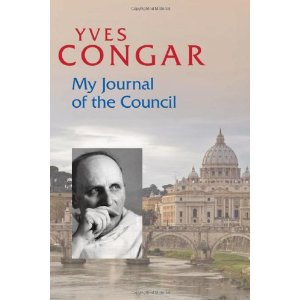 My Journal of the Council
by Yves Congar, OP
Liturgical Press, 2012
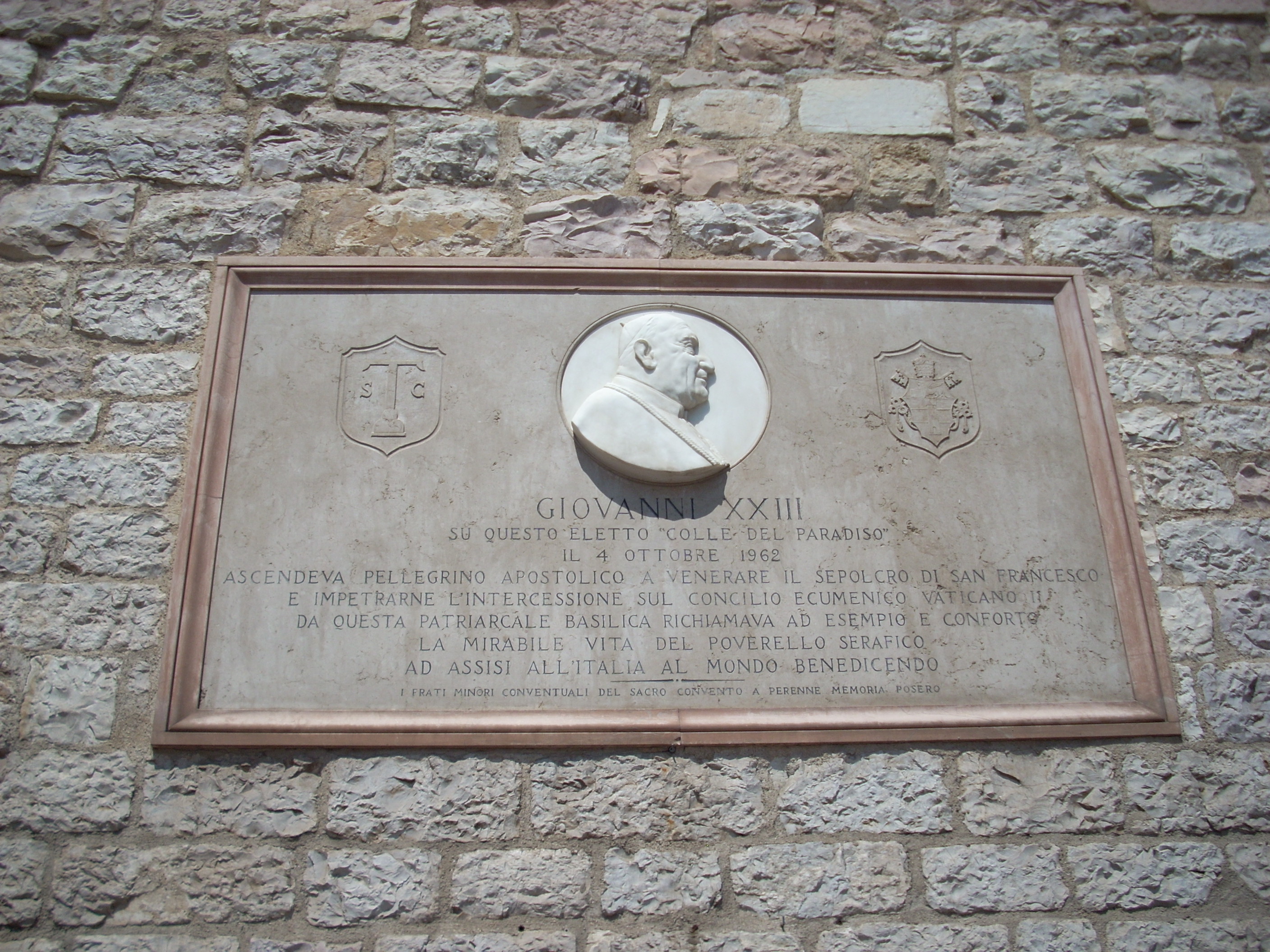
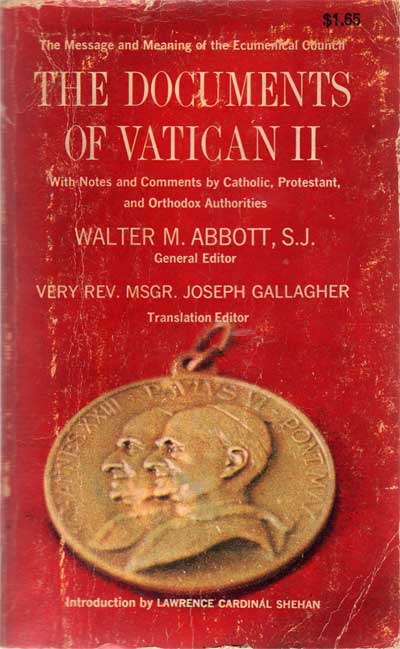
Even as my arteries and my religious views harden with age, I remain a daughter of Vatican II. The first session of the council was officially convened on my 12th birthday in 1962, and the fruits of the council were the single most important influence on my faith formation. As I’ve written here before, I still consider myself a Catholic of the John XXIIIrd Generation, and proud of it. I carried a well-thumbed copy of the Little Red Book, Catholic Version—The Documents of Vatican II, edited by Walter M. Abbott, SJ—through my high school years with the original nuns-thrown-under-the-bus, the IHMs of Los Angeles, and on into my 40 years in catechetical media and publishing. My return to the Church after a long lapse was in part triggered by seeing the plaque at the Basilica of St Francis in Assisi commemorating John XXIII’s visit to Assisi to ask Francis’s blessing on the council, and feeling the call to be back among folks who answer Christ’s continual call to “Go, rebuild my Church.” And since my reversion, though I agree that the ‘spirit of Vatican II’ has suffered from abuse and atrophy on both ecclesiological extremes, I continue to read the documents the council produced with awe at their depth and richness.
So I was delighted to be offered the chance to review Yves Congar’s My Journal of the Council. In 1,000+ pages (counting extensive front and back matter and footnotes that often eat up half a page—don’t bother reading them, they exist solely to identify the gabillion names Congar drops), My Journal publishes the near-daily notes on the council, from its preparatory sessions through the fourth official session, kept by the French Dominican theologian who had such a profound influence on the council’s ecclesiology and, in particular, its approach to ecumenism and interfaith relationships.
 It’s a fascinating, frustrating, harrowing, hilarious read. The proscription against watching how sausage is made also applies to the conciliar expression of doctrine, I suspect. Nothing in Fr Abbott’s neat little red paperback collection of documents prepared me for the utter (seeming) chaos in which the Holy Spirit worked to get ’em done, or the collection of flawed, vain, petty, ambitious, brilliant and/or clueless (i.e., human) characters through whom the Spirit moved to do so.
Congar, on the other hand, holds nothing back. It’s no wonder he stipulated that these memoirs could not be released until after 2000; ears are buzzing and sod spinning in ecclesial graves around the world. Other reviewers have noted examples of Congar’s keen skewering of those with whom he disagreed—Cardinal Ottaviani, chief defender of the ancien regime of monarchical papacy and Vatican bureaucracy, for example, is consistently described in terms disparaging enough that I expected to find ‘buffoon: see Ottaviani’ as an index entry—but he often saw even his early allies, like the French Jesuit Jean Daniélou, through a slightly jaundiced eye:
Fr Daniélou does not examine things too closely. . . . He is extraordinary. Whether you turn him upside down or any other way, he always falls on his feet. (p. 292)
But it’s not Congar the caricaturist—or Congar the quintessential Frenchman, appalled enough to note in CAPITAL LETTERS the bad accents of bishops from the French colonies, or quick to take potshots at all things Roman, especially the weather (“Terrible weather: snow driven by the wind. Impossible to find a taxi!” p. 721); or Congar the impatient critic of all things liturgically swishy and ostentatious (“The Veni Creator was sung, alternately with the Sistine Choir, which is nothing but an opera chorus . . . elegant crooning by paid professionals,” p. 87); or Congar the suffering (but not silently) servant, recounting the impossibility of maintaining his 24/7 schedule of consulting, writing, preaching, teaching, and traveling while living with a mysterious, painful, and debilitating neurological disease (“This is THE worst day that I have had. I can no longer walk and have absolutely no strength. I am dragging myself along with the gait of a cripple,” p. 412); or even Congar the theologian, passionately applying an oilcan to those rusty window hinges so that Christ and his Church might engage with the world unencumbered by imperial baggage and baroque accretions (“All this heavy and costly apparatus, prestigious and infatuated with itself, imprisoned in its own myth of seigneurial grandeur, belongs to the non-Christian part of the Roman Church and it is this that . . . prevents its opening out to a fully evangelical and prophetic task,” p. 93)—that is the real reason to read My Journal. Here are the reasons:
 Because whatever you feel about the Second Vatican Council, we are all of us—Catholic or not, liberal or conservative, trad or happyclappy—its sons and daughters. The council is as much a part of who we are today as a Church and a world as anything, and the more we know about our roots, the better and stronger and truer we will grow in this Year of Faith. Feel free to boo the parts that piss you off (Congar certainly did); myself, I think Paul Philibert’s preface is whiny claptrap, but those of my age cohort who ride the bus with nuns will eat it up.
Because it will help you remember—or, for most of you who weren’t around, recognize—the heady days of the Church’s Arab Spring. Whatever you think of what came after Vatican II, My Journal is a couple of pounds of proof that we are better off now than we were 50 years ago. That we laity can scrap about that in public and in comboxes and even at the Synod on the New Evangelization is only one of the many hard-won fruits of the council. It’s also fun, in these days of people writing off the USCCB as lily-livered liberals, to note that the US hierarchs at the council come off, in Congar’s view, as intransigent political reactionaries concerned only with padding the investment portfolios they started when they were Wall Street brokers. Where’s a TARDIS when you need one? Time travel would so help dissolve the polarizations we fall into when we forget about swinging pendulums!
Because it will astonish you that anything at all got done. If a camel is a horse designed by a committee, try to think about what it takes to develop definitive doctrinal statements by committee . . . after committee . . . after committee. Then imagine that the members of these committees, most of whom do not speak one another’s native languages, must do this work in a language native to none of them: Latin. Imagine that the process is exquisitely boring (“Many bishops headed for the bar,” Congar notes, a couple of hundred times, and you’ll want to do the same if you read the transcript of every discussion). Imagine that this work is being done in the absence of electric typewriters, photocopiers, computers, faxes, overnight mail, the Internet, cellphones, or iAnything: drafts are created in longhand or painstakingly typed with layers of carbon paper, translated, circulated by hand or snail mail, revised, returned, read aloud, commented on, and lathered, rinsed, repeated over and over again. And all this is played out in the almost unbearable tension between the immovable object of papal primacy and the irresistible force of collegiality, the push of institution and the pull of mission, the Church and the World.
Because it will prove, if you need proof, that the Holy Spirit is alive and at work. Cf, all of the above.
In spite of his frustrations and his daily conviction that his health would not permit him to participate in the council one day more, Yves Congar endured, and the best of his intentions triumphed through God’s grace. He was faithful to the terms on which he agreed to serve the council and keep the journal:
After all, I have nothing to lose, and I must do my duty. It is always necessary to say what one knows or believes to be true. So I shall be frank and will try to be evangelical. The grace of the Lord will do the rest—Indeed it will! (p. 17)
Indeed it did. And so may each of us vow, and be as faithful.
_____
Visit the Patheos Book Club to learn more about Yves Congar and My Journal of the Council. Read excerpts and check out other bloggers’ responses to the book.
Previous Post

October 23, 2012
After Us, the Deluge: Egregious Twaddle on Pilgrimage
Next Post
November 5, 2012 I'm That Guy: The Gunpowder of Being Catholic in Public
Browse Our Archives
Select a Category Abortion Advent Art Bishops Book Review Catholicism Fortnight 4 Freedom In the News Lent Marriage Mary Mental Health New Evangelization Nuns Pilgrimage 2012 Pop Culture Pope Francis Religious Education Reverts Saints' Lives and Legends Sin Staying Catholic Uncategorized Year of Faith
Select a Month May 2016 May 2015 April 2015 March 2015 December 2014 November 2014 October 2014 September 2014 August 2014 July 2014 June 2014 April 2014 March 2014 February 2014 December 2013 November 2013 October 2013 September 2013 August 2013 July 2013 June 2013 May 2013 April 2013 March 2013 February 2013 January 2013 December 2012 November 2012 October 2012 September 2012 August 2012 July 2012 June 2012 May 2012 April 2012 March 2012 February 2012 January 2012 November 2011 April 2011 March 2011 December 2010
Follow Us!
TAKE THE
Religious Wisdom Quiz
Who prophesied about the birth of Jesus in the Old Testament?
Select your answer to see how you score.
Ezekiel Isaiah Jeremiah Daniel
Related posts from Egregious Twaddle

Depressed and Catholic: Learning It's OK to Live

5 Reasons Why Catholics (of All People!) Should...

Pope and African Bishops to Cardinal Kasper: "Can...

The Magdalene's Cave: Thoughts on Priesthood and Women
TRENDING AT PATHEOS Catholic

Rejecting Doom: Christian Hope And Human Action
Christianity is a religion of hope. We are to have hope and...

It’s What Comes From Within Which Matters
One of the most difficult things for us to understand is why...

Why I Choose the Eucharist Over the Sermon
Choose the Eucharist, Not the Sermon What are we supposed to get...

5 Design Elements Found in Spiritually Rooted Homes
Putting Spirituality Into Home Decor Our homes are more than our living...

Credo: A Story of God Told with the...
About 10 years ago, I began to imagine a personal "Credo" that...

The Anatomy of Divine Revelation in Catholic Thought
The claim that God has made Himself known to human beings is...
view all Catholic blogs
Ad-Free & Subscriber Log-In Subscription Support
- About Us
- 2026 Calendar
- Videos
- Podcasts
- Library of World Religions
- Faith In Media Tracker
- Advertise With Us
- Write for Us
- Privacy Policy
- Terms of Service
- Do Not Sell My Data
- Contact Us
- Radiant Digital
- Manage Newsletter Subscriptions
- Unsubscribe From Notifications
- Sitemap
Copyright 2008-2026, Patheos. All rights reserved.
Subscription Support Ad-Free & Subscriber Log-In
Follow Patheos