
BuddhistCatholicContemplativeEvangelicalGeneral ChristianHinduJewishLatter-day SaintMuslimNew VisionsProgressive Christian
Beliefs
- Buddhist
- Catholic
- Contemplative
- Evangelical
- General Christian
- Hindu
- Jewish
- Latter-day Saint
- More Voices
- Muslim
- New Visions
- Pagan
- Progressive Christian
Topics
- Religion News
- Food and Religion
- Sports and Religion
- Religious Art
- Religious Music and Entertainment
- Religious Events
- History and Religion
- Style and Religion
- Politics and Religion
- Women in Religion
- Recreation Outdoors and Religion
- Business Finance and Religion
- Careers Workplace and Religion
- Education and Religion
- Family Parenting and Religion
- Health Fitness and Religion
- Home and Religion
- Relationships and Religion
- Technology and Religion
- Travel and Religion
Columnists
- Buddhist Columnists
- Business Finance and Religion Columnists
- Careers Workplace and Religion Columnists
- Catholic Columnists
- Contemplative Columnists
- Education and Religion Columnists
- Evangelists Columnists
- Family Parenting and Religion Columnists
- General Christian Columnists
- Health Fitness and Religion Columnists
- Hindu Columnists
- History and Religion Columnists
- Home and Religion Columnists
- Jewish Columnists
- More Voices Columnists
- Latter Day Columnists
- Muslim Columnists
- New Visions Columnists
- Nonreligious Columnists
- Pagan Columnists
- Politics and Religion Columnists
- Progressive Columnists
- Recreation Outdoors and Religion Columnists
- Relationships and Religion Columnists
- Religion News Columnists
- Religious Art Columnists
- Religious Events Columnists
- Religious Music and Entertainment Columnists
- Sports and Religion Columnists
- Style and Religion Columnists
- Technology and Religion Columnists
- Travel and Religion Columnists
- Women in Religion Columnists
Resource Library
- 2026 Calendar
- Library of World Religions
- The 100 Most Holy Places on Earth
- Patheos Answers
- Podcasts
- Videos
- Faith Leaders Database
- Anglican Episcopalian
- Bahai
- Baptist
- Buddhism
- Christianity
- Confucianism
- Eastern Orthodoxy
- Hinduism
- Holiness and Pentecostal
- ISKCON
- Islam
- Judaism
- Lutheran
- Methodist
- The Church of Jesus Christ of Latter-day Saints
- New Age
- Paganism
- Presbytarian and Reformed
- Protestantism
- Religion Behind the Scenes
- Roman Catholic
- Scientology
- Shia Islam
- Sikhism
- Sufism
- Sunni Islam
- Taoism
- Zen
- See all religions
Research Tools
 Ad-Free & Subscriber Log-In Subscription Support
Ad-Free & Subscriber Log-In Subscription Support
Follow Patheos 

- Trending:
- Forgiveness
- |
- Marriage
- |
- Consciousness
- |
- Death Penalty
- |
- Election
- |
- Halloween
 Egregious Twaddle
- Home
- Catholic
- Finding the Frog: Egregious Twaddle on Pilgrimage
Finding the Frog: Egregious Twaddle on Pilgrimage
Last updated on: May 2, 2016 at 11:03 am by Joanne McPortland
Finding the Frog: Egregious Twaddle on Pilgrimage 2016-05-02T11:03:37-06:00 Joanne McPortland
Patheos Explore the world's faith through different perspectives on religion and spirituality! Patheos has the views of the prevalent religions and spiritualities of the world.
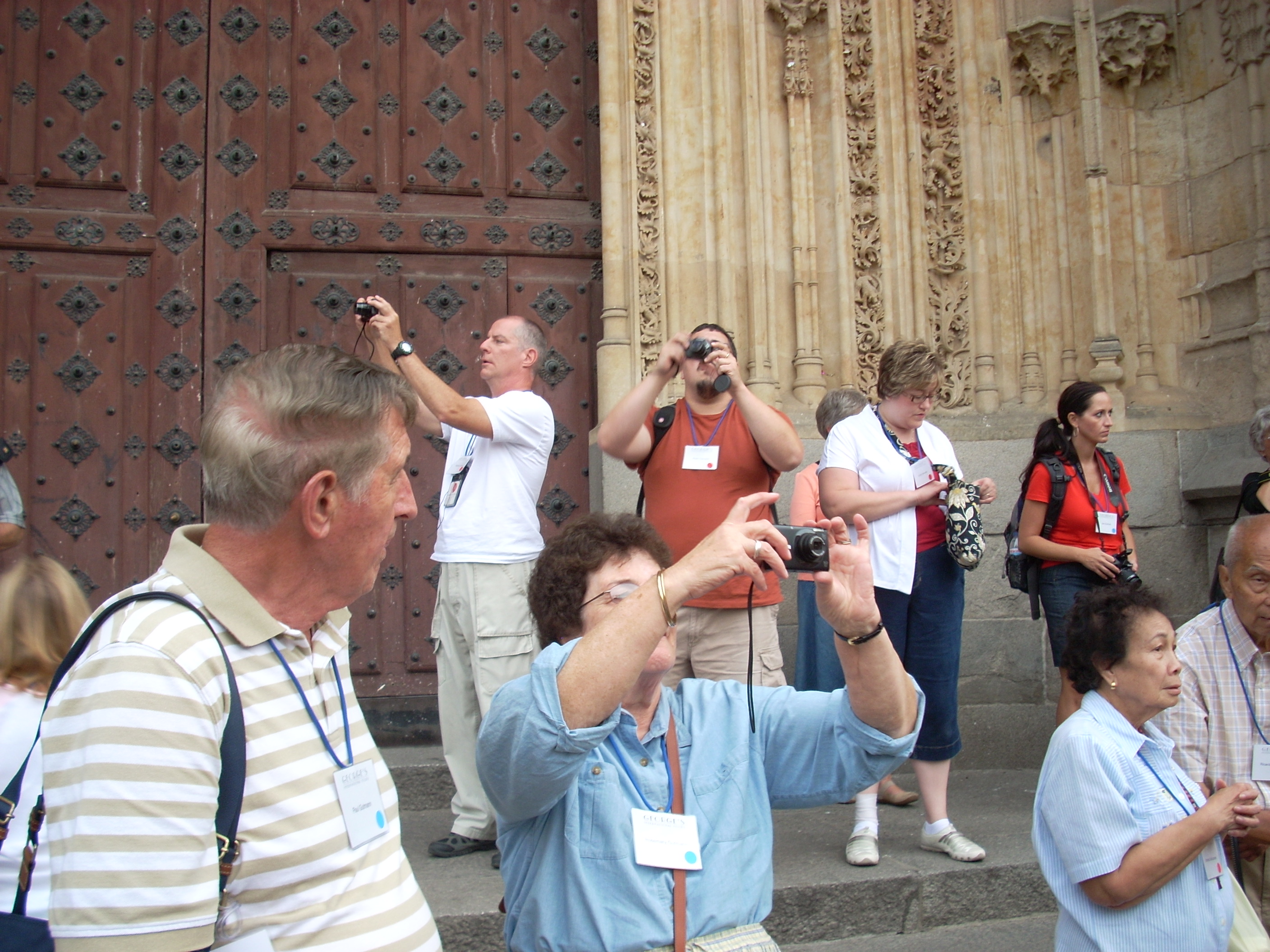
In which we learn that pilgrimage cultivates a different way of seeing: We come to honor visionaries, and are expected to come away visionaries ourselves.
Pilgrimage 2012, Day 4: Fatima to Salamanca, Spain, by way of Coimbra, Portugal
I’ve gotten behind in posting, due to a combination of the exhaustion that accompanies cramming so many powerful experiences into each day and the instability of network connections. The downside is that you’re probably wondering whether, like that Italian sailor who hung out in these parts raising money for a trip across the ocean-sea, we’ve dropped off the edge of the earth. The upside is that the delay allows me some time for that emotion recollected in tranquility business Wordsworth was so fond of.
We left Fatima (reluctantly, on my part, which was a surprise) on Monday morning, with a quick stop for the Blue Bus group to see the exterior of the parish church in Aljustrel, where Blessed Francisco spent many hours in prayer of reparation for the sins committed by others. Sin. Reparation. Heaven. Hell. Penance. Intercession. Suffering. Mercy. These are not terms we’re used to hearing at home much, but they are the lingua franca of pilgrims, and have been since the whole tradition started. In this context, the words come simply and naturally. And they begin to work on us, like water on stone, continuing to ask of us conversion, literally, a turning around.
We traveled on to Coimbra, home to a Portuguese university where students dress in black suits, white shirts, and black capes a la Hogwarts. We saw them on the streets, freshmen heading for an initiation rite. It’s the particular and peculiar custom in Coimbra for students to ask their significant others to tear the hem of their cloak. When the relationship ends, the tear is sewn up, and the cape is torn again by the next new love. Seniors, we were told, have capes that look like fringed curtains.
Coimbra is also home to a unique style of fado, the singing of melancholy love ballads. Male students serenade their girlfriends with fado they compose. (Because this started as a student custom long before the university became coed, no woman sings fado in Coimbra.) Friends gather to judge the quality of the performance, but because it’s considered impolite to wake the neighbors, they indicate their approval with a restrained cough, like a throat-clearing ahem, ahem.
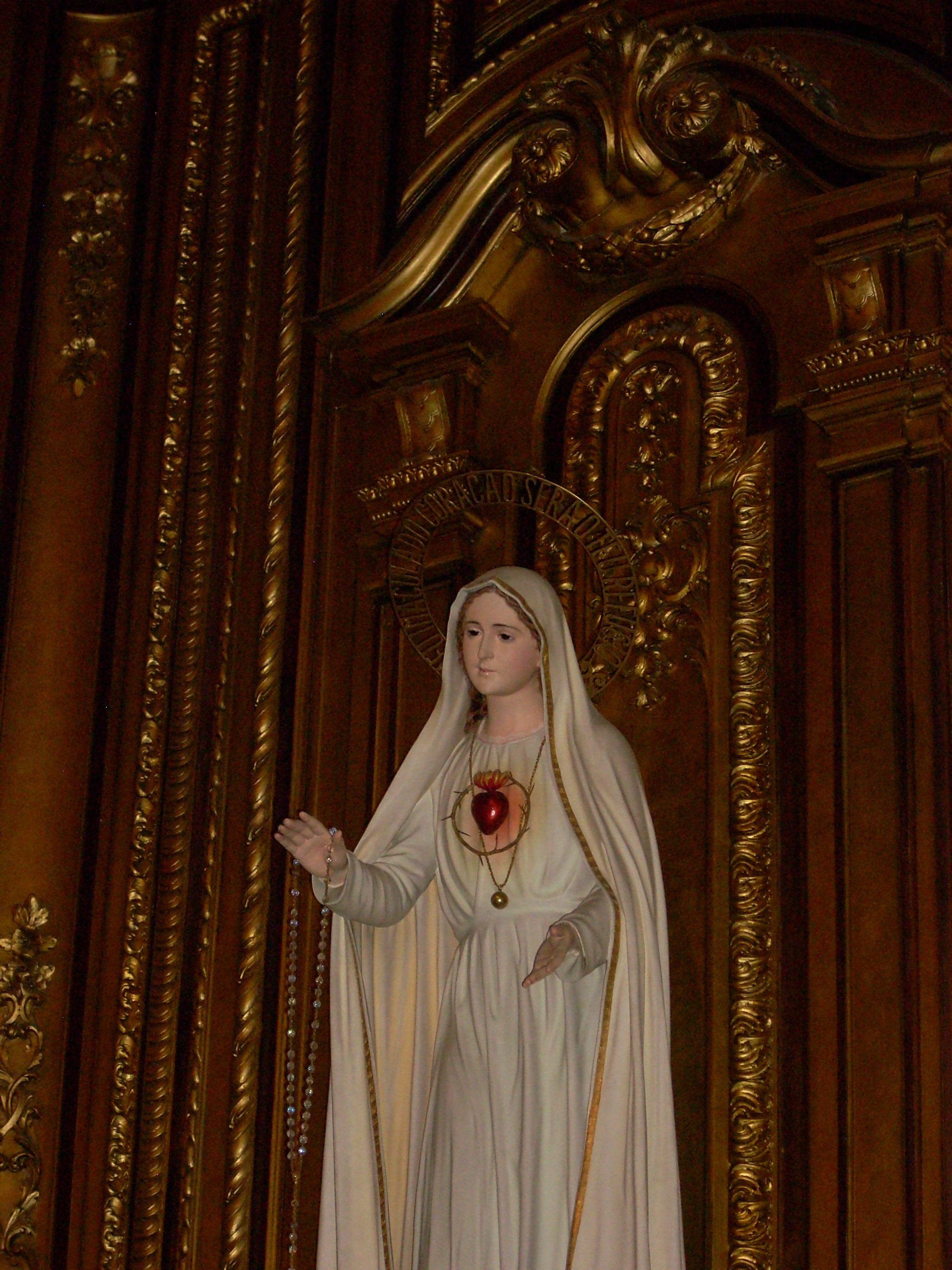 But we came to Coimbra to pay tribute to another love: Sr Lucia’s for the Lady of Fatima. It was in Coimbra that Lucia, a Dorothean sister, spent her long last years in a convent of the Discalced Carmelites, separated from Francisco and Jacinta and longing for heaven. But her life was no melancholy ballad. Those who knew her (she went home to the Lady in 2005) describe Sr Lucia as cheerful and practical, never complaining, never seeking attention. In the convent chapel, we saw a statue of the Lady made from Lucia’s own memory, which differs from the well-known crowned statue of Our Lady of the Rosary only in being more tender and less aloof, with her Immaculate Heart visibly afire. Francisco and Jacinta, with haloes indicating their status as beati, are pictured at the Lady’s feet, but there is no representation of Lucia, who decreased as the Lady increased. The message for us: We are, even the holiest and most privileged of us, merely instruments. Whatever vision this pilgrimage grants us, it is meant to shine through us as though we were simple, clear glass windows, magnifying the Light as Lucia (whose name means light) did. As Mary does.
From Coimbra we headed northeast to the Spanish border, and into Spain to Salamanca. Another medieval university city, the place where the Dominican-led school of philosophy developed the first notion of human rights: the right to life, to personal property, to freedom of thought. The university and Salamanca’s two conjoined cathedrals, Vieja and Nueva (old and new) were a long haul up a steepish incline. Our guide showed us the graffiti painted by successful doctoral candidates since the university’s founding: the word VICTOR in complicated calligraphy, painted first in a mixture of oil, clay, and bulls’ blood, but now with red ink. (I wanted to write VICTOR for having made it up the hill, with knees that increasingly make each step feel like I am wearing matched cilices. The cross I bear on this pilgrimage is the wages of decades of gluttony and sloth.)
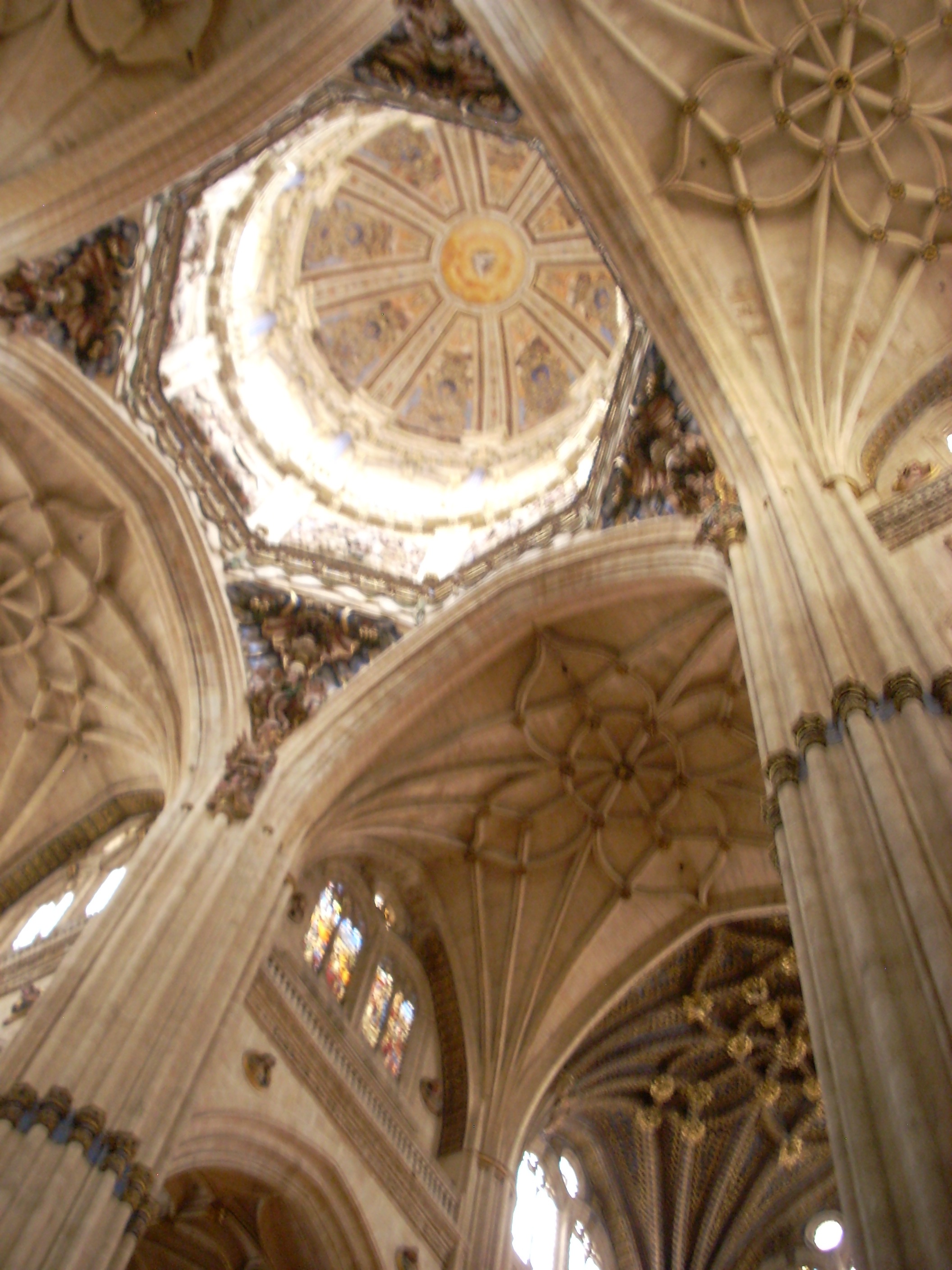
In the Catedral Nueva of Salamanca. The frog is next door on the facade of the University; you’ll have to look for it yourself.
Our guide pointed out the ornate facades of the university, with its medallions of Their Catholic Majesties, Ferdinand and Isabella. And then she challenged us to find the frog—a skull with a frog perched on top, symbolizing the mortal consequences of sins of the flesh (as if my knees were not evidence enough)—nestled among the 4 stories of curlicues and filigree. “Just look!” she kept saying. “Here, I will even point.” We could hear frogs—the peeping and chirping of the frog toys vendors were selling all around us—but we couldn’t for the life of us see one. Some of us lied and said we did, as we had with those Magic Eye 3D pictures or Where’s Waldo books. But I think the truth us we are just not able to see sin and death as easily as earlier pilgrims could.
Finding the frog is what pilgrimages are for. Not only getting better at finding the sin in others, but becoming more compassionate when we do. You can see it happening on the Red and Blue Buses as the days go by. The things that irritate us about one another at first become points of empathy and relationship as stories unfold and we learn what cilices of the heart we are all wearing, what crosses every pilgrim carries. In The Reed of God, Caryll Houselander says we become more like Mary—she who had no sin to see—when we do that, when we open ourselves to God’s will and wisdom.
The great understanding given by the Spirit of Wisdom must involve us in a lot of suffering. We shall be obliged to see the wound that sin has inflicted on the people of the world. We shall have X-ray minds; we shall see through the bandages people have laid over the wounds that sin has dealt them; we shall see Christ in others, and that vision will impose an obligation on us for as long as we live, the obligation of love.
And along this road, this camino, we get better at not only finding the sin in ourselves, but at laying it down at the foot of the cross like unneeded baggage and walking away lighter and truer, if with an undertone of necessary melancholy. The pilgrim life is like a good fado, a ballad sung in the night to God the Beloved, not disturbing the neighbors but quietly and passionately risking our hearts. Ahem, ahem.
_____
Next: Salamanca to Madrid, with visits to St Teresa of Avila and St John of the Cross
Previous Post

September 17, 2012
The Peace of the World: Egregious Twaddle on Pilgrimage
Next Post

September 21, 2012 Castles in Spain: Egregious Twaddle on Pilgrimage
Browse Our Archives
Select a Category Abortion Advent Art Bishops Book Review Catholicism Fortnight 4 Freedom In the News Lent Marriage Mary Mental Health New Evangelization Nuns Pilgrimage 2012 Pop Culture Pope Francis Religious Education Reverts Saints' Lives and Legends Sin Staying Catholic Uncategorized Year of Faith
Select a Month May 2016 May 2015 April 2015 March 2015 December 2014 November 2014 October 2014 September 2014 August 2014 July 2014 June 2014 April 2014 March 2014 February 2014 December 2013 November 2013 October 2013 September 2013 August 2013 July 2013 June 2013 May 2013 April 2013 March 2013 February 2013 January 2013 December 2012 November 2012 October 2012 September 2012 August 2012 July 2012 June 2012 May 2012 April 2012 March 2012 February 2012 January 2012 November 2011 April 2011 March 2011 December 2010
Follow Us!
TAKE THE
Religious Wisdom Quiz
What Christian group follows the Augsburg Confession?
Select your answer to see how you score.
Pentecostals Presbyterians Methodists Lutherans
Related posts from Egregious Twaddle

Finding My Way Back to Fatima, and Down...

Depressed and Catholic: Learning It's OK to Live

5 Reasons Why Catholics (of All People!) Should...

Pope and African Bishops to Cardinal Kasper: "Can...
TRENDING AT PATHEOS Catholic

Rejecting Doom: Christian Hope And Human Action
Christianity is a religion of hope. We are to have hope and...

It’s What Comes From Within Which Matters
One of the most difficult things for us to understand is why...

Why I Choose the Eucharist Over the Sermon
Choose the Eucharist, Not the Sermon What are we supposed to get...

5 Design Elements Found in Spiritually Rooted Homes
Putting Spirituality Into Home Decor Our homes are more than our living...

Credo: A Story of God Told with the...
About 10 years ago, I began to imagine a personal "Credo" that...

The Anatomy of Divine Revelation in Catholic Thought
The claim that God has made Himself known to human beings is...
view all Catholic blogs
Ad-Free & Subscriber Log-In Subscription Support
- About Us
- 2026 Calendar
- Videos
- Podcasts
- Library of World Religions
- Faith In Media Tracker
- Advertise With Us
- Write for Us
- Privacy Policy
- Terms of Service
- Do Not Sell My Data
- Contact Us
- Radiant Digital
- Manage Newsletter Subscriptions
- Unsubscribe From Notifications
- Sitemap
Copyright 2008-2026, Patheos. All rights reserved.
Subscription Support Ad-Free & Subscriber Log-In
Follow Patheos