
BuddhistCatholicContemplativeEvangelicalGeneral ChristianHinduJewishLatter-day SaintMuslimNew VisionsProgressive Christian
Beliefs
- Buddhist
- Catholic
- Contemplative
- Evangelical
- General Christian
- Hindu
- Jewish
- Latter-day Saint
- More Voices
- Muslim
- New Visions
- Pagan
- Progressive Christian
Topics
- Religion News
- Food and Religion
- Sports and Religion
- Religious Art
- Religious Music and Entertainment
- Religious Events
- History and Religion
- Style and Religion
- Politics and Religion
- Women in Religion
- Recreation Outdoors and Religion
- Business Finance and Religion
- Careers Workplace and Religion
- Education and Religion
- Family Parenting and Religion
- Health Fitness and Religion
- Home and Religion
- Relationships and Religion
- Technology and Religion
- Travel and Religion
Columnists
- Buddhist Columnists
- Business Finance and Religion Columnists
- Careers Workplace and Religion Columnists
- Catholic Columnists
- Contemplative Columnists
- Education and Religion Columnists
- Evangelists Columnists
- Family Parenting and Religion Columnists
- General Christian Columnists
- Health Fitness and Religion Columnists
- Hindu Columnists
- History and Religion Columnists
- Home and Religion Columnists
- Jewish Columnists
- More Voices Columnists
- Latter Day Columnists
- Muslim Columnists
- New Visions Columnists
- Nonreligious Columnists
- Pagan Columnists
- Politics and Religion Columnists
- Progressive Columnists
- Recreation Outdoors and Religion Columnists
- Relationships and Religion Columnists
- Religion News Columnists
- Religious Art Columnists
- Religious Events Columnists
- Religious Music and Entertainment Columnists
- Sports and Religion Columnists
- Style and Religion Columnists
- Technology and Religion Columnists
- Travel and Religion Columnists
- Women in Religion Columnists
Resource Library
- 2026 Calendar
- Library of World Religions
- The 100 Most Holy Places on Earth
- Patheos Answers
- Podcasts
- Videos
- Faith Leaders Database
- Anglican Episcopalian
- Bahai
- Baptist
- Buddhism
- Christianity
- Confucianism
- Eastern Orthodoxy
- Hinduism
- Holiness and Pentecostal
- ISKCON
- Islam
- Judaism
- Lutheran
- Methodist
- The Church of Jesus Christ of Latter-day Saints
- New Age
- Paganism
- Presbytarian and Reformed
- Protestantism
- Religion Behind the Scenes
- Roman Catholic
- Scientology
- Shia Islam
- Sikhism
- Sufism
- Sunni Islam
- Taoism
- Zen
- See all religions
Research Tools
 Ad-Free & Subscriber Log-In Subscription Support
Ad-Free & Subscriber Log-In Subscription Support
Follow Patheos 

- Trending:
- Forgiveness
- |
- Marriage
- |
- Consciousness
- |
- Death Penalty
- |
- Election
- |
- Halloween
 Egregious Twaddle
- Home
- Catholic
- The Great Both/And
The Great Both/And
Last updated on: May 2, 2016 at 11:04 am by Joanne McPortland
The Great Both/And 2016-05-02T11:04:56-06:00 Joanne McPortland
Patheos Explore the world's faith through different perspectives on religion and spirituality! Patheos has the views of the prevalent religions and spiritualities of the world.
Is it always Or?
Is it never And?
~ Stephen Sondheim, “Moments in the Woods,” from Into the Woods
Fr Robert Barron weighs in today against “the worst kind of exaggerated hoo-hah” in politics and religion, rejecting the imbalanced reactions on both sides to the choice of Paul Ryan as Republican vice-presidential candidate and reminding Ryan—and all of us—that we are not a Church of one-sided extremists. There are checks and balances built into Catholic social morality, and juggling the values of subsidiarity and solidarity is key.
Fr Barron takes his theme (as I do the title of this post) from Chesterton’s description, in Orthodoxy, of what Fr Barron calls the “bipolar extremism” of the Church.
In his wonderful Orthodoxy, written over a hundred years ago but still remarkably relevant today, G.K. Chesterton said that Catholicism is marked through and through by the great both/and principle. Jesus is both divine and human. He is not one or the other; nor is he some bland mixture of the two; rather, he is emphatically one and emphatically the other. In a similar way, the Church is radically devoted to this world and radically devoted to the world to come. In the celibacy of its priests, it is totally against having children, and in the fruitful marriage of its lay people, it is totally for having children.
In its social teaching, this same sort of “bi-polar extremism” is on display. Solidarity? The Church is all for it. Subsidiarity? The Church couldn’t be more enthusiastic about it. Not one or the other, nor some bland compromise between the two, but both, advocated with equal vigor. I think it would be wise for everyone to keep this peculiarly Catholic balance in mind as the debate over Paul Ryan’s policies unfolds.
I wonder if Fr Barron was inspired to take up this topic the same way I was inspired to continue it—by hearing, on last Sunday’s NPR Weekend Edition, an interview with Stephen Prothero, Professor of American Religion at Boston University. Discussing with host Linda Wertheimer the religious novelty of the forthcoming election—the fact that for the first time in US history, no WASP (White Anglo-Saxon Protestant) is on either major party’s ticket—Prothero noted that this means Americans will be exploring Mormonism in ways they haven’t before. But it was the exchange that came next that had me yelling at the car radio.
PROTHERO: And then, I think we’re going to have perhaps even more interesting conversation about what kind of Catholicism is really the appropriate one for American life. We’ve got someone who’s a social justice Catholic with Joe Biden. And we have someone who’s much more kind of family values Catholic with Paul Ryan.
WERTHEIMER: Or a social conservative Catholic, we might even say.
PROTHERO: That’s right – who’s focusing on, you know, the side of Catholicism that says no to abortion, rather than the side of Catholicism that says take care of the poor and the oppressed.
At first it was the arrogance of pundits determining “what kind of Catholicism is really the appropriate one for American life” that riled me. Excuse me, Professor, but even if there were different kinds of Catholicism (red Catholics and blue Catholics, identified at parish registration?), determining which one is “most appropriate for American life” is not up for a vote. FirstAmendment FirstAmendment FirstAmendment. (Not that anybody pays much attention to that old chestnut.)
The more I stewed in my rile, though, the more I recognized what really made me angry is the ease by which we Catholics have allowed ourselves to be reduced to this kind of stereotyping—and then played against one another as a consequence. “Social justice Catholic” (“the side of Catholicism that says take care of the poor and the oppressed”). “Family values Catholic” (“the side of Catholicism that says no to abortion”). These are not just handy MSM memes. They are, increasingly and frighteningly, the labels we ourselves pick up and apply to our lapels, our bumper stickers, and our minds.
They’re big labels, with lots of room for aggregate stereotyping. It can look like this at the check-in table of the Exaggerated Hoo-Hah Convention:
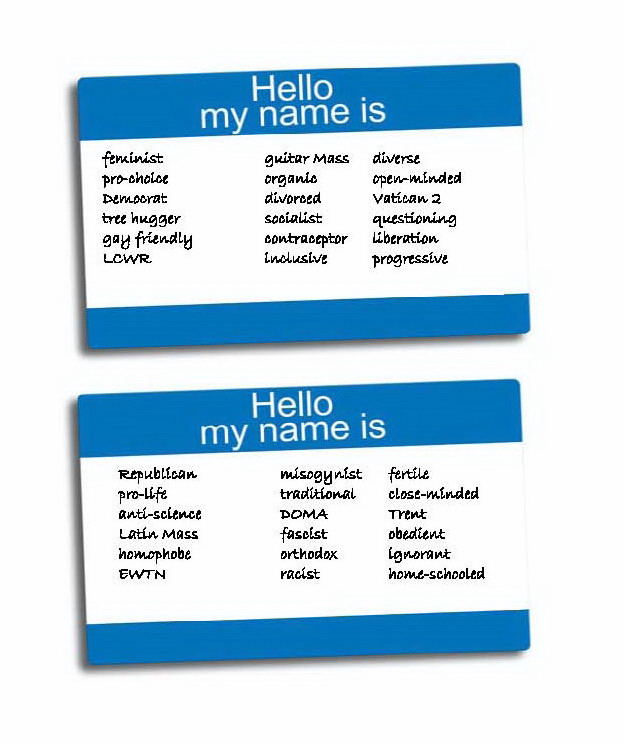
Social Justice Catholic (top), Family Values Catholic (bottom)
The thing is, the Body of Christ is one, no matter what divisive labels are slapped on it, no matter what divisive labels we buy and slap on ourselves. There are no “kinds” of Catholicism, and we are not forced to choose which brand is “most appropriate for America.” We can stand for the lives of children without compromising the freedom or future of women. We can proclaim what is not only our belief in faith but the undeniable evidence of science, that a human life is a human life from conception, without subscribing to ignorant and hateful notions about the “legitimacy” of rape.
We can sing along with gusto to “Be Not Afraid” on Sunday morning and demonstrate in support of traditional marriage in the afternoon, just as we can put on a black lace mantilla and chant the Latin Mass on a First Friday and go off to work protecting the legal rights of aliens and homosexual persons and welfare recipients. We can recycle and favor fiscal responsibility on the federal level, vote Republican and favor a single-payer national health solution, pray in front of an abortion clinic on one day and outside Death Row the next.
We can wear habits and work for social justice, attempt to slow global warming and attend Eucharistic Adoration, fight the HHS mandate and vote Democrat. We can be elected Vice-President of a country in which abortion is legal and pray a well-worn Rosary while waiting in the White House situation room for word of a secret operation to take out Osama bin Laden. We can run for Vice-President of a country where abortion is legal and say flat out that we believe a fertilized ovum is a person.
We not only can do these paradoxical both/and things, we must. It’s getting scary out there, and we’re being called to be not less than we are, but all that Christ is. There’s no other way to be Catholic, and no better way to live “the kind of Catholicism that is most appropriate for America.” Pull off those labels. Refuse to slap them on others, refuse to wear them, with one exception courtesy of Fr Barron: Bi-Polar Extremists, that’s us.
Previous Post

August 18, 2012
I Confess (but not frequently enough)--UPDATED
Next Post
August 22, 2012 The Myth of the Femuncula
Browse Our Archives
Select a Category Abortion Advent Art Bishops Book Review Catholicism Fortnight 4 Freedom In the News Lent Marriage Mary Mental Health New Evangelization Nuns Pilgrimage 2012 Pop Culture Pope Francis Religious Education Reverts Saints' Lives and Legends Sin Staying Catholic Uncategorized Year of Faith
Select a Month May 2016 May 2015 April 2015 March 2015 December 2014 November 2014 October 2014 September 2014 August 2014 July 2014 June 2014 April 2014 March 2014 February 2014 December 2013 November 2013 October 2013 September 2013 August 2013 July 2013 June 2013 May 2013 April 2013 March 2013 February 2013 January 2013 December 2012 November 2012 October 2012 September 2012 August 2012 July 2012 June 2012 May 2012 April 2012 March 2012 February 2012 January 2012 November 2011 April 2011 March 2011 December 2010
Follow Us!
TAKE THE
Religious Wisdom Quiz
What does "Jordan" (as in Jordan River) mean?
Select your answer to see how you score.
To descend To open To heal To anoint
Related posts from Egregious Twaddle

Depressed and Catholic: Learning It's OK to Live

No Good Guys, No Bad Guys: Fr Greg...

5 Reasons Why Catholics (of All People!) Should...

Dearest Pope Francis . . . Snap Out...
TRENDING AT PATHEOS Catholic

Rejecting Doom: Christian Hope And Human Action
Christianity is a religion of hope. We are to have hope and...

It’s What Comes From Within Which Matters
One of the most difficult things for us to understand is why...

Why I Choose the Eucharist Over the Sermon
Choose the Eucharist, Not the Sermon What are we supposed to get...

5 Design Elements Found in Spiritually Rooted Homes
Putting Spirituality Into Home Decor Our homes are more than our living...

Credo: A Story of God Told with the...
About 10 years ago, I began to imagine a personal "Credo" that...

The Anatomy of Divine Revelation in Catholic Thought
The claim that God has made Himself known to human beings is...
view all Catholic blogs
Ad-Free & Subscriber Log-In Subscription Support
- About Us
- 2026 Calendar
- Videos
- Podcasts
- Library of World Religions
- Faith In Media Tracker
- Advertise With Us
- Write for Us
- Privacy Policy
- Terms of Service
- Do Not Sell My Data
- Contact Us
- Radiant Digital
- Manage Newsletter Subscriptions
- Unsubscribe From Notifications
- Sitemap
Copyright 2008-2026, Patheos. All rights reserved.
Subscription Support Ad-Free & Subscriber Log-In
Follow Patheos