
BuddhistCatholicContemplativeEvangelicalGeneral ChristianHinduJewishLatter-day SaintMuslimNew VisionsProgressive Christian
Beliefs
- Buddhist
- Catholic
- Contemplative
- Evangelical
- General Christian
- Hindu
- Jewish
- Latter-day Saint
- More Voices
- Muslim
- New Visions
- Pagan
- Progressive Christian
Topics
- Religion News
- Food and Religion
- Sports and Religion
- Religious Art
- Religious Music and Entertainment
- Religious Events
- History and Religion
- Style and Religion
- Politics and Religion
- Women in Religion
- Recreation Outdoors and Religion
- Business Finance and Religion
- Careers Workplace and Religion
- Education and Religion
- Family Parenting and Religion
- Health Fitness and Religion
- Home and Religion
- Relationships and Religion
- Technology and Religion
- Travel and Religion
Columnists
- Buddhist Columnists
- Business Finance and Religion Columnists
- Careers Workplace and Religion Columnists
- Catholic Columnists
- Contemplative Columnists
- Education and Religion Columnists
- Evangelists Columnists
- Family Parenting and Religion Columnists
- General Christian Columnists
- Health Fitness and Religion Columnists
- Hindu Columnists
- History and Religion Columnists
- Home and Religion Columnists
- Jewish Columnists
- More Voices Columnists
- Latter Day Columnists
- Muslim Columnists
- New Visions Columnists
- Nonreligious Columnists
- Pagan Columnists
- Politics and Religion Columnists
- Progressive Columnists
- Recreation Outdoors and Religion Columnists
- Relationships and Religion Columnists
- Religion News Columnists
- Religious Art Columnists
- Religious Events Columnists
- Religious Music and Entertainment Columnists
- Sports and Religion Columnists
- Style and Religion Columnists
- Technology and Religion Columnists
- Travel and Religion Columnists
- Women in Religion Columnists
Resource Library
- 2026 Calendar
- Library of World Religions
- The 100 Most Holy Places on Earth
- Patheos Answers
- Podcasts
- Videos
- Faith Leaders Database
- Anglican Episcopalian
- Bahai
- Baptist
- Buddhism
- Christianity
- Confucianism
- Eastern Orthodoxy
- Hinduism
- Holiness and Pentecostal
- ISKCON
- Islam
- Judaism
- Lutheran
- Methodist
- The Church of Jesus Christ of Latter-day Saints
- New Age
- Paganism
- Presbytarian and Reformed
- Protestantism
- Religion Behind the Scenes
- Roman Catholic
- Scientology
- Shia Islam
- Sikhism
- Sufism
- Sunni Islam
- Taoism
- Zen
- See all religions
Research Tools
 Ad-Free & Subscriber Log-In Subscription Support
Ad-Free & Subscriber Log-In Subscription Support
Follow Patheos 

- Trending:
- Forgiveness
- |
- Marriage
- |
- Consciousness
- |
- Death Penalty
- |
- Election
- |
- Halloween
 Egregious Twaddle
- Home
- Catholic
- Road Maps to the Kingdom: A Catholic Review of Tim Stafford’s “Miracles”
Road Maps to the Kingdom: A Catholic Review of Tim Stafford’s “Miracles”
Last updated on: May 2, 2016 at 11:21 am by Joanne McPortland
Road Maps to the Kingdom: A Catholic Review of Tim Stafford’s “Miracles” 2016-05-02T11:21:39-06:00 Joanne McPortland
Patheos Explore the world's faith through different perspectives on religion and spirituality! Patheos has the views of the prevalent religions and spiritualities of the world.
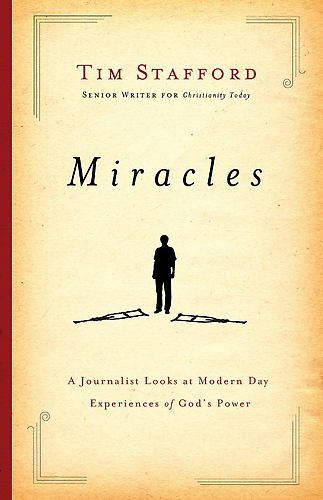 The material world does not need God’s miraculous interference; but God cannot deprive Himself of the power to interfere with it when He sees fit to do so. ~ Rev. Charles Coppins, SJ, A Brief Text-book of Logic and Philosophy, 1891
The world may not need miracles, but those of us living in it often seem to. Some more than others.
I welcomed the chance to review Tim Stafford’s new book Miracles: A Journalist Looks at Modern-Day Miracles from a Catholic standpoint for the Patheos Book Club even before Stafford’s topic jumped into the headlines via the stories of “miraculous” survivals of the Aurora shooting. We Catholics, after all, have a unique (if bipolar) relationship with miracles. We see them everywhere: in weeping statues and rosary chains turned to gold, in the Turin shroud and the E-Bay grilled cheese sandwich. And yet we’re remarkably blasé about them. We’re not, for the most part, a Church that goes on about miracles, or works them into our day-to-day ministry, even in those parts of what Tim Stafford calls “the majority world” where Western skepticism has not yet worked its unmagic, and where among Pentecostal Protestant missions, Stafford reports, “miracles seem to be the normal entry point for people becoming followers of Jesus” (p. 148). For Catholics, miracles are a kind of religious bling—nice to flash on special occasions, but not a necessary part of the wardrobe of faith.
Tim Stafford comes to his exploration from a distinctly different place. He is a journalist, but a religious journalist, not one looking to write a secular exposé. A Presbyterian for whom the charismatic strand of Christianity holds a special attraction, Stafford writes in part to answer his own spiritual questions. He confesses toward the start of Miracles:
All my life I’ve wanted God to show up in ways I can point to. I’ve never been totally satisfied with warm feelings and good morals alone; I want to see God at work in ways that can only be him. (p. 31)
That longing to see God in action is a kind of looking to miracles-as-proof that Stafford recognizes is both incomplete and unavoidable. In the best passages of Miracles, he leaves it behind, and approaches a sense of the role of miracle in the lives of followers of Jesus that Christians of all traditions and persuasions (including Catholics) can agree with and learn from. Miracles—in the Bible, in the apostolic age, today—are not meant to prove, but to point toward. They are, literally, signs of what is already in our midst and yet to come: the kingdom of God, in which sin and death are no more.
Miracles are signs pointing toward resurrection. Jesus did miracles that prefigured his resurrection. Our miracles are a foretaste of our resurrection, and of the renewal of the whole earth. (p. 200)
There are many other places in Miracles where Stafford’s way and mine diverge, however. Much of the book is devoted to exploring the modern Protestant Pentecostal/charismatic movement and the centrality of miraculous healings to that tradition. My own experience of the Catholic charismatic movement is limited, and though I respect those who find it a source of spiritual renewal, it was never my calling.
Stafford notes with what seems almost like a bit of envy that Catholics, alone among Christians, have a codified process for determining the veracity of miraculous cures (p. 53). He refers to the investigation, by the Congregation for the Causes of Saints, of miracles worked through the intercession of candidates for formal inclusion in the Church’s calendar of saints. One such miracle is required for a person to be beatified (called Blessed, and honored in local churches or religious congregations); another is needed for the Blessed to be named Saint and honored universally. (The old rules required as many as four miracles, at least two of them “first-class,” or demonstrably incapable of any explanation but divine intervention. When Pope John Paul II relaxed the rules for canonization in 1983, comedian Don Novello’s spot-on Fr Guido Sarducci character, “gossip columnist for L’Osservatore Romano,” lamented on Saturday Night Live, “Two stinking miracles? And one of them can be a card trick!”)
These miracles are the exception to the rule that miracles should not be used to prove anything; for the Church, they are proof that a person is already a participant in the eternal merits of Christ in heaven, and thus worthy to be called Saint. God makes saints; the Church only recognizes them, when the signs are there. Catholics also maintain the Board of Medicine at Lourdes, established by Pope Pius X to certify cures associated with the place of pilgrimage—so they would not be dismissed as card tricks.
Stafford goes very lightly over accounts of miracles from the centuries between the apostolic era and the charismatic renewal, dismissing as “legend” (p. 116) the countless wonders worked by saints and martyrs while they were alive or by intercession after their deaths. It’s important to remember, I’d argue, that the word legend can also apply to the coordinates on a map, so these too are signs pointing the way to the kingdom, if more ornately curlicued than the highway signs Stafford likes to use as an analogy. And he can’t quite disguise his sniff of Protestant revulsion when it comes to miracles associated with relics and other material objects (p. 124)—though as a good Reformer he’s quick to point out that these have been a lucrative revenue stream for Catholicism (p. 125). Stafford does stop short of Calvin’s condemnation of all post-biblical miracles, which would have called into question the modern-day miracles he covers in the book.
The chapters on the Pentecostal revival in the United States and around the world were, for me, only mildly interesting and something of a distraction from the topic of miracles. Even more problematic—especially for a book that claims to be aimed at those in the middle ground between unquestioning belief and complete skepticism (pp. 22-23)—is the chapter entitled Can a Scientist Believe in Miracles?, in which Stafford veers off into an attack on the New Atheism, and methinks protests too much.
But Stafford’s penultimate chapter, What We Know and How We Should Use It, should be required reading for Christians across the board, whatever their stance toward miracles. There’s rich material here for opening up and discussing—I wish Stafford had used the practical suggestions for approaching miracles from this chapter as the outline for the book!—and for putting into practice. It’s a miracle of clarity, and I recommend you start reading Miracles there, on page 199.
Myself, I’m going to start with one of Stafford’s least Catholic suggestions: Seek miracles in community. Maybe it’s time to haul that bling out of the safe-deposit box more often, and bring it to the party.
_____
Visit the Patheos Book Club to read an excerpt from Tim Stafford’s Miracles: A Journalist Looks at Modern-Day Experiences of God’s Power and to explore other bloggers’ responses to the book. At the same link, you can join a live chat with Tim Stafford about his new book and share your own experiences of modern miracles on Wednesday, July 25, from 2-3 pm EST.
Previous Post

July 23, 2012
Look Here! Of Monsters and Miracles--UPDATED
Next Post
July 25, 2012 Oh, for [Delete Deity]'s Sake!--UPDATE 3
Browse Our Archives
Select a Category Abortion Advent Art Bishops Book Review Catholicism Fortnight 4 Freedom In the News Lent Marriage Mary Mental Health New Evangelization Nuns Pilgrimage 2012 Pop Culture Pope Francis Religious Education Reverts Saints' Lives and Legends Sin Staying Catholic Uncategorized Year of Faith
Select a Month May 2016 May 2015 April 2015 March 2015 December 2014 November 2014 October 2014 September 2014 August 2014 July 2014 June 2014 April 2014 March 2014 February 2014 December 2013 November 2013 October 2013 September 2013 August 2013 July 2013 June 2013 May 2013 April 2013 March 2013 February 2013 January 2013 December 2012 November 2012 October 2012 September 2012 August 2012 July 2012 June 2012 May 2012 April 2012 March 2012 February 2012 January 2012 November 2011 April 2011 March 2011 December 2010
Follow Us!
TAKE THE
Religious Wisdom Quiz
Who tricked Isaac into giving him Esau's blessing?
Select your answer to see how you score.
Leah Laban Jacob Rebekah
Related posts from Egregious Twaddle
iDolatry? There's an App for That!

"A Palpable Hopefulness": A Book Response and a...
In the Breaking of the Bread: A Book...
Vale of Tears or Vale of Soul-Making? A...
TRENDING AT PATHEOS Catholic

The Parable Of The Sower And The Word...
One of Christ’s most famous parables is that of the sower who...

Rejecting Doom: Christian Hope And Human Action
Christianity is a religion of hope. We are to have hope and...

Why I Choose the Eucharist Over the Sermon
Choose the Eucharist, Not the Sermon What are we supposed to get...

5 Design Elements Found in Spiritually Rooted Homes
Putting Spirituality Into Home Decor Our homes are more than our living...

Credo: A Story of God Told with the...
About 10 years ago, I began to imagine a personal "Credo" that...

The Anatomy of Divine Revelation in Catholic Thought
The claim that God has made Himself known to human beings is...
view all Catholic blogs
Ad-Free & Subscriber Log-In Subscription Support
- About Us
- 2026 Calendar
- Videos
- Podcasts
- Library of World Religions
- Faith In Media Tracker
- Advertise With Us
- Write for Us
- Privacy Policy
- Terms of Service
- Do Not Sell My Data
- Contact Us
- Radiant Digital
- Manage Newsletter Subscriptions
- Unsubscribe From Notifications
- Sitemap
Copyright 2008-2026, Patheos. All rights reserved.
Subscription Support Ad-Free & Subscriber Log-In
Follow Patheos