
BuddhistCatholicContemplativeEvangelicalGeneral ChristianHinduJewishLatter-day SaintMuslimNew VisionsProgressive Christian
Beliefs
- Buddhist
- Catholic
- Contemplative
- Evangelical
- General Christian
- Hindu
- Jewish
- Latter-day Saint
- More Voices
- Muslim
- New Visions
- Pagan
- Progressive Christian
Topics
- Religion News
- Food and Religion
- Sports and Religion
- Religious Art
- Religious Music and Entertainment
- Religious Events
- History and Religion
- Style and Religion
- Politics and Religion
- Women in Religion
- Recreation Outdoors and Religion
- Business Finance and Religion
- Careers Workplace and Religion
- Education and Religion
- Family Parenting and Religion
- Health Fitness and Religion
- Home and Religion
- Relationships and Religion
- Technology and Religion
- Travel and Religion
Columnists
- Buddhist Columnists
- Business Finance and Religion Columnists
- Careers Workplace and Religion Columnists
- Catholic Columnists
- Contemplative Columnists
- Education and Religion Columnists
- Evangelists Columnists
- Family Parenting and Religion Columnists
- General Christian Columnists
- Health Fitness and Religion Columnists
- Hindu Columnists
- History and Religion Columnists
- Home and Religion Columnists
- Jewish Columnists
- More Voices Columnists
- Latter Day Columnists
- Muslim Columnists
- New Visions Columnists
- Nonreligious Columnists
- Pagan Columnists
- Politics and Religion Columnists
- Progressive Columnists
- Recreation Outdoors and Religion Columnists
- Relationships and Religion Columnists
- Religion News Columnists
- Religious Art Columnists
- Religious Events Columnists
- Religious Music and Entertainment Columnists
- Sports and Religion Columnists
- Style and Religion Columnists
- Technology and Religion Columnists
- Travel and Religion Columnists
- Women in Religion Columnists
Resource Library
- 2026 Calendar
- Library of World Religions
- The 100 Most Holy Places on Earth
- Patheos Answers
- Podcasts
- Videos
- Faith Leaders Database
- Anglican Episcopalian
- Bahai
- Baptist
- Buddhism
- Christianity
- Confucianism
- Eastern Orthodoxy
- Hinduism
- Holiness and Pentecostal
- ISKCON
- Islam
- Judaism
- Lutheran
- Methodist
- The Church of Jesus Christ of Latter-day Saints
- New Age
- Paganism
- Presbytarian and Reformed
- Protestantism
- Religion Behind the Scenes
- Roman Catholic
- Scientology
- Shia Islam
- Sikhism
- Sufism
- Sunni Islam
- Taoism
- Zen
- See all religions
Research Tools
 Ad-Free & Subscriber Log-In Subscription Support
Ad-Free & Subscriber Log-In Subscription Support
Follow Patheos 

- Trending:
- Forgiveness
- |
- Marriage
- |
- Consciousness
- |
- Death Penalty
- |
- Election
- |
- Halloween
 Egregious Twaddle
- Home
- Catholic
- Ever Ancient, Ever New
Ever Ancient, Ever New
Last updated on: May 2, 2016 at 11:22 am by Joanne McPortland
Ever Ancient, Ever New 2016-05-02T11:22:32-06:00 Joanne McPortland
Patheos Explore the world's faith through different perspectives on religion and spirituality! Patheos has the views of the prevalent religions and spiritualities of the world.
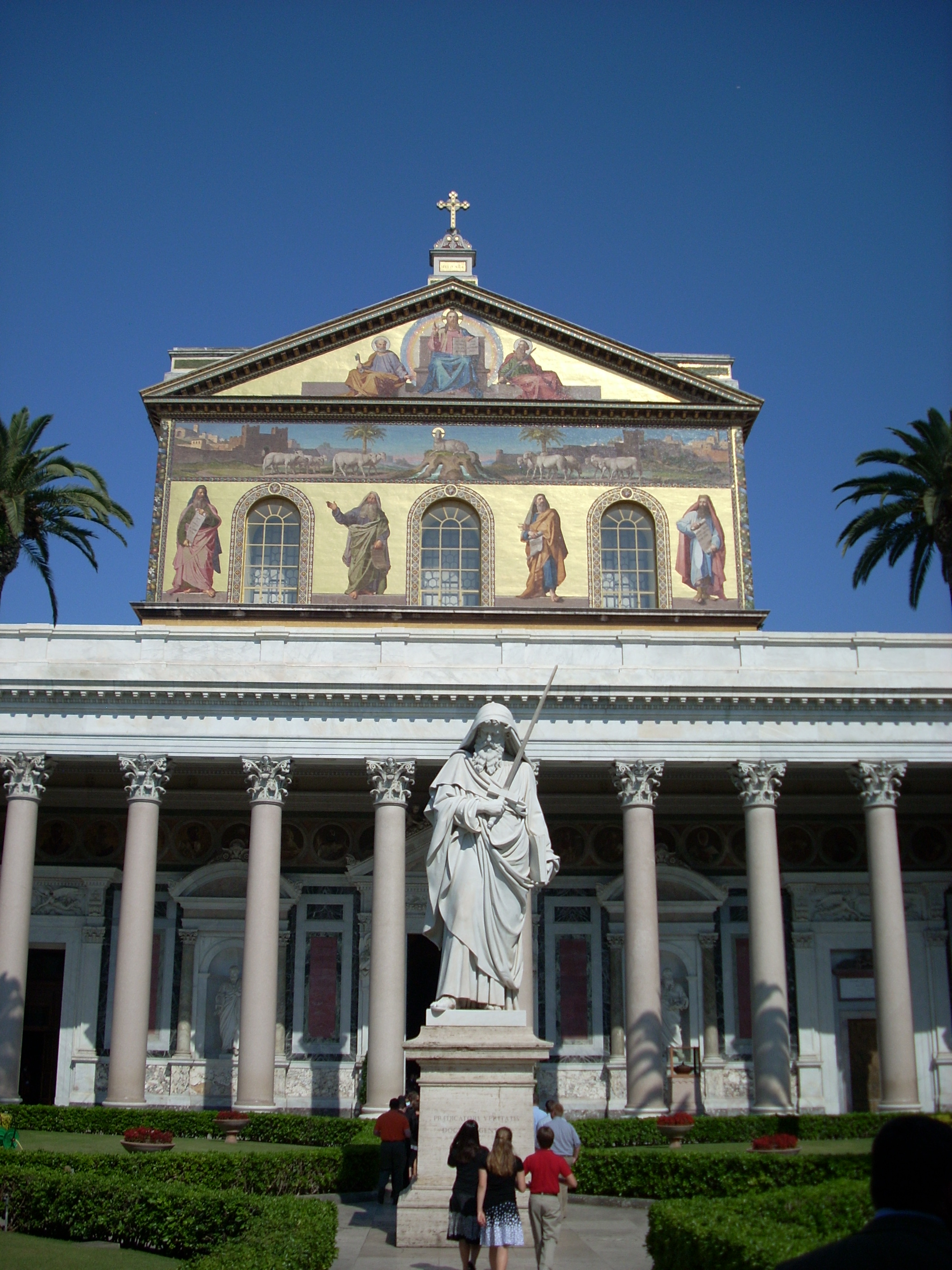 One of the first churches I visited in Rome was San Paolo fuori le Mura, the Basilica of St Paul Outside the Walls. I was there for the Papal Vespers celebrated on the Vigil of the Solemnity of Sts Peter and Paul in 2010. It was my first taste of the zoo that is a liturgy celebrated by the Holy Father. I was astonished to see that as soon as the entrance procession was signaled, the standing-room-only congregation who had been so reverently prayerful up to that moment suddenly leaped, as one, atop the temporary chairs that filled the knave and began snapping photos with the all the hyped-up aggression of paparazzi going after Alec Baldwin. So I saw only the tip of the Pope’s staff as he passed up the aisle, confirmed by the level of applause. (Roman congregations, I learned, cheer for all vaguely notable personages in the run-up to the Pope, but the decibel level reaches Beatles concert proportions for The Man.) I did get a slightly better view of Pope Benedict XIV later in the service, as he appeared, a tiny figure, on the distant Jumbotron set up before a side altar.
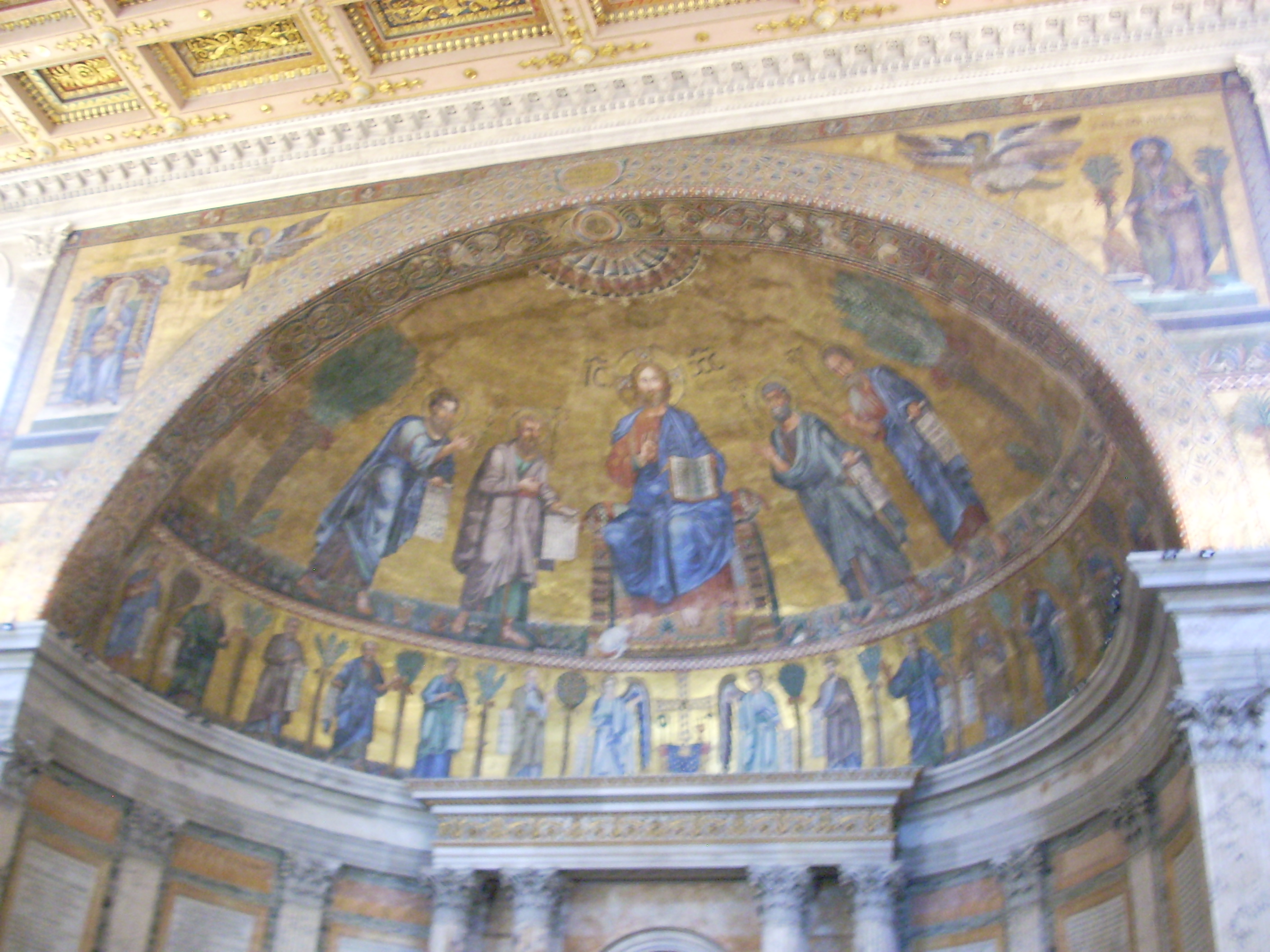
I have to confess, though, that it was the basilica itself that was the star for me that day and later in the week when our tour group returned for a more peaceful closeup. I had given illustrated lectures on Church art that featured the apse mosaics, with their Byzantine palm trees—just like the palm trees outside the basilica! I don’t know why Rome’s palm trees came as such a surprise, but I felt like I was back home in LA—flanking Christ the Just Judge, a teeny-tiny Pope Honorius III, the 13th-century pontiff who commissioned the murals, curled up by Jesus’ right foot, about to kiss a regal toe. To see the mosaics in person, the shimmer of glass and gold that no photograph can capture, was immensely moving. (I gave thanks then, and give thanks always, to the Vanderburgh Family for making it possible.)
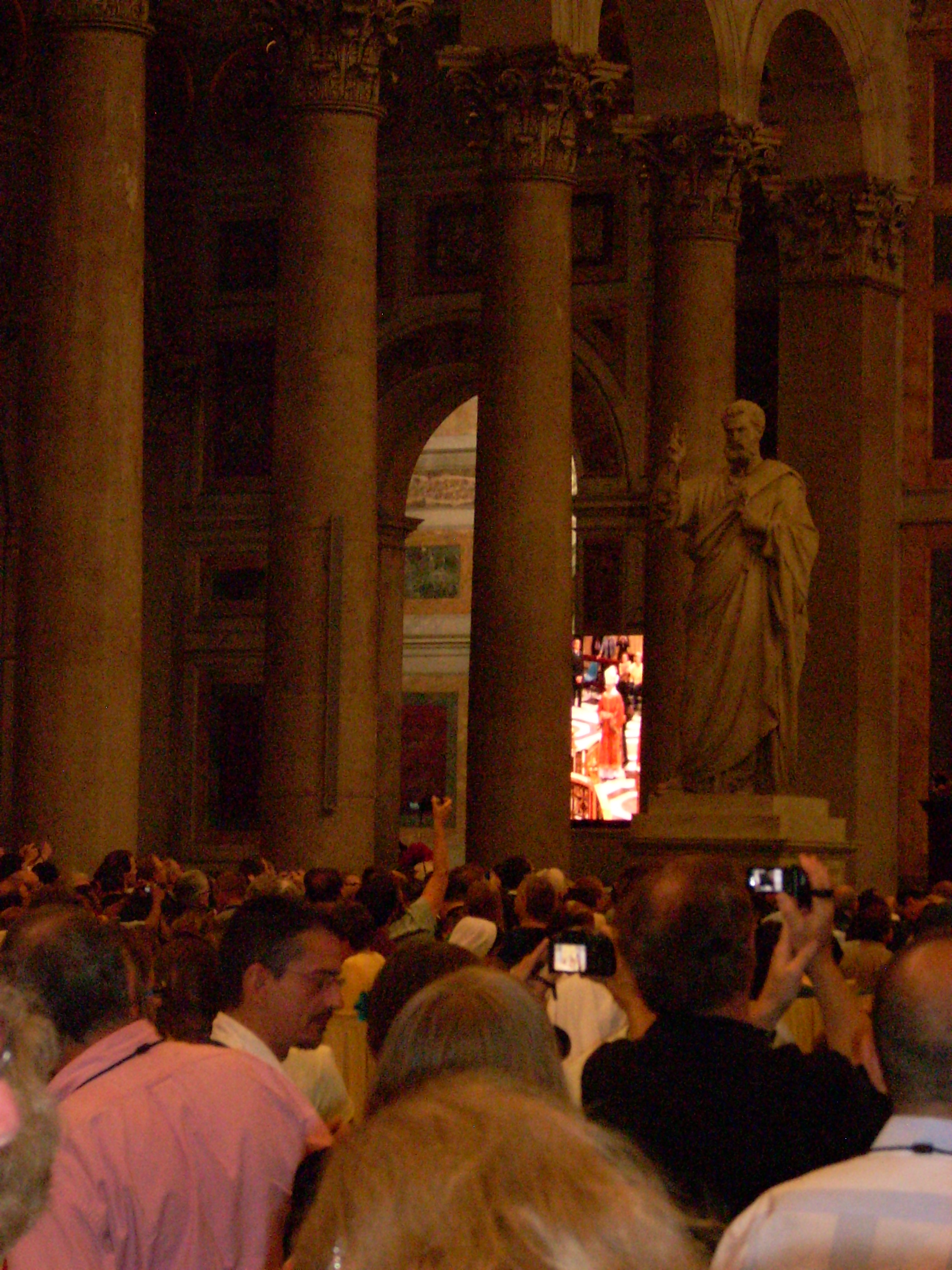 So I was delighted to see that Kathy Schiffer has called attention to St Paul Outside the Walls in her Seasons of Grace blog, spotlighting the major reconstruction of the Basilica that occurred 189 years ago next week. Though this was the most ambitious reworking of San Paolo—necessitated by a devastating fire—it was by no means the first in the church’s long history, and I can’t help but see in that a sign of hope in these days when speculation about the Church’s survival abounds both within and without her walls. Some points for reflection:
Founded on the Apostle, Literally
The original basilica (from the Greek for royal building, because this model of Christian church is based on the audience halls of Byzantine rulers) was built by our old pal Constantine, he of memory both blessed and cursed, on the site where, by popular tradition, the remains of St Paul were interred after his beheading. Paul was a citizen of Rome, even if a heretic to Rome’s gods and to the Judaism of his birth, so he was entitled to a citizen’s burial—outside the walls of the city, as was the rule for all burials in ancient Rome. Recent excavations under the basilica have yielded burial materials consistent with the era of Paul’s martyrdom, and there are plans to transfer what might be the saint’s remains to join those of St Peter in the Vatican.
Since the earliest days, we as Church have also built on the foundation laid by the life of the Apostle to the Gentiles, and we have had reason to be both grateful to Constantine and troubled by the imperial legacy he left us.
Ad Orientem
As Kathy Schiffer points out, San Paolo is one of the places in Rome where the Church’s Eastern blood continues to be most recognizable. The mosaic tradition began as early as the 4th century, when the Emperor Theodosius erected a larger and more lavish church on the site of Constantine’s original. For 700 years, San Paolo was the home church of the Latin Patriarch of Alexandria, so it has always helped us to keep one eye turned to the East.
At a time when we in the US tend to go on a bit more than we should about how we’re being persecuted, it’s good to have a reminder of how we are linked to a long tradition of survivors of real persecution in the East—and to continue to “look East” in prayer and solidarity with them.
In the Midst of the World
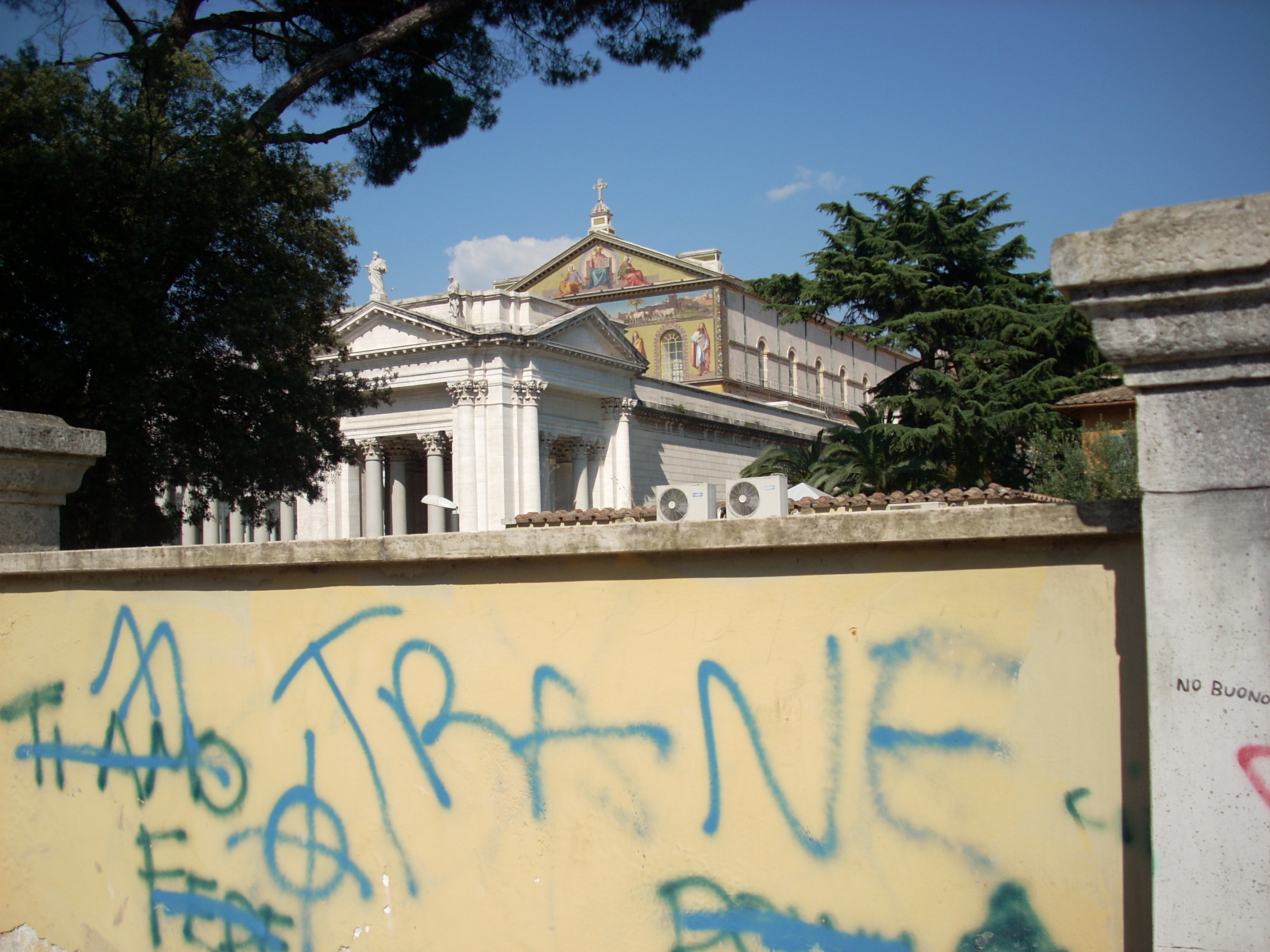 For a good part of its history, St Paul Outside the Walls was isolated by its location, but in the 20th century industrial development and low-income housing sprang up around the basilica. There have been attempts to buy back some of the surrounding land to create buffer zones of greenspace, but as my photo shows, San Paolo is now firmly in the world, if not of it.
And that’s as it should be. As Church, we need fewer buffer zones and walls, more open doors and open arms.
Surviving, Renewing
Over the centuries the basilica survived Saracen invasions, earthquakes, the rise and fall of a double monastery on its grounds, being renewed and rebuilt in part while preserving its original character longer than almost any other church in Rome. Then came the catastrophic fire of 1823, and the world’s response to raise San Paolo from the ashes.
I think St Paul Outside the Walls is a model of the Church in miniature that way. The building made of living stones, built on Christ the cornerstone, has survived many an assault, has renewed and rebuilt itself, has let the world in, even at risk of martyrdom. I have faith that it will be ever so, until we are called home to meet the Just Judge at last.
Previous Post

July 7, 2012
5 Things That Too Shall Pass
Next Post
July 10, 2012 Stop Bashing Bishops! (Seriously)
Browse Our Archives
Select a Category Abortion Advent Art Bishops Book Review Catholicism Fortnight 4 Freedom In the News Lent Marriage Mary Mental Health New Evangelization Nuns Pilgrimage 2012 Pop Culture Pope Francis Religious Education Reverts Saints' Lives and Legends Sin Staying Catholic Uncategorized Year of Faith
Select a Month May 2016 May 2015 April 2015 March 2015 December 2014 November 2014 October 2014 September 2014 August 2014 July 2014 June 2014 April 2014 March 2014 February 2014 December 2013 November 2013 October 2013 September 2013 August 2013 July 2013 June 2013 May 2013 April 2013 March 2013 February 2013 January 2013 December 2012 November 2012 October 2012 September 2012 August 2012 July 2012 June 2012 May 2012 April 2012 March 2012 February 2012 January 2012 November 2011 April 2011 March 2011 December 2010
Follow Us!
TAKE THE
Religious Wisdom Quiz
Who said, "Let there be light"?
Select your answer to see how you score.
Elijah God Paul Moses
Related posts from Egregious Twaddle

Depressed and Catholic: Learning It's OK to Live

5 Reasons Why Catholics (of All People!) Should...

Pope and African Bishops to Cardinal Kasper: "Can...

The Magdalene's Cave: Thoughts on Priesthood and Women
TRENDING AT PATHEOS Catholic

Rejecting Doom: Christian Hope And Human Action
Christianity is a religion of hope. We are to have hope and...

It’s What Comes From Within Which Matters
One of the most difficult things for us to understand is why...

Why I Choose the Eucharist Over the Sermon
Choose the Eucharist, Not the Sermon What are we supposed to get...

5 Design Elements Found in Spiritually Rooted Homes
Putting Spirituality Into Home Decor Our homes are more than our living...

Credo: A Story of God Told with the...
About 10 years ago, I began to imagine a personal "Credo" that...

The Anatomy of Divine Revelation in Catholic Thought
The claim that God has made Himself known to human beings is...
view all Catholic blogs
Ad-Free & Subscriber Log-In Subscription Support
- About Us
- 2026 Calendar
- Videos
- Podcasts
- Library of World Religions
- Faith In Media Tracker
- Advertise With Us
- Write for Us
- Privacy Policy
- Terms of Service
- Do Not Sell My Data
- Contact Us
- Radiant Digital
- Manage Newsletter Subscriptions
- Unsubscribe From Notifications
- Sitemap
Copyright 2008-2026, Patheos. All rights reserved.
Subscription Support Ad-Free & Subscriber Log-In
Follow Patheos