
BuddhistCatholicContemplativeEvangelicalGeneral ChristianHinduJewishLatter-day SaintMuslimNew VisionsProgressive Christian
Beliefs
- Buddhist
- Catholic
- Contemplative
- Evangelical
- General Christian
- Hindu
- Jewish
- Latter-day Saint
- More Voices
- Muslim
- New Visions
- Pagan
- Progressive Christian
Topics
- Religion News
- Food and Religion
- Sports and Religion
- Religious Art
- Religious Music and Entertainment
- Religious Events
- History and Religion
- Style and Religion
- Politics and Religion
- Women in Religion
- Recreation Outdoors and Religion
- Business Finance and Religion
- Careers Workplace and Religion
- Education and Religion
- Family Parenting and Religion
- Health Fitness and Religion
- Home and Religion
- Relationships and Religion
- Technology and Religion
- Travel and Religion
Columnists
- Buddhist Columnists
- Business Finance and Religion Columnists
- Careers Workplace and Religion Columnists
- Catholic Columnists
- Contemplative Columnists
- Education and Religion Columnists
- Evangelists Columnists
- Family Parenting and Religion Columnists
- General Christian Columnists
- Health Fitness and Religion Columnists
- Hindu Columnists
- History and Religion Columnists
- Home and Religion Columnists
- Jewish Columnists
- More Voices Columnists
- Latter Day Columnists
- Muslim Columnists
- New Visions Columnists
- Nonreligious Columnists
- Pagan Columnists
- Politics and Religion Columnists
- Progressive Columnists
- Recreation Outdoors and Religion Columnists
- Relationships and Religion Columnists
- Religion News Columnists
- Religious Art Columnists
- Religious Events Columnists
- Religious Music and Entertainment Columnists
- Sports and Religion Columnists
- Style and Religion Columnists
- Technology and Religion Columnists
- Travel and Religion Columnists
- Women in Religion Columnists
Resource Library
- 2026 Calendar
- Library of World Religions
- The 100 Most Holy Places on Earth
- Patheos Answers
- Podcasts
- Videos
- Faith Leaders Database
- Anglican Episcopalian
- Bahai
- Baptist
- Buddhism
- Christianity
- Confucianism
- Eastern Orthodoxy
- Hinduism
- Holiness and Pentecostal
- ISKCON
- Islam
- Judaism
- Lutheran
- Methodist
- The Church of Jesus Christ of Latter-day Saints
- New Age
- Paganism
- Presbytarian and Reformed
- Protestantism
- Religion Behind the Scenes
- Roman Catholic
- Scientology
- Shia Islam
- Sikhism
- Sufism
- Sunni Islam
- Taoism
- Zen
- See all religions
Research Tools
 Ad-Free & Subscriber Log-In Subscription Support
Ad-Free & Subscriber Log-In Subscription Support
Follow Patheos 

- Trending:
- Forgiveness
- |
- Marriage
- |
- Consciousness
- |
- Death Penalty
- |
- Election
- |
- Halloween
 Egregious Twaddle
- Home
- Catholic
- Where the Wild Things Are Reunited
Where the Wild Things Are Reunited
Last updated on: May 2, 2016 at 11:33 am by Joanne McPortland
Where the Wild Things Are Reunited 2016-05-02T11:33:39-06:00 Joanne McPortland
Patheos Explore the world's faith through different perspectives on religion and spirituality! Patheos has the views of the prevalent religions and spiritualities of the world.
Maurice Sendak, who died today, was always someone I respected more than loved.
I was 13 when Where the Wild Things Are was published, so too old to come to it as a child. My son liked it fine, but it wasn’t up there at the top of the list of read-it-AGAINs with Cloudy with a Chance of Meatballs, Alexander and the Terrible, Horrible, No-Good, Very Bad Day, or the weird Swedish fairytale about Princess Ingeborg.
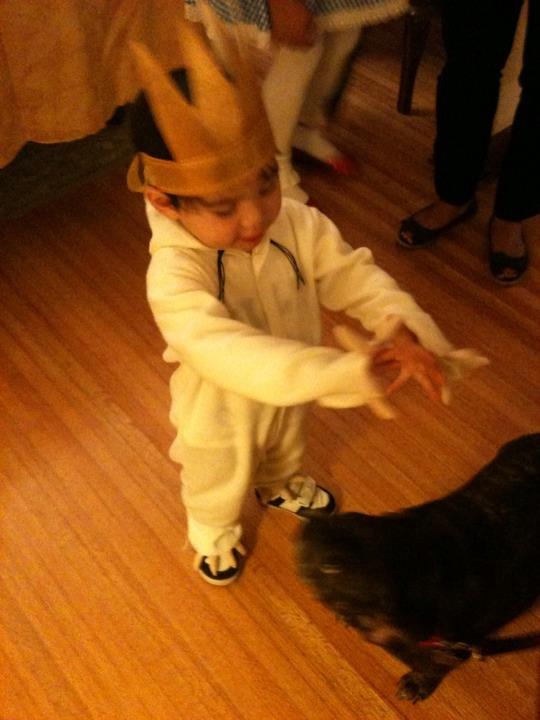 My grandson as Max, stirring up
a wild rumpus with a sleepy dog
That was fine with me. I don’t have trouble with the anarchic spirit of childhood Sendak’s work evoked, but wild things scare me–maybe because my own childhood was so peopled with them, even if their wildness was emotionally rather than physically threatening. In the Night Kitchen, though a pretty disturbing book in lots of ways, was less of a problem for some reason. (The childhood nudity that gets that book banned from library shelves was not a stopper, since my son attended The Last Unreformed Hippie Preschool in Hollywood, where clothing was as optional for toddlers as it had been for Woodstock attendees.) I was fascinated by the evolution of Brundibar, from Sendak and Tony Kushner’s storybook based on the children’s opera originally performed in the Theresienstadt concentration camp in Czechoslovakia through their revival of the opera itself. I knew that Sendak had described the focus of his life’s work as “the struggle to survive childhood,” a struggle I honor but don’t feel comfortable cuddling up to, wild thing that it is.
So it took me by surprise, this afternoon, when I was brought to sobbing by a replay of Sendak’s last Fresh Air conversation with Terry Gross. I was driving, and only caught the end, in which Sendak makes some very personal observations about belief, loss, and death–a good 15 minutes, during which he is himself audibly weeping. I had to pull over. Talking with Gross about the death of loved ones, Sendak says he doesn’t believe there’s anything after death, so when someone dies, that’s it, they’re gone forever. And he loves them so much, and the emptiness is so great. Faced with this inevitability, Sendak (like Christopher Hitchens before him) forcibly maintains his lifelong atheism. But then he says, “Still, part of me believes I will see my brother [Jack, a frequent colaborator on children’s books, who died in 1995] again . . . in some dream state.” I had to pull over, because I was crying so hard myself.
I think this man of very great imagination and very little faith might be (like Hitchens) in for a surprise. It doesn’t matter that he thought he didn’t believe; he loved, and that works. It doesn’t matter that the person he loved longest in his life, next to his brother, was another man, Sendak’s partner of 50 years who predeceased him; not that it’s anybody’s business, as even Mark Shea said this past week, but Sendak himself said their relationship was less about “being gay” than about sharing the pleasures of good books and good music–the blessing of comfortable intimacy that marks all good marriages in the end anyway. It speaks well of Sendak that if he was an idolator, he counted among his gods Melville, Dickinson, and Mozart. And in his conversation with Terry Gross, he described what he has come to see as his version of religion simply: “I am in love with the world.” The Creator of the world takes that as a compliment, I bet.
Here’s my prayer. God of Surprises, let Maurice and his brother and his partner and his parents and his family members lost in the Holocaust (but never lost to You) and Herman and Emily and Wolfgang Amadeus be kicking up a joyful rumpus, not in some dream state but in the place where all the wild things–beyond our imaginings, beyond what eye has seen or ear heard–are reunited, now and always.
Previous Post

May 8, 2012
Holy Communion!
Next Post
May 9, 2012 The Heartburn of Sex
Browse Our Archives
Select a Category Abortion Advent Art Bishops Book Review Catholicism Fortnight 4 Freedom In the News Lent Marriage Mary Mental Health New Evangelization Nuns Pilgrimage 2012 Pop Culture Pope Francis Religious Education Reverts Saints' Lives and Legends Sin Staying Catholic Uncategorized Year of Faith
Select a Month May 2016 May 2015 April 2015 March 2015 December 2014 November 2014 October 2014 September 2014 August 2014 July 2014 June 2014 April 2014 March 2014 February 2014 December 2013 November 2013 October 2013 September 2013 August 2013 July 2013 June 2013 May 2013 April 2013 March 2013 February 2013 January 2013 December 2012 November 2012 October 2012 September 2012 August 2012 July 2012 June 2012 May 2012 April 2012 March 2012 February 2012 January 2012 November 2011 April 2011 March 2011 December 2010
Follow Us!
TAKE THE
Religious Wisdom Quiz
What was the primary worship language in the Bible?
Select your answer to see how you score.
Hebrew Greek Aramaic Latin
Related posts from Egregious Twaddle

Finding My Way Back to Fatima, and Down...

Depressed and Catholic: Learning It's OK to Live

No Good Guys, No Bad Guys: Fr Greg...

5 Reasons Why Catholics (of All People!) Should...
TRENDING AT PATHEOS Catholic

Rejecting Doom: Christian Hope And Human Action
Christianity is a religion of hope. We are to have hope and...

It’s What Comes From Within Which Matters
One of the most difficult things for us to understand is why...

Why I Choose the Eucharist Over the Sermon
Choose the Eucharist, Not the Sermon What are we supposed to get...

5 Design Elements Found in Spiritually Rooted Homes
Putting Spirituality Into Home Decor Our homes are more than our living...

Credo: A Story of God Told with the...
About 10 years ago, I began to imagine a personal "Credo" that...

The Anatomy of Divine Revelation in Catholic Thought
The claim that God has made Himself known to human beings is...
view all Catholic blogs
Ad-Free & Subscriber Log-In Subscription Support
- About Us
- 2026 Calendar
- Videos
- Podcasts
- Library of World Religions
- Faith In Media Tracker
- Advertise With Us
- Write for Us
- Privacy Policy
- Terms of Service
- Do Not Sell My Data
- Contact Us
- Radiant Digital
- Manage Newsletter Subscriptions
- Unsubscribe From Notifications
- Sitemap
Copyright 2008-2026, Patheos. All rights reserved.
Subscription Support Ad-Free & Subscriber Log-In
Follow Patheos