
BuddhistCatholicContemplativeEvangelicalGeneral ChristianHinduJewishLatter-day SaintMuslimNew VisionsProgressive Christian
Beliefs
- Buddhist
- Catholic
- Contemplative
- Evangelical
- General Christian
- Hindu
- Jewish
- Latter-day Saint
- More Voices
- Muslim
- New Visions
- Pagan
- Progressive Christian
Topics
- Religion News
- Food and Religion
- Sports and Religion
- Religious Art
- Religious Music and Entertainment
- Religious Events
- History and Religion
- Style and Religion
- Politics and Religion
- Women in Religion
- Recreation Outdoors and Religion
- Business Finance and Religion
- Careers Workplace and Religion
- Education and Religion
- Family Parenting and Religion
- Health Fitness and Religion
- Home and Religion
- Relationships and Religion
- Technology and Religion
- Travel and Religion
Columnists
- Buddhist Columnists
- Business Finance and Religion Columnists
- Careers Workplace and Religion Columnists
- Catholic Columnists
- Contemplative Columnists
- Education and Religion Columnists
- Evangelists Columnists
- Family Parenting and Religion Columnists
- General Christian Columnists
- Health Fitness and Religion Columnists
- Hindu Columnists
- History and Religion Columnists
- Home and Religion Columnists
- Jewish Columnists
- More Voices Columnists
- Latter Day Columnists
- Muslim Columnists
- New Visions Columnists
- Nonreligious Columnists
- Pagan Columnists
- Politics and Religion Columnists
- Progressive Columnists
- Recreation Outdoors and Religion Columnists
- Relationships and Religion Columnists
- Religion News Columnists
- Religious Art Columnists
- Religious Events Columnists
- Religious Music and Entertainment Columnists
- Sports and Religion Columnists
- Style and Religion Columnists
- Technology and Religion Columnists
- Travel and Religion Columnists
- Women in Religion Columnists
Resource Library
- 2026 Calendar
- Library of World Religions
- The 100 Most Holy Places on Earth
- Patheos Answers
- Podcasts
- Videos
- Faith Leaders Database
- Anglican Episcopalian
- Bahai
- Baptist
- Buddhism
- Christianity
- Confucianism
- Eastern Orthodoxy
- Hinduism
- Holiness and Pentecostal
- ISKCON
- Islam
- Judaism
- Lutheran
- Methodist
- The Church of Jesus Christ of Latter-day Saints
- New Age
- Paganism
- Presbytarian and Reformed
- Protestantism
- Religion Behind the Scenes
- Roman Catholic
- Scientology
- Shia Islam
- Sikhism
- Sufism
- Sunni Islam
- Taoism
- Zen
- See all religions
Research Tools
 Ad-Free & Subscriber Log-In Subscription Support
Follow Patheos 

- Trending:
- Advent
- |
- Forgiveness
- |
- Thanksgiving
- |
- Election
- |
- Seasonal Holidays
- |
- Marriage
 Eastern Catholic Person
- Home
- Catholic
- This time, I have a tradition: on solidarity with the Hong Kong extradition protests in Chicago
This time, I have a tradition: on solidarity with the Hong Kong extradition protests in Chicago
Last updated on: June 10, 2019 at 11:45 pm by Justin Tse
This time, I have a tradition: on solidarity with the Hong Kong extradition protests in Chicago 2019-06-10T23:45:18-07:00 Justin Tse
Patheos Explore the world's faith through different perspectives on religion and spirituality! Patheos has the views of the prevalent religions and spiritualities of the world.
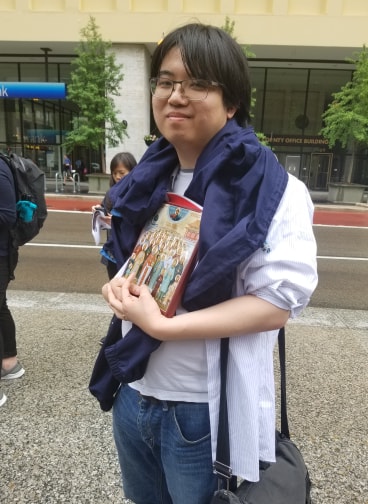
photo by student
I was holding my icon of the Holy Martyrs of China on my heart at the solidarity gathering in Chicago for the Hong Kong protests on June 9 — the ones that brought over a million people out to the streets in Hong Kong to oppose the amendments that would allow the Beijing government to request the extradition of whoever, including dissidents, it has deemed to have committed a crime against it — when a student of mine who was also there took a picture of me. Like me, she is a Christian; unlike me, she is not Eastern Catholic, or in any of the Orthodox churches, for that matter. I don’t know if it was me being superstitious, but as the icon was pressed to my chest as is the tradition of us Orthodox Christians going to march and to protest, I felt it glowing warmly. I smiled. Then, I told my student how I felt. This time, I said, I have a tradition.
Last time, of course, was the Umbrella Movement. I had a tradition then too, at least technically. I was Anglican, canonically so, but it was messy. My wife and I were searching then for an ecclesial home. At that time, we split our time between Vancouver, where our families are, and Seattle, where I was doing a postdoctoral fellowship, and had stumbled on a church that met in a community center, mostly populated by young Asian Canadian families and led by some of the loveliest of people with whom we remain friends to this day. As ours is a marriage of liturgical sensibilities as we come from Christian communities that eschew denominational labels, it was liturgical enough for me, yet sufficiently liturgically unstructured for her, though with the same criteria, we were worshipping at the Latin student ministry in Seattle’s U-District too. It was in that Christian community, and the other younger Asian Canadian evangelical communities with which we were networked, that those of us who were justice-minded were mobilized to the solidarity protests in front of the Chinese consulate. There, we encountered the Eastern Catholic Jesuit who taught us spiritual discernment and Galician chant, and it was in that encounter that we noted the stark contrast between the Chinese churches of our childhoods, which wanted to remain political, and the Kyivan Church’s post-Maidan social justice spirituality.
In the early days of my catechumenate, my spiritual father would say that there was a feeling of ecclesial homelessness in my story. I am Anglican, I used to say, I can believe all the things and even attend a non-Anglican church, to which the question then became, why are you here, then? It was a fair question, one that took me a year of mystagogy and an article in an Asian American evangelical magazine to figure out. It was that, despite being open to everything and trying to dialogue with everyone, I had chosen a side in the Umbrella Movement. I came out to the protests. I organized a theological forum and a retreat on it. I edited a scholarly volume on it. We wrote an ecumenical open letter, and then some, against a member of our community in Vancouver who purported to frame all Chinese Christians as against the protests.
The Anglicans, on the other hand, had a bit more of a mixed record. Hong Kong Sheng Kung Hui — the ‘holy public community,’ as the church is translated in Cantonese — has an international reputation among ecumenical theologians as ground zero of women’s ordination to the priesthood, so there are a number of fawning treatments over it as the soil from which postcolonial feminist theology can grow. To their credit, the Anglicans who aligned with such social justice politics all came out for the Umbrella Movement — two of them, Kwok Pui Lan and Rose Wu are even in my book — but the guy who wrote the playbook for dialogue as a way forward for Hong Kong, Archbishop Paul Kwong, came out swinging against even the peaceful and legal preparatory movement, Occupy Central with Love and Peace, making fun of the young people by asking if they had brought their Filipina nannies with them. Of course, another way that Kwong was dialoguing went beyond his role as Primate of the Anglican Church of Hong Kong; he is also a member of the Chinese People’s Political Consultative Committee, an advisory body to the Beijing government, and with his skills in dialoguing, he maneuvered his way through the Primates’ Meeting [whatever it was] in 2016 and became the head of the Anglican Consultative Council’s office, which is tasked by the Archbishop of Canterbury for keeping the Communion, (un)bound by bonds of affection, together. It turns out when you’re everybody’s friend, your de facto position is pro-establishment, because they’re your friends too.
In the five years between the Umbrella Movement and these protests against the extradition amendments that the Hong Kong Government is trying to ram through, I have done a lot of reflecting on this journey, much of it on this blog. The feeling that I have this time is different, though the circumstances are similar. When the protests ended with police violence, I certainly felt that same indignation that I felt five years ago, as the Umbrella Movement and Ferguson coincided in timing within weeks, the same emotion that led tens of thousands of Hong Kong people to come down to the streets chanting, Protect the students. They can’t kill us all.
There is no occupation this time, at least not yet. But beyond that material difference, even that anger is tempered with something else. It is a sense of certainty that I did not have last time, a clarity that contrasted the nagging feelings of doubt five years ago. At that time, you could still make the case that the yellow-ribboners, as the democracy protesters were called, were in active contest with the blue-ribboners who opposed the Umbrella Movement and that there was maybe something somehow reasonable that the blockade of roads and the disruption of local commerce amounted to what the courts, in sentencing some of the members of the Occupy 9, are now calling a ‘public nuisance.’ But five years does make a difference. In the interim, a woman has been convicted of attacking the police with her breasts. A public official has made the case that the autonomy of Hong Kong in the ‘one country, two systems’ framework only applies to what is above the ground, not under it, as the station that would connect the city to the mainland would be located there. The sentences of Umbrella Movement protesters have been revised to become more severe. The Chief Executive, Carrie Lam Cheng Yuet-ngor, has not only declared that she was called by God to become the top official in Hong Kong, but has also given the go-ahead for a land reclamation project on Lantau Island that would cost a fortune to the public and would not even be environmentally feasible according to the experts. For most who could read the signs of the times even before 2014, the government could not be trusted, not after the government sent the Ng Ka Ling case on immigration in 1999 to Beijing in an erosion of judicial autonomy, the debacle over the Article 23 National Security Bill that sent half a million people to the streets in protest for free speech, and the political reform package that would require candidates to ‘Love China, Love Hong Kong.’ But what has come after the Umbrella Movement is sheer political ludicrousness, with the twisting of the law to achieve political purposes so obvious that even Kafka couldn’t make this stuff up.
And what is that political purpose? Is it not to erode the framework of one country, two systems? Much more than the issues of democracy and universal suffrage, it was the obvious threat to this legal arrangement in 2014 that caused the protests that year, with the timing of the ‘white paper’ in June and the ‘green paper’ in August that spelled out Beijing’s position on Hong Kong: that its autonomous way of life was always subjected to the ‘one country.’ And why the crystallization of this position, after years of Beijing administrations playing coy? For that, we might look to the advent of Xi Jinping’s ‘Chinese Dream’ and the actions of his program in power that spell it out: the codification of Xi Jinping Thought into the national constitution, the Belt-Road Initiative to achieve Chinese global hegemony, the ‘sinicization’ of religion that throws Tibetans, Uyghurs, and Christians of all kinds under the bus, and the relentless attempt to integrate Hong Kong into the Chinese nation-state as a sign of things to come if ‘reunification’ with Taiwan is pursued. If there is a core to this agenda, it is its focus on the Chinese in what Deng Xiaoping before him called ‘socialism with Chinese characteristics,’ at that time referring to what could be adapted for the Chinese nation-state’s situation, but now reifying Chineseness as a national identity into which others will be assimilated, even through re-education and surveillance. There is a nation now, despite its many ethnic groups and indigenous peoples, that now privileges the dominant Chinese ethnicity — the Han people — as the de facto normal people, bound by blood. Indeed, such are the appeals to Hong Kong and Taiwan to just become ‘Chinese’ — it is that what is shared is Chinese blood, a Han nationalism that exceeds the political boundaries that exist because Hong Kong and Taiwanese people have never consented to being part of this nationalist project.
A student who has followed my work in Asian American studies tells me that she understands why I make fun of identity politics, but that I should also consider that my students who are searching for their identities are doing so in the academy because they have always been considered subjects to be studied in school, not persons in their own right. I considered what she said, and I think she’s right. In an assimilationist politic, the people who are being assimilated are treated as the studied population, never as agents in their own right. In this way, they are subjugated. The response to subjugation is often the development of an identity politic, one that is in danger as being as ethnonationalist as what they are opposing, but the deeper message they are trying to send is that there is a life that they know to be lived on their own terms, quite separately from the demands of nationalist assimilation and its fictional claims of blood that are, to be quite frank, racist in the sense that they promote bogus biological hierarchies too. I have a home that is not the nation you want me to be part of, the message usually is, though its focus on identity often leads to the more problematic claim that that home is its own nation. Hong Kong people have been all over the map on this question, of whether Hong Kong is its own nation or city-state or whatever, and in the last five years, the organs of the Beijing government have been all too happy to lump them all into the category of those who agitate for ‘Hong Kong independence.’ That pitting of nationalism against nationalisms is overdetermined, a kind of gaslighting that makes you feel crazy for noticing that most Hong Kong people are asking a much more reasonable question when it comes to their identities. I have a home already, they are saying. Why should I have to be part of this other thing that I’m not part of, especially since it seems to require me giving up my sense of home?
When I looked at my student with that peaceful smile with the icon on my heart and said that I have a tradition this time, what I am saying is that I too am operating with such a posture now. If it was the Umbrella Movement that the Holy Spirit used to blow me into this Kyivan Church of ours, it is this church that has taught me the practice of anti-colonialism. The history of our people, after all, is that everybody wants to claim that we are them — Byzantine, Russian, Austro-Hungarian, Polish, anything but we ourselves. When Ukrainians protested on the Maidan in a Revolution of Dignity nine months before the events of Hong Kong, the ideologues of the Russian World, who needed Ukrainians to be part of their pan-Slavic fantasy as much as the Chinese Dream is a reverie about Han supremacy, orchestrated an invasion of Ukraine in a war that continues to this day. In the demands over the centuries of the colonization of Ukraine that this black earth that is coveted by all these other empires is actually someone’s home, various strands of Ukrainian nationalism have emerged, and the propagandists of neo-imperialism are all too happy to point out all of their excesses. But at heart, the reason the hierarchy of our church came out with the people onto the public square of the Maidan is because the anti-colonial demands of our church amount to telling nationalistic imperial powers to get out of our homes. We already have homes, loved ones, everyday lives, traditions of worship, and cultures of personhood. We don’t need your empire to assimilate us, thank you very much. Dignity is not your gift to us; we have it already where we live in how we live.
I could not have understood this anti-colonial sensibility that is so opposed to national and imperial assimilation while I was ecclesially homeless. To make the claim that I have to home, I actually have to be homed. When I join in solidarity with all kinds of people whose lives are being threatened by assimilationist demands, I do so from my home. It is why I am so insistent that the Kyivan Church is my home even though I am not Ukrainian and therefore able to see clearly the toxicities of its nationalism. As my brother Julian Hayda puts it, the crisis in our church over the fact that nation has all too often been synonymous with church will either kill it off because all of our young people will leave, or it generate the kind of repentance that will lead to us being identified as the people of womanist justice that we really are in our history and tradition. I have hope that the latter path will win out. There is no way that the home that I found through the Umbrella Movement, from a city and location in the Pacific usually far from the concerns of Ukrainian nationalists, is not truly Catholic in the sense that the local church of Kyiv in its global form is open to everyone who seeks a place to be shaped into a person of dignity in Christ through our Orthodox practices.
It is in this way that the icon of the Holy Martyrs of China tells the story of what is burning in my heart. These Christians from across communions and denominations bore witness to the ideologies of nationalism and imperialism, as the Boxers in the late nineteenth century were whipped into a frenzy and encouraged by an empress who felt her power waning to kill ‘foreigners,’ the non-assimilated, the others within the space that is supposed to belong only to the people who look and act a certain way. The icon is a window into the lives of the Orthodox martyrs, especially the priestly family of St Mitrophanes and the educator St Ia, who were Chinese people killed for not being Chinese because they were Orthodox. By giving their lives, they bore witness to the violence of assimilation, that when you become a subject of this kind of race-based fantasy, you don’t get to have an everyday life. Your activities are policed, the way you worship and connect with the supernatural is called into question, your families are invalidated, and your home is taken away from you, often by those working as agents of regimes they find perfectly reasonable because the distinction between those who are us and those who are not has been naturalized and even rendered invisible. The only blood involved in such stories is that which cries out from the ground for justice, and their place in our iconography shows them as alive in the resurrection, vindicated over against empires and nations that would not leave them alone to worship their G-d.
My student reflected on the solidarity gathering that we had in Chicago that she saw another side of me. To our surprise, a number of pastors from various ends of the Chinese evangelical community, from more traditional to more experimental, came out. Observing my interaction with them, she said that she finally could see how at one point, it could have gone either way for me, ordination in the church or professional development in academia. There was an ease with which I spoke with the pastors, she remarked, as if we were colleagues, and yet the differences remained, respectfully so. It was a reflection that mirrored what I have been hearing my friends in Hong Kong say, from being part of the march of over one million people. At one level, the protest in Hong Kong was about the legal intricacies of extra-national extradition, that it really is scary that trumped up charges could plausibly be leveled at anyone who has so much as have been critical of the Chinese regime so that even non-citizens can be arrested for such things on Hong Kong territory. But at a more basic level, it was that people from across the political spectrum, ideological conceptions, and everyday practices knew that the two systems in one country, two systems was central in preserving whatever way of life they knew and that its erosion meant giving up their homes in a city where they might all disagree with each other on everything else. The ideology of the Hong Kong government, as many officials all the way up to the top have said themselves, is to integrate Hong Kong with the mainland. Integration is but another word for assimilation, and the price of being assimilated is the existence of home.
I came home that night with such reflections in raw form and struggled with how to write them. A few hours later, I received a note from my student. She said she had a song that would be the basis of her meditations on her experience of the protest. As I heard her sing, I realized I knew the song. It was the black spiritual ‘We Shall Not Be Moved,’ one of the anthems of the same Civil Rights Movement that had inspired Occupy Central with Love and Peace in the first place. We shall not be, we shall not be moved, she sings, we shall not be, we shall not be moved, just like a tree planted by the water, we shall not be moved. Singing of our sisterhood and brotherhood, of fighting for our freedom, she repeats, just like a tree planted by the water, we shall not be moved. In these words of the black church, I say again that I have a tradition, and so does she, because we are home, and just like a tree planted by the water, we shall not be moved.
Previous Post

June 8, 2019
The enthronement of Metropolitan Borys before the New-Martyrs

Browse Our Archives
Select a Category Academia Anglican Communion anti-racism Aristotle Asia-Pacific Asian American Asian Canadian BlackLivesMatter Cantonese Catholic China Chinglican church politics Church-State Politics Civil Society Conservative Eastern Christianity Evangelical Evangelical Left Feminist/Womanist Theology Food Greek-Catholic Church of Kyiv Hong Kong Housekeeping Kyivan Church Latin Catholicism Law Liberal Liberation Theology New Calvinism Pentecostal/Charismatic Protestant Psychoanalysis Publics Religion Ethnicity Wired Secular Sovereignty TPCIU Uncategorized
Select a Month July 2019 June 2019 May 2019 April 2019 March 2019 February 2019 January 2019 December 2018 November 2018 October 2018 September 2018 August 2018 July 2018 June 2018 May 2018 March 2018 February 2018 January 2018 December 2017 November 2017 October 2017 September 2017 August 2017 July 2017 June 2017 April 2017 March 2017 February 2017 January 2017 December 2016 November 2016 October 2016 September 2016 August 2016 July 2016 January 2016 December 2015 November 2015 October 2015 August 2015 April 2015 March 2015 February 2015 December 2014 November 2014 September 2014 August 2014 July 2014 June 2014 May 2014 April 2014 March 2014 December 2013 November 2013 October 2013 September 2013 August 2013 July 2013 June 2013 May 2013 April 2013 March 2013 February 2013 January 2013 December 2012 October 2012 June 2012 May 2012 April 2012 February 2012 January 2012
Follow Us!
TAKE THE
Religious Wisdom Quiz
Where in the Bible can we find the phrase "a time to be born and a time to die"?
Select your answer to see how you score.
Job Genesis Matthew Ecclesiastes
Related posts from Eastern Catholic Person
I've found my way home: on the unraveling...
The Bay Area of the nineties is where...
The enthronement of Metropolitan Borys before the New-Martyrs
I am no longer ashamed of being from...
TRENDING AT PATHEOS Catholic

Bad Survey Questions Distort Eucharistic Theology
It seems to be the newest thing: someone conducts a bad survey...

If Baptism Washes Away Sin, Why Do Catholics...
The seven sacraments stand as the foundation of Catholic ecclesial life. The...

Far from promoting indifference, inaction, or quietism, Paul consistently tells us to...

The Power of Setting a Good Example
Remember last August when the Chicago White Sox hosted a "Pope Hat...

A Catholic Critique of Biblical Unitarianism
If the statistics are to be believed, Unitarianism is rising worldwide. Although...

How Grandma Tourism Helps Grandparents Live Their Vocation
Grandma, The New Travel Influencer What started as a nostalgia-inspired social media...
view all Catholic blogs
Ad-Free & Subscriber Log-In Subscription Support
- About Us
- 2026 Calendar
- Videos
- Podcasts
- Library of World Religions
- Faith In Media Tracker
- Advertise With Us
- Write for Us
- Privacy Policy
- Terms of Service
- Do Not Sell My Data
- Contact Us
- Radiant Digital
- Manage Newsletter Subscriptions
- Unsubscribe From Notifications
- Sitemap
Copyright 2008-2026, Patheos, part of the Radiant Digital network of media brands. All rights reserved.
Subscription Support Ad-Free & Subscriber Log-In
Follow Patheos