
BuddhistCatholicContemplativeEvangelicalGeneral ChristianHinduJewishLatter-day SaintMuslimNew VisionsProgressive Christian
Beliefs
- Buddhist
- Catholic
- Contemplative
- Evangelical
- General Christian
- Hindu
- Jewish
- Latter-day Saint
- More Voices
- Muslim
- New Visions
- Pagan
- Progressive Christian
Topics
- Religion News
- Food and Religion
- Sports and Religion
- Religious Art
- Religious Music and Entertainment
- Religious Events
- History and Religion
- Style and Religion
- Politics and Religion
- Women in Religion
- Recreation Outdoors and Religion
- Business Finance and Religion
- Careers Workplace and Religion
- Education and Religion
- Family Parenting and Religion
- Health Fitness and Religion
- Home and Religion
- Relationships and Religion
- Technology and Religion
- Travel and Religion
Columnists
- Buddhist Columnists
- Business Finance and Religion Columnists
- Careers Workplace and Religion Columnists
- Catholic Columnists
- Contemplative Columnists
- Education and Religion Columnists
- Evangelists Columnists
- Family Parenting and Religion Columnists
- General Christian Columnists
- Health Fitness and Religion Columnists
- Hindu Columnists
- History and Religion Columnists
- Home and Religion Columnists
- Jewish Columnists
- More Voices Columnists
- Latter Day Columnists
- Muslim Columnists
- New Visions Columnists
- Nonreligious Columnists
- Pagan Columnists
- Politics and Religion Columnists
- Progressive Columnists
- Recreation Outdoors and Religion Columnists
- Relationships and Religion Columnists
- Religion News Columnists
- Religious Art Columnists
- Religious Events Columnists
- Religious Music and Entertainment Columnists
- Sports and Religion Columnists
- Style and Religion Columnists
- Technology and Religion Columnists
- Travel and Religion Columnists
- Women in Religion Columnists
Resource Library
- 2026 Calendar
- Library of World Religions
- The 100 Most Holy Places on Earth
- Patheos Answers
- Podcasts
- Videos
- Faith Leaders Database
- Anglican Episcopalian
- Bahai
- Baptist
- Buddhism
- Christianity
- Confucianism
- Eastern Orthodoxy
- Hinduism
- Holiness and Pentecostal
- ISKCON
- Islam
- Judaism
- Lutheran
- Methodist
- The Church of Jesus Christ of Latter-day Saints
- New Age
- Paganism
- Presbytarian and Reformed
- Protestantism
- Religion Behind the Scenes
- Roman Catholic
- Scientology
- Shia Islam
- Sikhism
- Sufism
- Sunni Islam
- Taoism
- Zen
- See all religions
Research Tools
 Ad-Free & Subscriber Log-In Subscription Support
Ad-Free & Subscriber Log-In Subscription Support
Follow Patheos 

- Trending:
- Forgiveness
- |
- Marriage
- |
- Consciousness
- |
- Death Penalty
- |
- Election
- |
- Halloween
 Eastern Catholic Person
- Home
- Catholic
- Betrayal is not redemptive: for Great and Holy Thursday
Betrayal is not redemptive: for Great and Holy Thursday
Last updated on: April 26, 2019 at 12:44 pm by Justin Tse
Betrayal is not redemptive: for Great and Holy Thursday 2019-04-26T12:44:45-07:00 Justin Tse
Patheos Explore the world's faith through different perspectives on religion and spirituality! Patheos has the views of the prevalent religions and spiritualities of the world.
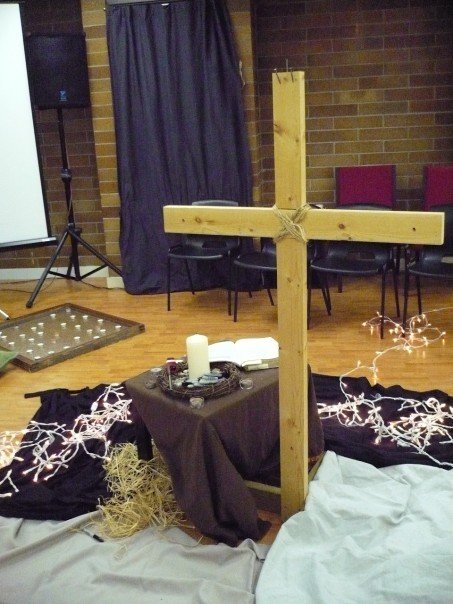
photo somebody took of something I organized while I was still in ministry
One of the lines that struck me very deeply when I first heard it in the old translation of the Novus Ordo anaphora was, Before he was given up to death, a death he freely accepted, he took bread and gave you thanks. I’m sure it was used when I was in Catholic high school, but the first time I really listened to it was while I was on retreat at my priest friend’s house of studies in Berkeley immediately after finishing my internship at a Chinese Anglican church in Richmond. The English words have now changed, of course — that was the 1975 translation of Eucharistic Prayer II, which has become in the 2010, At the time he was betrayed and entered willingly into his Passion. I’d almost venture to say that I like the first half of the new translation along with the second half of the old: a betrayal, but a death he freely accepted. It captures the lesson that I learned in my brief time in discerning a calling to the pastorate, specifically the Anglican priesthood, that I took away about what ministry ends up becoming. Friends of mine tell me that, having become Greek Catholic instead of Roman, I am now once again a viable candidate for ordination, as a married man. My retort is that it would first have to be a death that I freely accept.
My short-lived experimental foray into ministry had come to a formal end around that time. It was why I was on retreat at my priest’s friend’s house; I needed to get away from Richmond, away from Chinese evangelicalism, away from the noise of those spaces. It is a bit perversely funny that a year before, I had preached on the word betrayal in the Gospel according to John when some of the members of the youth group that I had founded, citing ‘betrayal’ from their leaders on very flimsy ground, had brought about its implosion, a turn of events that I was too inexperienced at the time to handle. The failure hardened me, casting my entire experience in the church, particular the Chinese evangelical one, as a series of betrayals that I had experienced since I was a young pastor’s kid. My mother objected, of course, begging me to recall the happy memories. The truth, of course, is that I probably needed therapy; the problem, as it were, was that my own father was a pastoral psychotherapist. Trapped in this overdetermined narrative, I concluded that what I needed to do was to get out, and in a probably sacrilegious scene now that I look back on it, I lit the candles at the altar in our sanctuary and told God that I quit. Remove me, if it’s helpful, I said. I fled into the system of academia, a world that I thought would not be beholden to such petty betrayals because it would not be presumably such a bubble. I’ve been in it long enough now, five years on its job market before I landed a permanent post, to know that I have grown into a much wiser man now.
The kondak and tropars for Great and Holy Thursday warn against becoming the betrayer, Judas, a lover of money. There is nothing redemptive about the sufferings of the betrayed, which means that there is no illusion that can recast traitorous acts that destroy friendships, relationships, careers, and ministries as something good in the end. My parents tried to remind me while I was going through my funk that Joseph eventually forgave his brothers, telling them that what they meant for evil, God meant for good when he was ruler of Egypt. But as a friend and I reflected yesterday on our arduous career journey within the academic sector — which is as hard hit, I am told, as any other professional sector in our zombie neoliberal economy — that we were not sure that it made us any better as people. If anything, it has made us lose a little bit of faith in humanity, especially people we counted as friends who then betrayed us when it worked to their advantage in climbing the ladder of prestige. It is against such betrayals — the love of money — that the mediations of Great and Holy Thursday warn, because the hell that they describe is the irreparable damage that selling out the ones you love will plunge you into, the pouch of money eloquently described in the tropars as the hangman’s noose. The warning is absolute: betrayal is absolutely evil, the nadir of the abyss.
This mystagogical lesson of the absolute devastation of the betraying act is imparted to us on Great and Holy Thursday, the eve of the Passion of the Lord, to warn us from the cheap ideology of the second chance. There is a fantasy that sometimes persists as a kind of perverse application of theodicy that what I meant for evil, God can still turn into good. No. The betrayal may effect a series of events that leads the betrayed to new life, but woe to the one by which the handing over is effected. The injunction against betraying a friend is thus unequivocal, closing off the speculation that the sins that I myself commit somehow do not matter in terms of my social conduct and ironically opening the possibility of reflecting on how I got where I was, though I was broken by the betrayals that got me here. It was why that line from the mass struck me as I capped off my time in ministry — that despite the betrayal, it was a death the Lord freely accepted. Reclaiming the events of my own personal history yet again as I must do every Great and Holy Week, I do not have to gloss over or sugarcoat the pain that has befallen me in church, academia, or otherwise in the worlds that I inhabit. There is no need to explain them away, or to explain them at all. It is what happened, no more, no less, and as I accept them, I become more conscious of where I am as I stand before the Lord, who in these days is crucified for us. May we share together in his resurrection.
Previous Post

April 24, 2019
A child in Kassiani's garden: for Great and Holy Wednesday
Next Post
April 26, 2019 I was born in the year of Chornobyl: for Great and Holy Friday
Browse Our Archives
Select a Category Academia Anglican Communion anti-racism Aristotle Asia-Pacific Asian American Asian Canadian BlackLivesMatter Cantonese Catholic China Chinglican church politics Church-State Politics Civil Society Conservative Eastern Christianity Evangelical Evangelical Left Feminist/Womanist Theology Food Greek-Catholic Church of Kyiv Hong Kong Housekeeping Kyivan Church Latin Catholicism Law Liberal Liberation Theology New Calvinism Pentecostal/Charismatic Protestant Psychoanalysis Publics Religion Ethnicity Wired Secular Sovereignty TPCIU Uncategorized
Select a Month July 2019 June 2019 May 2019 April 2019 March 2019 February 2019 January 2019 December 2018 November 2018 October 2018 September 2018 August 2018 July 2018 June 2018 May 2018 March 2018 February 2018 January 2018 December 2017 November 2017 October 2017 September 2017 August 2017 July 2017 June 2017 April 2017 March 2017 February 2017 January 2017 December 2016 November 2016 October 2016 September 2016 August 2016 July 2016 January 2016 December 2015 November 2015 October 2015 August 2015 April 2015 March 2015 February 2015 December 2014 November 2014 September 2014 August 2014 July 2014 June 2014 May 2014 April 2014 March 2014 December 2013 November 2013 October 2013 September 2013 August 2013 July 2013 June 2013 May 2013 April 2013 March 2013 February 2013 January 2013 December 2012 October 2012 June 2012 May 2012 April 2012 February 2012 January 2012
Follow Us!
TAKE THE
Religious Wisdom Quiz
Who was the scribe and priest that led a second group back to Jerusalem?
Select your answer to see how you score.
Nehemiah Mordecai Zerubbabel Ezra
Related posts from Eastern Catholic Person

I've found my way home: on the unraveling...
Tiananmen is my first childhood memory: reflections on...

Patriyarkhat: 'Attending to the movements of my heart'

I'm flattered to be named an Asian American...
TRENDING AT PATHEOS Catholic

The Parable Of The Sower And The Word...
One of Christ’s most famous parables is that of the sower who...

Rejecting Doom: Christian Hope And Human Action
Christianity is a religion of hope. We are to have hope and...

Why I Choose the Eucharist Over the Sermon
Choose the Eucharist, Not the Sermon What are we supposed to get...

5 Design Elements Found in Spiritually Rooted Homes
Putting Spirituality Into Home Decor Our homes are more than our living...

Credo: A Story of God Told with the...
About 10 years ago, I began to imagine a personal "Credo" that...

The Anatomy of Divine Revelation in Catholic Thought
The claim that God has made Himself known to human beings is...
view all Catholic blogs
Ad-Free & Subscriber Log-In Subscription Support
- About Us
- 2026 Calendar
- Videos
- Podcasts
- Library of World Religions
- Faith In Media Tracker
- Advertise With Us
- Write for Us
- Privacy Policy
- Terms of Service
- Do Not Sell My Data
- Contact Us
- Radiant Digital
- Manage Newsletter Subscriptions
- Unsubscribe From Notifications
- Sitemap
Copyright 2008-2026, Patheos. All rights reserved.
Subscription Support Ad-Free & Subscriber Log-In
Follow Patheos