
BuddhistCatholicContemplativeEvangelicalGeneral ChristianHinduJewishLatter-day SaintMuslimNew VisionsProgressive Christian
Beliefs
- Buddhist
- Catholic
- Contemplative
- Evangelical
- General Christian
- Hindu
- Jewish
- Latter-day Saint
- More Voices
- Muslim
- New Visions
- Pagan
- Progressive Christian
Topics
- Religion News
- Food and Religion
- Sports and Religion
- Religious Art
- Religious Music and Entertainment
- Religious Events
- History and Religion
- Style and Religion
- Politics and Religion
- Women in Religion
- Recreation Outdoors and Religion
- Business Finance and Religion
- Careers Workplace and Religion
- Education and Religion
- Family Parenting and Religion
- Health Fitness and Religion
- Home and Religion
- Relationships and Religion
- Technology and Religion
- Travel and Religion
Columnists
- Buddhist Columnists
- Business Finance and Religion Columnists
- Careers Workplace and Religion Columnists
- Catholic Columnists
- Contemplative Columnists
- Education and Religion Columnists
- Evangelists Columnists
- Family Parenting and Religion Columnists
- General Christian Columnists
- Health Fitness and Religion Columnists
- Hindu Columnists
- History and Religion Columnists
- Home and Religion Columnists
- Jewish Columnists
- More Voices Columnists
- Latter Day Columnists
- Muslim Columnists
- New Visions Columnists
- Nonreligious Columnists
- Pagan Columnists
- Politics and Religion Columnists
- Progressive Columnists
- Recreation Outdoors and Religion Columnists
- Relationships and Religion Columnists
- Religion News Columnists
- Religious Art Columnists
- Religious Events Columnists
- Religious Music and Entertainment Columnists
- Sports and Religion Columnists
- Style and Religion Columnists
- Technology and Religion Columnists
- Travel and Religion Columnists
- Women in Religion Columnists
Resource Library
- 2026 Calendar
- Library of World Religions
- The 100 Most Holy Places on Earth
- Patheos Answers
- Podcasts
- Videos
- Faith Leaders Database
- Anglican Episcopalian
- Bahai
- Baptist
- Buddhism
- Christianity
- Confucianism
- Eastern Orthodoxy
- Hinduism
- Holiness and Pentecostal
- ISKCON
- Islam
- Judaism
- Lutheran
- Methodist
- The Church of Jesus Christ of Latter-day Saints
- New Age
- Paganism
- Presbytarian and Reformed
- Protestantism
- Religion Behind the Scenes
- Roman Catholic
- Scientology
- Shia Islam
- Sikhism
- Sufism
- Sunni Islam
- Taoism
- Zen
- See all religions
Research Tools
 Ad-Free & Subscriber Log-In Subscription Support
Ad-Free & Subscriber Log-In Subscription Support
Follow Patheos 

- Trending:
- Forgiveness
- |
- Marriage
- |
- Consciousness
- |
- Death Penalty
- |
- Election
- |
- Halloween
 Eastern Catholic Person
- Home
- Catholic
- ‘She’s relatable’: on St Mary of Egypt Social Justice Fellowship
‘She’s relatable’: on St Mary of Egypt Social Justice Fellowship
Last updated on: April 15, 2019 at 9:26 pm by Justin Tse
‘She’s relatable’: on St Mary of Egypt Social Justice Fellowship 2019-04-15T21:26:29-07:00 Justin Tse
Patheos Explore the world's faith through different perspectives on religion and spirituality! Patheos has the views of the prevalent religions and spiritualities of the world.
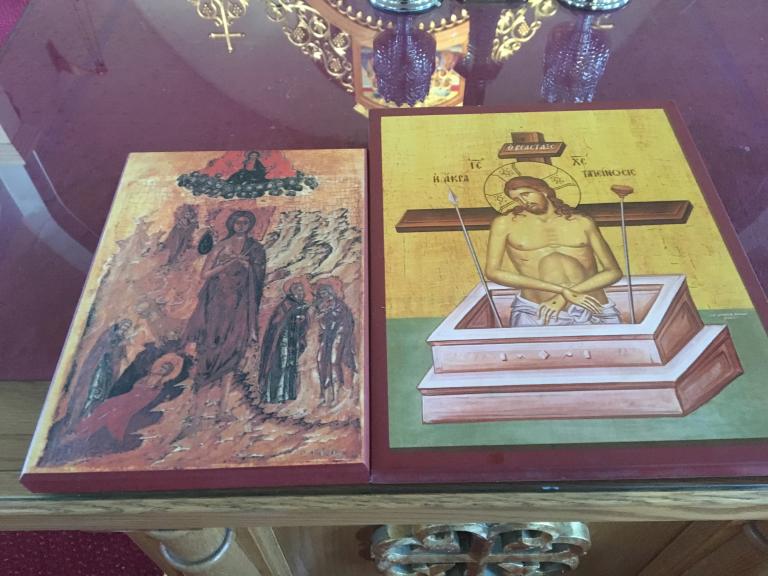
photo by me
A few weeks ago, those of us who compose our mission group in Chicago, St Mary of Egypt Social Justice Fellowship, were talking about sainthood. I’m not perfect enough to be a saint, one of us said, and our leader, the inimitable Julian Hayda, replied, Well, that’s why we are named after St Mary of Egypt. The point of sainthood, he reminded us, is that we are not perfect. Anyone who ever became holy has come out of a life of sin, of having the passions completely overwhelm a clear perception of the world and a restlessness in the beingness of the divine. Our Venerable Mother Mary of Egypt was a prime example, he said, having been driven entirely by her bodily desires until she was confronted in Jerusalem by the icon of the Most Holy Theotokos blocking her entry into a temple where the Elevation of the Cross was being celebrated. From there, the Spirit drove her out into the desert, where she spent decades untangling her body from its captivity to desire, achieving such a perfect integration of her erotic presence with her body that she was clairvoyant, could quote directly from Scripture without having ever read a word of it, and levitated while she praised with arms upraised. The first seventeen years were the hardest, I reminded our group that she said. The original commentator gave an amused smirk. She’s relatable, she said.
The thing is, our emphasis on social justice can seem a bit off-putting to some people. Usually, the opposition comes from political conservatives, who seem to prefer to focus on individual acts of charity and service instead of addressing broader problems of structure and policy. This objection is very strange to me because the supposed roots of their political tradition in Edmund Burke’s Reflections on the Revolution in France is all about structure and how a particular political formation — monarchy with aristocracy — achieves what might be called social justice, the protections of personal safety and the prosperity that assures the everyday person of food and shelter, better than the bourgeois capitalism that had cut off the heads of the king, queen, and everybody seen to support them. Even the libertarian conception of a society, most verbosely articulated by the true mother of those who typically call themselves ‘conservative’ in the Republican Party’s sense, Ayn Rand, presupposes that the roll-back of institutional structures in political governance and economic regulation will unleash the creative potential of the individual, resulting in broad-based prosperity rooted in personal responsibility. This too is a vision of social justice, one that we at our fellowship generally disagree with but cannot deny is what social justice technically is: a proposal that the structures of a society that prevent human persons from being, as St Irenaeus put it, a ‘human being fully alive,’ often by denying them the basic necessities to live by unevenly distributing food, water, housing, transportation, and education, should at the very least be reformed and at the most extreme be abolished and replaced. Conservative ideologies, in a number of forms, are as much about social justice in this sense as those on what they call the ‘left’; it’s just that the varieties of conservatism, from Burkeanism to libertarianism and everything in between and off the radar, tend to be rooted in a kind of nostalgia that is much more of a mixed bag in liberal, socialist, and radical circles.
Social justice, in other words, does not have a left-right problem, at least as a term. Even the apolitical have an understanding of the term, at least in the sense that they, most of all, should never become too poor to live, which means that social justice is usually only alienating to people whose lives are not already precarious. But it is a term that also scares everyone, precarious or not, and the real reason that it does, I think, has nothing to do with ideology or even that the notion that ‘doing politics’ is dangerous. The truest fear is that social justice can seem to be a call for utopia, a desire that is relatable but would require a kind of sainthood that is unachievable. Activists, generally of the radical sort in anti-racist, feminist, and queer circles, are the first to acknowledge that social justice spaces can be scary places. They are sites where the word problematic tends to proliferate, that dirty word that points out that someone is importing the very tropes and even structural reinforcement of the racism, classism, misogyny, homophobia, transphobia, ageism, ableism, and so on and so forth that they purport to oppose. Hardened by the skirmishes of the Cold War, both political conservatives and consensus-driven liberals usually laugh at this phenomenon, likening them to the show trials and forced confessions under regimes named for Stalin and Mao. Like their myopia about social justice as a word, they often forget that they have other words for problematic, like hypocrisy and lack of integrity, that they use to police their own circles. The point is that whatever the vision of social justice is, it requires a kind of practical perfection that is usually unachievable. The only option, it seems, is to become a realist; the only problem is that realists often allow their cynicism to root out the idealists in their midst too.
I think, at least at a subconscious level, most of the members of our small mission are comforted by our invocation of St Mary of Egypt as patron because we have all been somehow burned by the above already. The mistake that most people, sometimes including ourselves, make about how missions are constituted is that they are supposed to be composed of folks whose entire lives are circumscribed by the church, a problem that is compounded in the Kyivan Church with a quick ethnonationalist association of that worshipping community with some kind of Ukrainian ethnicity. Maybe our lives might be simpler if only it were so, but none of us is paid to be a professional Christian, which means that we at least have workplaces where we actually make the money we need to afford those basic necessities of housing, food, transport, and communications. Some of us are academics, others are journalists, and while none of us would claim to be an activist, we do find ourselves in those circles from time to time and are familiar with its discourses. We know ourselves to be, as they say, problematic, and as others might say, sinful, whether by association or by action (and sometimes both).
St Mary of Egypt shows us that addressing the structural injustices of our society begins and continues with personal repentance. It is quite something, some of us noted as we did the Matins canon for the Sunday of St Mary of Egypt on the fifth week of the Great Fast, that before the tropars of the saint were verses about the rich man and Lazarus. Perhaps they also form preparatory mystagogy for Lazarus Saturday the next week, but the point remains that on this week, as we ponder St Mary of Egypt and as we hear her story read during the Great Canon of St Andrew of Crete the Thursday before, our contemplations of the personal passions for which we must be penitent go hand in hand with the reflection that it is hard for the rich to inherit the kingdom of God, that the poor who are outside their doors ready to lick the scraps from the table will rest in the bosom of Abraham, and those whose lives willfully reinforce structural injustice will go down to the trash heap of Gehenna and burn for eternity. We join St Mary of Egypt in horror at what our own sinfulness does in the world to restrict its commons and deny humanity to the poor. Our pursuit of social justice comes from a posture of repentance.
What we are doing as St Mary of Egypt Social Justice Fellowship is quite practical, in fact. We have found ourselves in a temple on the south side of Chicago, one with dwindling numbers due to an aging population. But more to the point is why this temple exists in that neighbourhood in the first place, an area that now has very few Ukrainians. As we say on our website, part of our understanding of what we are doing comes from our realization that our own people, the ones who built this church, were complicit in making this place a food and transit desert. It is an area that was subject to the phenomenon of white flight decades before, vacating it not only of people but also of institutions that could sustain everyday life through employment, transit, commerce, and food provisions. Our modest start will be to build a community garden at the temple, one in which our neighbours can participate so that we can grow food together. It’s not much we are offering, but it’s a recognition that those who caused the problem should have a hand in helping to overcome it.
Here, we might draw inspiration from the part about structural problems in St Sophronius of Jerusalem’s hagiography of St Mary of Egypt that is often ignored. When St Mary of Egypt takes communion from her visitor Abba Zosima, she tells him that in time, the problems of the monastery in Palestine that he is visiting will be revealed all too soon, and this revelation, as well as the clean-up, is exactly what happens after she is laid to rest. What we are realizing is that if social injustice begins in the house of God, it is that there that we might also begin a social justice fellowship, as nothing more than an act of repentance to the world that we have wronged. St Mary of Egypt is relatable because in this endeavour, more of our sins and our problematic complicities will be revealed, and instead of covering them up, we own them like a naked woman doing penance in the wilderness beyond the Jordan. She is our patron, because without her, any act of social justice we might attempt will collapse under the weight of our hypocrisy. Venerable Mother Mary, pray to G-d for us!
Also published on the website of St Mary of Egypt Social Justice Fellowship.
St Mary of Egypt Social Justice Fellowship

Next Post
April 17, 2019 Fasting is about justice: today's Sixth Hour reading
Browse Our Archives
Select a Category Academia Anglican Communion anti-racism Aristotle Asia-Pacific Asian American Asian Canadian BlackLivesMatter Cantonese Catholic China Chinglican church politics Church-State Politics Civil Society Conservative Eastern Christianity Evangelical Evangelical Left Feminist/Womanist Theology Food Greek-Catholic Church of Kyiv Hong Kong Housekeeping Kyivan Church Latin Catholicism Law Liberal Liberation Theology New Calvinism Pentecostal/Charismatic Protestant Psychoanalysis Publics Religion Ethnicity Wired Secular Sovereignty TPCIU Uncategorized
Select a Month July 2019 June 2019 May 2019 April 2019 March 2019 February 2019 January 2019 December 2018 November 2018 October 2018 September 2018 August 2018 July 2018 June 2018 May 2018 March 2018 February 2018 January 2018 December 2017 November 2017 October 2017 September 2017 August 2017 July 2017 June 2017 April 2017 March 2017 February 2017 January 2017 December 2016 November 2016 October 2016 September 2016 August 2016 July 2016 January 2016 December 2015 November 2015 October 2015 August 2015 April 2015 March 2015 February 2015 December 2014 November 2014 September 2014 August 2014 July 2014 June 2014 May 2014 April 2014 March 2014 December 2013 November 2013 October 2013 September 2013 August 2013 July 2013 June 2013 May 2013 April 2013 March 2013 February 2013 January 2013 December 2012 October 2012 June 2012 May 2012 April 2012 February 2012 January 2012
Follow Us!
TAKE THE
Religious Wisdom Quiz
What famous cathedral is in Paris, known for its flying buttresses and rose windows?
Select your answer to see how you score.
Notre Dame St. Paul's St. Peter's Canterbury
Related posts from Eastern Catholic Person

I've found my way home: on the unraveling...

This time, I have a tradition: on solidarity...

Patriyarkhat: 'Attending to the movements of my heart'

I'm flattered to be named an Asian American...
TRENDING AT PATHEOS Catholic

Creation, Preservation, and Teleology in Catholic Theology
As I write this, it is very early Monday morning. Like millions...

The Parable Of The Sower And The Word...
One of Christ’s most famous parables is that of the sower who...

Rejecting Doom: Christian Hope And Human Action
Christianity is a religion of hope. We are to have hope and...

Why I Choose the Eucharist Over the Sermon
Choose the Eucharist, Not the Sermon What are we supposed to get...

5 Design Elements Found in Spiritually Rooted Homes
Putting Spirituality Into Home Decor Our homes are more than our living...

Credo: A Story of God Told with the...
About 10 years ago, I began to imagine a personal "Credo" that...
view all Catholic blogs
Ad-Free & Subscriber Log-In Subscription Support
- About Us
- 2026 Calendar
- Videos
- Podcasts
- Library of World Religions
- Faith In Media Tracker
- Advertise With Us
- Write for Us
- Privacy Policy
- Terms of Service
- Do Not Sell My Data
- Contact Us
- Radiant Digital
- Manage Newsletter Subscriptions
- Unsubscribe From Notifications
- Sitemap
Copyright 2008-2026, Patheos. All rights reserved.
Subscription Support Ad-Free & Subscriber Log-In
Follow Patheos